
On this page
Start here
Quick answer
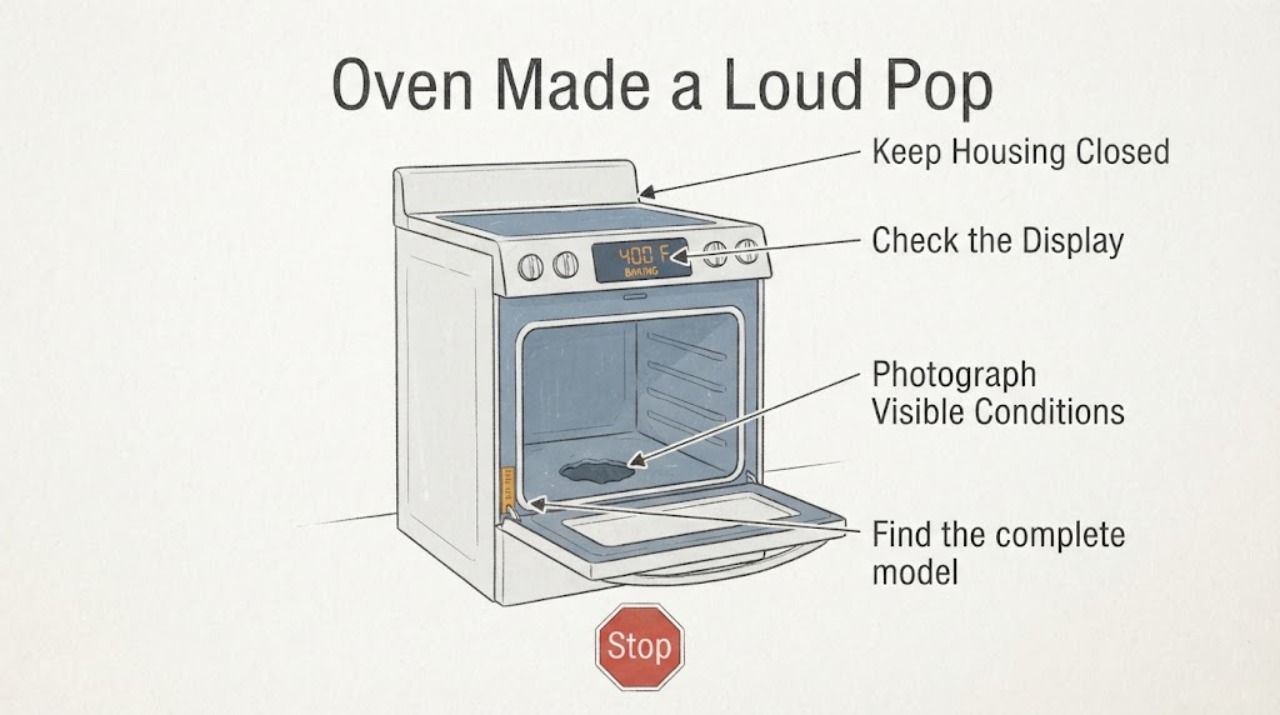
Turn the JennAir oven off and do not bake, broil, or run a self-clean cycle again after a loud pop followed by a visible hole in the oven bottom. JennAir documents that some popping sounds can come from normal metal expansion, a gas valve cycling, or a removable oven bottom that is not seated correctly, but that general noise guidance does not establish that a visibly holed or deformed bottom is safe. Keep the door closed while the oven cools, do not touch or cover the hole, and arrange JennAir or qualified appliance service. If there is a gas smell, flame outside the normal burner area, smoke, sparking, or a tripped protection device, leave the area as appropriate and use the local emergency or gas-safety procedure rather than testing the oven again.
Work through in order
Diagnostic checks
Use only checks that match the exact appliance or system and its official guide.
-
Check 1
Stop the oven immediately: cancel the cooking cycle, turn all oven controls off, and do not restart bake, broil, convection, or self-clean to see whether the hole changes. Keep the oven door closed while it cools unless an emergency requires leaving the area.
Expected result: The oven is cooling without smoke, flame outside the normal burner area, gas odor, sparking, or a new electrical trip, or one of those hazards is present.
Next step: If there is gas odor, uncontrolled flame, smoke, sparking, or a protection trip, leave the area as appropriate and follow local emergency or gas-safety guidance. Otherwise keep the oven out of service and continue only with the cool, external documentation step.
Why this matters
Why: A hole after a loud pop is an unresolved physical-damage event, not a normal-operation confirmation. Whirlpool's oven guidance notes that opening the door to cool faster can pose a safety hazard; gas odor, smoke, flame, or electrical symptoms raise the urgency beyond routine troubleshooting.
-
Check 2
After the oven is fully cool and power or fuel hazards are absent, photograph the hole and surrounding bottom from outside the cavity without touching, prying, scraping, or inserting a tool. Record the hole's location, approximate visible size, discoloration, loose metal, soot, insulation, or any exposed element, burner, wiring, or opening.
Expected result: The opening is only in a visibly removable or loose bottom panel, or it exposes another layer, heating/burner area, insulation, wiring, or scorched material.
Next step: Keep the oven off in either case. Do not remove or reseat a deformed panel, patch the hole with foil or sealant, or reach toward an element or burner; send the photos to JennAir or qualified service for exact model assessment.
Why this matters
Why: JennAir says some models have a removable oven bottom, but the shared guidance does not identify which construction belongs to this unmodeled oven. An exposed layer or scorched area cannot be classified from a photograph as a harmless panel movement, and touching it can worsen damage or create an injury risk.
-
Check 3
Find the complete JennAir model and serial information from the rating label or owner documents without moving the built-in oven or removing panels. Use the model number to open the exact JennAir manual and support route.
Expected result: The model number is available and its JennAir manual identifies the oven-bottom construction, or the model cannot be confirmed.
Next step: Give the exact model, serial if available, the 400°F setting, time of the pop, and the photos to JennAir service. If the model is missing, request an in-person assessment rather than borrowing another model's manual procedure.
Why this matters
Why: JennAir's support guidance directs owners to use the model number for manuals and troubleshooting resources. A range, gas oven, electric wall oven, and model with a removable bottom can have different internal layouts, so the word "hole" cannot select a replacement panel or burner part.
-
Check 4
Arrange manufacturer or qualified appliance service before any further heating. Tell the technician that the oven was baking at 400°F, a loud pop occurred, and a hole was then seen in the bottom; report any gas odor, flame, smoke, sparking, or control/power change.
Expected result: The service provider confirms a removable bottom panel issue, or reports damage to the cavity, burner, element, insulation, wiring, or controls.
Next step: Follow the exact service determination. Keep the oven unavailable until the technician confirms that the damaged area and all affected safety functions have been repaired; do not accept a foil, sealant, or improvised metal patch as a substitute for the specified part.
Why this matters
Why: JennAir's general page can explain possible noise mechanisms but cannot diagnose the damaged assembly without the exact model and inspection. A confirmation of one component does not authorize a user to repair adjacent gas, high-temperature, or electrical parts.
Use your observations
Decision map
Find the observation that best matches what you see, then follow the next safe action.
-
PATH 01Next step
What you see
The oven has cooled and there is no gas odor, smoke, sparking, or uncontrolled flame, but the bottom still has a visible hole or deformation.
Do this next
Leave the oven off, document the damage and model, and arrange JennAir or qualified service before heating it again.
Why this path and its safety boundary
Why it matters: The immediate emergency indicators are absent, but the cavity or bottom-panel damage remains unresolved and is outside a normal sound check.
-
PATH 02Next step
What you see
The opening appears to be in a removable oven-bottom panel, but the panel is bent, loose, scorched, or cannot be identified from the exact model manual.
Do this next
Do not lift, force, reseat, or cover the panel. Have service compare the part and surrounding cavity with the exact model documentation.
Why this path and its safety boundary
Why it matters: JennAir acknowledges that some models use a removable bottom and can make an oil-canning pop if it is not installed correctly, but that does not establish that this panel can be safely reseated after a hole-forming event.
-
PATH 03Next step
What you see
The hole exposes a burner, heating element, insulation, wiring, or a visibly burned or melted area.
Do this next
Keep the oven off and arrange qualified service. Do not reach inside, test continuity, restart the oven, or attempt an internal repair.
Why this path and its safety boundary
Why it matters: The event may involve more than a cosmetic or removable panel and cannot be safely narrowed to a normal expansion noise.
-
PATH 04Next step
What you see
Gas odor, flame outside the normal burner area, smoke, sparking, or a protection trip occurs after the pop.
Do this next
Leave the area as appropriate, avoid switches or ignition sources when gas may be present, and follow local emergency or gas-safety instructions. Do not return to inspect or test the oven until it is cleared.
Why this path and its safety boundary
Why it matters: The symptom has an immediate safety dimension and should not be treated as an ordinary oven-noise question.
Helpful context
Understand the symptom
A normal popping explanation does not clear a visible hole
JennAir's Product Help page says that heating and cooling can make porcelain and steel pop or crack, a gas valve can make a single pop while cycling, and some models have a removable oven bottom that can make an oil-canning noise if it is not installed correctly. Those explanations address a sound. They do not identify the part represented by a hole, confirm that the cavity floor is intact, or authorize another 400°F test. Because the task has no model number and the source page is shared across ranges and ovens, the damaged area must be assessed against the exact manual by service.
When checks do not resolve it
Need a professional?
Call JennAir or qualified appliance service before any further heating when an oven makes a loud pop and a hole, deformation, scorch mark, exposed layer, or loose bottom is visible. Use emergency or gas-safety services for gas odor, uncontrolled flame, smoke, sparking, or an electrical protection trip. Do not patch the hole, reseat a damaged panel, remove the oven from its cabinet, or repair gas, high-temperature, or electrical parts yourself.
Common questions
FAQ
Can an oven normally make a popping sound while heating?
JennAir says heating and cooling can make porcelain and steel pop or crack, a gas valve can make a single pop while cycling, and some models have a removable bottom that can make an oil-canning noise. Those explanations do not clear an oven with a visible hole; stop using it and arrange an exact-model assessment.
Should I put foil, sealant, or a metal patch over the hole?
No. A patch can change heat, airflow, gas-burner, or insulation behavior and can hide damage from the technician. Keep the oven off and have JennAir or qualified service identify the correct construction and repair.
Can I remove the oven bottom to see what happened?
Do not remove or reseat it after a loud pop and hole unless the exact model manual and service assessment explicitly establish that it is safe. JennAir notes that some models have removable bottoms, but the shared guidance does not identify the part or authorize inspection of a damaged oven by the owner.
What information will service need?
Give the exact model, cooking mode and 400°F setting, when the pop occurred, photos of the hole and surrounding area, and whether there was gas odor, smoke, flame, sparking, or a protection trip. Do not infer that the cause was an igniter, element, valve, or control board from the hole alone.
Read the exact guide
Official sources
- FAQs About the AquaLift Oven Cleaning CycleJennAir Product Help · Used only for JennAir's instruction to use the model number to locate manuals and documents and its service link. The AquaLift cleaning details are not applied to the unknown oven or used to diagnose the hole.
- Pop or Popping Noise in Oven - RangeJennAir Product Help · Used for JennAir's documented possible causes of a pop, including metal expansion, gas-valve cycling, and a removable oven bottom that is not installed correctly, plus the direction to contact or schedule service. It does not diagnose a hole or clear continued use after visible damage.
- Oven Overheating: Possible Causes and SolutionsWhirlpool · Used only for general manufacturer safety context: damaged heating components can contribute to overheating, an oven vent affects heat regulation, and opening the door to cool faster can pose a safety hazard. It is not used to transfer a component diagnosis to the JennAir topic.
Community feedback
Share a repair observation
Share a plain-text repair observation. Accepted observations are published automatically; this page may take a moment to update.