
On this page
Start here
Quick answer
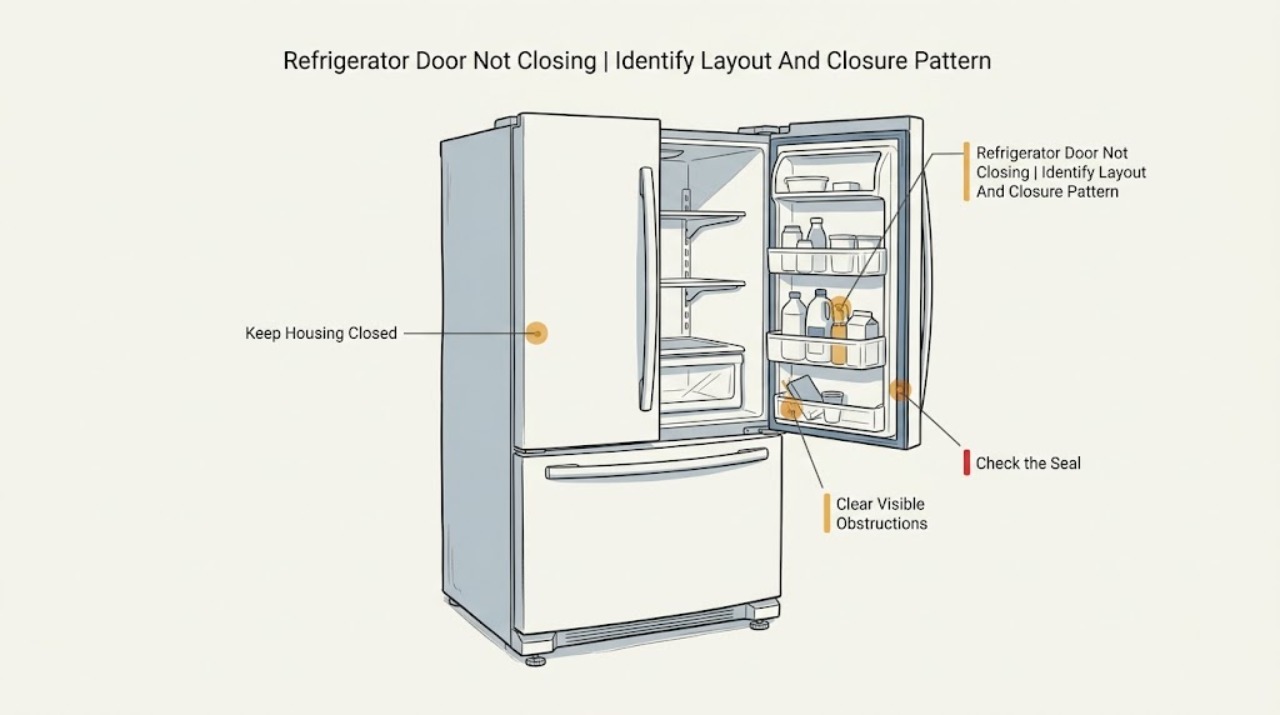
Start by identifying the JennAir layout, then inspect the door path rather than forcing the door. JennAir's official guidance points first to food packages, tall bottles, shelves or bins that are out of position, shipping material, a dirty or damaged gasket, an outward-folded vertical seal on applicable French-door models, and an unlevel cabinet. Remove only an obvious obstruction, clean the gasket and the surface it touches, and verify the cabinet is stable and level using the exact Owner's Manual or Installation Instructions. For models that support it, JennAir describes small leveling-foot or roller adjustments that can restore a slight rear tilt and self-closing action; use a helper and disconnect power before moving the appliance or removing hinge covers. If the door is heavy, dropped, visibly bent, rubbing the cabinet, has a loose hinge, remains misaligned after external checks, or requires removing door hardware, stop and arrange qualified service. Do not force the door, defeat a seal, loosen hinge bolts without support, or use a French-door procedure on a single-door or undercounter model.
Before you begin
Safety first
- This article covers ordinary-access inspection and model-approved minor adjustments only. Do not remove the door, loosen hinge hardware without support, work near electrical components with power connected, or move a heavy refrigerator without help.
Work through in order
Diagnostic checks
Use only checks that match the exact appliance or system and its official guide.
-
Check 1
Record the complete JennAir model number and identify the layout: single-door, French-door, bottom-freezer, built-in, or undercounter. With the refrigerator stable, open and close the affected door gently and note whether it stops on an object, springs back, sits lower than its mate, rubs the cabinet, or will not stay closed after release.
Expected result: The door is stopped by something, the gap or height is uneven, the gasket does not contact evenly, a French-door center seal is outward, the door is heavy or loose, or the model/layout is uncertain.
Next step: Follow the matching branch and exact model literature. Do not use a full-size French-door procedure on an undercounter or built-in model without confirmation.
Stop if: Stop for a dropped or unstable door, exposed hinge hardware, a cracked cabinet, broken glass, a water-line strain, or a door that requires force to move.
Why this matters
Why: The observations distinguish loading, seal, French-door mullion, leveling/alignment, and hardware branches. JennAir's procedures differ by configuration, so the model determines which adjustment instructions apply.
-
Check 2
Open the door normally and inspect the door bins, shelves, drawers, ice bin if fitted, tall bottles, food packages, trim, and the outside door area. Push a shelf or drawer fully into its intended position and remove only an obvious package, shipping spacer, debris, or packaging material that blocks closure.
Expected result: A bottle or package, shelf/bin, drawer, ice bin, shipping material, or debris prevents the door from reaching the frame; or the entire visible path is clear.
Next step: Rearrange the load and close the door once without force. If a shelf, rail, bin, or drawer will not seat correctly, use the exact manual or arrange service rather than bending it.
Stop if: Do not slam, lean on, pry, or hold the door shut; do not remove a shelf, drawer, hinge, or door panel to make room unless the exact model manual specifically directs it.
Why this matters
Why: JennAir identifies overfilled bins, tall containers, mis-seated drawers or ice bins, and packaging as common physical causes. If the path is clear and the door still stops or rebounds, the cause is more likely seal, level, alignment, or hardware.
-
Check 3
With the door open and the appliance not being forced, inspect the entire gasket and the clean surface it touches. Wipe away food particles or sticky residue with a suitable damp cloth, then check for a flattened corner, tear, crack, gap, detachment, or gasket that is twisted out of its channel.
Expected result: The gasket is dirty or sticky, a corner is folded, the seal is visibly damaged or detached, or the gasket and contact surface are clean and continuous.
Next step: Clean and gently reposition only an obvious fold if the exact manual permits it. For a damaged or detached gasket, or a continuing gap after cleaning, keep the door closed as much as practical and arrange qualified service.
Stop if: Do not glue, cut, stretch, heat, or permanently reshape the gasket, and do not use a damaged door that cannot seal or that rubs electrical components.
Why this matters
Why: JennAir says dirt and particles can create resistance or improper sealing. A clean but cracked, warped, detached, or persistently gapped gasket is a seal-replacement or installation issue, not a setting that can be corrected by pushing harder.
-
Check 4
Only for a JennAir French-door refrigerator with the vertically hinged center seal, look at the seal while the left door is open. Confirm it folds inward and is not left projecting outward across the meeting edge before the doors close; do not remove the seal or door hardware.
Expected result: The center seal is folded outward, the seal folds inward normally, or the refrigerator is not a French-door model.
Next step: If the model's seal is visibly outward, fold it inward by hand as JennAir describes and close the doors gently once. If it will not move, remains outward, or the doors are uneven, arrange service.
Stop if: Do not force the mullion, remove its hinge, alter the door switch, or use this procedure on a non-French-door model.
Why this matters
Why: JennAir says the hinged seal folds inward when the left door opens and forms the seal between the doors when both close. An outward position can physically prevent closure, but this branch does not apply to single-door, undercounter, or other layouts.
-
Check 5
If the visible path and gasket are acceptable, check the cabinet side-to-side and front-to-back with a level or the exact model's approved method. Observe whether the door self-closes smoothly from about halfway open and whether the cabinet rocks. If a leveling adjustment is permitted, disconnect power before moving the unit, protect the floor, keep the cord and water line slack, and use a helper.
Expected result: The cabinet rocks or is out of level, the door sits low or swings open, the unit is stable and the door self-closes, or the model's feet/rollers cannot be identified from its manual.
Next step: Make only small, manual-approved leveling changes to the accessible feet or rollers, rechecking stability and closure each time. If the procedure requires moving a heavy refrigerator or removing a grille without help, stop and arrange service.
Stop if: Do not tip or drag the refrigerator alone, pull it by the door, stretch water tubing or the power cord, or adjust feet while the unit is unstable.
Why this matters
Why: JennAir links an unlevel cabinet with doors that swing open, fail to sit flush, or do not seal. A stable, level cabinet with a low or loose door shifts suspicion to model-specific alignment or hinge hardware.
-
Check 6
After the accessible checks, document the model, layout, obstruction result, gasket condition, level result, door height, hinge noises, and whether the door closes without force. If alignment remains uneven or the door is heavy, dropped, loose, rubbing, or requires hinge-cover or door-hardware work, stop instead of continuing the adjustment.
Expected result: The door still will not close or seal, one door is lower, the gap is uneven, the hinge is loose/noisy, the door was removed during installation, or the door now closes normally.
Next step: For a persistent or hardware-related condition, arrange qualified JennAir appliance service or installer correction and provide the exact model and observations. If closure is restored, monitor the gasket contact and temperature without forcing the door.
Stop if: Do not loosen or remove hinge bolts alone, remove the door, drill or shim the cabinet without the manual, or operate with a door that cannot seal securely.
Why this matters
Why: JennAir's alignment guidance uses model-specific hardware and warns that a supported door can drop or twist when hinge hardware is loosened. Persistent closure failure after visible and leveling checks is a service condition, not proof that a gasket or hinge part should be ordered.
Use your observations
Decision map
Find the observation that best matches what you see, then follow the next safe action.
-
PATH 01Next step
What you see
Does the door stop at the same point because a bottle, package, shelf, drawer, bin, ice bin, or shipping material is in the way?
Do this next
If the item will not seat correctly or the door still stops after the path is clear, use the model manual or arrange service rather than forcing the door.
Why this path and its safety boundary
Why it matters: A visible obstruction is the leading cause. Remove or reseat only the accessible item, then close the door gently once.
-
PATH 02Next step
What you see
Is the gasket dirty, folded, cracked, detached, or leaving a visible gap when the door is closed?
Do this next
Do not stretch, glue, heat, or cut the gasket. Keep the door from being used as a clamp and arrange qualified service if the gap remains.
Why this path and its safety boundary
Why it matters: Clean particles and correct only an obvious fold allowed by the manual. A damaged or detached gasket needs model-specific service or replacement.
-
PATH 03Next step
What you see
On a French-door model, is the vertically hinged center seal projecting outward instead of folding inward?
Do this next
If the seal remains outward or the door heights are uneven, stop at service; this branch does not apply to single-door or undercounter models.
Why this path and its safety boundary
Why it matters: JennAir identifies this position as a cause of French doors not closing or sealing. Fold it inward only as the official model guidance describes.
-
PATH 04Next step
What you see
Is the cabinet rocking, out of level, or allowing a door to swing open or sit lower than the other?
Do this next
If the cabinet is stable and the door remains low, loose, heavy, or misaligned, arrange service for alignment or hinge work.
Why this path and its safety boundary
Why it matters: JennAir links level and stable feet/rollers with smooth self-closing and even sealing. Make only model-approved accessible leveling adjustments with power disconnected and a helper.
-
PATH 05Next step
What you see
Does the door require force, sag after opening, rub the cabinet, or need hinge-cover/door-hardware removal?
Do this next
Stop using the door as a repair lever, keep the appliance stable, and arrange qualified JennAir service or installer correction with the exact model information.
Why this path and its safety boundary
Why it matters: Treat this as a professional boundary. A door can drop or twist when hinge hardware is loosened, and a heavy built-in or full-size refrigerator can be unstable when moved.
Helpful context
Understand the symptom
Classify the closure symptom before adjusting anything
A bottle or shelf can stop the door at one spot, a gasket can create resistance or a gap, and an unlevel cabinet can let a door swing open or sit low. A French-door unit adds a vertically hinged seal between the doors. A door that is heavy, dropped, bent, or loose at the hinge is a hardware problem, not a reason to turn an adjustment screw at random.
Correct visible loading and seal conditions first
JennAir recommends rearranging packages and bottles, returning shelves or bins to their intended positions, and removing packaging or debris from the door area. A gasket should be clean and free of food particles. These are accessible checks; do not pry the door shut or treat a torn, warped, or detached gasket as a leveling problem.
Leveling and alignment are model-dependent
JennAir's general leveling guide covers many models, but it still directs owners to the exact manual for feet, rollers, grille access, and door hardware. Some full-size French-door manuals use leveling screws and a hinge-pin alignment screw, while an undercounter or built-in model may use a different installation method. Disconnect power before moving the refrigerator or removing hinge covers, keep water lines and the cord from stretching, and use help to prevent tipping or dropping the door.
Safety boundary
Stop conditions
- Stop for a dropped, unstable, bent, cracked, or loose door; exposed hinge hardware; water-line or cord strain; broken glass; or a door that requires force to move.
- Do not slam, pry, tape, clamp, or hold the door closed, and do not operate when the gasket cannot seal securely.
- Do not loosen or remove hinge bolts alone, remove a door, alter a door switch, or remove hinge covers without disconnecting power and following the exact model manual.
- Do not drag or tip a heavy refrigerator alone, stretch the water line or cord, or make unapproved cabinet shims or structural modifications.
- Do not glue, cut, heat, stretch, or order a gasket, hinge, alignment screw, or door part without the exact model and a qualified diagnosis.
When checks do not resolve it
Need a professional?
Arrange qualified JennAir appliance service or installer correction when a clean, unobstructed door remains misaligned; the gasket is damaged or detached; leveling does not restore closure; the door is heavy, dropped, loose, or rubbing; a French-door seal will not return to position; or hinge, door, electrical, or water-line access would be required. Stop immediately for an unstable or damaged door, broken glass, cord or water-line strain, or any need to force the door.
Safety scope: This article covers ordinary-access inspection and model-approved minor adjustments only. Do not remove the door, loosen hinge hardware without support, work near electrical components with power connected, or move a heavy refrigerator without help.
Common questions
FAQ
Why will my JennAir refrigerator door not stay closed?
Check for packages, tall bottles, shelves, bins, drawers, ice-bin position, packaging, a dirty gasket, and an unlevel cabinet. On an applicable French-door model, also check that the vertical center seal folds inward. A heavy, loose, sagging, or damaged door needs service rather than force.
Can an unlevel JennAir refrigerator make the door open by itself?
Yes. JennAir says an unlevel cabinet can make doors swing open, fail to sit flush, or seal improperly. Check level and stability first, then use only the exact model's approved leveling procedure with power disconnected before moving the appliance.
What should I check on a JennAir French-door refrigerator?
Inspect the center vertical hinged seal while the left door is open. JennAir says it should fold inward while open and form the seal between the doors when both close. If it remains outward, reposition it only as the model guidance permits; do not remove the seal or hinge.
Should I adjust the JennAir refrigerator hinges myself?
Only minor, model-approved alignment or leveling steps should be considered, and the exact manual controls the procedure. JennAir says to disconnect power near electrical components and support the door before loosening hinge hardware. A heavy, dropped, loose, or bent door should be handled by qualified service.
Can I replace a JennAir refrigerator gasket if the door will not seal?
First clean the gasket and its contact surface and check for an obvious fold. A cracked, warped, detached, or persistently gapped gasket is model-specific; do not glue, cut, stretch, or heat it. Confirm the exact model and arrange qualified service when replacement or channel work is needed.
Read the exact guide
Official sources
- Owner's ManualJennAir · Official manual for the model family identified in the document; use the reader's exact JennAir model manual before applying any adjustment or removal step.
- Door Not Closing - RefrigeratorJennAir Product Help · Applies to JennAir French-door bottom-freezer models only; it is not a universal procedure for single-door, built-in, or undercounter configurations.
- Doors Not Closing ProperlyJennAir Product Help · JennAir full-size refrigerator guidance. Exact door, gasket, hinge, and leveling procedures remain model-dependent.
- Doors are Not Sealing Properly - Undercounter RefrigeratorJennAir Product Help · Applies to JennAir undercounter refrigerators; used here to corroborate the gasket/level/obstruction mechanism, not to transfer undercounter adjustment hardware to full-size models.
- How to Level the RefrigeratorJennAir Product Help · JennAir says the general steps apply to most models, but directs owners to the exact Owner's Manual or Installation Instructions for locations and full safety details.
- Aligning the Refrigerator DoorsJennAir Product Help · JennAir alignment guidance with model-dependent hardware; it is not permission to loosen or remove door hardware on an unidentified model.
Community feedback
Share a repair observation
Share a plain-text repair observation. Accepted observations are published automatically; this page may take a moment to update.