
On this page
Start here
Quick answer
If a JennAir refrigerator trips a breaker or GFCI, leave the refrigerator off and do not keep resetting the circuit to see whether it runs. Note whether the trip happens immediately, when the compressor or cooling starts, or after a period of operation; also look for moisture, a damaged cord, a warm or discolored outlet, odor, smoke, or other appliances losing power. JennAir says its refrigerator should use a grounded three-prong outlet, a circuit serving the refrigerator, and no extension cord, and directs owners to an electrician when the problem continues. Check only from a dry, safe position that the cord is not on an extension cord or adapter and that the outlet or plug shows no visible damage. Do not install a larger breaker, bypass protection, open the refrigerator, pull out a built-in unit, or perform energized tests. Arrange an electrician for a recurring trip and qualified JennAir appliance service for an internal fault.
Before you begin
Safety first
- The user may record the trip pattern and inspect visible dry connections without moving the unit. A licensed electrician must assess the circuit and protective device; qualified appliance personnel must handle internal controls, wiring, compressor, fans, defrost components, sealed refrigeration, and any live testing.
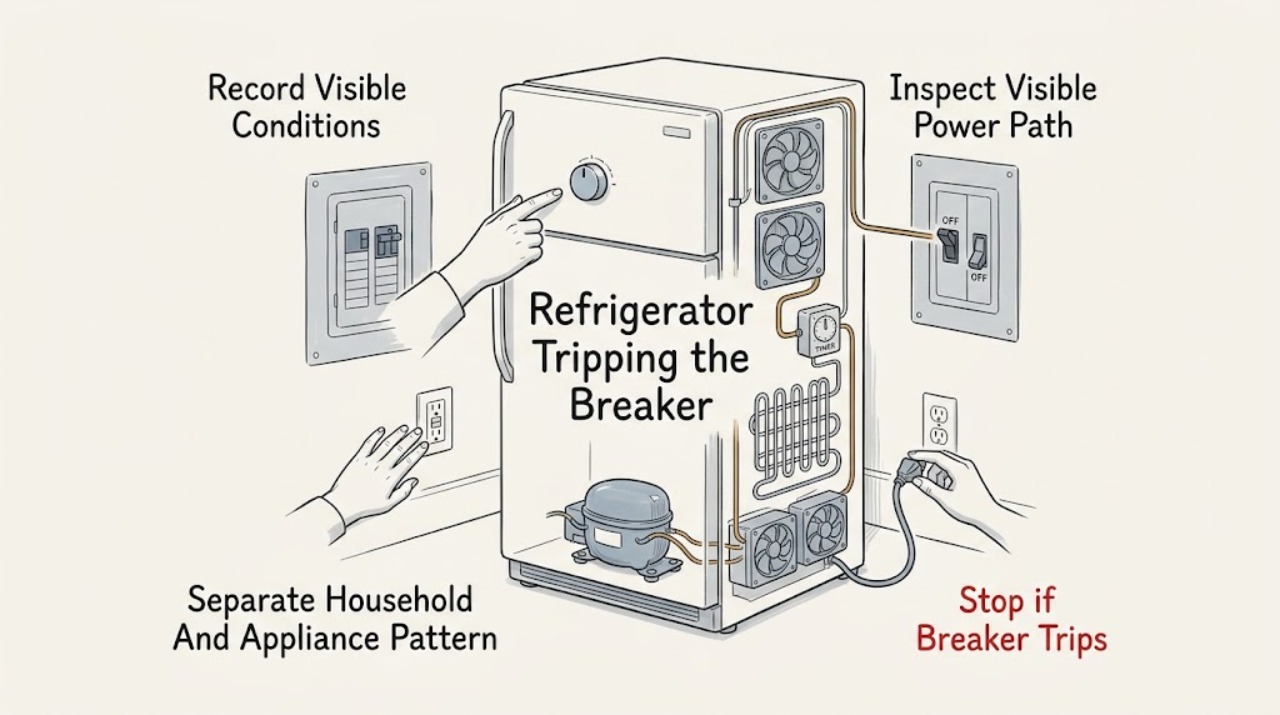
Work through in order
Diagnostic checks
Use only checks that match the exact appliance or system and its official guide.
-
Check 1
Leave the refrigerator off after the breaker or GFCI opens. From a dry, safe position, record the time and trigger: immediately on connection, when cooling starts, after running for a while, or when another household load is used. Do not reconnect it to reproduce the trip.
Expected result: The protection opens immediately; only cooling startup seems to trigger it; it opens after a delay; or the whole circuit loses power with other loads.
Next step: Keep the circuit and refrigerator off and use the matching branch. Preserve the trip history instead of attempting another reset.
Stop if: Stop and keep clear for smoke, sparks, burning odor, heat, a damaged cord, moisture, or a warm or discolored outlet.
Why this matters
Why: Timing narrows the handoff between household supply and appliance diagnosis but does not prove a failed component. An immediate trip or a trip with other loads warrants electrical assessment; a cooling-related or delayed trip also needs appliance service if the supply is safe.
-
Check 2
Without moving the refrigerator or removing any cover, inspect only what is visible from the front or an already accessible dry position: whether the plug is fully seated, whether an extension cord or adapter is being used, and whether the cord, plug, outlet face, or nearby floor shows damage or moisture. Do not handle a wet plug.
Expected result: An extension cord or adapter is present; the cord or plug is cracked, cut, hot, loose, or discolored; the outlet or floor is wet; or everything visible is dry and undamaged.
Next step: If an extension cord or adapter is present, stop using the arrangement and have the proper supply assessed; do not substitute a larger breaker. For damage or moisture, keep the circuit off and call an electrician. If no visible issue exists, continue only with documentation and professional assessment.
Stop if: Do not touch wet electrical parts, straighten damaged prongs, tape a cord, pull the refrigerator out, or make electrical measurements.
Why this matters
Why: JennAir explicitly says not to use an extension cord and calls for a grounded three-prong outlet. Damage or moisture creates an immediate electrical safety boundary. A normal-looking visible connection does not rule out a concealed supply or appliance fault.
-
Check 3
From the electrical panel or controls only, note whether the opened protection is a branch breaker, GFCI outlet, or another protective device, and whether other outlets or appliances on that circuit are also without power. Do not change the device rating or use a different circuit as a test.
Expected result: Only the refrigerator circuit opens; a GFCI opens; several loads lose power; or the device will not remain on even with the refrigerator disconnected by a qualified person.
Next step: Leave the protective device in its safe state and give the pattern to a licensed electrician. If the supply is cleared, schedule JennAir or qualified refrigeration service rather than reconnecting to test.
Stop if: Do not repeatedly reclose the breaker or GFCI, remove the panel cover, bypass protection, install a larger breaker, or use an extension cord.
Why this matters
Why: A single affected circuit can still have either a supply or refrigerator fault. Multiple affected loads or a protective-device problem increases the need for an electrician. A repeated refrigerator-specific trip after a safe supply assessment increases the need for appliance service, but no pattern is safe to diagnose by swapping protection.
-
Check 4
Read the model label without moving the refrigerator and record whether it is freestanding, built-in, column, or undercounter. Note recent installation, relocation, cleaning, water-line work, or electrical work, and whether the cord is accessible or the unit is hardwired according to its installation.
Expected result: The trip began after installation or movement; the refrigerator is tightly integrated or hardwired; water or condensation is near the electrical path; or there is no recent change and the unit is accessible.
Next step: Give the model and installation context to the electrician and appliance technician. Do not pull out, tilt, or disassemble an integrated refrigerator; keep it off if water or electrical damage is present.
Stop if: Stop for a strained water line, unstable cabinetry, exposed wiring, water near electrics, or any need to move the appliance.
Why this matters
Why: JennAir publishes different refrigerator families and directs owners to model-specific manuals. Installation history can expose a supply, cord, clearance, or connection issue, while integrated or hardwired units have a higher movement and access boundary.
-
Check 5
Prepare the service handoff: model and serial information, the protective device that opened, exact trip timing, visible supply condition, recent installation history, food temperature concern, and photos taken without opening or moving the unit. Keep the refrigerator off until the responsible professional clears it.
Expected result: The trip is repeatable; the breaker remains open; the supply has been cleared but the refrigerator still cannot run; or the refrigerator has no visible damage but the cause is unknown.
Next step: Call a licensed electrician for the household supply and a qualified JennAir appliance technician for an appliance-specific fault. Follow the exact model manual only after the professional says restoring power is safe.
Stop if: Do not restore power for a trial, open panels, perform energized tests, or replace internal parts yourself.
Why this matters
Why: A repeatable or unexplained trip remains an electrical and appliance safety issue, not a parts-selection problem. The evidence helps the electrician and JennAir service provider decide whether to assess the circuit, cord, controls, compressor, fans, defrost system, or wiring.
Use your observations
Decision map
Find the observation that best matches what you see, then follow the next safe action.
-
PATH 01Safety boundary
What you see
The breaker or GFCI opens as soon as the refrigerator is connected, or it will not remain closed with the refrigerator involved.
Do this next
Leave the refrigerator off and call a licensed electrician. Do not keep reconnecting it, change the protective-device rating, or use an extension cord.
Why this path and its safety boundary
Why it matters: The immediate priority is electrical isolation. The timing may indicate a supply, cord, protection, or appliance fault, but it cannot identify the cause without professional testing.
Safety stop: Keep away from smoke, heat, moisture, damaged cords, and scorched outlets.
-
PATH 02Safety boundary
What you see
The circuit stays on initially but opens when cooling begins or after the refrigerator has run for a while.
Do this next
Keep the unit off, record the timing, protect food, and arrange a licensed electrician plus qualified JennAir appliance service as appropriate. Do not reproduce the trip.
Why this path and its safety boundary
Why it matters: A load-dependent or delayed pattern makes professional appliance and electrical assessment important, but it does not prove a compressor, fan, defrost, or control failure.
Safety stop: Do not restore power when there is odor, abnormal heat, moisture, or cord or outlet damage.
-
PATH 03Safety boundary
What you see
Other loads lose power, or a GFCI or protective device opens even when the refrigerator is not the only apparent load.
Do this next
Leave the protective device in its safe state and have a licensed electrician assess the circuit. Do not move the refrigerator to another circuit as a diagnostic experiment or install a larger breaker.
Why this path and its safety boundary
Why it matters: The household circuit or protection may be part of the problem. JennAir recommends a circuit serving only the refrigerator, but changing wiring or protection is electrician work.
Safety stop: Do not repeatedly reclose the device or bypass its protection.
-
PATH 04Safety boundary
What you see
There is moisture, a wet or damaged plug, a hot or discolored outlet, a cut cord, smoke, sparks, or burning odor.
Do this next
Keep clear, leave the appliance off, and contact emergency services for an active fire or a licensed electrician for the electrical condition. Do not touch wet parts or move the refrigerator.
Why this path and its safety boundary
Why it matters: The condition is an immediate electrical or fire hazard. Normal troubleshooting and food-preservation steps are secondary to keeping people away and isolating power only from a safe position.
Safety stop: Do not handle the cord or outlet, remove covers, or restore power.
-
PATH 05Safety boundary
What you see
No visible supply hazard is found, but the refrigerator repeatedly trips protection or the cause cannot be identified safely.
Do this next
Keep it off and provide the model, trip history, installation type, and visible checks to an electrician and qualified JennAir service provider.
Why this path and its safety boundary
Why it matters: A concealed supply or internal appliance fault remains possible. The absence of visible damage is not a clearance to operate the unit.
Safety stop: Do not order a control, compressor, or cord by symptom alone and do not perform internal or energized tests.
Helpful context
Understand the symptom
A breaker trip is a safety event, not a normal refrigerator symptom
A refrigerator can be silent after a household breaker or GFCI opens, but the trip itself does not identify whether the cause is the outlet, circuit, cord, compressor, fan, defrost system, or another internal component. JennAir has a dedicated Tripping Breaker support entry under refrigerator No Power. Treat the first trip as information to record, not as an invitation to repeat the event.
Record when the protection opens
Write down whether the breaker opens as soon as the refrigerator is connected, when cooling starts, after the appliance has run for a while, or only when another load is used on the same circuit. Record whether the display, interior light, or temperature control was active, and photograph any visible warning or damage from a dry position. Do not create a new trip by plugging and unplugging repeatedly.
The accessible supply boundary
JennAir guidance calls for a grounded three-prong outlet, a circuit serving the refrigerator, and no extension cord. These are installation and supply requirements, not permission to rewire a circuit or alter its protection. If an extension cord, adapter, loose plug, damaged cord, hot outlet, scorch mark, moisture, or burning odor is present, keep the refrigerator off and use a licensed electrician. Do not substitute a larger breaker or a different protective device.
When appliance service takes over
If the circuit and outlet are safe but the refrigerator trips protection again when cooling or another internal function starts, the next decision requires electrical and appliance diagnosis. A technician may need to distinguish a supply fault from a compressor, fan, defrost, control, or wiring fault. That work can involve hazardous voltage and sealed refrigeration equipment, so it is outside user checks.
Protect food while the unit is off
Keep the doors closed and move perishable food to a safe refrigerator or cooler if cooling has stopped. Do not repeatedly restore power just to check temperature. Give the electrician or JennAir service provider the model number, installation type, trip timing, circuit or GFCI details, and any visible safety signs.
Safety boundary
Stop conditions
- Leave the refrigerator off after a trip; do not repeatedly reclose the breaker or GFCI to test it.
- Do not install a larger breaker, bypass a protective device, use an extension cord or adapter, or move the refrigerator to another circuit as an experiment.
- Do not touch a wet plug, outlet, cord, exposed wiring, scorch mark, or hot electrical part.
- Do not pull out, tilt, open, or disassemble a built-in, column, hardwired, or water-connected refrigerator.
- Do not perform energized electrical measurements or internal parts replacement; use a licensed electrician and qualified appliance technician.
Only after diagnosis
Potential parts
- model-matched power cord, outlet component, or protective connection
Consider only if a licensed electrician or qualified technician identifies a damaged or incorrect supply component; a breaker trip alone does not identify a replaceable part.
Supply work is installation-specific and may be regulated. Confirm the exact model and have electrical work performed by a licensed electrician. - model-matched control, compressor, fan, defrost, or wiring component
Consider only after qualified testing identifies an internal appliance fault and the exact model service documentation supports the diagnosis.
Do not order or replace internal electrical or refrigeration parts from the symptom alone.
When checks do not resolve it
Need a professional?
Leave the JennAir refrigerator off and call a licensed electrician when a breaker or GFCI trips again, will not remain on, affects other loads, or the outlet, plug, cord, or circuit is damaged or uncertain. Arrange qualified JennAir appliance service when the supply is cleared but the refrigerator trips when cooling starts, trips after running, or has an unexplained appliance-specific fault. Stop immediately for smoke, sparks, burning odor, abnormal heat, moisture near electrical parts, a cut or hot cord, a scorched outlet, or an active fire. Do not repeatedly reset protection, install a larger breaker, use an extension cord or adapter, move a built-in refrigerator, open panels, perform energized tests, or replace internal parts. Keep doors closed and protect food while the unit is safely out of service.
Safety scope: The user may record the trip pattern and inspect visible dry connections without moving the unit. A licensed electrician must assess the circuit and protective device; qualified appliance personnel must handle internal controls, wiring, compressor, fans, defrost components, sealed refrigeration, and any live testing.
Common questions
FAQ
Why does my JennAir refrigerator keep tripping the breaker?
The trip can involve the household circuit, protective device, outlet or cord, or an internal refrigerator load. Record when it happens, leave the refrigerator off, and have a licensed electrician and qualified appliance technician assess it rather than repeatedly resetting the circuit.
Can I use an extension cord with a JennAir refrigerator?
No. JennAir refrigerator power guidance says not to use an extension cord and calls for a grounded three-prong outlet and a circuit serving the refrigerator. Have an electrician correct an unsuitable supply instead of improvising a connection.
Should I install a larger breaker so my JennAir refrigerator stops tripping?
No. A larger protective device can create a serious safety hazard and does not diagnose the cause. Leave the circuit in its safe state and call a licensed electrician.
Can I keep resetting the breaker to see whether the refrigerator runs?
No. Do not repeat the event. Record whether the trip was immediate, cooling-related, delayed, or shared with other loads, then arrange professional assessment.
What should I do if the outlet or cord is wet or damaged?
Keep the refrigerator off and do not touch wet electrical parts or a damaged cord. Call a licensed electrician, and use JennAir service for any appliance-specific fault after the supply is made safe.
Read the exact guide
Official sources
- Contact Us | JennAirJennAir · Official JennAir United States contact page; service availability and contact process are regional.
- Operation - Product Help | JennAirJennAir · Official JennAir operation index for the French Door Bottom Freezer family; other refrigerator families and controls may differ.
- Tripping Breaker - Refrigerator - Product Help | JennAirJennAir · Official JennAir Product Help page under the French Door Bottom Freezer Refrigerator family; exact installation and electrical details vary by refrigerator model.
- Control Panel Not Working - Refrigerator - Product Help | JennAirJennAir · Official JennAir control-panel guidance for the French Door Bottom Freezer family; power-outage indicators and modes vary by model.
Community feedback
Share a repair observation
Share a plain-text repair observation. Accepted observations are published automatically; this page may take a moment to update.