
On this page
Start here
Quick answer
First locate the sound and compare it with the exact Kelvinator model manual. The opened Kelvinator KBM653TSE bottom-freezer manual identifies cracking during automatic defrost or material expansion, a short crack when the thermostat switches the compressor, compressor motor noise, bubbling or splashing from refrigerant flow, water flowing to the evaporation container during defrost, and air movement on some models as normal operating sounds. It also says warm edges near the door joint can be normal. A rattle or vibration is more consistent with an unlevel cabinet or an object touching the top, back, wall, or cupboard, so check only those accessible external conditions. If the sound is grinding, scraping, repeated hard clicking, electrical buzzing with heat or odor, or is accompanied by smoke, sparks, a hot cord, water near electricity, a damaged cabinet, rising temperatures, or repeated breaker trips, stop use safely and arrange authorized service. Do not remove panels, reach into fans, test a compressor or capacitor, open the refrigerant circuit, or apply another Kelvinator model's instructions. The KBM653TSE manual is model-specific; confirm your rating-label model before using its sound descriptions.
Before you begin
Safety first
- This page covers model identification, external sound classification, accessible leveling and contact checks, door and gasket observation, and temperature or power-path observation. Fans, compressors, motor mounts, thermostats, defrost components, controls, wiring, refrigerant, sealed systems, and live testing require qualified service.
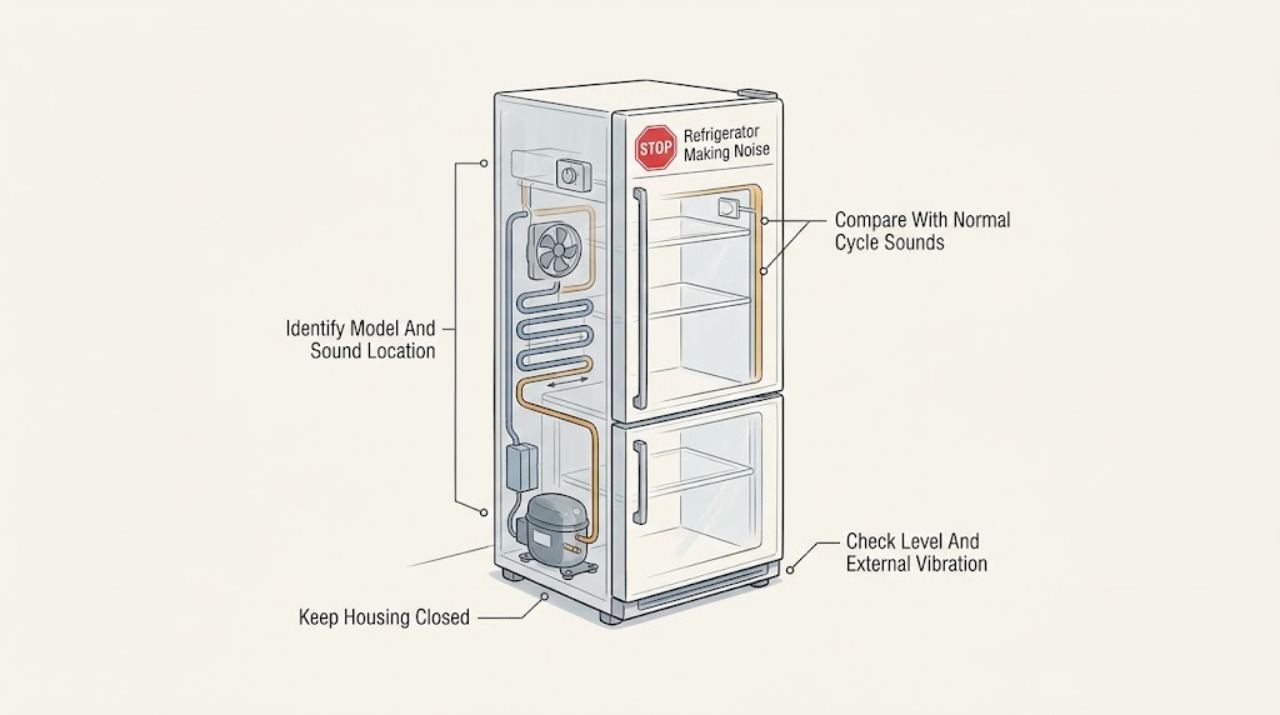
Work through in order
Diagnostic checks
Use only checks that match the exact appliance or system and its official guide.
-
Check 1
Read the rating label and identify the exact Kelvinator model. From a safe position, record whether the sound is at the rear or underside, inside a compartment, near the door joint, or outside where an object or wall could touch the cabinet. Note whether it occurs at startup, during steady cooling, during defrost, or when a door moves.
Expected result: The model matches the KBM653TSE manual, a different model has a different manual, or the model cannot be confirmed; the sound has a repeatable time and location or is intermittent and unclear.
Next step: Use the exact model manual for sound names and access rules. If the model is unknown, limit checks to safe external observations and contact Kelvinator support or an authorized service centre.
Stop if: Stop for smoke, burning odor, sparks, shock, a hot or damaged cord, water near electricity, abnormal heat, loss of cooling, or repeated breaker trips.
Why this matters
Why: The normal-sound list is reliable for the identified KBM653TSE family but is not proof for every Kelvinator design. Timing and location help separate compressor, refrigerant, defrost, airflow, door, and external-vibration routes without opening the cabinet.
-
Check 2
Without touching moving or hot parts, listen for a short crack at compressor switching, a motor hum during cooling, bubbling or splashing, water flow during defrost, or soft air movement. Compare the sound with the exact manual and note whether cooling and compartment temperatures remain normal.
Expected result: The sound matches a documented cycle event and the appliance cools normally, or it is harsh, continuous, new, synchronized with failed cooling, or unlike the manual.
Next step: Monitor a normal cycle if no hazard is present. For an unexplained or worsening sound, record a short description and arrange authorized service without opening the cabinet.
Stop if: Do not run repeated test cycles through scraping, grinding, electrical buzzing with odor or heat, smoke, arcing, or abnormal vibration.
Why this matters
Why: A documented cycle sound with normal cooling is consistent with operation. A sound unlike the manual, especially with a temperature or safety symptom, needs service rather than a guessed component.
-
Check 3
Inspect the accessible exterior for a cabinet touching a wall or cupboard, an object on top or beside it, a loose item vibrating behind it, an uneven floor, or a door that moves because the cabinet is not level. Correct only a clearly safe external obstruction or leveling adjustment permitted by the model instructions.
Expected result: The cabinet or an object is contacting another surface, the floor or rollers are visibly uneven, or no external vibration source is visible.
Next step: Remove an external object and follow the exact manual for safe leveling or clearance. If the sound remains or the appliance is built in or heavily loaded, arrange service instead of forcing movement.
Stop if: Do not reach behind a powered unit, remove panels, put hands near fans or the compressor, pull a built-in unit by its doors, or wedge the cabinet against a wall.
Why this matters
Why: Contact and leveling can amplify a normal compressor or refrigerant sound into a rattle or vibration. If no external source exists, an internal fan, compressor, or mounting issue remains possible but is not identified.
-
Check 4
Observe whether the sound coincides with automatic defrost, door opening or closing, a door alarm, visible frost, or a door that does not close squarely. Inspect the gasket and closure from outside for an obvious obstruction or damage; do not remove the door or defrost with a tool or heat source.
Expected result: The sound occurs during defrost or material temperature change, the door or gasket is obstructed or damaged, frost is becoming heavy, or closure and defrost conditions look normal.
Next step: Remove only an obvious closure obstruction and use the exact manual for defrost or gasket care. Arrange service for heavy ice, a damaged seal, repeated door alarms, or a sound that continues outside the documented cycle.
Stop if: Do not chip ice, use a hair dryer or heater, force the door, remove hinges, or open internal panels.
Why this matters
Why: The KBM653TSE manual treats defrost and expansion cracking as normal, but heavy ice, a poor seal, or a door problem can alter airflow and make the appliance run or sound differently. Normal visible closure does not rule out an internal fault.
-
Check 5
Check only from a dry, safe position whether the refrigerator maintains its model setting, whether the compressor appears to start and stop normally, and whether the accessible cord, plug, and outlet show heat, scorching, moisture, or damage. Do not make a live electrical measurement.
Expected result: Cooling remains normal and the power path is intact, or the sound is accompanied by rising temperature, repeated failed starts, a hot or damaged cord, smoke, burning odor, water, or a breaker trip.
Next step: Monitor only when the appliance is safe and temperatures are stable. Isolate the unit for a hazard and contact an authorized appliance technician or qualified electrician for the appropriate side of the problem.
Stop if: Do not repeatedly reset a breaker, reconnect a hot or damaged unit, test live wiring, or keep operating through smoke, sparks, burning odor, shock, water near electricity, or abnormal heat.
Why this matters
Why: Normal cooling and power conditions support a normal-sound or vibration route. A sound combined with cooling loss or an electrical warning points to a safety or internal service issue, not a leveling adjustment.
-
Check 6
Prepare the exact model, sound description, location, timing, temperature behavior, door and level observations, and any hazard or alarm for Kelvinator support or an authorized service centre. Keep the appliance disconnected if the sound is accompanied by a safety warning or failed cooling.
Expected result: The sound persists after safe external checks, differs from the exact manual, worsens, returns with each cycle, or accompanies abnormal temperature, smoke, odor, vibration, or electrical symptoms.
Next step: Arrange Kelvinator authorized service or a qualified appliance technician, and use a qualified electrician for the household outlet, cord, breaker, or circuit.
Stop if: Do not remove covers, reach into the compressor or fan area, open the refrigerant circuit, test capacitors or wiring, bypass protection, or order a part by sound description alone.
Why this matters
Why: An internal fan, compressor, motor mount, thermostat, defrost component, control, or refrigerant circuit may require diagnosis. The sound alone cannot safely select a replacement part.
Use your observations
Decision map
Find the observation that best matches what you see, then follow the next safe action.
-
PATH 01Safety boundary
What you see
The exact model manual matches a short crack, compressor motor sound, bubbling or refrigerant flow, defrost water flow, air movement, or expansion sound, and cooling remains normal.
Do this next
Monitor the sound and internal temperatures. Recheck the exact manual if the sound changes, becomes harsh or continuous, or cooling performance changes.
Why this path and its safety boundary
Why it matters: This pattern is consistent with the documented operating cycle for the KBM653TSE manual, not evidence of a failed component.
Safety stop: Do not ignore smoke, burning odor, sparks, shock, abnormal heat, loss of cooling, or repeated breaker trips merely because the appliance also makes a normal sound.
-
PATH 02Safety boundary
What you see
The sound is a rattle or vibration and an object, wall, cupboard, uneven floor, or unlevel cabinet is visibly contacting or amplifying the appliance.
Do this next
Remove the safe external contact and use the model-approved leveling or clearance procedure. Arrange service if the noise persists or movement is unsafe.
Why this path and its safety boundary
Why it matters: External contact or leveling is a plausible explanation; it does not establish an internal motor or compressor failure.
Safety stop: Do not reach behind a powered appliance, pull a built-in unit by the door, remove covers, or wedge the cabinet into a new position.
-
PATH 03Safety boundary
What you see
The sound occurs during defrost or temperature change, or door closure, gasket, or frost conditions are abnormal without electrical hazard.
Do this next
Use the exact manual for safe defrost and gasket care, remove only obvious closure obstructions, and arrange service for heavy frost, a damaged seal, or persistent abnormal sound.
Why this path and its safety boundary
Why it matters: Defrost and material expansion can be normal, while a poor seal or heavy frost can change airflow and operating noise.
Safety stop: Do not chip ice, apply direct heat, force the door, remove hinges, or open internal panels.
-
PATH 04Safety boundary
What you see
The sound is grinding, scraping, repeated hard clicking, or a new continuous hum, or it coincides with failed cooling, repeated failed starts, heavy frost, or abnormal vibration after external checks.
Do this next
Stop user diagnosis and arrange Kelvinator authorized service with the model, sound timing, and temperature observations.
Why this path and its safety boundary
Why it matters: An internal fan, compressor, motor mount, defrost component, thermostat, control, or refrigerant problem is possible, but the sound does not identify the component.
Safety stop: Do not remove panels, reach into moving parts, test a capacitor, handle refrigerant, or substitute a compressor, fan, or control.
-
PATH 05Safety boundary
What you see
The noise is electrical or accompanied by smoke, burning odor, sparks, shock, melting, a hot or damaged cord, water near electricity, abnormal heat, or repeated breaker trips.
Do this next
If safe, isolate power without touching a hazardous part, keep clear, and contact an authorized appliance technician; use a qualified electrician for the outlet, breaker, cord, or household circuit.
Why this path and its safety boundary
Why it matters: This is a stop-use safety event, not a normal-noise or vibration diagnosis.
Safety stop: Do not reconnect, repeatedly reset protection, touch wet or energized parts, remove panels, or continue listening tests.
Helpful context
Understand the symptom
Classify the sound before trying to fix it
A refrigerator can crack as materials expand or during automatic defrost, click as the thermostat switches the compressor, bubble as refrigerant moves, or make a soft air and motor sound during normal cooling. Record when the sound occurs—startup, steady running, defrost, door movement, or after a power interruption—and where it comes from. A sound description without the model and location cannot identify a failed part.
External vibration is a separate route
Kelvinator's support material and the KBM653TSE manual point to a cabinet that is not level, a floor or roller issue, an object touching the cabinet, or insufficient clearance at the wall or cupboard as possible vibration sources. Inspect and correct only an obvious external condition. Do not pull a built-in or heavily loaded appliance out by force.
Abnormal sound plus a symptom needs service
A harsh scrape, grinding sound, repeated failed starts, electrical odor, smoke, heat, or a simultaneous loss of cooling is not explained by the manual's normal-sound list. Keep the cabinet closed and the appliance off when a hazard is present. A compressor, fan, thermostat, control, defrost part, or refrigerant fault needs model-specific professional diagnosis.
Safety boundary
Stop conditions
- Stop immediately for smoke, burning or electrical odor, sparks, shock, melting, abnormal heat, a hot or damaged cord or plug, water near electricity, failed cooling with heat, cabinet damage, or repeated breaker trips.
- Do not remove panels, reach into fans or the compressor area, test capacitors or live wiring, open the refrigerant circuit, bypass protection, or choose a replacement part from a sound description alone.
- Do not chip frost, apply direct heat, pull a built-in or heavily loaded appliance by its doors, or clean a restricted condenser area unless the exact manual explicitly allows the work.
- Use the exact Kelvinator model manual for normal sound descriptions, defrost behavior, leveling, clearance, door and gasket handling, and service instructions. The KBM653TSE manual is not universal proof for every Kelvinator model.
- Arrange authorized service when the noise is unexplained, worsening, mechanically harsh, associated with cooling loss, or persistent after safe external checks.
When checks do not resolve it
Need a professional?
Contact Kelvinator authorized service or a qualified appliance technician when a sound differs from the exact model manual, persists after safe leveling and external-object checks, becomes grinding or scraping, accompanies cooling loss or heavy frost, or suggests a fan, compressor, motor mount, thermostat, defrost, control, or refrigerant fault. Use a qualified electrician for a hot, wet, scorched, loose, or damaged outlet, cord, breaker, or household circuit. Stop use immediately for smoke, burning odor, sparks, shock, melting, abnormal heat, water near electricity, or repeated trips.
Safety scope: This page covers model identification, external sound classification, accessible leveling and contact checks, door and gasket observation, and temperature or power-path observation. Fans, compressors, motor mounts, thermostats, defrost components, controls, wiring, refrigerant, sealed systems, and live testing require qualified service.
Common questions
FAQ
What refrigerator noises does Kelvinator consider normal?
The opened KBM653TSE manual lists cracking during defrost or material expansion, short thermostat switching cracks, compressor motor noise, refrigerant bubbling or splashing, defrost water flow, and air movement on some models as normal. Confirm the sound against your exact model manual.
Why is my Kelvinator refrigerator rattling or vibrating?
Kelvinator support points to an unlevel cabinet or floor, an object on or beside the unit, or the cabinet touching a wall or cupboard. Correct only an obvious safe external cause; persistent vibration needs service.
Is a cracking sound during defrost normal on a Kelvinator refrigerator?
For the KBM653TSE manual, cracking during automatic defrost or as the appliance warms and cools is listed as normal. A harsh or continuous crack, heavy frost, cooling loss, or an electrical warning changes the decision to service.
Why does my Kelvinator refrigerator make bubbling or water sounds?
The KBM653TSE manual attributes bubbling or splashing to refrigerant flow and water-flow noise to water moving to the evaporation container during defrost. If the sound is new and harsh or cooling is failing, arrange service rather than opening the system.
Is a warm door edge related to a Kelvinator refrigerator noise?
The KBM653TSE manual says edges at the door joint may become warm while the compressor operates, especially in warm seasons. Warmth with stable cooling can be normal; abnormal heat, odor, smoke, or cooling loss requires immediate stop and service.
Should I replace the compressor or fan because my Kelvinator refrigerator is noisy?
No. The sound does not identify a failed compressor, fan, mount, thermostat, defrost part, control, or refrigerant circuit. Keep the cabinet closed and arrange authorized service after safe external checks.
Read the exact guide
Official sources
- Kelvinator Refrigerator Bottom freezer XXL 650/1300 litres KBM653TSEKelvinator · Kelvinator KBM653TSE product identity and matching manual link
- TroubleshooterKelvinator Australia · Kelvinator Australia refrigerator and freezer troubleshooting, noisy-operation and service guidance
- Fridge - Freezer / User ManualKelvinator · Kelvinator KBM653TSE bottom-freezer refrigerator and twin configuration
Community feedback
Share a repair observation
Share a plain-text repair observation. Accepted observations are published automatically; this page may take a moment to update.