
On this page
Start here
Quick answer
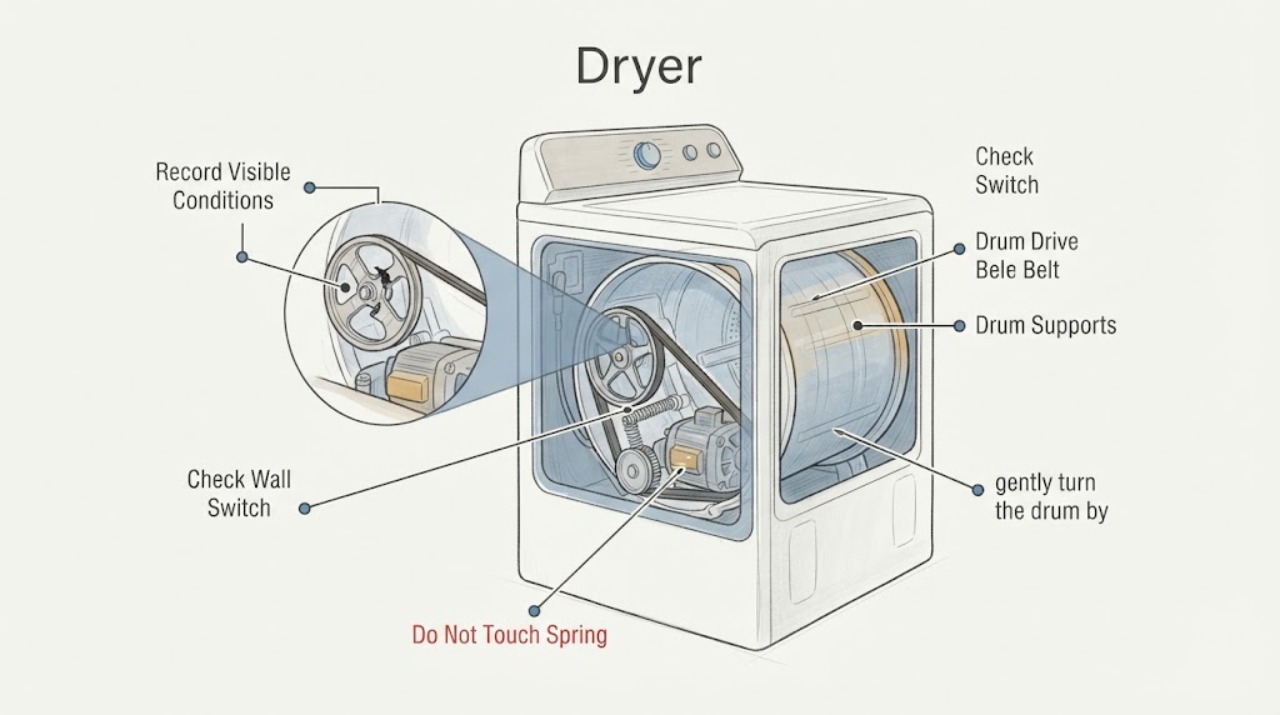
For Kenmore 110.6192311, treat a reported broken motor pulley as a lead, not a confirmed diagnosis. The exact-model report says the belt broke and the owner had previously repaired the heating element, limit switches, thermostat, belt, guides, and drum seal; a reply identified the photographed motor-end piece as a pulley and also mentioned the belt. That history does not prove which part failed first. With the dryer unplugged and cool, first confirm the complete model and whether the drum turns smoothly by hand, whether it is loose or bound, and whether the belt is visibly slack or broken only if it can be seen without opening the cabinet. Separate a drum that will not turn from a drum that turns but a motor only hums, squeals, stalls, or overheats. Do not run it with a suspected drive failure, remove panels, test live wiring, or order a pulley/belt/motor from the claim alone; arrange qualified dryer service for the exact model.
Work through in order
Diagnostic checks
Use only checks that match the exact appliance or system and its official guide.
-
Check 1
Read the complete model and serial label and record whether Kenmore 110.6192311 is an electric or gas dryer. Compare the label with the exact-model report before applying any belt, pulley, motor, or access instruction.
Expected result: The label matches 110.6192311; a digit or suffix differs; the fuel type is uncertain; or the label cannot be read without moving the dryer.
Next step: Use the complete model in Kenmore's official manual portal and provide it to service. If the label does not match, stop this model-specific path and do not borrow another 110-series procedure.
Stop if: Do not pull, tilt, or open the dryer merely to find the label; arrange safe help if access is unsafe.
Why this matters
Why: Kenmore 110-series dryers can differ in wiring, fuel hazards, drive layout, and model documentation. The full identity is required to decide whether an observation or part description applies.
-
Check 2
Stop the dryer, remove the load, disconnect its power from a dry safe location, and let it cool. If it is gas-fired and there is any gas odor, do not operate switches or touch the gas connection; leave the area and follow local emergency guidance.
Expected result: The drum stopped normally; the dryer was stalled, hot, or smelled of burning rubber; smoke, sparks, or gas odor is present; or no hazard is found.
Next step: Keep the dryer off for any hazard and arrange prompt qualified service. Continue only with the visible drum and seam checks when the area is dry and safe.
Stop if: Do not operate switches during a gas odor, touch wet/damaged electrical equipment, or restart after smoke, sparking, burning odor, or repeated breaker trips.
Why this matters
Why: A stalled drive can overheat the motor or belt, while gas, smoke, and electrical signs are hazards rather than diagnostic clues. A safe cool, disconnected dryer permits only limited external observation.
-
Check 3
With power disconnected and the drum empty, gently turn the drum by hand through slow rotations. Note smooth motion, a rough or tight spot, binding, wobble, a scrape at one position, or a drum that spins unusually freely; do not remove the belt or panels.
Expected result: The drum turns smoothly with normal resistance; it is bound or rough; it wobbles; it scrapes once per turn; or it turns unusually freely and the belt is visibly slack or broken at an accessible edge.
Next step: Record the exact resistance and visible result. Keep the dryer off and arrange exact-model service for any rough, bound, loose, or drive-path symptom rather than opening the cabinet.
Stop if: Do not force the drum, insert tools into the seam, handle a spring-loaded drive, or reach behind the drum.
Why this matters
Why: Roughness, binding, or wobble keeps drum supports, glides, idler, belt tracking, bearing, or alignment in the decision set. An unusually free drum with a visible slack/broken belt supports a drive-path failure, but it does not prove the motor pulley was the first failed part.
-
Check 4
Record what happened when the problem appeared: whether the drum stopped turning, whether the motor hummed or squealed, whether heat remained, whether the sound was front/rear/lower-rear, and whether the belt had recently been replaced. Do not run another cycle solely to reproduce it.
Expected result: The drum will not turn; the drum turns but the motor hums or stalls; there is squealing or rumbling; heat works but tumbling stops; or the only evidence is a suspected pulley visible during a prior repair.
Next step: Give the technician the symptom sequence and prior repair history. Keep the dryer off until the drive system is inspected with the correct model procedure.
Stop if: Do not use a heated cycle with a stalled drum, burning rubber, abnormal heat, or a suspected drive failure.
Why this matters
Why: No tumble can involve belt, pulley, idler, motor, drum support, or a safety/control interruption. A motor hum with a stationary drum keeps the drive path open; sound location can suggest a branch but cannot prove a pulley, belt, or motor fault.
-
Check 5
List all prior repairs and parts, including the belt, guides/glides, drum seal, heating element, limit switches, and thermostat, and note which repair immediately preceded the current problem. Do not assume a prior replacement was installed or tensioned correctly without model-specific records.
Expected result: The belt or pulley was recently replaced; several drive or drum parts were replaced at different times; the problem followed a repair; or repair timing is unknown.
Next step: Provide receipts, photos, and the repair sequence to qualified service. Ask for a complete drive-path inspection rather than a pulley-only replacement decision.
Stop if: Do not glue a pulley, substitute a belt, bypass a safety device, lubricate unknown parts, or remove cabinet panels as a trial.
Why this matters
Why: Repeated repairs and timing can reveal a belt-tracking, alignment, support, or installation interaction, but they do not establish a specific failed part. The exact post confirms extensive repair history but has no verified resolution.
-
Check 6
With the dryer isolated and dry, inspect only the visible door opening, drum edge, lint area, exhaust outlet, cord, and floor for loose metal, torn seal material, heat damage, lint accumulation, or a damaged cord. Do not interpret a clean exterior as proof that the internal drive is sound.
Expected result: Loose metal or seal damage is visible; lint or heat damage is present; the cord/outlet is damaged; or no external defect is found.
Next step: Remove only loose reachable debris without tools, correct lint/exhaust issues externally, and arrange service for any damage or persistent no-tumble symptom. Do not restart to prove the result.
Stop if: Stop for sharp metal, exposed wiring, heat damage, smoke, burning odor, gas odor, or water near electrical equipment.
Why this matters
Why: Visible debris or seal damage can add drag or scraping, while lint and heat damage can contribute to repeated safety-device or drive problems. No visible issue leaves internal belt, idler, pulley, motor, or support diagnosis unresolved.
Use your observations
Decision map
Find the observation that best matches what you see, then follow the next safe action.
-
PATH 01Next step
What you see
The drum is unusually free to turn and the belt is visibly slack or broken at an accessible edge, with no odor or electrical hazard.
Do this next
Keep the dryer off and have the exact model's drive path inspected. Do not order a pulley or belt solely from the owner’s description.
Why this path and its safety boundary
Why it matters: A drive-path failure is more likely than a seized drum support, but the motor pulley, belt, idler, motor shaft, and installation remain unresolved.
-
PATH 02Next step
What you see
The drum is rough, bound, wobbly, or scraping, even though the owner suspects a motor pulley.
Do this next
Leave power off and arrange qualified service for internal inspection. Provide hand-turn results and repair history; do not force the drum or open the cabinet.
Why this path and its safety boundary
Why it matters: Drum supports, guides, idler, bearing, seal, alignment, or a belt-tracking problem may be contributing; a pulley-only explanation is not sufficient.
-
PATH 03Next step
What you see
The drum turns but the motor hums, squeals, stalls, overheats, or the dryer had a repeated drive repair immediately before the symptom.
Do this next
Keep the dryer off and request a complete drive-path diagnosis for model 110.6192311. Do not run another heated cycle or test live parts.
Why this path and its safety boundary
Why it matters: The motor, pulley, belt, idler, alignment, or motor-start path remains possible. Sound and repair timing can prioritize inspection but cannot identify the failed component.
-
PATH 04Next step
What you see
Smoke, burning rubber, gas odor, sparks, exposed wiring, abnormal heat, damaged cord, or repeated breaker trips appear.
Do this next
Leave the dryer off, isolate power or gas only from a safe location when appropriate, and obtain qualified appliance, electrical, or gas help. Do not restart.
Why this path and its safety boundary
Why it matters: Continued operation can create fire, gas, or electrical risk; this is a stop-use condition.
Helpful context
Understand the symptom
The opened exact-model post identifies Kenmore 110.6192311 and describes a belt failure plus a suspected motor-end pulley issue. Kenmore's official manual portal requires the complete model number to retrieve model-specific manuals and resources. Confirm every digit, the serial number, and whether the dryer is electric or gas before using any access or parts information.
A pulley can be visibly damaged while the belt, idler, motor shaft, drum support, or a prior repair remains part of the causal chain. The key decision is not whether a pulley name sounds plausible; it is whether the drum is free, whether it can be driven, and whether a safe external observation shows a repeatable symptom. The exact report contains no verified repair outcome.
Disconnect power from a dry, safe location and let the dryer cool before any external observation. Do not open the cabinet, handle a belt or spring-loaded drive system, bypass a safety device, test energized wiring, or operate the dryer with a stalled drum, burning odor, smoke, exposed wiring, or gas odor.
When checks do not resolve it
Need a professional?
Have this ready
- Full model 110.6192311 and serial, electric/gas type, drum hand-turn result, visible belt/seam observations, sound character and location, whether heat remains, prior repair list and timing, photos, and any hazard. Ask for drive-path diagnosis rather than a pulley-only part recommendation.
Common questions
FAQ
Is the motor pulley definitely broken on Kenmore 110.6192311?
Not from the report alone. The owner described a belt failure and a motor-end piece, and a reply called it a pulley, but the belt, idler, motor shaft, drum supports, and prior installation still need model-specific inspection.
What does a dryer that will not tumble tell me?
It keeps the belt, motor pulley, idler, motor, drum support, and control/safety path in the decision tree. A hand-turn result and the sound when the failure began are more useful than assuming a pulley from the symptom.
Can I run the dryer briefly to see if the new pulley works?
Do not run it with a suspected broken pulley, loose belt, stalled drum, burning odor, or abnormal heat. Keep power disconnected and have the drive path inspected safely.
Does the owner's long repair history identify the next part?
No. It makes repair timing and previous belt, guide, seal, and heating work important evidence, but it cannot prove whether the next failure is the pulley, belt, idler, motor, support, or an installation interaction.
Can I open the cabinet because I have repaired this dryer before?
Do not open it as a trial or test live parts. A dryer contains moving, spring-loaded, hot, gas, and electrical hazards; provide the exact model and repair history to qualified service.
Read the exact guide
Official sources
- Find Your Manual | Kenmore Appliance Manuals & GuidesKenmore / Transform SR Brands · Opened the official Kenmore manuals portal; it requires entering the complete model number to retrieve model-specific manuals and resources for dryers and related appliances.
- Help with Kenmore Dryer 110.6192311Reddit r/appliancerepair · Exact-model community post for Kenmore 110.6192311; the owner reports a broken belt, a suspected motor-end pulley issue, and a history of repairing multiple dryer components.
- Customer Care & Support | Kenmore AppliancesKenmore / Transform SR Brands · Opened the official Kenmore customer-care page; it provides product manuals, safety/compliance, warranty, and appliance repair routes without selecting a component for this symptom.
Community feedback
Share a repair observation
Share a plain-text repair observation. Accepted observations are published automatically; this page may take a moment to update.