
On this page
Start here
Quick answer
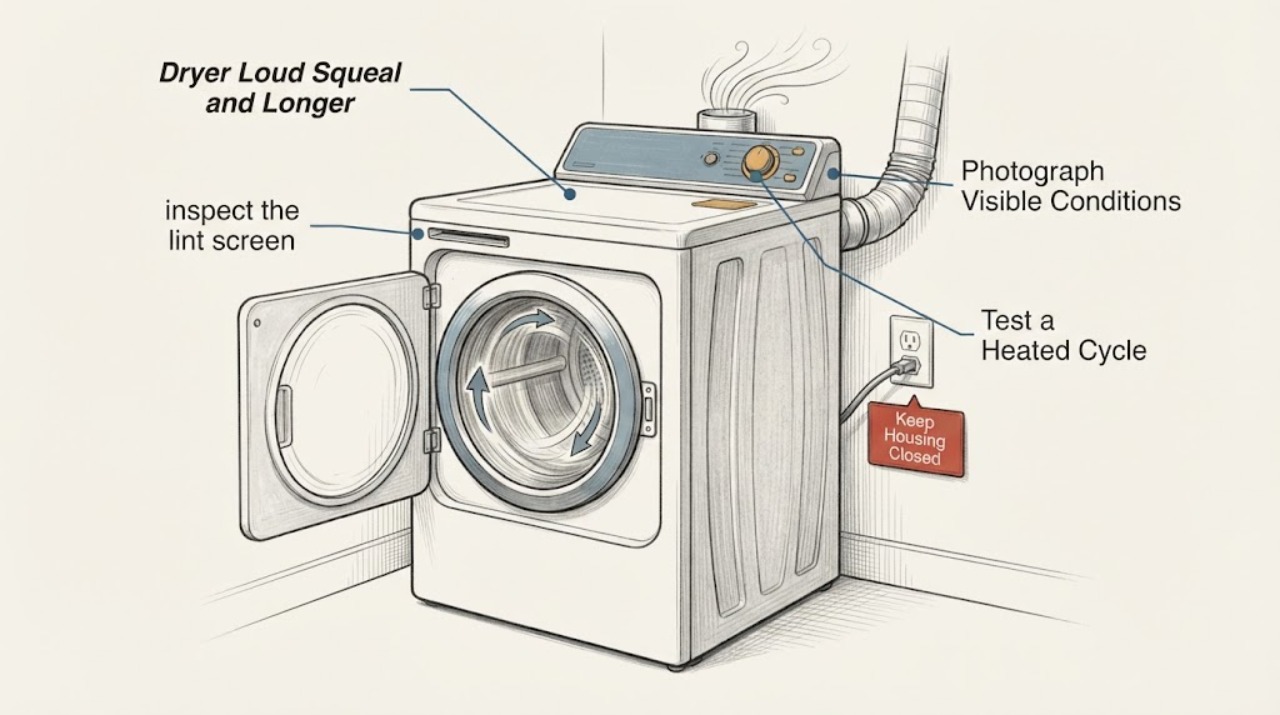
Treat a loud squeal that began suddenly and is paired with towels taking longer to dry as a stop-and-document problem, not as proof that one roller, belt, or motor should be replaced. First verify the complete Kenmore model from the rating label and whether the dryer is gas or electric: the supplied M11808210 entry is shorter than Kenmore's current manual-portal guidance for model numbers, so it may be incomplete or misrecorded. With power isolated from a dry, safe position, remove the load, inspect the lint screen and only visible exhaust path for blockage or crushing, and gently turn an empty drum only if it moves freely and the manual permits that observation. A restricted vent can explain longer drying, while a squeal that remains with an empty drum or is accompanied by roughness, wobble, scraping, heat, smoke, gas odor, or electrical odor needs qualified service. Do not run repeated heated tests, move the dryer to reach the rear, open panels, or decide repair versus replacement until a written diagnosis and estimate identify the confirmed fault, safety condition, and exact model/fuel version.
Before you begin
Safety first
- Do not run repeated heated tests, operate with a missing or disconnected lint screen/duct, move the dryer alone to reach the rear, disconnect gas, open panels, remove the belt, lubricate unknown parts, or perform live electrical or gas tests.
Work through in order
Diagnostic checks
Use only checks that match the exact appliance or system and its official guide.
-
Check 1
Stop the dryer, remove the towels, and from a dry, safe position isolate power before any inspection. If it is a gas dryer and gas is smelled, do not operate switches or relight anything; leave the area and follow local emergency guidance. Photograph the rating plate exactly, including the full model, serial, market, and fuel information, and record whether the squeal began suddenly after a move, heavy load, or period unused.
Expected result: The label confirms a complete model and gas/electric type, the supplied M11808210 text is incomplete or does not match, or there is smoke, gas odor, burning rubber, electrical odor, abnormal heat, a damaged cord, sparks, or a breaker trip.
Next step: Use only the matching Kenmore manual after the identity is confirmed. For a hazard or an identity that cannot be confirmed without moving or opening the dryer, leave it off and arrange qualified appliance, gas, or electrical help.
Stop if: Do not touch a damaged or wet cord, operate switches during a gas odor, repeatedly reset a breaker, move the dryer, or open panels.
Why this matters
Why: Model and fuel identity control the manual, access method, supply hazard, and part fit. A fire, gas, or electrical warning is a stop-use condition, not a reason to reproduce the squeal.
-
Check 2
Describe the sound without assigning a part: note whether it is a high squeal, chirp, scrape, rumble, thump, or electrical buzz; whether it follows drum rotation, begins only after heat, changes as the load tumbles, or remains after the drum is empty. Record the towel load size, cycle and heat setting, total time, and whether the clothes were merely damp or unusually hot. Do not run another heated cycle solely to make the sound recur.
Expected result: The sound is load-dependent, repeats once per drum turn, starts with heat or blower operation, continues with an empty drum, or cannot be safely characterized because the dryer must be run again.
Next step: Keep the event record for service. Continue only with power-off visible checks; if the empty-drum sound is loud, metallic, rough, or worsening, stop using the dryer.
Stop if: Do not use heat, run unattended, remove safety panels, or perform live electrical or gas tests to identify the sound.
Why this matters
Why: A change with load or drum position separates a contact or drum-motion observation from a drying-airflow observation, but sound alone cannot distinguish a roller, belt, idler, blower, motor, seal, or another internal condition. A new squeal plus longer drying deserves both mechanical and airflow evidence.
-
Check 3
With the dryer off and power isolated, inspect the lint screen and only the visible exhaust route for heavy lint, a crushed or kinked duct, an obstructed exterior hood, or lint accumulating around the back and floor. Do not pull the dryer away from the wall or disconnect a gas connector or exhaust duct as a user test; if the path cannot be seen safely, arrange qualified dryer-vent service.
Expected result: The lint screen or visible duct is packed, the duct is crushed or kinked, the exterior hood is visibly obstructed, the path looks clear, or access requires moving the dryer.
Next step: Clean only the removable lint screen as its manual directs and correct no more than a plainly visible, safe obstruction. Leave the dryer off and obtain qualified vent/appliance service for a hidden, crushed, disconnected, or inaccessible path.
Stop if: Do not operate without the lint screen, use a damaged or disconnected exhaust path, move the dryer alone, or reach into the chassis to clean lint.
Why this matters
Why: Kenmore and CPSC both link restricted airflow with longer drying and fire risk. A clear visible section does not rule out a hidden restriction or an internal airflow fault, and it does not explain away a persistent mechanical squeal.
-
Check 4
Only if the dryer is empty, cool, disconnected from power, free of visible hazards, and the matching manual does not prohibit it, gently turn the drum by hand through a few slow turns. Observe smooth motion, a repeatable scrape, roughness, binding, wobble, or an off-center gap at the visible drum edge; inspect only for a loose pocket item or obvious seal damage without inserting tools or reaching behind the drum.
Expected result: The drum turns smoothly and the squeal cannot be reproduced without power, the drum scrapes once per turn, feels rough or tight, wobbles, or a visible object/seal gap is present.
Next step: Remove only a loose object that is plainly reachable without tools. For roughness, wobble, a trapped object, an uneven gap, or persistent squeal, leave the dryer off and request model-specific service.
Stop if: Do not force the drum, remove the belt, lubricate unknown supports, pry the seam, insert wire or a pick, or open the blower or motor area.
Why this matters
Why: Smooth hand motion does not rule out a powered drive or airflow problem. Roughness, wobble, repeatable contact, or visible damage moves the case toward internal mechanical service, but does not identify one replaceable part from the observation alone.
-
Check 5
Before choosing repair or replacement, request a written diagnosis and estimate for the confirmed model and fuel version. Ask the provider to separate the sound path from the drying path, state which external airflow and supply checks were completed, identify the test or observation that proves a failed component, list parts and labor separately, and describe the safety and recurrence condition after repair.
Expected result: The provider can reproduce the squeal or drying fault and document its cause, identifies only a symptom or generic part guess, cannot verify the supplied model, or finds a vent, gas, electrical, or installation issue outside the dryer.
Next step: Compare repair and replacement only after the exact identity, safety condition, verified fault, warranty/parts availability, and complete estimate are written down. Seek a second qualified diagnostic opinion when the first report cannot separate the two symptoms.
Stop if: Do not authorize a roller, belt, motor, blower, or control replacement solely because it has not yet been changed, and do not keep operating to prove the estimate.
Why this matters
Why: A documented fault and complete estimate support a targeted repair decision. A generic 'old dryer' or one-part guess does not establish that replacement is safer or cheaper, while an external vent, gas, or electrical issue may need a different qualified professional.
Use your observations
Decision map
Find the observation that best matches what you see, then follow the next safe action.
-
PATH 01Next step
What you see
Towels take longer to dry, the lint screen or visible exhaust path is restricted, and there is no squeal-related roughness, heat, odor, or electrical warning.
Do this next
Clean the owner-accessible lint screen and have an inaccessible or damaged vent path inspected by qualified service. Do not run repeated heated loads while airflow remains questionable.
Why this path and its safety boundary
Why it matters: The drying evidence is consistent with a restricted airflow path, which Kenmore and CPSC identify as a cause of longer drying and a fire concern; it does not prove the squeal has the same cause.
-
PATH 02Safety boundary
What you see
The squeal remains with an empty drum, hand rotation is rough or wobbly, a scrape repeats at one drum position, or a seal/gap or trapped object is visible.
Do this next
Leave the dryer off and request qualified model-specific appliance service. Provide the hand-turn result, sound timing, visible gap/object, full model, and gas/electric type.
Why this path and its safety boundary
Why it matters: The pattern supports an internal drum-motion or contact diagnosis beyond a safe visual check, but it does not select a roller, belt, idler, bearing, seal, blower, or motor by itself.
Safety stop: No forced rotation, heated cycle, panel removal, belt removal, lubrication, or internal live test.
-
PATH 03Next step
What you see
The supplied M11808210 entry cannot be matched to a complete rating-plate model, or the fuel type is uncertain between gas and electric.
Do this next
Stop parts research and obtain a clear rating-label photo or qualified service identification. Use the matching manual only after the complete model and fuel version are confirmed.
Why this path and its safety boundary
Why it matters: The manual, supply connection, access procedure, safety boundary, and part fit are unresolved. A Kenmore family resemblance is not enough to apply another model's instructions.
-
PATH 04Next step
What you see
The squeal appears only with a particular load or loose pocket hardware, disappears after a plainly visible object is removed, and the empty drum is smooth with normal drying and no hazard.
Do this next
Remove the loose object without tools and make no more than one safe comparison. Stop using the dryer if the squeal returns, becomes metallic, or drying remains abnormal.
Why this path and its safety boundary
Why it matters: The change supports a load/contact explanation rather than a confirmed internal part failure, but a damaged seal or repeat noise still needs service.
-
PATH 05Safety boundary
What you see
There is smoke, gas odor, burning rubber, electrical odor, sparks, abnormal heat, a damaged cord or outlet, lint near heat, violent movement, or a repeated breaker trip.
Do this next
Leave the dryer off and clear. For active fire or dangerous smoke, obtain emergency help from a safe location; otherwise arrange prompt qualified appliance, gas, electrical, or vent service as indicated.
Why this path and its safety boundary
Why it matters: This is an immediate fire, gas, electrical, or mechanical safety branch. Continued operation can make a loud-squeal or drying diagnosis unsafe.
Safety stop: Do not operate switches during a gas odor, touch damaged electrical equipment, reset a tripped breaker repeatedly, open panels, or restart the dryer.
Helpful context
Understand the symptom
The useful distinction here is not simply 'noisy' versus 'quiet.' The sudden onset of a loud squeal and the new drying-time change are two observations that may share an airflow or mechanical event, or may be separate. Longer drying raises the priority of the lint screen and exhaust path, while a squeal that continues with an empty, freely moving drum raises the priority of a qualified mechanical inspection. Neither pattern identifies a specific part by itself.
Do not let the short model entry drive a purchase. Kenmore's current manual search says model numbers are at least 11 characters, and Kenmore's fuel-type guidance distinguishes electric and gas connections. Confirm the complete rating-plate information, fuel type, and market first; an old or incomplete model record can send a repair or replacement decision to the wrong platform.
When checks do not resolve it
Need a professional?
Contact qualified Kenmore-compatible dryer service for a sudden persistent squeal, longer-than-normal towel drying that remains after safe visible airflow checks, an incomplete model/fuel identity, or any need to access internal drum, drive, blower, heat, gas, or electrical components.
Safety scope: Do not run repeated heated tests, operate with a missing or disconnected lint screen/duct, move the dryer alone to reach the rear, disconnect gas, open panels, remove the belt, lubricate unknown parts, or perform live electrical or gas tests.
Have this ready
- Provide the complete rating-plate model and serial, market, gas or electric type, date and trigger of the sound, sound character and location, whether it changes with load or empty-drum hand rotation, towel load and cycle, drying time, lint and vent observations, odors/heat/power events, and any prior repair history.
Common questions
FAQ
Is M11808210 the complete Kenmore model number?
It is not confirmed. Kenmore's current manuals page says model numbers will be at least 11 characters and asks users to enter the model number without special characters. M11808210 as supplied is shorter, so photograph the rating plate and confirm the complete model, serial, market, and fuel type before using a manual or ordering a part.
Can a blocked vent make the dryer squeal?
A blocked or crushed vent is well supported as an explanation for longer drying and overheating risk, but it does not prove the source of a squeal. Check the lint screen and visible exhaust path safely, then have an inaccessible path and the dryer itself assessed if both symptoms persist.
Should I replace the rollers or belt because the dryer squeals?
Not from the sound alone. A squeal can be load-dependent or related to a visible contact, while a persistent empty-drum sound or rough hand rotation needs internal diagnosis. Ask a technician to document the failed component and test result before approving a part.
How do I decide whether to repair or replace this dryer?
Do not decide from the one-day onset or age assumption alone. First confirm the model and gas/electric version, then obtain a written fault diagnosis and complete repair estimate that separates parts, labor, safety, vent or supply work, warranty, and recurrence risk. A second diagnostic opinion is appropriate when the first provider offers only a generic part guess.
Read the exact guide
Official sources
- How to Determine Whether You Have a Gas or Electric DryerKenmore Livemore · Official Kenmore brand guidance used only to distinguish visible gas/electric supply clues and associated safety boundaries, not to identify M11808210's platform.
- CPSC Publication 5022 - Overheated Clothes Dryers Can Cause FiresU.S. Consumer Product Safety Commission · Official CPSC safety alert used for general fire-prevention boundaries, not for diagnosing a Kenmore component or model.
- Find Your Manual | Kenmore Appliance Manuals & GuidesKenmore / Transform SR Brands LLC · Official Kenmore manual portal; used to establish the need for the complete model and to avoid treating M11808210 as a confirmed full identity.
- 3 Reasons to Clean Your Dryer Vent (And How to Do It)Kenmore Livemore · Official Kenmore brand guidance used for the general relationship between lint/airflow and longer drying; it is not a manual for the unconfirmed M11808210 model.
Community feedback
Share a repair observation
Share a plain-text repair observation. Accepted observations are published automatically; this page may take a moment to update.