
On this page
Start here
Quick answer
For the Kenmore Series 600 model 110.66132411, do not treat F3E2 as proof that a moisture sensor, thermistor, or control board needs replacement. The exact-model public case reports this display as a moisture-sensor error, while the opened Kenmore manual portal does not expose a model-specific F3 E2 definition. Whirlpool's official F3 E2 dryer page describes a moisture-sensor condition on its own dryer platform and discusses levelness, load contact, and Automatic versus Timed Dry; Whirlpool's service documentation separately says F3E2 can mean an open or shorted moisture-sensor strip and may be service-diagnostic-only on that platform. Those Whirlpool meanings are manufacturer evidence about a different platform, not permission to migrate a code to this Kenmore. First record the exact display, selected cycle, whether the load was small or damp, and whether the drum was turning and heating before the code. Keep the dryer off for smoke, burning odor, abnormal heat, sparks, damaged wiring, or a tripped breaker. If F3 E2 returns on this exact model, use the matching Kenmore documentation or arrange service rather than ordering a part from the code alone.
Before you begin
Safety first
- Disconnect power before any service. Do not open panels, probe live wiring, enter service diagnostics, bypass the door or belt switch, bridge a sensor or thermal device, or operate with safety panels or vent components removed. Stop for smoke, sparks, burning odor, abnormal heat, damaged wiring, repeated breaker trips, or gas odor.
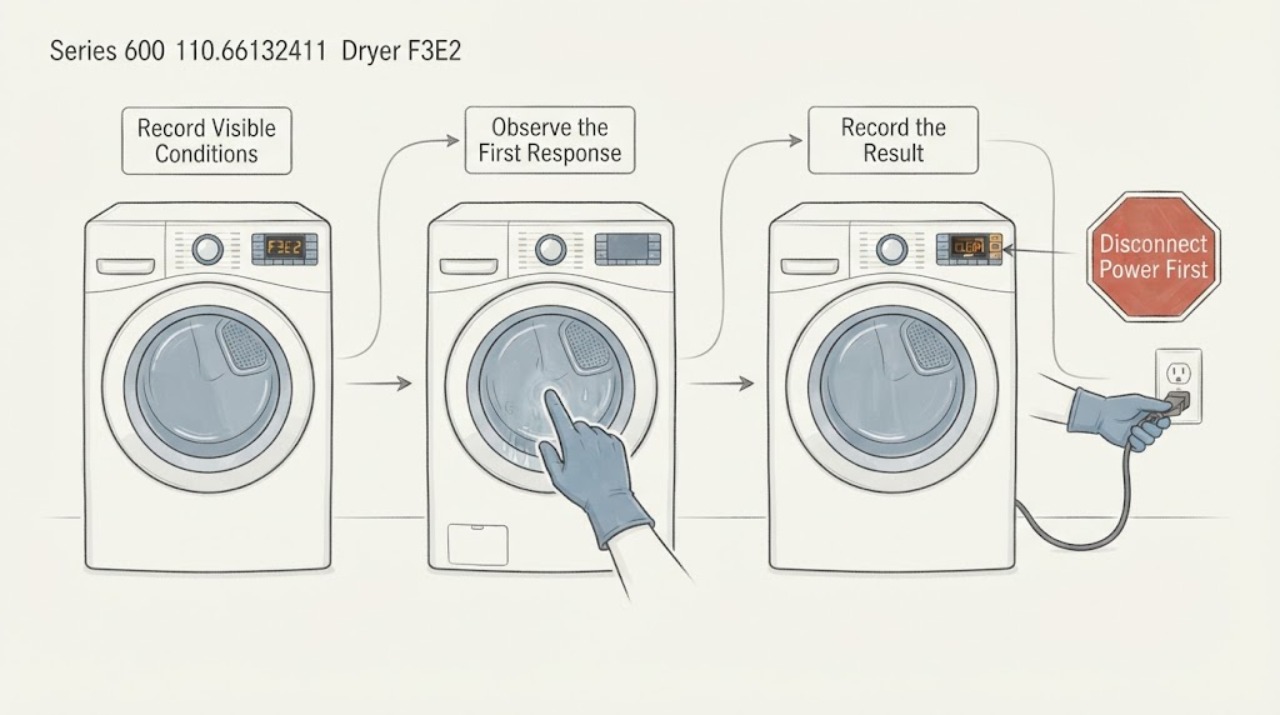
Work through in order
Diagnostic checks
Use only checks that match the exact appliance or system and its official guide.
-
Check 1
Stop the dryer and record the display exactly from a dry, safe position: F3E2, F3 E2, F3, E2, or another segment pattern. Write down the full model label as 110.66132411, whether the dryer is gas or electric if known, and whether the code appears immediately or after a cycle has run.
Expected result: The complete display is stable and the rating label matches 110.66132411, or the characters/model cannot be confirmed.
Next step: Photograph or transcribe the display and use 11066132411 in Kenmore's official manual lookup; if the lookup does not return a matching document, give the exact display and rating-label photo to service.
Stop if: Do not enter a service mode, clear stored faults, or restart repeatedly just to make the characters easier to read.
Why this matters
Why: A stable exact-model observation is stronger than a paraphrased code. An uncertain display or model cannot safely use either the Reddit wording or a Whirlpool code table.
-
Check 2
Use the last affected load and cycle as evidence rather than trying to reproduce the error. Record whether it was an Automatic/sensor cycle, a Timed Dry cycle, Air Fluff/no-heat, or another setting; note if the load was one item, a few small items, a mixed load, or still visibly damp.
Expected result: The code followed a small or single-item load, a normal-size load, an Automatic cycle, a Timed Dry cycle, or a no-heat cycle; the clothes were dry, damp, or unchanged.
Next step: Give the cycle/load timeline to the technician and follow only a cycle instruction found in the exact Kenmore manual. Do not choose a sensor or thermistor because the load was damp.
Stop if: Do not run a succession of small or wet loads, switch cycles repeatedly, or keep operating if the dryer becomes unusually hot or stops turning.
Why this matters
Why: On Whirlpool's documented dryer platform, small loads may not contact moisture sensors and Automatic and Timed Dry behave differently. That pattern is a useful observation for the Kenmore service record, but it does not establish the Kenmore code meaning or a failed sensor.
-
Check 3
From outside the unplugged or otherwise safely isolated dryer, record the prior operating sequence: did the drum rotate, did warm air begin, did the code appear before heat, after heat, or after the cycle ended, and did the drum stop when the code appeared? Do not open a panel or use a meter.
Expected result: The drum never turned, the drum turned without heat, heat was present before the display, or the code appeared with no clear timing.
Next step: Write the sequence on the service request and ask for the exact Kenmore technical documentation to be identified before any sensor, thermistor, heater, or control work is authorized.
Stop if: Do not bypass the door or belt switch, run with panels removed, probe terminals, or use a live test to decide between a sensor and a control.
Why this matters
Why: No rotation or no heat is a separate symptom path and cannot be assigned to a moisture sensor from F3E2 alone. A code after normal tumbling still needs exact-platform confirmation; the time sequence is not a component diagnosis.
-
Check 4
With power isolated and without reaching inside the cabinet, check only visible installation conditions: whether the dryer rocks or sits visibly out of level, whether the lint screen is present and accessible, and whether an external vent hose is plainly crushed or disconnected. Do not infer a hidden restriction or sensor failure from appearance alone.
Expected result: The cabinet rocks, the accessible lint screen is blocked or missing, the external hose is visibly crushed/disconnected, or the visible arrangement looks normal.
Next step: Correct only a plainly visible condition that the exact Kenmore manual permits a user to correct, then stop if F3 E2 remains. Request qualified inspection for any internal vent, sensor, harness, heater, or control question.
Stop if: Do not pull the dryer out alone, remove the rear/front panel, insert tools into the vent, or operate with a disconnected vent or missing safety panel.
Why this matters
Why: Whirlpool's official guidance links levelness and load contact to moisture sensing on its own platform, and its service documentation lists airflow and moisture sensing as distinct diagnostic paths. A visible issue can be reported or corrected only as allowed by the exact Kenmore manual; a normal exterior does not clear hidden wiring or controls.
-
Check 5
Review the event for a safety stop before considering any further observation. Look for smoke, sparks, burning lint or rubber odor, abnormal cabinet or outlet heat, damaged cord or wiring, repeated breaker trips, or gas odor if the dryer is gas-fired.
Expected result: Any hazard is present, or the dryer has no hazard signs and the code is the only symptom.
Next step: For a hazard, leave the dryer off and isolate power or gas only from a safe, dry location when that can be done without touching unsafe equipment; arrange urgent qualified appliance/electrical/gas help. Otherwise arrange model-specific service if F3 E2 persists.
Stop if: Do not reset the breaker repeatedly, relight a gas appliance during a gas odor, touch wet/damaged electrical parts, or run another heated cycle to compare symptoms.
Why this matters
Why: A hazard changes the problem from a code interpretation to a fire, gas, or electrical safety event. Without a hazard, the exact display and cycle history can be handed to service, but the lack of a hazard does not make a cross-platform code mapping safe.
-
Check 6
Prepare the service handoff without naming a replacement part: provide the model and serial label, exact display punctuation, cycle and load type, clothing moisture, drum/heat timing, visible level and vent observations, and any prior repair or cleaning history.
Expected result: A technician can match the model to a Kenmore technical sheet, or the provider proposes a sensor, thermistor, control, or harness solely from the F3E2 label.
Next step: Ask for the exact code definition, the test performed, the observed result, and the reason the proposed part fits this 110.66132411 before approving work. Keep the dryer off if the code returns or any hazard appears.
Stop if: Do not buy or install a moisture sensor, thermistor, control board, or harness based only on F3E2, a Whirlpool part number, or the model prefix.
Why this matters
Why: A model-matched technical sheet and measured result can distinguish a sensor-strip circuit from heat, drive, airflow, wiring, or control paths. A code-only part recommendation is not proof of fit or cause, especially because the exact Kenmore code table was not found in the opened public material.
Use your observations
Decision map
Find the observation that best matches what you see, then follow the next safe action.
-
PATH 01Next step
What you see
The rating label is 110.66132411, the display is clearly F3 E2/F3E2, and it appeared after an Automatic or sensor-style cycle with a normal-size load.
Do this next
Use the Kenmore model lookup and arrange a technician who will confirm the Kenmore platform and test path before selecting a part.
Why this path and its safety boundary
Why it matters: This is a useful exact-model service pattern, and the exact Reddit report labels the code a moisture-sensor error, but no opened Kenmore source confirms the code definition. A moisture-sensor, wiring, or control path is possible without proving which part failed.
-
PATH 02Safety boundary
What you see
The event involved one item or a very small load, the dryer was visibly out of level, and there was no smoke, odor, abnormal heat, or power event.
Do this next
Correct only the plainly visible level or loading condition if the exact Kenmore manual allows it, record whether the display returns, and stop rather than escalating to a part purchase if it does return.
Why this path and its safety boundary
Why it matters: Whirlpool's documented guidance says small loads may fail to contact sensors and levelness can affect sensor contact on that platform. This pattern lowers confidence in a hard sensor failure but cannot clear the Kenmore code without its own manual.
Safety stop: Do not repeatedly run tiny or wet loads, use a cross-brand reset, or bridge sensor contacts.
-
PATH 03Safety boundary
What you see
The drum did not rotate, never produced expected heat, stopped mid-cycle, or the clothing remained wet independently of the display.
Do this next
Keep the dryer off if the symptom persists and give the full timing to qualified service. Have the provider assess the relevant system rather than replacing a sensor by code label.
Why this path and its safety boundary
Why it matters: A drive, heat, airflow, or power symptom has been added; F3 E2 alone does not identify a moisture sensor as the cause and should not suppress those observations.
Safety stop: Do not run heated cycles to compare temperature, open panels, test live circuits, or bypass door/belt/thermal protection.
-
PATH 04Next step
What you see
The display is not actually F3 E2, the model label is not 110.66132411, or the code appears only inside an undocumented service screen.
Do this next
Stop using this article's code interpretation, capture the complete display and rating label, and obtain the matching manual or model-specific service diagnosis.
Why this path and its safety boundary
Why it matters: The evidence no longer matches this topic. Similar-looking E2, F3, F3E1, F3E5, or other codes can refer to different systems and must not be normalized into F3E2.
-
PATH 05Safety boundary
What you see
Smoke, sparks, burning odor, abnormal heat, damaged electrical parts, repeated breaker trips, or gas odor is present.
Do this next
Leave the dryer off and clear of the hazard. Seek emergency help for active fire or dangerous gas conditions, and qualified appliance/electrical/gas service for other hazards.
Why this path and its safety boundary
Why it matters: The immediate risk is fire, gas, or electric shock, not uncertainty about whether F3E2 names a sensor.
Safety stop: No restart, repeated breaker reset, gas relight, panel removal, live test, or bypass.
Helpful context
Understand the symptom
Identity comes first. The task identifies a Kenmore Series 600 dryer as 110.66132411, while the matching exact-model public report writes the model as 110.66132411 and the display as F3 E2. Kenmore's official public manuals page says to enter the model number to obtain the applicable manual, but the opened page does not provide a code table for this model. That means the code can be documented as an exact-model report, not as a confirmed Kenmore factory definition.
The F3 E2 label is also platform-sensitive. Whirlpool's official dryer help page calls F3E2 a moisture-sensor condition and recommends checking levelness and load contact; its service documentation describes an open or shorted moisture-sensor strip and says that code is service-diagnostic-only on the covered Whirlpool/Maytag platform. Those pages help explain why cycle, load, and levelness observations matter, but they do not prove that Kenmore 110.66132411 uses the same display logic, wiring, or service sequence.
When checks do not resolve it
Need a professional?
Call qualified Kenmore dryer service for a returning F3 E2 on 110.66132411, an unverified platform/code, or any need to inspect the sensor circuit, harness, control, heater, motor, thermal protection, or internal airflow. Add qualified electrical or gas help when the supply or gas path is suspect.
Safety scope: Disconnect power before any service. Do not open panels, probe live wiring, enter service diagnostics, bypass the door or belt switch, bridge a sensor or thermal device, or operate with safety panels or vent components removed. Stop for smoke, sparks, burning odor, abnormal heat, damaged wiring, repeated breaker trips, or gas odor.
Have this ready
- Provide 110.66132411, serial/rating-label details, the exact F3 E2 display, cycle and load type, clothing moisture, whether the drum rotated and produced heat, visible level/vent observations, hazard signs, and all prior repair or cleaning history.
Common questions
FAQ
Does F3E2 prove the moisture sensor is bad on Kenmore 110.66132411?
No. The exact-model Reddit report calls it a moisture-sensor error, but the opened Kenmore public manual portal does not expose a model-specific definition. Whirlpool documents a moisture-sensor meaning on its own dryer platforms; that is not enough to choose a Kenmore sensor, thermistor, or control board.
Should I run a larger load or Automatic cycle to clear F3E2?
Record whether the original event involved a small load or an Automatic cycle first. Whirlpool's official guidance says small loads and levelness can affect sensor contact on its platform, but this Kenmore code has not been tied to that guidance by an exact public Kenmore manual. Follow only the matching Kenmore manual and do not repeatedly run loads to reproduce the code.
Could F3E2 actually be a thermistor or control-board problem?
It cannot be decided from the label alone. The manufacturer service material opened here distinguishes moisture-sensor, thermistor, control, heat, and motor paths on a documented Whirlpool platform, which is exactly why a cross-platform part guess is unsafe. Ask service to identify the Kenmore platform and document a test result before naming a part.
Can I clean or test the sensor bars myself?
Do not scrub, bridge, probe, or access sensor wiring based on a community suggestion. Use only a user-accessible step explicitly documented for 110.66132411; otherwise keep power isolated and have qualified service identify the exact procedure.
Read the exact guide
Official sources
- Kenmore Dryer series 600 F3 E2 code.Reddit r/appliancerepair · Exact public report matching Kenmore Series 600 model 110.66132411 and F3 E2. It is community evidence only; it does not prove a manufacturer definition, a failed component, or a safe owner repair.
- F3 E2 - Error Code - DryerWhirlpool Corporation · Opened manufacturer guidance for a Whirlpool dryer platform only. It is used as a clearly bounded comparison for why levelness, load contact, and Automatic versus Timed Dry observations matter; it does not establish that Kenmore model 110.66132411 uses the same code table.
- Find Your Manual | Kenmore Appliance Manuals & GuidesKenmore · Official Kenmore manual portal used to route model 110.66132411/11066132411 to an applicable dryer manual; the opened page does not publish a model-specific F3 E2 definition.
- Technical ManualWhirlpool Corporation · Opened technician documentation for a Whirlpool/Maytag dryer platform only. It distinguishes F3E2 moisture-sensor open/shorted from thermistor and other paths and marks internal testing as service work; no Kenmore platform transfer is made.
Community feedback
Share a repair observation
Share a plain-text repair observation. Accepted observations are published automatically; this page may take a moment to update.