
On this page
Start here
Quick answer
First decide whether the drum is only tumbling intermittently after a cycle or is rotating continuously. Some Kenmore dryers have Wrinkle Guard; the official Kenmore page for model 26-60222 says that option tumbles clothes for up to 40 minutes after the dry cycle, but the assigned dryer has no model number, so its controls and time limit cannot be assumed. If the drum ignores the normal stop control, continues continuously, or the dryer has smoke, a burning smell, unusual heat, sparking, or a damaged cord, stop using it and arrange qualified appliance service. With the dryer off and cool, clean the lint screen and inspect only the accessible exhaust path; U.S. Fire Administration guidance says lint filters and dryer vents need regular cleaning and that a damaged, crushed, or restricted vent is a fire concern. Do not open the cabinet, bypass a door or control, or guess a timer, motor, relay, or board from this symptom.
Before you begin
Safety first
- Do not open the cabinet, bypass a door or control safety, perform live electrical tests, replace a timer/motor/relay/board based only on the symptom, or operate with smoke, burning odor, abnormal heat, damaged wiring, or restricted venting.
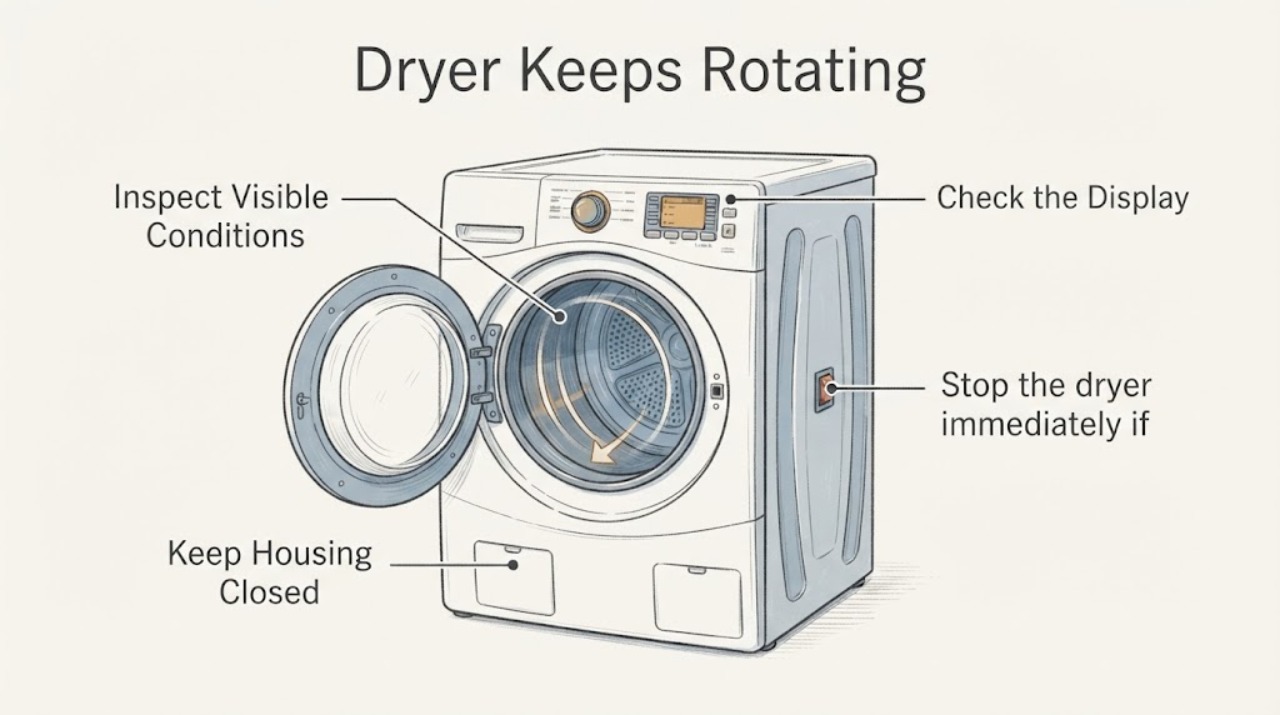
Work through in order
Diagnostic checks
Use only checks that match the exact appliance or system and its official guide.
-
Check 1
Read the dryer's model number from its rating label and record the selected cycle and options. Observe whether the drum tumbles only at intervals after the cycle ends or rotates continuously while the cycle is active or after the normal stop control is used.
Expected result: Wrinkle Guard or an equivalent anti-wrinkle option is visibly selected and the drum pauses between short tumbles; the drum runs continuously; or the model and option cannot be identified.
Next step: For intermittent movement, use the exact model manual to confirm the option and its limit. For continuous movement, an unknown control response, or movement beyond the model's documented limit, stop use and arrange qualified service rather than selecting a part by symptom.
Why this matters
Why: Kenmore documents Wrinkle Guard as a model feature that can tumble after a cycle. Intermittent post-cycle movement can therefore be intended on a model that has that option, while continuous movement is not explained by the published feature alone. The no-model task does not establish a universal duration or control sequence.
-
Check 2
Use the normal labeled stop or pause control once, without opening the cabinet or bypassing any lock, and note whether the drum stops as the panel indicates. Do not keep repeating the test if it ignores the command or the machine becomes hot, noisy, or odorous.
Expected result: The drum stops normally; it continues rotating after the normal control; or an electrical, burning, smoke, sparking, or abnormal-heat warning appears.
Next step: If it continues or a hazard appears, keep the dryer out of service and request qualified appliance service. Do not open the cabinet, bypass a control or door safety, or perform live measurements.
Why this matters
Why: A normal stop response is consistent with a control or option that is operating as selected, but it does not prove the model's feature timing. Ignoring the stop command or showing a hazard leaves the cause unresolved and is not a user-level timer, motor, relay, or board diagnosis.
-
Check 3
Stop the dryer immediately if there is smoke, a burning smell, visible sparking, unusual heat, a hot or damaged cord or plug, or a discolored receptacle. From a dry, safe location, isolate power only if doing so does not require touching a hazardous connection.
Expected result: A fire or electrical warning is present, or the exterior is cool and free of visible damage.
Next step: Keep the dryer off and arrange qualified appliance or electrical service; use emergency assistance for active smoke or fire. Do not restore power to reproduce the symptom.
Why this matters
Why: A warning sign can indicate a fire or shock hazard independent of why the drum is rotating. The absence of visible damage does not identify or clear an internal fault.
-
Check 4
With the dryer off, cool, and disconnected safely, clean the lint screen and inspect the accessible exhaust hose and outside vent opening for a crushed, damaged, or visibly restricted path. Do not dismantle the dryer chassis or reach into protected areas.
Expected result: Lint is heavy, the hose is crushed or damaged, the outside flap does not open during a safe normal operation, the path is visibly restricted, or the accessible path appears clear.
Next step: Do not use the dryer with a damaged or restricted exhaust path; have the vent corrected or professionally cleaned. If the path is clear but the drum still ignores the stop behavior, provide the observation and model number to appliance service.
Why this matters
Why: U.S. Fire Administration guidance identifies lint filters and dryer vents as maintenance and fire-safety points and warns about damaged, crushed, or restricted venting. This check does not prove that venting caused continuous rotation or identify an internal drive component.
-
Check 5
Prepare a service handoff with the model and serial label, gas or electric type, cycle and option selected, whether rotation is intermittent or continuous, the stop-control response, any code or indicator, lint and vent observations, and any odor, smoke, heat, or cord damage.
Expected result: The dryer continues rotating with Wrinkle Guard off or outside the exact manual's stated behavior, or the cause remains uncertain after the external safety checks.
Next step: Keep the dryer off until qualified appliance service assesses it. Give the technician the exact model and the one observed sequence; do not order an internal part or open the cabinet from this symptom alone.
Why this matters
Why: The remaining question is model-specific control and drive behavior. The available no-model evidence does not distinguish a timer, motor, relay, control board, or another component.
Use your observations
Decision map
Find the observation that best matches what you see, then follow the next safe action.
-
PATH 01Next step
What you see
The drum tumbles briefly at intervals only after the cycle ends and the exact model manual confirms Wrinkle Guard or an equivalent option is selected.
Do this next
Follow the exact manual for the option's duration and cancellation. If movement continues continuously or exceeds the documented behavior, stop use and request service.
Why this path and its safety boundary
Why it matters: The observed behavior is consistent with the documented anti-wrinkle feature for that model, not proof of a failed drive part.
-
PATH 02Next step
What you see
The drum rotates continuously while the cycle is active, ignores the labeled stop or pause command, or keeps running after the exact model's post-cycle feature should end.
Do this next
Stop using the dryer, keep the cabinet closed, and arrange qualified appliance service with the model and observed sequence. Do not bypass controls or perform live tests.
Why this path and its safety boundary
Why it matters: The symptom is outside the limited published Wrinkle Guard example, but the no-model evidence cannot identify a timer, motor, relay, or board.
-
PATH 03Next step
What you see
There is smoke, a burning smell, unusual heat, sparking, a damaged cord or receptacle, or a visibly restricted exhaust path.
Do this next
Keep it out of service and isolate power only from a safe dry location; obtain qualified service, and use emergency help for active smoke or fire. Do not run another load to reproduce the symptom.
Why this path and its safety boundary
Why it matters: The dryer has a fire or electrical safety concern that takes priority over diagnosing why the drum rotates.
-
PATH 04Next step
What you see
The model number or selected options cannot be read, and only the broad statement 'not stopping rotating' is available.
Do this next
Locate the rating label and manual before any further troubleshooting. Until then, do not assume another Kenmore model's Wrinkle Guard timing or order an internal part.
Why this path and its safety boundary
Why it matters: The identity is enough for a Kenmore dryer symptom page but not for a model-specific time limit, control sequence, or replacement-part conclusion.
Helpful context
Understand the symptom
Why the exact behavior matters
A periodic tumble after the cycle can be an anti-wrinkle feature, while a drum that keeps turning through a normal stop command is a different service symptom. Kenmore's published 26-60222 example documents Wrinkle Guard for up to 40 minutes after the cycle; other Kenmore models can use different controls and durations. Without the model from the rating label, use that page only to identify the feature category, not to assign a universal timer or internal fault.
Keep the safety checks external
A dryer that continues to run can still present a heat and fire concern if airflow is restricted or lint has accumulated. Check only the lint screen and accessible vent path with the appliance off and cool. Cabinet access, live electrical testing, and replacing an internal part require model-specific service information and appropriate qualifications.
When checks do not resolve it
Need a professional?
Safety scope: Do not open the cabinet, bypass a door or control safety, perform live electrical tests, replace a timer/motor/relay/board based only on the symptom, or operate with smoke, burning odor, abnormal heat, damaged wiring, or restricted venting.
Have this ready
- Exact model and serial, gas or electric type, selected cycle and options, intermittent versus continuous rotation, stop-control response, any displayed code, lint/vent observations, and any smoke, odor, heat, sparking, or cord damage.
Common questions
FAQ
Could this be Wrinkle Guard rather than a failure?
Possibly, if the drum only tumbles intermittently after the cycle and the exact Kenmore manual confirms that option. Kenmore's published 26-60222 example says Wrinkle Guard tumbles for up to 40 minutes, but that timing cannot be assigned to an unspecified model.
Should I keep running the dryer to see whether it eventually stops?
No. If it runs continuously, ignores the normal stop control, or has smoke, burning odor, unusual heat, sparking, cord damage, or restricted venting, keep it off and arrange qualified service. Do not repeat powered tests to identify an internal part.
Can the symptom identify a timer or motor part?
No. Without the model and a documented control sequence, continuous rotation does not distinguish a timer, motor, relay, board, or another condition. Give the exact model and observed behavior to service instead of ordering a part by symptom.
Read the exact guide
Official sources
- 6.5 cu. ft. Electric Dryer - WhiteKenmore / Transform SR Brands LLC · This is one specific Kenmore model page. It supports only the conditional statement that a Kenmore model may document Wrinkle Guard and that this model says it tumbles for up to 40 minutes; it does not establish timing or controls for an unspecified dryer.
- Appliance and Electrical Fire SafetyU.S. Fire Administration · General dryer safety guidance used for lint, vent, cord, outlet, and stop-use boundaries; it is not a Kenmore component diagnosis.
Community feedback
Share a repair observation
Share a plain-text repair observation. Accepted observations are published automatically; this page may take a moment to update.