
On this page
Start here
Quick answer
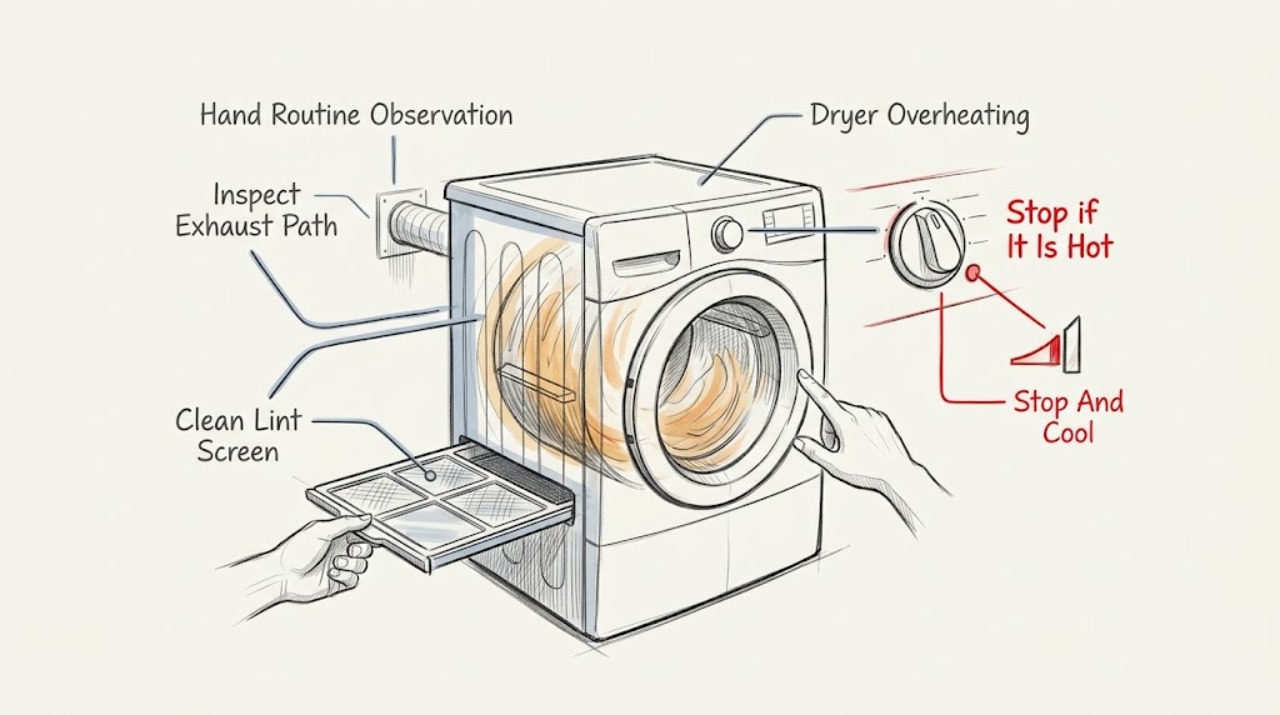
Stop the Kenmore dryer immediately, turn it off, and do not run another test cycle while the cabinet, clothes, control area, or exhaust feels unusually hot or smells scorched. Once it is cool and safe to approach, check the lint screen, the accessible exhaust path, the outside vent flap, the area behind the dryer, and the exact Kenmore use-and-care manual. Restricted airflow from lint or a crushed duct is a common fire-risk path, but a heating control, motor, thermostat, gas burner, or electrical fault can also overheat the dryer. Do not open the cabinet, bypass a thermal safety device, work on gas or live electrical parts, or keep using the dryer for smoke, flame, arcing, burn marks, a damaged cord, repeated shutdowns, or a hot outlet. Arrange qualified dryer service when cleaning the accessible airflow path does not resolve the overheating or when any warning sign appears.
Before you begin
Safety first
- This article supports shutdown, cooling, exterior observation, lint-screen care, accessible vent checks, and documentation only. Do not operate a hazardous dryer, open the cabinet, bypass safety controls, work on gas or live electrical parts, or use an improvised vent.
Work through in order
Diagnostic checks
Use only checks that match the exact appliance or system and its official guide.
-
Check 1
Stop the cycle, turn the Kenmore dryer off, and wait until the cabinet and laundry are cool enough to approach without touching hot surfaces; do not start another cycle to reproduce overheating.
Expected result: Record whether the symptom was a hot cabinet, unusually hot clothes, scorched odor, smoke, flame, control shutdown, or a hot plug or outlet, and whether it happened on an electric or gas dryer.
Next step: Keep the dryer off and move combustible laundry away; use the warning-sign branch for smoke, flame, heat, odor, or electrical damage, otherwise continue only with cool, exterior checks.
Stop if: Do not operate the dryer again for smoke, flame, arcing, burning odor, visible damage, a hot outlet or plug, or repeated thermal shutdown; leave it disconnected or the circuit off as safe and arrange qualified service.
Why this matters
Why: Heat, odor, smoke, flame, repeated shutdown, or a hot electrical connection makes this a safety event rather than a routine lint check. A single hot load without warning signs still requires an airflow check before reuse.
-
Check 2
With the dryer off and cool, remove and clean the lint screen exactly as the Kenmore use-and-care manual directs, and reinstall it fully before any future use.
Expected result: Record whether the screen is missing, loose, damaged, visibly clogged, coated with residue, or clean but the dryer still overheated.
Next step: Replace or service a damaged screen through the exact model instructions, then inspect the accessible exhaust path; do not run the dryer without the filter.
Stop if: Do not use the dryer without a properly seated lint filter, scrape a filter with a sharp tool, or spray flammable cleaner into the filter housing.
Why this matters
Why: A missing, loose, damaged, or clogged screen can allow lint accumulation and reduce safe airflow. A clean screen does not clear the exhaust duct or an internal heater or temperature-control fault.
-
Check 3
From the outside and behind the appliance only if it can be reached without moving a gas connection or stressing the cord, inspect the accessible exhaust duct and outside vent cover for crushing, kinks, separation, lint, nesting, or a closed flap.
Expected result: Classify the path as visibly clear and intact, restricted or crushed, disconnected, heavily linted, or inaccessible because the dryer is built in or the connection is unsafe to reach.
Next step: Keep the dryer off until a restricted path is cleaned and correctly reconnected according to the manual; arrange qualified service when the duct is damaged, inaccessible, or requires moving a gas dryer.
Stop if: Do not disconnect a gas line, reach into the cabinet, remove the rear panel, use the dryer with a disconnected duct, or substitute an improvised vent material.
Why this matters
Why: A restricted, crushed, disconnected, or lint-filled path can reduce airflow and cause heat buildup. An inaccessible or damaged path needs qualified vent or appliance service rather than cabinet disassembly.
-
Check 4
Check the area around the cool dryer for lint behind or beneath it, combustible clutter, a blocked airflow path, or a cord and outlet that are pinched, loose, damaged, or unusually warm; do not move the appliance to inspect hidden connections.
Expected result: Record lint accumulation behind the dryer, nearby items that can burn, a restricted exhaust route, a loose-fitting plug, discoloration, heat, or a damaged cord.
Next step: Clear only loose lint and combustible clutter from safe access, keep the dryer disconnected when electrical damage is present, and arrange a qualified electrician or appliance technician for cord, outlet, or hidden-lint concerns.
Stop if: Do not use an extension cord, tape a damaged cord, open an outlet, move the dryer across a gas connection, or vacuum inside the cabinet.
Why this matters
Why: Lint and clutter increase fire exposure, while a damaged or hot cord or outlet indicates an electrical hazard. A clear exterior does not rule out an internal heating or airflow fault.
-
Check 5
Review the last few loads without running another overheating test: note whether drying took longer than normal, clothes stayed damp, the load was unusually large, or fabrics had gasoline, cooking oil, cleaning-agent, or other volatile contamination.
Expected result: Record normal or extended drying time, poor exhaust flow, an overloaded drum, repeated overheat shutdowns, or contaminated items that were put in the dryer.
Next step: Stop drying contaminated items and follow the garment and chemical-safety instructions; arrange vent or appliance service for abnormal drying time or repeated overheat behavior.
Stop if: Do not dry clothing contaminated with gasoline, solvents, cooking oils, or other flammable substances, and do not leave hot laundry in the drum or a pile.
Why this matters
Why: Long drying time or damp clothes can signal a blocked lint screen or exhaust duct. Volatile residues can ignite or continue to heat after drying, so contaminated items change the fire-safety decision.
-
Check 6
If the dryer remains cool, the accessible lint screen and exhaust route are confirmed clear, and there are no warning signs, gather the Kenmore model number, dryer type, symptom history, and photos of the exterior vent path for a qualified technician.
Expected result: Confirm whether overheating returned after cleaning, whether the dryer is gas or electric, whether a thermal protection shutdown occurred, and whether any plug, cord, outlet, burner, or control symptom was present.
Next step: Leave the dryer off and request model-specific appliance service; use a qualified electrician for outlet, cord, breaker, or wiring symptoms and a qualified gas-appliance technician for gas-path concerns.
Stop if: Do not remove panels, bypass thermal fuses or thermostats, probe live circuits, adjust gas controls, or substitute parts by symptom alone.
Why this matters
Why: Persistent overheating after airflow checks points toward an internal heater, temperature control, motor, gas-control, or electrical fault that cannot be cleared from the outside.
Use your observations
Decision map
Find the observation that best matches what you see, then follow the next safe action.
-
PATH 01Safety boundary
What you see
There is smoke, flame, arcing, a burning or scorched odor, a hot plug or outlet, a damaged cord, visible melting, or repeated thermal shutdown.
Do this next
Stop using it, keep people away, disconnect or isolate power only when safe, and arrange qualified appliance or electrical service; follow local emergency procedures for active smoke or fire.
Why this path and its safety boundary
Why it matters: The dryer presents a fire or electrical hazard and should not be tested again.
Safety stop: Do not restart the dryer, reset a breaker repeatedly, open the cabinet, or attempt to extinguish an appliance fire with unsafe methods.
-
PATH 02Safety boundary
What you see
The lint screen is missing, loose, damaged, coated, or clogged.
Do this next
Keep the dryer off, restore the exact model-approved screen arrangement or obtain qualified service, and inspect the rest of the exhaust route before reuse.
Why this path and its safety boundary
Why it matters: Lint capture and airflow protection are compromised, so continued operation can increase heat and lint accumulation.
Safety stop: Do not run without the filter or fit a loosely compatible screen; do not scrape or modify the filter housing.
-
PATH 03Safety boundary
What you see
The duct is crushed, kinked, disconnected, lint-filled, blocked, or the outside vent cover does not open and exhaust during normal safe operation.
Do this next
Leave the dryer off until the vent path is cleaned and reconnected according to the Kenmore manual by a qualified person when access or gas connections are involved.
Why this path and its safety boundary
Why it matters: Restricted exhaust can reduce airflow and cause excessive heat buildup; a clear lint screen alone does not fix it.
Safety stop: Do not operate with a disconnected or improvised duct, reach into the cabinet, or move a gas dryer without qualified help.
-
PATH 04Safety boundary
What you see
The screen and accessible exhaust path are clear and intact, but the dryer still overheats, shuts down, or leaves clothes unusually hot.
Do this next
Stop testing and arrange model-specific qualified dryer service; provide the model, cycle, heat setting, drying history, and photos.
Why this path and its safety boundary
Why it matters: An internal heater, thermostat, thermal control, motor, gas burner, or electrical fault remains possible.
Safety stop: Do not bypass a thermal safety device, open panels, probe live circuits, adjust gas controls, or replace parts without diagnosis.
-
PATH 05Safety boundary
What you see
The load contains gasoline, solvents, cleaning agents, cooking oils, finishing oils, or another volatile residue.
Do this next
Keep the items out of the dryer and follow the clothing and chemical-safety instructions; clean or service the appliance if residue or odor is present.
Why this path and its safety boundary
Why it matters: The fabric may remain flammable or continue heating; a dryer cycle is not an appropriate test or remedy.
Safety stop: Do not dry, leave hot contaminated items in a drum or basket, or operate the dryer near flammable vapors.
-
PATH 06Safety boundary
What you see
The dryer cooled, the filter is correct, the accessible vent path is intact, no warning signs occurred, and a qualified person confirms safe operation.
Do this next
Clean the lint screen before and after each load, keep the area clear, follow the Kenmore manual, and monitor drying time and heat without unattended operation.
Why this path and its safety boundary
Why it matters: A maintenance or airflow restriction may have contributed, but recurrence remains a reason to stop and service the dryer.
Safety stop: Stop using it if overheating, unusual odor, smoke, hot connections, repeated shutdown, or restricted airflow returns.
Helpful context
Understand the symptom
Overheating is a stop condition before it is a repair diagnosis
A dryer that is noticeably hotter than normal, produces a scorched smell, shuts down on a thermal protection response, or leaves clothes unusually hot should not be repeatedly restarted. Let the appliance cool, keep combustible items away, and do not run an empty cycle to reproduce the symptom. The first safe distinction is between a restricted exhaust path and a fault inside the heater, temperature control, motor, gas burner, or electrical system; only the accessible airflow and exterior checks belong to ordinary troubleshooting.
Check lint and venting without cabinet disassembly
Clean the lint screen as the Kenmore manual directs and inspect the accessible duct behind the dryer for crushing, kinks, separation, or lint accumulation. When the dryer is later operating normally, the outside vent cover should open and exhaust should escape; a weak or absent flow indicates a restricted path that needs cleaning or qualified service. Do not operate with a missing, loose, damaged, or clogged lint filter, and do not reach into the cabinet or disconnect gas or electrical components as a homeowner overheating test.
A clean vent does not clear internal or electrical faults
If the accessible filter and vent path are clear but the dryer still overheats, the heater may not be cycling correctly, a temperature control or motor may be failing, or a gas model may have a burner or gas-control issue. Those parts require model-specific diagnosis. A hot plug or outlet, damaged cord, smoke, arcing, burning odor, or repeated protective shutdown is a fire and electrical boundary: leave the dryer off and arrange qualified service.
Safety boundary
Stop conditions
- Stop the dryer and do not run another test cycle for smoke, flame, arcing, a burning or scorched odor, melting, visible burn marks, a hot plug or outlet, or a damaged cord.
- Do not operate without the lint filter, with a loose or damaged filter, or with a crushed, disconnected, blocked, or improvised exhaust duct.
- Do not open the cabinet, remove panels, vacuum inside the chassis, bypass a thermal fuse or thermostat, or probe live electrical parts.
- Do not disconnect or adjust a gas line, burner, valve, or gas control; arrange qualified gas-appliance service for gas-path symptoms.
- Do not dry clothing contaminated with gasoline, solvents, cleaning agents, cooking oils, or other volatile substances, and do not leave hot laundry unattended.
Only after diagnosis
Potential parts
- Kenmore lint screen
Consider this category only if the exact model's screen is missing, damaged, loose, or cannot be cleaned according to the use-and-care instructions.
Confirm the exact Kenmore model and screen design before ordering; do not operate with a loose or generic screen that does not seat correctly. - dryer exhaust duct or vent component
Consider this category only when inspection confirms a crushed, damaged, disconnected, or restricted exhaust path and the repair follows the Kenmore manual and local installation requirements.
Confirm the exact dryer type, route, material, length, and installation requirements; gas connections and inaccessible duct work require qualified service. - dryer temperature-control or thermal-safety component
Consider this category only after airflow is confirmed and a qualified diagnosis identifies a failed temperature-control or thermal-safety component.
Confirm the exact model and technician diagnosis; never bypass, jumper, or substitute a thermal safety device.
When checks do not resolve it
Need a professional?
Arrange qualified dryer service when overheating persists after the cool, exterior lint-screen and vent checks; drying time remains abnormal; the dryer repeatedly shuts down; the vent path is inaccessible or damaged; the machine is gas and the symptom may involve the burner or gas controls; or an internal heater, thermostat, thermal safety, motor, or control fault is suspected. Use qualified electrical service for a hot or damaged outlet, cord, plug, breaker, arcing, smoke, or wiring concern.
Safety scope: This article supports shutdown, cooling, exterior observation, lint-screen care, accessible vent checks, and documentation only. Do not operate a hazardous dryer, open the cabinet, bypass safety controls, work on gas or live electrical parts, or use an improvised vent.
Common questions
FAQ
What should I do first if my Kenmore dryer is overheating?
Stop the cycle, turn the dryer off, and do not run another test cycle. After it cools, check the lint screen and accessible exhaust path without opening the cabinet. Smoke, flame, burning odor, hot connections, or repeated shutdowns require qualified service immediately.
Can a clogged dryer vent make a Kenmore dryer overheat?
Yes. CPSC says lint in the dryer or exhaust duct can block airflow and cause excessive heat buildup. Check the lint screen, accessible duct, and outside vent cover, but leave damaged, crushed, inaccessible, or disconnected venting to qualified service.
Can I run my dryer without the lint filter to see if it cools down?
No. USFA says not to use a dryer without its lint filter. Keep the dryer off until the correct filter is clean, undamaged, and seated according to the Kenmore manual.
Why does my Kenmore dryer still overheat after cleaning the lint screen?
The exhaust duct may still be restricted, crushed, disconnected, or blocked outside. If the accessible airflow path is clear, an internal heater, thermostat, thermal safety, motor, gas control, or electrical fault remains possible and needs qualified diagnosis.
Should I replace the thermostat or thermal fuse when a Kenmore dryer overheats?
Not by symptom alone. A safety device may be reacting to restricted airflow or another fault, and bypassing it is unsafe. Have a qualified technician identify the cause and confirm the exact model-specific part.
Can I dry clothes that smell like gasoline or cooking oil?
Do not put clothing contaminated with gasoline, solvents, cleaning agents, cooking oils, or other volatile residues into the dryer. CPSC recommends special care with these items because they can remain flammable or ignite; follow the garment and chemical-safety instructions instead.
When should I call a technician for a Kenmore dryer that runs hot?
Call when heat persists after the safe lint and vent checks, drying time is abnormal, the dryer repeatedly shuts down, the vent is inaccessible or damaged, or an internal heater, control, motor, gas, or electrical issue is possible. Stop immediately for smoke, flame, arcing, a burning odor, a hot plug or outlet, or a damaged cord.
Read the exact guide
Official sources
- CPSC Publication 5022 - Overheated Clothes Dryers Safety AlertU.S. Consumer Product Safety Commission · U.S. government consumer-safety alert for electric and gas clothes dryers; model-specific instructions and qualified service boundaries still apply.
- Appliance and Electrical Fire SafetyU.S. Fire Administration · U.S. government household appliance and electrical fire-prevention guidance.
- Clothes Dryer Fire SafetyU.S. Fire Administration · U.S. Fire Administration consumer fire-safety flyer for clothes dryers.
- Kenmore ManualsKenmore · Official Kenmore manual portal; model-specific instructions control operation, venting, gas or electric details, and maintenance.
Community feedback
Share a repair observation
Share a plain-text repair observation. Accepted observations are published automatically; this page may take a moment to update.