
On this page
Start here
Quick answer
Do not assume a startup screech means a specific bearing, belt, or pulley. First record the complete Kenmore model from the rating plate and whether the sound occurs only during the first seconds after a long idle or continues as the drum turns. Stop the dryer if there is a burning smell, smoke, sparking, unusual heat, or a damaged cord. With power removed and the drum empty, check only the accessible drum opening, lint filter, vent outlet, cabinet clearance, and level; do not open the cabinet or run repeated tests. A brief sound that fades may be a start-up or external vibration event, while a sharp sound that persists, repeats on an empty drum, changes with drum speed, or comes with poor airflow or heat needs model-specific service. Do not name an idler pulley, roller, belt, or bearing from sound alone.
Before you begin
Safety first
- Keep all checks external and de-energized. Do not reach through the drum opening toward the belt, blower, rollers, or motor, and never run the dryer with a door switch defeated. If the dryer is stacked or connected to gas, do not move or tilt it alone. For gas odor, leave the area and use the local emergency process from a safe location.
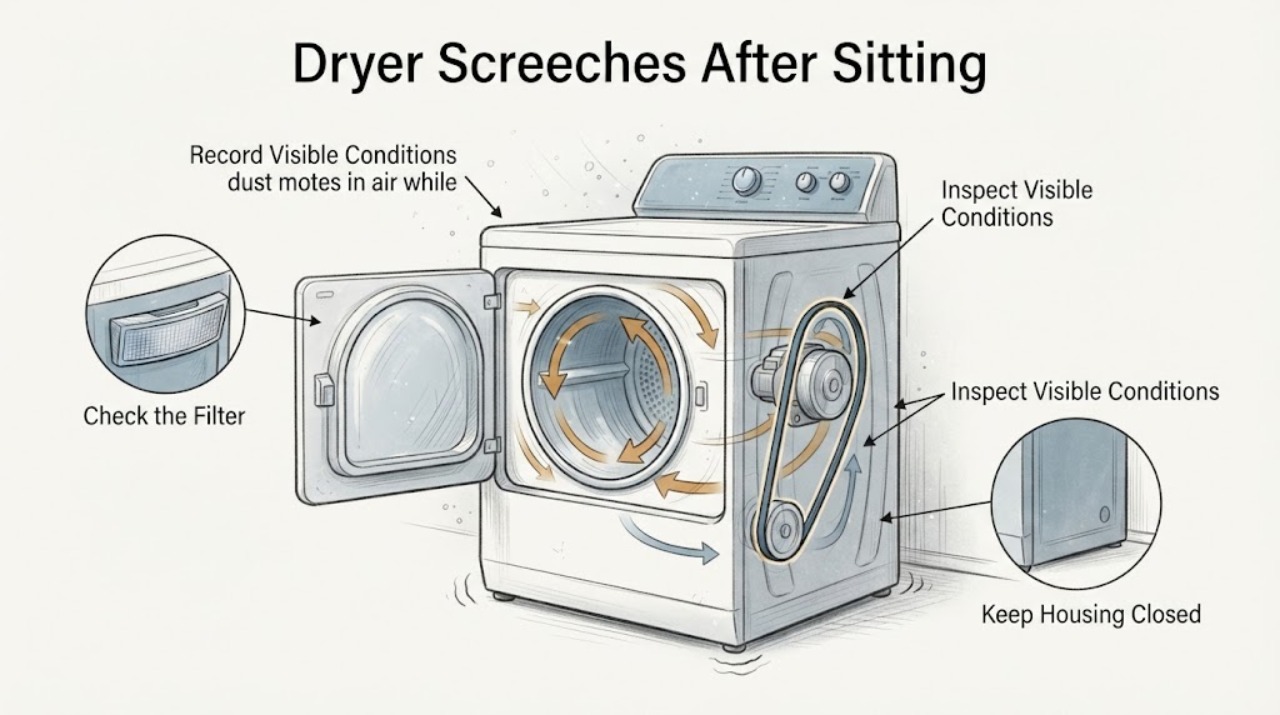
Work through in order
Diagnostic checks
Use only checks that match the exact appliance or system and its official guide.
-
Check 1
From a safe position, stop the dryer and record the complete model and serial plate, whether it is electric or gas, the time since the last use, the selected cycle, and a short description of the sound. Note whether the screech starts before the drum moves, lasts only a few seconds, follows drum speed, or continues for the whole attempt.
Expected result: The full model is 417.81122310 with a suffix or other plate detail, the fuel type is clear, and the sound is brief, continuous, intermittent, or tied to drum rotation.
Next step: Retrieve the manual for the complete plate identity and preserve the sound recording. Do not apply a different 417 or 9112 model's parts list or wiring diagram.
Stop if: Stop immediately for a burning or melted odor, smoke, sparks, a hot cord or outlet, gas odor, or an overheat event.
Why this matters
Why: Kenmore's official manual page uses the complete model number to locate model-specific guidance. Timing and speed relationship can prioritize a startup or external-vibration path versus a persistent rotating-system service path, but neither proves a named component.
-
Check 2
If the dryer is already off, cool, and free of hazard signs, remove the load and inspect only through the open door for coins, fasteners, a loose object, fabric caught at the seal, or visible drum damage. Clean and reseat the lint filter if it is accessible; do not reach behind the drum or remove any panel.
Expected result: A foreign object or caught item is visible, the lint filter is obstructed, the drum opening looks normal, or the screech was present with no clothing in the drum.
Next step: Remove only a loose, accessible object without force, close the door, and leave the dryer off if the screech remains. Do not use a knife, screwdriver, lubricant, or hand through a seal to reach an internal part.
Stop if: Do not run the dryer with an object rubbing the drum, a torn seal, exposed metal, or any need to bypass a door switch.
Why this matters
Why: An object or garment can create a load-related sound, and the official dryer guidance says to stop and check the drum for objects. A sound with an empty drum shifts concern toward the dryer itself, but does not identify whether the cause is the drum support, belt path, motor, or airflow system.
-
Check 3
Inspect the installation from outside without pulling or tilting the appliance: check that the cabinet is stable and not touching a wall, shelf, pedestal, or stacked appliance; confirm the visible exhaust path is not crushed; and look at the vent outlet for lint restriction. Do not remove the rear cover or reach into the blower or belt area.
Expected result: The cabinet rocks or contacts another surface, the noise changes when an accessible contact is cleared, the vent outlet is restricted, or the cabinet and visible airflow path are normal.
Next step: Clear only an accessible external contact or lint obstruction without moving the dryer through a gas or electrical connection. For a blocked duct, poor exhaust, or persistent screech, arrange qualified dryer service or professional vent cleaning.
Stop if: Do not move a stacked or gas dryer alone, disconnect the gas line, remove the exhaust housing, or continue with hot exhaust, smoke, or a burning odor.
Why this matters
Why: External resonance and airflow can amplify a normal startup sound or create rattling, while a normal exterior does not rule out a rotating component fault. Installation changes alone cannot establish that a pulley, roller, belt, or bearing is defective.
-
Check 4
Use the sound timing to classify the event without repeated trial runs: compare the original startup recording with whether the screech faded before a normal cycle, remained constant, became louder as the drum accelerated, or returned after the dryer sat idle again. Record whether the drum actually rotated and whether heating or airflow was normal only if that was already observed safely.
Expected result: The sound was a one-time brief startup event, returns every startup but fades, persists throughout drum rotation, or is accompanied by weak airflow, abnormal heat, or poor drying.
Next step: Leave the dryer off for a persistent, worsening, or recurring screech and provide the recording and timing log to a qualified technician. Do not keep running cycles to see whether the sound gets worse.
Stop if: Stop for any smoke, arcing, burning smell, hot cabinet or cord, repeated breaker trip, gas odor, or drum that binds or stops unexpectedly.
Why this matters
Why: A brief, self-limited sound is less concerning than a persistent speed-linked screech. Recurrence or a heat/airflow change means the noise cannot be dismissed as idle time, but the pattern still cannot select a safe internal part for a user replacement.
-
Check 5
If the dryer has no hazard sign but the screech remains after the external checks, request a model-specific service diagnosis and give the technician the complete plate identity, fuel type, idle duration, sound recording, location and timing of the noise, drum movement, vent observations, and any previous repair or overheat history.
Expected result: The technician can reproduce the sound and locate it at the drum opening, lower cabinet, rear airflow path, or motor area, or cannot reproduce it from the available evidence.
Next step: Ask for the identified failed or worn component, the evidence supporting it, and the safety checks required before reuse. Do not authorize an internal part solely because its name is commonly associated with dryer squealing.
Stop if: Do not open the cabinet, perform live electrical tests, bypass thermal or door protection, or operate after a fire, electrical, gas, or overheating warning.
Why this matters
Why: Location and reproducibility narrow the inspection, but a screech alone does not prove a roller, idler pulley, belt, bearing, blower, or motor. A no-reproduction result means the timing record and safe observation should be preserved rather than replaced with guesswork.
Use your observations
Decision map
Find the observation that best matches what you see, then follow the next safe action.
-
PATH 01Next step
What you see
The screech occurred only briefly at the first startup after a long idle, then stopped without odor, heat, poor airflow, or repeat noise.
Do this next
Keep the complete model record and monitor the next normal use without repeated testing. Arrange service if the screech returns, lasts longer, or changes the dryer's heat or airflow.
Why this path and its safety boundary
Why it matters: A temporary startup or installation-related event is more plausible than a confirmed failed internal part, but a single quiet cycle does not prove long-term reliability.
-
PATH 02Next step
What you see
The screech is present with an empty drum, follows drum speed, or continues for the whole cycle after the dryer has been idle.
Do this next
Leave the dryer off and request a qualified model-specific inspection. Do not select a roller, belt, idler pulley, or bearing based only on the sound.
Why this path and its safety boundary
Why it matters: The dryer itself is implicated more than a garment or pocket object, but the observation cannot distinguish a drum support, belt path, motor, or other internal cause.
-
PATH 03Next step
What you see
The sound changes when an accessible cabinet contact, loose object, or visible vent obstruction is corrected, and there is no hazard sign.
Do this next
Keep the cabinet stable and the visible exhaust path clear. Stop using the dryer and arrange service if the screech remains or returns.
Why this path and its safety boundary
Why it matters: An external vibration, object, or airflow contribution is more likely than an established internal failure, although recurrence requires another assessment.
-
PATH 04Next step
What you see
The screech is accompanied by weak exhaust, abnormal heat, a burning smell, smoke, sparking, a hot connection, or a gas odor.
Do this next
Stop the dryer, leave the area for gas odor, and contact qualified appliance, electrical, gas, or emergency service from a safe location as appropriate.
Why this path and its safety boundary
Why it matters: This is a fire, electrical, overheating, or gas-safety boundary rather than a routine noise classification.
Helpful context
Understand the symptom
A dryer that has been idle for a while can sound different on its first movement, but the useful discriminator is timing: does the screech fade as the drum runs, or does it continue and track every rotation? The 417 prefix and a sound recording are not enough to select an internal part. Kenmore's official manual lookup directs owners to use the complete model number, so confirm the full plate identity before applying any 417-family instruction.
Keep the user checks outside the cabinet. An empty drum, a foreign object, a loose installation, a lint or airflow issue, and a rotating support or belt-path fault can produce different sound patterns, but distinguishing the internal causes requires a de-energized model-specific inspection. A screech that is sharp, persistent, worsening, or accompanied by heat or odor is a service boundary rather than a reason to keep test-running the dryer.
When checks do not resolve it
Need a professional?
Stop using the dryer and arrange qualified service for a screech that persists, repeats after startup, follows drum speed, occurs with an empty drum, worsens, or is accompanied by poor airflow, abnormal heat, a damaged seal, drum binding, smoke, sparks, burning odor, a hot cord or outlet, repeated breaker trips, or gas odor. Do not open the cabinet, perform live tests, bypass a door or thermal safety, lubricate an unknown part, or repeatedly run the dryer to reproduce the sound.
Have this ready
- Provide the complete 417.81122310 model identity from the plate, serial number, electric or gas configuration, time out of use, sound recording, exact startup duration, sound location, whether the drum rotated, whether the sound was present empty, visible vent and cabinet observations, and any odor, heat, or breaker history.
Common questions
FAQ
Can a dryer screeching after sitting unused be assumed to be the bearing?
No. Startup timing can be relevant, but a screech can also involve an object, installation vibration, airflow, or an internal rotating path. Use the full model and a safe timing record; do not order a bearing from the sound alone.
Should I keep running the Kenmore dryer until the screech goes away?
No. Do not repeatedly test it. Stop for any odor, heat, smoke, sparks, gas odor, or persistent sound, and arrange qualified service. A single previously observed safe event should be documented rather than deliberately reproduced.
What can I check without opening a 417.81122310 dryer?
Confirm the complete model plate, inspect the drum opening for loose objects or caught fabric, reseat the accessible lint filter, check visible vent and cabinet clearance, and record sound timing. Do not remove panels or reach toward internal rotating parts.
What does it mean if the screech is only on startup?
A brief sound that fades may be a temporary startup or vibration event, while a sound that returns or follows drum speed needs inspection. The timing narrows the path but does not identify a pulley, roller, belt, or bearing.
Read the exact guide
Official sources
- Is it normal for my dryer to make sounds or noises?Frigidaire · Opened official manufacturer guidance for dryers, used only for general sound classification and safe external observation, not to assert Kenmore part fit or a Kenmore-specific diagnosis.
- Laundry Dryer NoisesFrigidaire · Opened official manufacturer guide used only for general external checks: loose objects, level and stable installation, and the boundary for service when noise persists; it is not a Kenmore-specific parts map.
- Find Your ManualKenmore · The opened official Kenmore page instructs owners to enter the complete model number, without special characters, to retrieve the correct manual. This is the applicable identity check for Kenmore model 417.81122310; it does not authorize use of another model's parts or wiring.
Community feedback
Share a repair observation
Share a plain-text repair observation. Accepted observations are published automatically; this page may take a moment to update.