
On this page
Start here
Quick answer
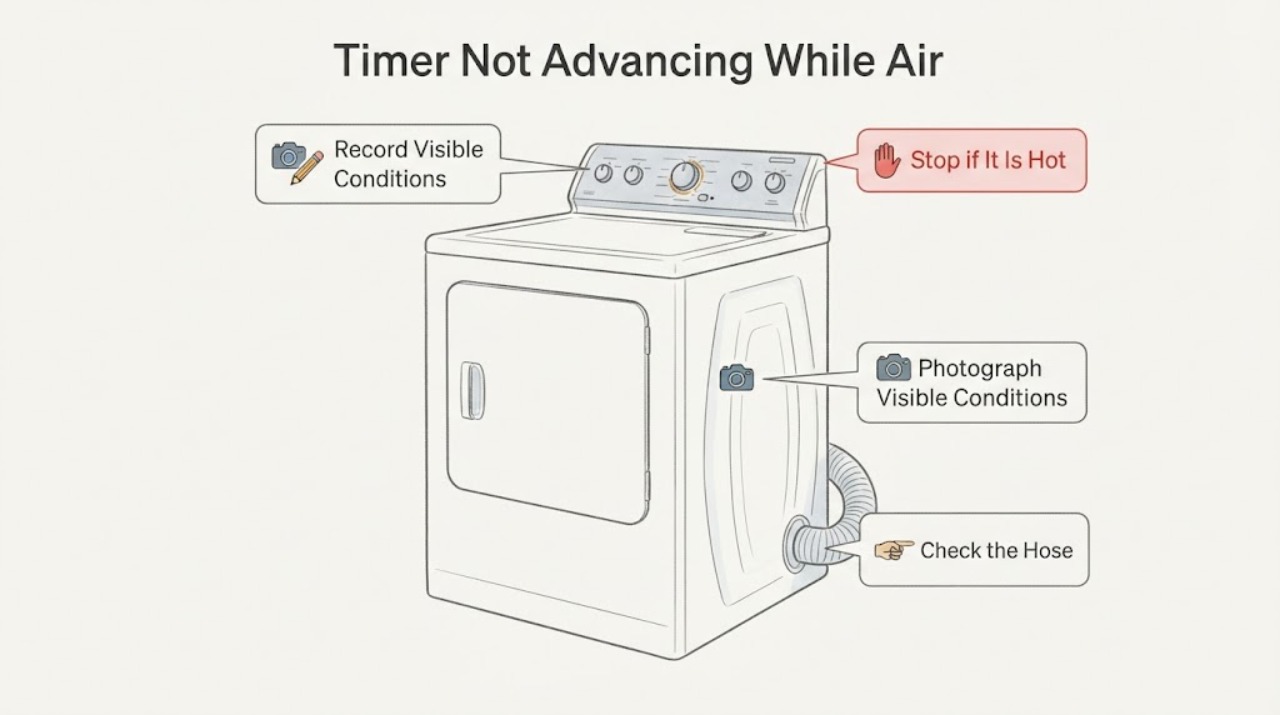
On a Kenmore 11067522600 dryer, a timer that seems not to advance can be normal in an automatic cycle, but Air Dry should not be treated as a heated cycle. If Air Dry is visibly producing heat, the timer is stalled, or the dryer is getting unusually hot, stop using it and remove the load. From a cool, dry position, verify the full model label, record the selected cycle and timer movement, inspect only the lint screen and visible exhaust for restriction, and note any burning smell, scorching, smoke, or hot connection. Do not run another heated or Air Dry test, open the cabinet, or perform a live test. The symptom does not prove that the timer, heater, thermostat, relay, or control is the failed part; have a qualified technician diagnose the exact platform and provide a model-matched repair estimate before ordering anything.
Work through in order
Diagnostic checks
Use only checks that match the exact appliance or system and its official guide.
-
Check 1
Stop the dryer, remove the load, and let it cool. From outside the cabinet, record whether the last cycle was Air Dry, Timed Dry, or an automatic cycle; whether the timer dial moved at all; and whether clothes, the drum, the exhaust, or the cabinet felt unusually hot. Do not restart it to confirm the observation.
Expected result: Air Dry produced noticeable heat, the timer did not move in a timed cycle, the timer moved only near the end of an automatic cycle, or there was unusual heat, smoke, odor, or scorching.
Next step: Keep the dryer off and use the safety branch for smoke, burning odor, scorching, a hot connection, or uncontrolled heat. Otherwise continue only with the identity and cool external checks.
Stop if: Do not run another heated or Air Dry cycle, leave the appliance unattended, or keep using it while the cycle and heat behavior disagree.
Why this matters
Why: A slowly moving timer can be normal in some automatic cycles, but heat in an Air Dry or Fluff cycle conflicts with the cycle's stated purpose. Heat, odor, or smoke turns the symptom into a fire or control-safety concern rather than a timer-only question.
-
Check 2
Read the model and serial label without removing a panel or moving the dryer and confirm every digit is 11067522600. Photograph the label and note the control layout, cycle names, and whether the dryer is electric or gas; do not assume a similar Kenmore 500-series number has the same timer or heat circuit.
Expected result: The label confirms 11067522600, a digit or suffix differs, or the energy type and model cannot be confirmed.
Next step: Give the label photo and control observations to a technician. Until identity is confirmed, stop at safe external checks and do not borrow a procedure from another Kenmore dryer.
Stop if: Do not pull the dryer forward, remove an access panel, disconnect gas, or access wiring to find the label.
Why this matters
Why: Kenmore's owner-support route uses the model and serial information to locate the matching manual and service path. An uncertain platform makes a timer, heater, thermostat, relay, or part claim unreliable.
-
Check 3
With the dryer off, cool, and disconnected from its ordinary user control, clean the lint screen and inspect only the visible exhaust hose, wall connection, and outside hood for crushing, disconnection, lint, or a flap that cannot open. Do not move the dryer or reach into the blower or heater area.
Expected result: The lint screen or visible vent is blocked, crushed, disconnected, or has weak airflow during an already-observed safe operation; or the accessible path looks normal.
Next step: Correct only an obvious, accessible lint-screen or vent connection issue while the dryer is off. If Air Dry heat or timer failure remains, keep the dryer off and arrange service.
Stop if: Do not operate with a blocked or disconnected exhaust, clean behind panels, or use heat to test airflow.
Why this matters
Why: Restricted exhaust can raise dryer temperature and contribute to long or abnormal cycles, but a clear visible vent does not clear a hidden control, heater, thermostat, or internal lint problem. Airflow does not explain why Air Dry would intentionally heat.
-
Check 4
From a dry standing position, inspect the visible plug, receptacle, cord, gas connection area if applicable, and household protection status for heat, discoloration, moisture, damage, or a repeat trip. Do not open a breaker panel, disconnect gas, remove a terminal cover, or make an energized electrical measurement.
Expected result: A plug or receptacle is hot or damaged, a breaker or fuse has operated, there is a gas odor, the dryer was recently moved, or the visible supply looks normal.
Next step: For heat, odor, damage, gas odor, or a repeat trip, leave the dryer off and call a qualified electrician, gas-appliance professional, or appliance technician as appropriate. Otherwise report the normal external finding during service.
Stop if: Do not reset a recurring trip, operate switches during a gas odor, handle exposed conductors, or continue with a damaged connection.
Why this matters
Why: A supply or installation problem can create abnormal heating or stop a cycle, and a used appliance may have an unknown connection history. A normal external supply still does not identify the timer or heat-control fault.
-
Check 5
Record whether the timer is a mechanical dial or electronic display and whether it advances in a documented Timed cycle, an automatic cycle, or not at all. Note whether Air Dry heats every time or only once, and preserve the load, cycle, start time, and temperature observations for service; do not enter a technician mode.
Expected result: The timer advances in Timed Dry but not automatically, never advances, or Air Dry consistently energizes heat.
Next step: Keep the dryer off if Air Dry heats or the timer remains stalled. Give the technician the exact cycle-by-cycle pattern and model label rather than ordering a timer or heater.
Stop if: Do not bridge contacts, open the console, test continuity or voltage, or repeat cycles to compare temperatures.
Why this matters
Why: Manufacturer guidance says a timer may move slowly or only as an automatic cycle reaches its moisture condition; consistent Air Dry heat is a separate abnormal observation. The pattern can involve a timer contact, cycling control, heater path, thermostat, or wiring, but it cannot select the failed part safely.
-
Check 6
Request a model-specific diagnosis before authorizing repair. Ask the technician to identify the platform, establish why Air Dry is heating, check the timer or control and heat-safety path, document airflow findings, and provide the exact part route, labor, warranty, and total estimate.
Expected result: The provider confirms a timer-only issue, a heater or thermostat/control issue, a vent or installation problem, or cannot yet establish the cause or an exact compatible part.
Next step: Authorize repair only after the diagnosis, compatible part path, installed cost, and warranty are documented. If the cause or part fit remains uncertain, keep the dryer out of service and obtain another qualified assessment.
Stop if: Do not order a timer, heater, thermostat, relay, or control from a symptom or a different Kenmore platform, and do not approve cabinet access for an unqualified person.
Why this matters
Why: The overlapping symptoms do not prove a timer, heater, thermostat, relay, or control failure. A second-hand dryer also has unknown prior work, so a model-matched diagnosis is necessary before a part is selected.
Use your observations
Decision map
Find the observation that best matches what you see, then follow the next safe action.
-
PATH 01Next step
What you see
Air Dry or Fluff produces noticeable heat, especially with a stalled timer, unusual heat, smoke, burning odor, scorching, or a hot connection.
Do this next
Stop using the dryer and arrange prompt qualified appliance service. Use electrical or gas professionals for a supply or fuel concern.
Why this path and its safety boundary
Why it matters: The no-heat cycle is behaving unsafely or outside its intended function; a control, heater, thermostat, wiring, or airflow fault is possible.
-
PATH 02Next step
What you see
The timer moves slowly or only near the end of an automatic cycle, while Air Dry remains cool and there is no unusual heat or odor.
Do this next
Verify the cycle selection and model label, then monitor only within the exact manual's normal behavior; arrange service if the timer never advances in a timed cycle or Air Dry later heats.
Why this path and its safety boundary
Why it matters: This pattern can be normal cycle behavior rather than a failed timer, but the exact 11067522600 manual and platform still control the conclusion.
-
PATH 03Next step
What you see
The vent path or visible connection is restricted, crushed, disconnected, or associated with excessive heat, while the timer symptom is intermittent.
Do this next
Keep the dryer off until the accessible vent issue is corrected safely; arrange service if heat or timer behavior persists or any hidden path needs access.
Why this path and its safety boundary
Why it matters: Airflow or installation can raise temperature and alter cycle behavior, but it does not by itself prove that the timer or heater is sound.
-
PATH 04Next step
What you see
The model label, energy type, or control platform does not match 11067522600, or the platform cannot be confirmed.
Do this next
Stop at external observations and have a qualified technician identify the appliance before ordering parts or performing diagnosis.
Why this path and its safety boundary
Why it matters: A borrowed timer or heating procedure could be incompatible and unsafe, especially for a second-hand machine.
-
PATH 05Next step
What you see
A qualified provider documents the exact cause, compatible part route, installed repair estimate, and warranty.
Do this next
Compare the documented repair scope and warranty with a replacement that fits the installation and household requirements; keep the dryer off until the selected repair is completed safely.
Why this path and its safety boundary
Why it matters: Repair can be evaluated from verified evidence rather than from the timer position or ownership history alone.
Helpful context
Understand the symptom
Verify the label before applying any model-specific procedure: 11067522600 is the assigned Kenmore dryer identity, but the opened manufacturer guidance is family-level and does not establish a safe internal access procedure for this used appliance. The key observation is not merely a slow timer; it is heat appearing in a cycle intended to provide air without heat.
Do not use the dryer to reproduce the fault. Airflow restriction, a control or timer contact, a thermostat or heater fault, or a platform mismatch can produce overlapping symptoms. In a second-hand appliance, the prior repair and installation history are unknown, so visible safety observations and a qualified diagnosis matter more than a guessed component.
When checks do not resolve it
Need a professional?
Arrange qualified appliance service for Air Dry heat, a timer that never advances in a timed cycle, repeated overheating, unusual odor or noise, a damaged connection, or any symptom requiring cabinet access. Use a licensed electrician for a recurring electrical trip or supply concern and a qualified gas professional for gas odor or fuel-line work.
Have this ready
- Provide the full 11067522600 model and serial information, energy type, control layout, selected cycle, timer movement, Air Dry heat observation, load and timing history, vent observations, and any odor, smoke, scorching, or trip history.
Common questions
FAQ
Is it normal for the timer not to move right away?
It can be normal for a timer to move slowly or only at certain points in an automatic cycle. That does not make Air Dry heat normal, and a timer that never advances in a timed cycle needs model-specific service diagnosis.
Why is Air Dry heating a safety concern?
Air Dry or Fluff is intended for tumbling without added heat. If the cycle produces noticeable heat, stop using the dryer; a control, heater, thermostat, wiring, or airflow fault may be involved and cannot be identified safely from outside.
Should I replace the timer first?
No. The same symptom can involve cycle behavior, airflow, supply, the timer or control, or the heat-safety path. Confirm 11067522600 and obtain a written model-specific diagnosis before selecting a part.
Read the exact guide
Official sources
- Laundry Appliances | Washers & Dryers | KenmoreKenmore · Opened Kenmore's official laundry page. It provides the brand's current laundry product and support context; use the exact rating label and model-specific manual rather than transferring current-product procedures to 11067522600.
- Dryer is not Drying or Experiencing Long Dry Times - Product Help | WhirlpoolWhirlpool · Opened official Whirlpool Product Help. It states that Air Dry or Fluff does not add heat and gives external ventilation and service guidance; it is not used to claim an exact Kenmore platform or component.
- Owner's ManualWhirlpool · Opened an official Whirlpool dryer owner's manual that explicitly says it covers several models. It is used only for general cycle and safety distinctions; it is not asserted as the exact Kenmore 11067522600 manual.
- 6.5 cu. ft. Electric Dryer - White | KenmoreKenmore · Opened Kenmore's official dryer product page. It states that Air Dry or air fluff uses no additional heat on that product; this is a brand-level cycle meaning, not proof that the assigned second-hand model has the same control layout or part fit.
- Dryer Timer Genuine Original Equipment Manufacturer (OEM) part | KenmoreKenmore · Opened Kenmore's official parts page for a dryer timer. It demonstrates that Kenmore provides a model-based parts route; it does not establish that this timer fits 11067522600 or that the timer is the cause.
Community feedback
Share a repair observation
Share a plain-text repair observation. Accepted observations are published automatically; this page may take a moment to update.