
On this page
Start here
Quick answer
On Kenmore 110.96274100, a drum that stops at the end of drying while the timer dial keeps turning is not automatically a bad timer. First identify whether the dial is merely settling by inertia, whether the dryer is in a cool-down or wrinkle-prevention stage, and whether the drum, heat, and timer truly remain active. Kenmore says the exact model manual must be located by the full model number; comparable manufacturer dryer guidance describes wrinkle-prevention as intermittent, heat-free tumbling after the normal cycle, while a timer that continues continuously after the drum and heat have stopped is a different symptom. With the dryer cool and safely disconnected, record the selected cycle, option, dial movement, heat, and whether opening the door stops the behavior. Do not open the control console, perform live electrical tests, or buy a timer or motor from the symptom alone. Stop use for a stuck running drum, continued heat, burning odor, smoke, sparking, a hot cord, or an inability to stop the appliance normally.
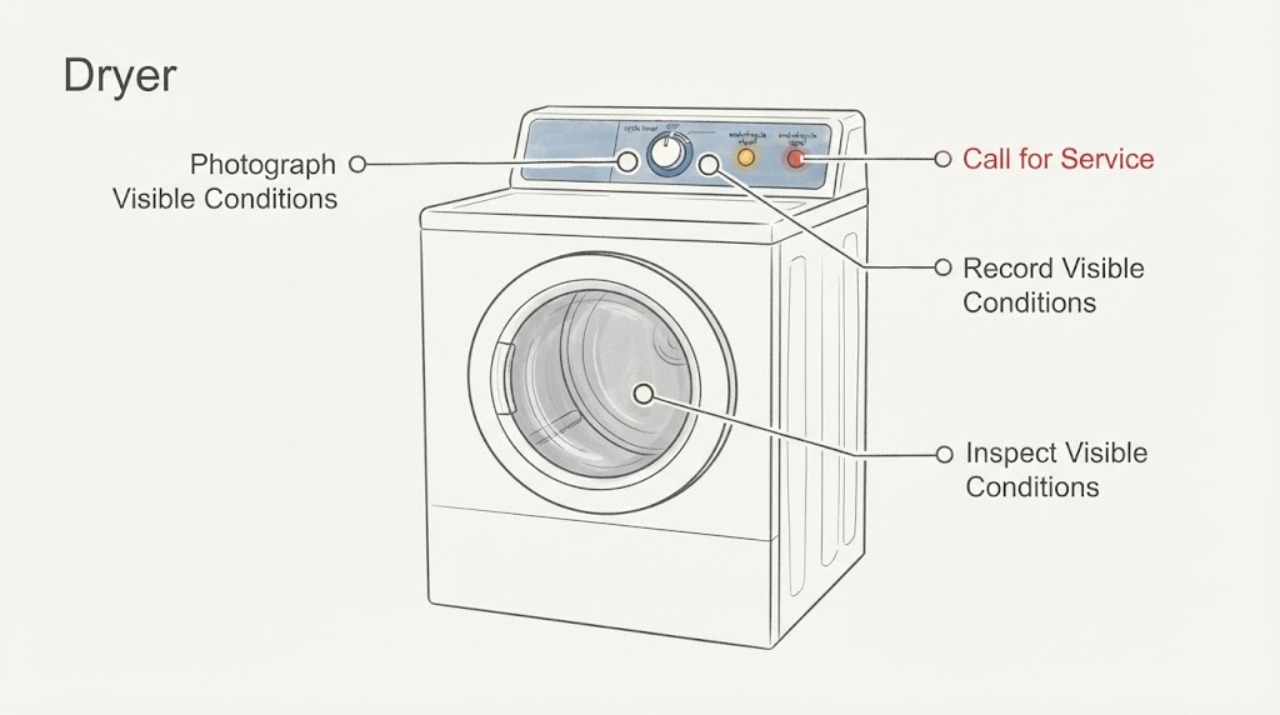
Work through in order
Diagnostic checks
Use only checks that match the exact appliance or system and its official guide.
-
Check 1
Read and photograph the rating label, recording Kenmore model 110.96274100 exactly, including every suffix and the market. Use the complete model in Kenmore's manual portal and record whether the dryer is gas or electric, which cycle and options were selected, and whether the dial is mechanical or the display is electronic.
Expected result: The label confirms 110.96274100, the model is incomplete or different, or the available manual does not show the reported cycle and end behavior.
Next step: Keep the model record with the service request. If the identity or manual is unresolved, stop at safe observation and do not apply another Kenmore series' timer or option instructions.
Stop if: Do not remove the console, expose wiring, or use a model-specific service sequence that was not confirmed for 110.96274100.
Why this matters
Why: Kenmore states that the full model number is needed to retrieve the matching manual. Model identity controls the timer layout, cycle names, fuel-related hazards, and whether wrinkle prevention or cool down is offered; a similar Kenmore label is not enough.
-
Check 2
At the next occurrence, remain outside the dryer and record the sequence: the selected cycle reaches its end, the drum stops, the timer dial moves briefly or continuously, the heater appears to stop, and the dial eventually reaches OFF or another home position. Do not reach into the drum or open a door while heat or moving parts are present.
Expected result: The dial moves only briefly after the drum stops, moves in repeated intervals with no heat, turns continuously, or the drum/heater also continues after the expected end.
Next step: Use the matching branch below. Do not keep the dryer running to watch the dial complete if the drum, heater, odor, or temperature is abnormal.
Stop if: Stop use for continued heat, a stuck running drum, smoke, burning odor, sparking, abnormal heat, or an appliance that cannot be stopped normally.
Why this matters
Why: Brief movement can be knob inertia or a control transition. Repeated no-heat tumbling can fit a wrinkle-prevention stage on models that have it. Continuous timer motion or continued heat/drum operation is not explained by a normal heat-free end option and needs model-specific diagnosis.
-
Check 3
With the dryer off, cool, and disconnected from its accessible power source, note the dial position and gently observe whether the knob is loose, rubbing the console, or visibly returning under its own spring or control action. Do not remove the knob, console, or timer housing to inspect contacts.
Expected result: The knob is loose or rubbing, the dial is stationary after the drum stops, the dial rotates smoothly to its home position, or the dial keeps turning with the dryer disconnected.
Next step: Correct only a plainly visible obstruction without opening the console. If movement is continuous, the knob cannot be positioned normally, or the symptom returns, arrange qualified service instead of dismantling the control area.
Stop if: Do not open the timer, sand contacts, handle wiring, perform electrical tests, or work inside the console.
Why this matters
Why: A loose or rubbing knob can create an apparent dial fault without proving a timer failure. A dial that continues to turn with power removed would not be an energized timer-motor action and should be recorded for service; no exterior clue can identify internal timer contacts.
-
Check 4
After the dryer is cool and disconnected, record whether opening the door at the end stops all motion and heat, and whether the timer then remains in the same position or continues to advance. Use only the normal door action; do not defeat the door switch or repeatedly restart the dryer.
Expected result: Opening the door stops the drum and any heat, opening the door has no effect, or the drum stops but the timer continues to move after the door is open.
Next step: Record the exact cycle and door response for service. Leave the dryer off if the timer continues unexpectedly, the door cannot stop operation, or the appliance returns to heat or motion without a normal command.
Stop if: Do not bypass the door switch, hold it closed, remove the door, or restore power repeatedly to reproduce the behavior.
Why this matters
Why: A normal door response helps separate end-of-cycle tumbling from a failure to stop the appliance, but it does not identify a timer contact or motor. A timer that advances after the drum is stopped remains an unresolved control symptom, especially if it is continuous rather than an optional no-heat stage.
-
Check 5
Review the selected cycle and options against the exact Kenmore manual, looking specifically for Cool Down, Wrinkle Guard/Finish Guard, End of Cycle, or an automatic cycle that can alter the end sequence. Record whether the load is still tumbling without heat and whether the manual says the option ends when the door opens.
Expected result: The matching manual documents a periodic no-heat end option, no such option is selected, or the manual does not match the control panel and reported behavior.
Next step: If the exact manual explains the no-heat end stage and the dryer stops normally when the option ends, monitor only with no heat or hazard. Otherwise leave it off and arrange qualified appliance service.
Stop if: Do not select a cycle from another model, run a high-heat cycle to force the timer to stop, or open the console.
Why this matters
Why: A documented no-heat end option can explain intermittent tumbling after the main cycle, but only the exact manual establishes whether 110.96274100 has it. A continuous dial movement without a documented option, or behavior inconsistent with the manual, needs service rather than a timer part guess.
-
Check 6
Prepare the service record: full model and fuel type, selected cycle and options, whether the drum stopped, whether heat stopped, how the timer moved, door response, dial position, load condition, lint/vent condition, and any odor, smoke, sparking, abnormal heat, or power event. Keep the dryer off if the end state is not clearly normal.
Expected result: The timer symptom repeats, the end option is not documented for the exact model, the dial does not reach OFF/home, the dryer continues heat or motion, or a safety warning appears.
Next step: Give the record and model label to Kenmore or qualified appliance service. Ask them to confirm the exact cycle-control behavior before replacing any component.
Stop if: Stop immediately for smoke, burning odor, sparking, exposed wiring, a hot cord, abnormal heat, gas odor, or inability to stop the dryer safely.
Why this matters
Why: This record lets a qualified technician distinguish a normal end-stage option or dial issue from a timer-control, motor, heater, door-switch, or wiring fault. A timer that keeps turning is not enough evidence to choose a timer or motor.
Use your observations
Decision map
Find the observation that best matches what you see, then follow the next safe action.
-
PATH 01Next step
What you see
The drum has stopped, no heat remains, and the dial moves only briefly or settles at its home position without restarting the dryer.
Do this next
Record the cycle and watch one normal end only if the model manual supports it and no hazard is present. Arrange service if the dial repeatedly turns continuously or fails to reach the documented end position.
Why this path and its safety boundary
Why it matters: This is more consistent with a control transition or knob inertia than with a dryer that is still running. The exact-model report shows why dial movement must be observed rather than assumed to be a failed timer.
-
PATH 02Next step
What you see
The matching manual documents a Wrinkle Guard, Finish Guard, or similar end option, and the drum restarts only intermittently without heat after the normal cycle.
Do this next
Follow the exact Kenmore option instructions and open the door or use the documented control to end it. Escalate if heat, continuous motion, or unexplained timer movement remains.
Why this path and its safety boundary
Why it matters: Whirlpool's opened dryer guidance describes this pattern as a normal wrinkle-prevention function on models that offer it, but a comparable feature cannot be transferred to Kenmore 110.96274100 without its manual.
-
PATH 03Next step
What you see
The drum stops but the timer continues turning continuously, does not reach the documented home position, or keeps moving after the normal end option is excluded.
Do this next
Leave the dryer off and arrange qualified Kenmore appliance service. Provide the model, cycle, dial movement, door response, and whether heat stopped; do not open the console or order a timer from the symptom alone.
Why this path and its safety boundary
Why it matters: This is the independent timer-control branch in the exact 110.96274100 report. It indicates an unresolved cycle-control symptom, not a confirmed timer contact, resistor, motor, or other part.
-
PATH 04Next step
What you see
The drum or heater continues after the expected end, the door does not stop operation normally, or the appliance restarts without a documented wrinkle-prevention command.
Do this next
Stop using the dryer and obtain qualified appliance service. Do not bypass a door switch, repeat high-heat cycles, or open the control area.
Why this path and its safety boundary
Why it matters: The issue has crossed from a dial observation into a possible control, door-switch, heater, or safety problem. The visible sequence cannot identify which internal part is responsible.
-
PATH 05Next step
What you see
Smoke, burning odor, sparking, exposed wiring, a hot cord, abnormal heat, gas odor, or an inability to stop the dryer accompanies the timer symptom.
Do this next
Stop using the dryer, isolate power or gas only from a safe position, leave the area for a suspected gas release, and obtain qualified appliance, electrical, or gas service. Use local emergency guidance for smoke or fire.
Why this path and its safety boundary
Why it matters: This is an immediate fire, gas, or electrical safety boundary, not an ordinary timer adjustment.
Helpful context
Understand the symptom
Separate three different observations: the drum has stopped and the dial is coasting, the selected program is performing an optional cool-down or wrinkle-prevention action, or the timer is still driving the appliance after the cycle should be over. The exact 110.96274100 community report describes the drum stopping while the timer continues to the home position, but it does not prove which internal contact or timer mechanism is involved. Kenmore's own manual portal says to retrieve the owner's material with the complete model number, so do not borrow a cycle diagram or part conclusion from another Kenmore dryer.
A normal end stage should be heat-free when a wrinkle-prevention feature is active. The opened Whirlpool references describe periodic tumbling after the normal cycle and a stop after cool down when that option is not selected, but those references are comparison guidance only. If the Kenmore drum stops yet heat remains, the drum restarts unexpectedly, the dial turns continuously, or the dryer cannot be stopped by the normal door or control action, leave it off and arrange service.
When checks do not resolve it
Need a professional?
Arrange qualified Kenmore appliance service when the timer continues continuously after the drum and heat stop, fails to reach the documented home position, the exact manual does not explain the end behavior, or the symptom returns. Stop immediately for a drum or heater that continues unexpectedly, a door that cannot stop operation, smoke, burning odor, sparking, exposed wiring, a hot cord, abnormal heat, gas odor, or repeated power trips. Do not open the control console, perform live electrical tests, bypass a door switch, or choose a timer, motor, resistor, or heater from this symptom alone.
Common questions
FAQ
Does a timer dial that keeps turning prove the timer is bad?
No. First exclude knob inertia, a documented cool-down or wrinkle-prevention stage, and the possibility that the drum and heat have already stopped while the dial is completing a control transition. The exact 110.96274100 report is an observation, not a confirmed part diagnosis.
Can the dryer tumble after the cycle ends and still be normal?
Some dryers periodically tumble without heat when a wrinkle-prevention option is selected. Whirlpool's official guidance describes that behavior, but Kenmore 110.96274100 must be checked against its own manual before treating the movement as normal. Continuous timer motion or any continued heat is a service concern.
How do I find the correct manual for Kenmore 110.96274100?
Use Kenmore's official manuals page with the complete model number, preserving every digit and suffix. If the portal cannot identify the model or the manual does not match the controls, do not use another series' cycle or timer instructions; provide the label photo to service.
Should I replace the timer or motor first?
Neither should be selected from the timer symptom alone. Record whether the drum and heat stopped, whether the dial moved continuously, the door response, the exact cycle, and the model. A qualified technician should confirm the cycle-control fault and fitment before any component is chosen.
Read the exact guide
Official sources
- Dryer Turns On after Cycle is CompleteWhirlpool Product Help · General manufacturer guidance: selected Wrinkle Shield or Wrinkle Control can periodically tumble after the normal cycle; this page is not proof that Kenmore 110.96274100 has that option.
- Dryer's end of cycle stops when it should but timer keeps spinning?Anecdotal observation for the exact Kenmore 110.96274100 case only; it supports a decision split, not a universal timer or part diagnosis.
- Owner's ManualWhirlpool · Comparison only, not an exact Kenmore manual: describes heat-free periodic tumbling, door stop behavior, automatic versus timed cycles, and a normal stop after cool down when Wrinkle Shield is not selected.
- Kenmore ManualsKenmore · Use the complete Kenmore 110.96274100 model number to retrieve matching owner's material; the portal does not itself establish the timer fault or part fit.
Community feedback
Share a repair observation
Share a plain-text repair observation. Accepted observations are published automatically; this page may take a moment to update.