
On this page
Start here
Quick answer
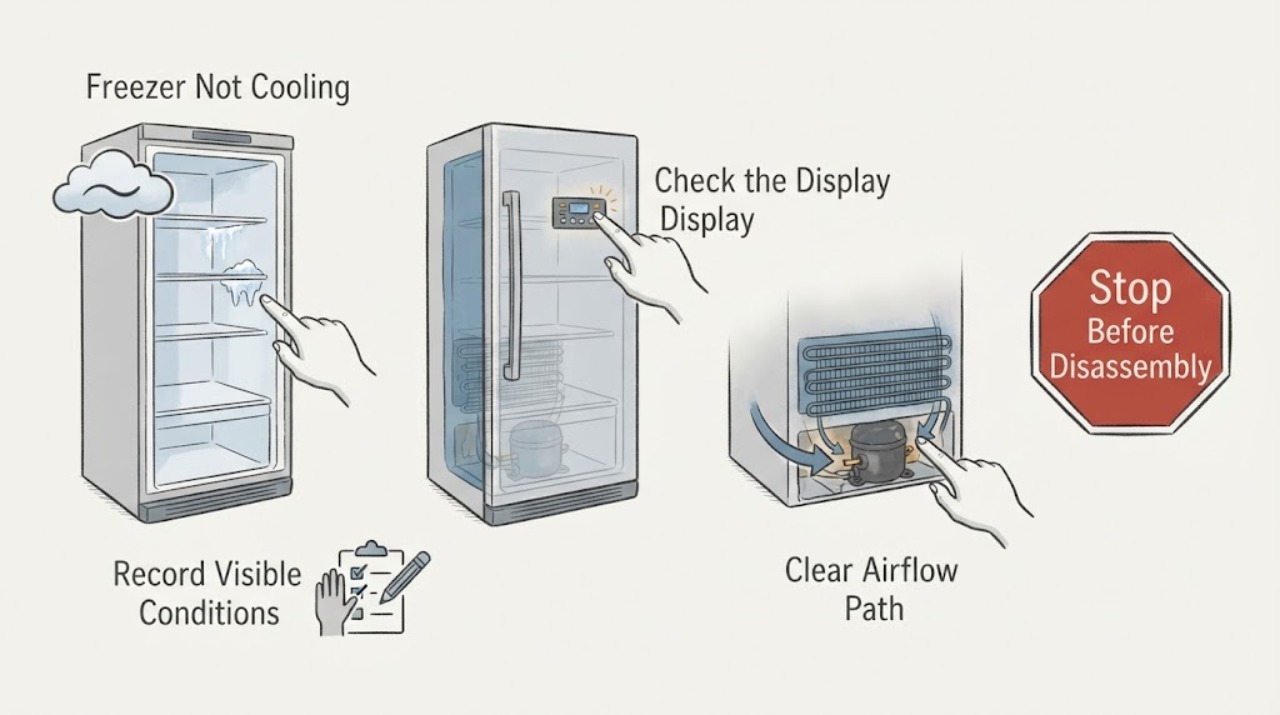
If a Kenmore freezer is not cooling, keep the door closed to protect the food, then determine whether the unit has power and whether the temperature control is set to Off or too warm. Check for blocked interior vents, an overpacked cabinet, a door or lid that does not seal, and heavy frost that restricts airflow. A compressor hum, fan sound, or refrigerant gurgle can show that the unit is attempting to cool, but those sounds do not prove the system is working. Use the exact Kenmore model manual for controls and access points. Do not remove sealed-system or electrical covers; arrange qualified service for persistent warmth, a failed fan, repeated clicking, heavy frost that returns, or any damaged cord or burning smell.
Work through in order
Diagnostic checks
Use only checks that match the exact appliance or system and its official guide.
-
Protect food and record the temperature state
Keep the freezer door or lid closed except for a quick, safe observation. Note whether packages still have ice crystals, whether a freezer thermometer is available, and whether food is soft or fully thawed. Group packages together only if you can do so without leaving the door open.
Expected result: Ice crystals or a measured temperature within current food-safety guidance may support keeping or refreezing some food; fully thawed or warm perishable food requires the applicable food-safety decision. Do not rely on smell or appearance alone.
Next step: Keep the door closed while arranging service or deciding on safe food handling. Then check power and controls without repeatedly opening the cabinet.
Why this matters
Why: A cooling fault can become a food-safety problem before diagnosis is complete. Door openings add heat and make the later cooling checks less reliable.
-
Check power and the temperature control
Look for an interior light, display, or other normal power indication. Confirm the power cord is fully seated in the intended receptacle and check the home's breaker or GFCI only from a dry, safe position. Verify the Kenmore temperature control is not set to Off or the warmest setting, using the exact model manual.
Expected result: No light, display, or operating sound suggests a power or control path issue. If the unit has power but the control is Off or too warm, correcting that setting may restore a cooling call. If the breaker trips again, do not keep resetting it.
Next step: If power cannot be restored safely, use an electrician or appliance technician. If power and the control are normal, continue to airflow, door-seal, and frost checks.
Why this matters
Why: A freezer cannot cool without power and an active cooling control. A repeated electrical trip is evidence of a fault, not a successful reset.
-
Check the door or lid seal and interior airflow
Inspect the gasket around the closed door or lid for dirt, gaps, tears, deformation, or an item preventing closure. Confirm food packages are not pressed against interior vents and that the cabinet is not packed so tightly that air cannot circulate. Clean only accessible gasket surfaces according to the manual.
Expected result: A gasket that does not contact evenly, a door held open by an item, or blocked vents can let warm air in or restrict cold-air circulation. If the seal and airflow are clear but the freezer remains warm, continue to the frost and operating-sound checks.
Next step: Close the door or lid and limit openings while the unit runs. If the gasket is damaged or cannot seal, arrange model-specific replacement or service rather than forcing it into place.
Why this matters
Why: Warm air leaks and blocked circulation can mimic a failed compressor or control. Correcting them is a low-risk check that does not require opening the appliance.
-
Look for frost that is blocking airflow
Without removing an interior panel, inspect the visible rear wall, vents, and accessible surfaces for a thick or rapidly returning frost layer. Do not scrape ice, pierce the liner, or use an open flame or high heat. If the manual describes a safe owner defrost procedure for the model, follow that procedure only after protecting the food and unplugging as directed.
Expected result: Heavy frost covering the rear area or vents can reduce airflow and points toward a defrost, door-seal, or moisture problem. Little frost with a warm cabinet points elsewhere, such as power, control, fan, compressor, or sealed-system service.
Next step: If a safe manual defrost temporarily restores cooling but frost returns, schedule service for the underlying cause. If the frost cannot be cleared without tools or panels, stop and call a technician.
Why this matters
Why: Frost is a clue, not proof of a failed heater or thermostat. Removing panels or testing a defrost circuit requires model-specific access and electrical precautions.
-
Use operating sounds without dismantling the unit
From outside the closed cabinet, note whether you hear a compressor hum, an interior fan, or refrigerant gurgling during a normal cooling attempt. Do not put fingers near a fan, remove a guard, or repeatedly cycle power just to reproduce a sound.
Expected result: A hum, fan sound, or gurgle can indicate that the freezer is attempting to cool, but continued warmth after the unit has had time to stabilize means the sound is not proof of successful cooling. A repeated click followed by silence or no sound at all narrows the next step toward service.
Next step: If the freezer runs yet remains warm after the model's stabilization period, arrange service. If the compressor repeatedly clicks, stops, or becomes unusually hot, stop repeated restarts and call a technician.
Why this matters
Why: Sound helps distinguish a completely dead unit from one running with an airflow or sealed-system problem, but it cannot identify a failed component by itself.
-
Escalate a persistent cooling failure
Record the Kenmore model number, power and control observations, frost pattern, door-seal condition, sound pattern, and food temperature state. Keep the door closed and make the appliance accessible for a qualified technician without removing covers or attempting sealed-system tests.
Expected result: The freezer remains warm after safe power, control, seal, airflow, and frost checks; a fan does not operate, frost returns, a compressor will not start, or cooling is uneven.
Next step: Arrange qualified appliance service. Keep food in a safe alternate freezer or follow current food-safety guidance; do not order a part from the symptom alone.
Why this matters
Why: The remaining possibilities can involve the defrost system, fan, start device, compressor, control, or sealed refrigeration system. These cannot be confirmed safely from a generic Kenmore page without the model and proper test equipment.
Use your observations
Decision map
Find the observation that best matches what you see, then follow the next safe action.
-
PATH 01Safety boundary
What you see
The light, display, and operating sound are all absent.
Do this next
Do not open the freezer control panel or bypass grounding to make it run.
Why this path and its safety boundary
Safety stop: Continue with control, airflow, frost, and operating-sound checks.
-
PATH 02Safety boundary
What you see
The door or lid does not seal, or packages block vents.
Do this next
Replace or repair a damaged seal only with model-specific guidance; do not force a warped gasket.
Why this path and its safety boundary
Safety stop: Continue to the frost and sound branches.
-
PATH 03Safety boundary
What you see
Heavy frost covers a visible rear area or blocks a vent.
Do this next
If frost returns after a safe defrost, treat it as an underlying defrost, seal, or moisture fault rather than repeatedly defrosting.
Why this path and its safety boundary
Safety stop: Continue with the control, fan, compressor, and service assessment.
-
PATH 04Safety boundary
What you see
The freezer hums or runs but food remains soft or the measured temperature does not recover.
Do this next
Do not assume a running compressor means the sealed cooling system is healthy.
Why this path and its safety boundary
Safety stop: Monitor after a control change or restoration of power using the model's stabilization guidance.
-
PATH 05Safety boundary
What you see
The unit repeatedly clicks or tries to start and then stops.
Do this next
Do not replace a start device or compressor without model-specific diagnosis.
Why this path and its safety boundary
Safety stop: Continue non-invasive checks only if there is no safety or performance escalation.
-
PATH 06Safety boundary
What you see
Food is fully thawed, warm, or the freezer has been open during the failure.
Do this next
Separate food decisions from appliance repair; a later repair does not make unsafe food safe.
Why this path and its safety boundary
Safety stop: Keep the door closed while troubleshooting and arranging service.
Helpful context
Understand the symptom
Start with food protection, not a repair part. Keep the freezer closed and record whether the interior is slightly soft, fully thawed, or still contains ice crystals. Then split the problem into no power, restricted airflow, a door or lid seal problem, or a cooling-system fault. Kenmore models are built on different platforms, so the model manual controls the location of filters, vents, fans, and access panels.
Safety boundary
Unplug the freezer before cleaning an accessible area or moving it, and do not step into water to reach a receptacle or breaker. Do not chip ice with a knife, use a heat gun, remove an evaporator cover, open electrical panels, or work on refrigerant tubing. Stop for smoke, a burning smell, a damaged cord, arcing, repeated breaker trips, or a bulging or leaking cabinet, and arrange qualified service.
Safety boundary
Stop conditions
- Stop for smoke, burning smell, arcing, a damaged cord, repeated breaker trips, or water near electrical equipment.
- Do not chip ice, use an open flame or high heat, remove evaporator or electrical covers, or work on refrigerant tubing.
- Stop moving the freezer if it is unstable or too heavy to move safely; ask for qualified help.
- Keep children and pets away from a failed freezer and any leaking or contaminated water.
Only after diagnosis
Potential parts
- door or lid gasket
Only consider this category if the exact model's seal is torn, deformed, or confirmed unable to close and seal after cleaning and alignment checks.
Confirm the complete Kenmore model and manufacturer fit information before ordering; seals are not universal. - defrost system component
Only consider this category if heavy frost returns and a technician confirms a defrost-circuit fault for the exact model.
Do not infer a failed heater, thermostat, or control from frost alone; model-specific diagnosis and safe access are required. - evaporator fan assembly
Only consider this category if airflow is absent or mechanically noisy and a qualified technician isolates the fan after checking for frost blockage.
Confirm the model and fan configuration before ordering; do not reach through a guard or test a moving blade. - compressor start or sealed-system component
Only consider this category after professional testing confirms a start or sealed-system fault; running warm alone is not enough evidence.
Sealed-system and electrical components require exact model identification and qualified installation.
When checks do not resolve it
Need a professional?
Arrange qualified appliance service when the Kenmore freezer remains warm after the safe power, control, door-seal, airflow, and frost checks; when frost returns, a fan is absent or scraping, the compressor repeatedly clicks, or cooling is uneven. Use an electrician for a damaged receptacle or repeated breaker trip, and follow current food-safety guidance for thawed food.
Common questions
FAQ
Why is my Kenmore freezer running but not cooling?
Check the temperature control, door or lid seal, blocked vents, heavy frost, and the operating sounds. A freezer that runs but remains warm may have an airflow, defrost, fan, control, compressor, or sealed-system problem that needs model-specific service.
How long should I wait after changing the freezer setting?
Use the exact Kenmore manual for stabilization guidance. Official freezer support notes that a freezer may need time to stabilize after installation, a power event, or a setting change; keep the door closed while waiting and arrange service if it remains warm.
What does heavy frost on the back wall of a Kenmore freezer mean?
Heavy frost can restrict airflow and may point to a door-seal, moisture, or defrost problem. Do not scrape or heat the ice; follow the model manual's safe defrost procedure or arrange service if access requires a panel.
Is food safe when a Kenmore freezer stops cooling?
Keep the door closed and follow current USDA or FDA guidance. Ice crystals or a safe measured temperature can help with the decision, while fully thawed or warm perishable food should not be judged by smell or appearance alone.
Read the exact guide
Official sources
- Upright & Chest Freezer - Not WorkingGE Appliances · General upright and chest freezer cooling fault guidance
- Freezing and Food SafetyU.S. Department of Agriculture Food Safety and Inspection Service · Frozen food safety during freezer failure
- Freezer - Not Freezing or Not CoolingFrigidaire · General manufacturer freezer cooling checks
- Kenmore ManualsKenmore · Kenmore model manuals and appliance support
- Food and Water Safety During Power Outages and FloodsU.S. Food and Drug Administration · Food safety during freezer power or cooling failures
Community feedback
Share a repair observation
Share a plain-text repair observation. Accepted observations are published automatically; this page may take a moment to update.