
On this page
Start here
Quick answer
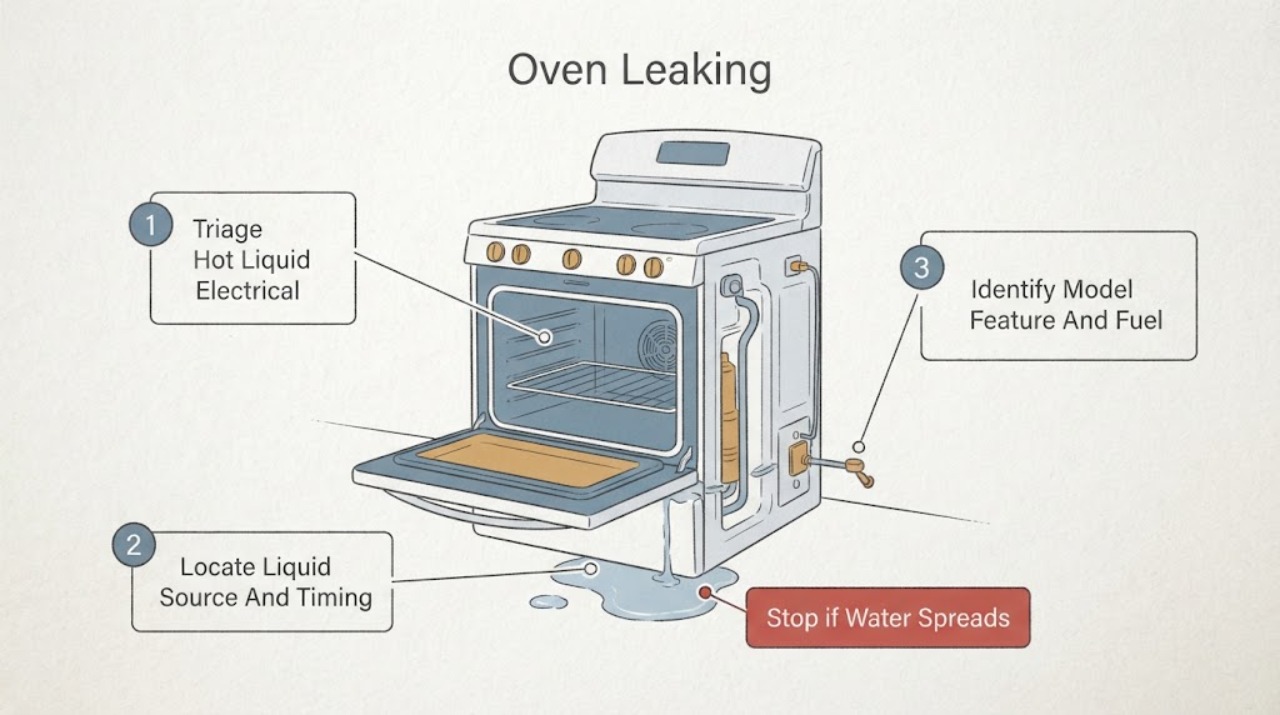
First keep hands away from hot liquid and isolate any electrical or gas danger. A Kenmore oven may leave moisture from steam, condensation, or a model-specific steam-clean or steam-bake feature, while food, cleaner, or a damaged door can make liquid appear to leak. Do not assume a conventional oven has a water line. Once the oven is cool and safe, record where the liquid starts, whether it follows a cleaning or steam cycle, and whether the model has a water reservoir. If liquid comes from behind the appliance, the door, a gas or water connection, or reaches electrical parts, stop using it and arrange qualified service.
Before you begin
Safety first
- Keep the oven cool and checks external. Heat, liquid, gas, and electricity can create burn, fire, shock, or combustion hazards. A suspected gas leak requires immediate evacuation and safe-location reporting; concealed leaks and internal repairs require qualified service.
Work through in order
Diagnostic checks
Use only checks that match the exact appliance or system and its official guide.
-
Check 1
From a safe position, determine whether the liquid is hot, whether it is near the plug, socket, controls, or wiring, and whether there is smoke, a burning smell, gas odor, soot, an abnormal flame, or delayed ignition. Do not touch liquid or electrical parts while hot or wet.
Expected result: Hot liquid, liquid near electrics, smoke, burning odor, gas odor, soot, abnormal flame, or delayed ignition is present; alternatively the oven is cool and no danger sign is visible.
Next step: If any danger sign is present, stop using the oven. Isolate power only from a dry, safely reachable disconnect and do not move the range; for gas odor or combustion danger, leave and contact emergency or gas help from a safe location. If no danger sign is present, wait until the oven is fully cool before observing the leak path.
Stop if: Stop immediately for gas odor, smoke, soot, abnormal flame, delayed ignition, burning smell, hot liquid, or water near electrical parts.
Why this matters
Why: A thermal, electrical, fire, or gas hazard takes priority over identifying the liquid source.
-
Check 2
After the oven is cool and safe, place a dry towel outside the appliance to track new moisture without opening panels, then record whether it starts at the cavity floor, inner door, door corners, lower drawer, side, or behind the oven and whether it appears during cooking, after cooling, after cleaning, or after a steam feature.
Expected result: Moisture is confined to the cavity or door after steam or cleaning, follows the door edge, pools in a drawer or on the floor, or begins behind the appliance.
Next step: If moisture is only surface residue after a documented feature, continue to the model-identity check. If it starts behind the appliance, enters a drawer, or returns during ordinary use, leave the oven off and arrange service.
Stop if: Stop if locating the source requires moving the oven, opening a panel, reaching behind hot equipment, or touching a gas or electrical connection.
Why this matters
Why: Location and timing separate condensation or a feature-related residue from a damaged seal, spill, installation issue, or internal water or gas-related fault.
-
Check 3
Read the full model number from the rating label without moving the oven, then use the Kenmore manual and product information to confirm whether the appliance is a standard oven, a gas or electric range, or a model with Steam Bake, Steam Clean, or a water reservoir. Do not fill any reservoir unless the manual explicitly says the model has one.
Expected result: The model has a documented steam or cleaning water feature, the model has no documented water feature, or the model identity cannot be confirmed safely.
Next step: If the feature is documented, follow only its manual for fill amount, placement, and post-cycle drying. If no water feature is documented, treat recurring liquid as a spill, condensation, door issue, or fault and arrange service if it persists. If the model cannot be confirmed, do not operate the feature and request model-specific support.
Stop if: Stop if the label requires moving the appliance, if the model is unreadable, or if confirming the feature would require opening the appliance or handling gas or electrical parts.
Why this matters
Why: Kenmore configurations differ: some cooking products advertise a water reservoir for steam, while other ovens have no user water path. A water feature cannot be assumed from a wet oven.
-
Check 4
With the oven cool, inspect the visible door gasket, inner door corners, cavity floor, racks, and lower drawer opening for a torn seal, a gap, food residue, or cleaner residue. Wipe only accessible surfaces with the model-approved method; do not remove the door or seal unless the exact manual authorizes it.
Expected result: The liquid follows a damaged or displaced gasket, carries food or cleaner residue from the door, or has no visible surface source.
Next step: If a loose accessible obstruction is covered by the manual, correct it and monitor after a cool, ordinary use only if no hazard exists. For a torn seal, damaged door or glass, liquid under the cavity, or recurrence with no visible cause, leave the oven off and arrange service.
Stop if: Stop for cracked glass, a hot or damaged gasket, liquid beneath the cavity, sharp edges, or any need to remove the door or interior panels.
Why this matters
Why: A door-seal gap can let steam and condensation escape, while residue can look like a leak. No surface source raises the need for qualified inspection.
-
Check 5
Compare the event with the manual's feature instructions: note whether a documented steam or cleaning cycle was selected, whether a reservoir was filled, whether liquid is clear or carries food or cleaner, and whether moisture appears during a normal dry bake with no water feature in use.
Expected result: Moisture occurs only after a documented steam or cleaning operation, only after a spill or residue, or during ordinary use without a relevant feature.
Next step: For a documented feature, allow the oven to cool and follow the exact cleanup and drying instructions once. For ordinary-use recurrence, pooling, or liquid from behind the unit, stop using the oven and provide the timing and source record to a technician.
Stop if: Stop for steam burns, cleaner fumes, liquid near controls, gas odor, smoke, or any need to dismantle a cleaning or steam system.
Why this matters
Why: Feature-related moisture and a spill can be handled through model-specific care, while repeated liquid during ordinary use suggests a seal, installation, internal component, or unrelated source that should not be guessed at.
-
Check 6
If the leak persists after the safe surface and model-feature checks, record the model, fuel type, liquid color and odor, exact source, cycle and temperature context, whether the door seals, and any smoke, gas, heat, or electrical symptom before contacting qualified service.
Expected result: The moisture stopped after a documented, low-risk cleanup, or it returns, pools, reaches electrics, comes from behind the appliance, or is accompanied by an unsafe symptom.
Next step: If unresolved, leave the oven out of service and contact Kenmore support or a qualified appliance technician. For gas odor, smoke, abnormal flame, or delayed ignition, leave immediately and contact emergency or gas help from a safe location.
Stop if: Do not move the range, remove panels, loosen gas fittings, probe wiring, relight a burner, or continue use when liquid, heat, odor, smoke, or electrical danger persists.
Why this matters
Why: Persistent or concealed liquid cannot be safely diagnosed by replacing a gasket or adding water based only on the complaint. Gas, water, electrical, and high-temperature systems require model-specific boundaries.
Use your observations
Decision map
Find the observation that best matches what you see, then follow the next safe action.
-
PATH 01Next step
What you see
Hot liquid, water near electrics, smoke, burning odor, sparks, damaged wiring, or a tripped breaker is present.
Do this next
Stop using the oven and isolate power only if dry and safely reachable. Keep clear and obtain qualified service.
-
PATH 02Next step
What you see
Gas odor, soot, abnormal flame, delayed ignition, or other combustion warning appears.
Do this next
Do not operate controls or electrical switches in the area. Leave immediately and contact gas emergency help or fire responders from a safe location; do not move or inspect the range.
-
PATH 03Next step
What you see
The exact manual confirms a steam or cleaning feature and moisture appears only after that feature.
Do this next
Follow only the model-specific reservoir, cooldown, and cleanup instructions. Persistent pooling or moisture outside the cavity needs service.
-
PATH 04Next step
What you see
Liquid follows the door edge or carries food or cleaner residue and no concealed source is visible.
Do this next
After cooling, clean only accessible surfaces with the model-approved method. A damaged seal, door, glass, or recurring liquid needs service.
-
PATH 05Next step
What you see
Liquid appears during ordinary use, pools under the cavity, enters a drawer, or starts behind the oven.
Do this next
Do not assume a water line or replace a part from the symptom. Leave the oven off and arrange qualified inspection without moving it.
Helpful context
Understand the symptom
A wet oven does not always have a plumbing leak
Water on or under an oven can come from steam or condensation, a water reservoir on a supported steam feature, cleaning-cycle residue, spilled food, or a door that does not seal. A conventional model may have no water path at all. The useful first observation is the source and timing: cavity floor, inner door, lower drawer, front corner, behind the unit, or a nearby wall; during cooking, after cooling, after cleaning, or after filling a model-specific reservoir.
Protect yourself from heat, electricity, and gas
Do not wipe hot liquid with bare hands or reach into a heated oven. If water is near a plug, outlet, controls, or wiring, keep clear and isolate power only if the disconnect is dry and safely reachable. If there is a gas odor, soot, abnormal flame, or delayed ignition, do not operate the oven or electrical switches; leave and contact gas emergency help or fire responders from a safe location. Do not move the range to inspect a connector.
Use the exact Kenmore manual
Kenmore's manual portal asks for the full model number and provides manuals for ovens and ranges. Use that manual to confirm whether your model supports steam bake, steam clean, a reservoir, a drain path, or a removable door seal. Do not transfer a reservoir-filling instruction, cleaning procedure, or part location from another Kenmore model.
When moisture is expected and when it is not
A small amount of moisture after a supported steam or cleaning function may be expected, but the manual should define how that feature is filled and cleared. Liquid that continues to pool, appears during an ordinary dry bake, enters a drawer, comes from behind the unit, or returns after wiping is not explained by a generic steam assumption. Treat persistent or unexplained liquid as a service issue.
Do not confuse food or cleaner with an appliance leak
Sticky, colored, or greasy liquid along the door edge may be food residue or cleaner rather than a water connection. Once the oven is fully cool and power is safely isolated if required by the manual, clean only the accessible surface using model-approved instructions. Do not flood the cavity, spray controls, remove panels, or use a sharp tool to clear a seal or drain.
When to arrange service
A technician should assess any leak from behind the oven, a damaged door or seal, a water-reservoir or steam system that leaks, liquid near electrical components, or a gas-related symptom. Give the service provider the model, liquid description, source and timing, cycle used, whether the oven was gas or electric, and any odor, smoke, flame, or electrical behavior.
Safety boundary
Stop conditions
- Stop for hot liquid, water near electrics, smoke, burning odor, sparks, damaged wiring, gas odor, soot, abnormal flame, or delayed ignition.
- Do not assume an ordinary oven has a water line; do not fill a reservoir without exact model instructions.
- Never move the appliance, loosen gas fittings, open panels, remove the door, or probe wiring to find a leak.
Only after diagnosis
Potential parts
- oven door gasket
Consider only if qualified diagnosis confirms a damaged or displaced gasket is allowing steam or liquid to escape at the door.
Confirm the complete model number and manufacturer fit information; do not replace the seal from moisture alone. - steam or cleaning system component
Consider only when the exact model has the feature and qualified diagnosis confirms a reservoir, valve, seal, or related component is leaking.
Many ovens have no water system; verify the documented feature and model-specific fit before any part decision.
When checks do not resolve it
Need a professional?
Call Kenmore support or a qualified appliance technician when liquid persists, comes from behind the oven, enters a drawer, reaches electrical parts, follows a damaged door or seal, or appears on a model without a documented water feature. For gas odor, abnormal flame, delayed ignition, smoke, or suspected combustion danger, leave immediately and contact emergency or gas help from a safe location.
Common questions
FAQ
Does water under a Kenmore oven always mean a plumbing leak?
No. It may be condensation, a spill, cleaning residue, or a model-specific steam feature. Check the exact model manual; persistent liquid, liquid from behind the unit, or water near electrics needs service.
Can I add water to my Kenmore oven to stop the leak?
No. Only use a water reservoir or steam feature when the exact model manual documents it and gives the procedure. Do not add water to an ordinary oven or flood the cavity.
What if liquid is coming from the oven door?
After the oven is cool, inspect the visible gasket and door edge for residue or damage. Clean only accessible surfaces as the manual allows; a torn seal, damaged door, or recurring liquid needs service.
Is it safe to use the oven if water is near the outlet?
No. Keep clear of wet electrical parts and stop using the appliance. Isolate power only if the disconnect is dry and safely reachable, then arrange qualified service.
What should I do if the leak is accompanied by a gas smell?
Do not operate the oven or electrical switches in the area. Leave immediately and contact gas emergency help or fire responders from a safe location; do not move the range or look for the leak.
Read the exact guide
Official sources
- Customer Care & Support | Kenmore AppliancesKenmore · Kenmore manuals, safety, warranty, and repair support routing
- Certain Older Gas Connectors May Be DangerousU.S. Consumer Product Safety Commission · Gas-appliance connector safety and suspected gas-leak response
- Ranges | Cooking | KenmoreKenmore · Kenmore range configuration and gas/electric product variation
- Cooking Appliances | Ranges, Ovens & More | KenmoreKenmore · Kenmore cooking-product feature identity, including model-dependent steam features
- Find Your Manual | Kenmore Appliance Manuals & GuidesKenmore · Kenmore model manuals and appliance resources for ovens and ranges
Community feedback
Share a repair observation
Share a plain-text repair observation. Accepted observations are published automatically; this page may take a moment to update.