
On this page
Start here
Quick answer
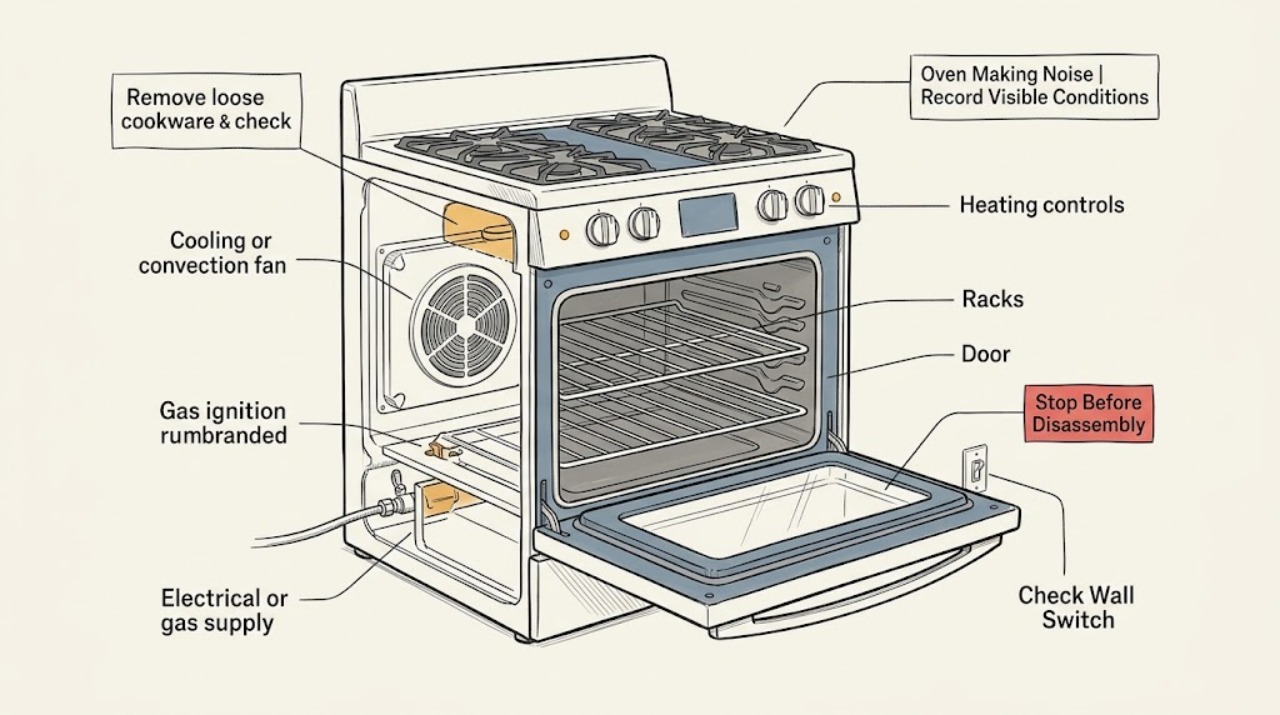
Record exactly when the sound starts, whether the oven is gas or electric, which mode is selected, whether the fan or burner is operating, and whether heat, smoke, an odor, or an error display accompanies it. A brief click or pop during a gas bake or broil ignition, a short fan or relay cycle, and mild expansion sounds can be normal on some models; a cooling fan may also continue after heating ends. A grinding, scraping, rattling, rapidly chattering, persistent electrical hum, loud vibration, or noise that changes with the door or fan needs closer inspection. With the oven off and cool, check only that racks, trays, and the door are seated and that the accessible vent is not blocked. Use the Kenmore model manual for the exact fan, control, and mode behavior. Do not remove panels or test wiring, igniters, relays, gas valves, or motors. Stop immediately for gas odor, hissing, delayed ignition, an abnormal or yellow flame, smoke, fire, burning or electrical smell, sparks or arcing, a damaged cord, uncontrolled heat, or a breaker that trips again; leave gas emergencies and energized or gas-system repairs to qualified professionals.
Work through in order
Diagnostic checks
Use only checks that match the exact appliance or system and its official guide.
-
Check 1
Write down the exact sound in plain words, when it begins and ends, whether it is one click, a short series, a hum, buzz, scrape, grind, rattle, pop, whoosh, or rhythmic chatter, and whether it changes with Bake, Broil, Convection, preheat, cool-down, the oven light, or the door. Record the model number, fuel type, display message, temperature, and whether heat is normal.
Expected result: A short sound tied to a specific heating or ignition event is more consistent with a normal operating component than a sound that is continuous, rapidly repeating, metallic, or independent of the selected mode. A sound with an odor, smoke, abnormal flame, or loss of heat is a safety or fault branch.
Next step: Use the model manual and the matching type-specific checks below. If the sound is hazardous or its source cannot be safely observed, stop rather than running another cycle.
Why this matters
Why: Noise diagnosis depends on timing and model behavior; similar words can describe a fan, gas valve, relay, expanding metal, loose rack, or a failing component.
-
Check 2
With the oven off and cool, remove loose cookware and check that racks, trays, and any removable panels listed by the manual are seated correctly. Check only the accessible oven vent and surrounding clearance for an object or obstruction; do not reach behind the appliance or into the fan shroud.
Expected result: A rattle that disappears when a loose rack or tray is reseated is likely an external fit issue. A scraping, grinding, or vibration that remains with the oven empty points toward a fan, motor, mount, or internal component rather than cookware.
Next step: Reseat only the accessible item and make one brief, supervised observation if there are no safety warnings. If the sound remains, do not remove covers; arrange service for an internal fan, motor, mount, or control diagnosis.
Why this matters
Why: Loose removable items can resonate when the fan or burner cycles, but they do not explain a gas odor, electrical smell, arcing, or an oven that cannot control heat.
-
Check 3
If the oven has convection or a cooling fan, note whether the sound follows fan start, changes speed, continues after the oven is switched off, or becomes a scrape or grind. Keep hands and tools away from the fan and do not operate the oven with a blocked vent or an exposed fan area.
Expected result: A smooth airflow sound or a fan that runs briefly during or after heating may be normal for that model. A new bearing-like grind, blade scrape, loose-object rattle, loud vibration, or fan that runs continuously while the oven is cool is not resolved by changing cooking temperature.
Next step: Compare the behavior with the Kenmore manual for the exact model. If the fan noise is harsh, persistent, or accompanied by overheating, smoke, or an error, leave the oven off and arrange qualified service.
Why this matters
Why: Fans and their controls can cycle as part of heat management, but abnormal mechanical noise or a fan that does not follow the model's documented behavior requires professional inspection.
-
Check 4
For a gas oven only when there is no gas odor or hissing, identify whether a brief click or pop occurs as the bake or broil burner ignites and whether the flame appears promptly and normally through the model's intended observation area. Turn the control off promptly; do not repeatedly ignite, relight, adjust the regulator, or remove burner parts.
Expected result: A short series of igniter clicks, a single valve pop, or a brief whoosh tied to prompt ignition can be a documented normal sound on applicable gas models. Continued clicking, delayed ignition, a loud bang, yellow or unstable flame, or noise with no flame is a gas or ignition fault and an immediate stop branch.
Next step: Turn the control fully off. For any delayed ignition, abnormal flame, odor, or repeated failure, stop using the oven and arrange qualified gas-appliance service without opening the gas path.
Why this matters
Why: Official gas-range guidance distinguishes normal ignition sounds from abnormal flame behavior, while the exact sequence and visibility vary by model.
-
Check 5
For an electric oven, note whether the sound is a single relay-like click at element cycling, a low hum that tracks heating, or rapid chatter from the control area. Check the display for an error and the external breaker only from a dry, safe position; do not open the control panel, terminal cover, or test live wiring.
Expected result: An occasional click synchronized with an element or control cycle may be normal, but rapid chatter, a loud persistent buzz, heat at the control area, a blank or flashing display, or a breaker trip indicates a control, supply, or wiring branch.
Next step: If a breaker trips again, the cord or outlet is hot or damaged, or the sound continues while the oven is not heating normally, leave it off and arrange electrical or appliance service.
Why this matters
Why: Heating controls can cycle elements, but a sound that is new, escalating, or associated with unstable power cannot be safely diagnosed by listening alone.
-
Check 6
After the safe observations, compare the sound with the model manual's normal-operation and troubleshooting descriptions. Record the mode, temperature, door position, fan state, heat result, exact code, and whether the sound stops when the oven is safely switched off and cool. Do not repeat a test to reproduce smoke, gas odor, sparks, a loud bang, uncontrolled heat, or a breaker trip.
Expected result: A documented normal sound with no adverse symptom can be monitored. A new or persistent sound, a sound from the control area, a recurring code, or a noise that continues after cool-down needs service even if the oven still heats.
Next step: Keep the oven out of use when the sound is unexplained or abnormal and provide the complete observation record to a qualified technician. Do not replace a fan, relay, igniter, valve, sensor, or control based on noise alone.
Why this matters
Why: Kenmore manuals are model-specific, and official range instructions direct recurring faults or abnormal flame conditions to qualified service rather than internal user repair.
Use your observations
Decision map
Find the observation that best matches what you see, then follow the next safe action.
-
PATH 01Next step
What you see
The sound is brief, tied to a documented bake/broil ignition, fan cycle, element cycle, or normal expansion event, and there is no odor, smoke, abnormal flame, or loss of control.
Do this next
Use the Kenmore manual to confirm the model-specific behavior and monitor it. Arrange service if the sound becomes louder, continuous, mechanical, or changes the oven's operation.
-
PATH 02Next step
What you see
A rattle disappears after a cool oven's accessible rack, tray, or other removable item is correctly reseated.
Do this next
Use the oven only if all items are secure and no other symptom exists. Do not remove panels to chase a rattle that remains or comes from the fan/control area.
-
PATH 03Next step
What you see
A scrape, grind, loud vibration, persistent hum, or rapid chatter follows a fan, motor, relay, or control area and remains after loose items are removed.
Do this next
Stop using the oven and arrange qualified appliance service. The noise alone cannot identify a safe replacement part or authorize opening the appliance.
-
PATH 04Next step
What you see
A gas oven has continued clicking, delayed ignition, a loud bang, yellow or unstable flame, no flame, gas odor, or hissing.
Do this next
Turn the control off if it is safe to do so, do not relight or operate switches in a gas-odor area, leave, and contact gas or emergency assistance from a safe location. Do not inspect or adjust the gas path.
-
PATH 05Next step
What you see
The display shows an error, the oven overheats or cannot turn off, the sound persists while cool, or the same noise returns after a documented reset.
Do this next
Leave the oven out of use and arrange qualified service with the exact code, model, mode, temperature, and timing of the noise. Do not bypass safety controls or repeatedly cycle power.
-
PATH 06Next step
What you see
There is smoke, fire, burning or electrical smell, sparks or arcing, a damaged cord, water near electrics, a cracked surface, uncontrolled heat, or a breaker that trips again.
Do this next
Stop immediately. Isolate power only from a safe, dry position and obtain qualified or emergency help; do not touch the hazard, open panels, or run another test. If gas may be involved, leave without operating electrical switches or phones in the area.
Helpful context
Understand the symptom
The timing of the sound is the first useful clue
A sound that happens only while preheating or while a gas burner lights is different from a scrape that follows the convection fan, a relay-like click that repeats rapidly, or a vibration that continues with the oven off. Note the model number, fuel type, cooking mode, door position, fan state, sound duration and rhythm, and whether the oven still heats. A Kenmore manual is the authority for that specific control and fan design.
Separate normal operating sounds from a hazard
Some brief clicking, valve popping, burner ignition, relay, fan, or metal expansion sounds can be normal on the applicable model. They are not normal when accompanied by gas odor, hissing, delayed ignition, abnormal flame, smoke, fire, burning or electrical odor, sparks, arcing, uncontrolled heat, a cracked or damaged surface, or repeated power trips. Do not keep running the oven to reproduce a dangerous sound.
When checks do not resolve it
Need a professional?
Arrange qualified appliance service for a new grinding, scraping, loud vibration, rapid relay chatter, persistent hum, recurring code, noise after cool-down, or any noise that changes heating or fan behavior., For gas models, stop immediately for gas odor, hissing, delayed ignition, loud ignition bang, no flame after a brief attempt, or an abnormal/yellow/unstable flame; do not relight or adjust gas components., Stop for smoke, fire, burning or electrical odor, sparks or arcing, a damaged cord, water near electrical parts, a cracked surface, uncontrolled heat, or a breaker that trips again. Isolate power only when safely reachable., Do not remove the control panel, fan cover, burner, igniter, relay, gas valve, or wiring, and do not diagnose or replace an internal part from the sound alone.
Common questions
FAQ
Is a clicking sound from a Kenmore oven normal?
A brief click tied to an element or documented gas ignition cycle can be normal on some models. Rapid chatter, continuous clicking, clicking without prompt ignition, or clicking with gas odor, a code, smoke, or abnormal heat requires stopping and service.
Why does my oven make a pop or whoosh during heating?
On applicable gas models, a valve pop or brief whoosh can occur when a bake or broil burner ignites. A loud bang, delayed ignition, abnormal flame, or repeated failed ignition is not a normal test result; turn the control off and arrange qualified service.
Why does my Kenmore oven fan keep running after I turn it off?
A cooling fan may continue while components cool, depending on the model. Compare the duration and behavior with the Kenmore manual. Grinding, scraping, continuous running while cool, overheating, or an error needs service.
Can a loose oven rack cause a rattling noise?
Yes, a loose rack or tray can rattle as the oven or fan operates. With the oven off and cool, reseat accessible items once. If the noise remains or comes from the fan or control area, do not remove panels; arrange service.
What should I do if the oven makes an electrical buzzing or relay noise?
Note whether it follows an element cycle and check the external breaker only from a dry, safe position. Rapid chatter, a hot or damaged cord, smoke, electrical odor, or a breaker that trips again means stop immediately and obtain qualified help; never open the control panel.
What should I do if I smell gas while investigating an oven noise?
Do not operate switches, appliance controls, phones, flames, or engines in the area. Leave, keep others away, and contact emergency or gas assistance from a safe location. Do not return or test the oven until professionals say it is safe.
Read the exact guide
Official sources
- Kenmore ManualsKenmore · Kenmore model-specific oven, range, and stovetop manuals and troubleshooting resources
- Recognizing and Responding to Pipeline EmergenciesU.S. Department of Transportation, Pipeline and Hazardous Materials Safety Administration · Natural-gas odor emergency precautions, ignition-source avoidance, evacuation, and safe-location reporting
- Gas Range User InstructionsWhirlpool · Gas-range normal operating sounds, ignition timing, fan relay cycling, flame observations, and model-manual safety boundaries
Community feedback
Share a repair observation
Share a plain-text repair observation. Accepted observations are published automatically; this page may take a moment to update.