
On this page
Start here
Quick answer
Treat a Kenmore oven that will not turn off as an active heating and safety problem before treating F1 as a diagnosis. If the oven is heating and the controls do not stop it, use the dedicated breaker only from a safe, dry location and only when there is no smoke, flame, gas odor, water, or other immediate danger; do not keep pressing keys or try to reproduce the fault. If gas odor, smoke, sparks, or flames are present, leave the area and follow emergency guidance instead of operating switches. Once the oven is safely off and cool, photograph the exact display and obtain the complete model number. Kenmore's manual library requires a model-driven lookup, and F1 meanings and user reset steps can differ by platform; without that model, do not assign F1 to a control board, sensor, latch, or other part.
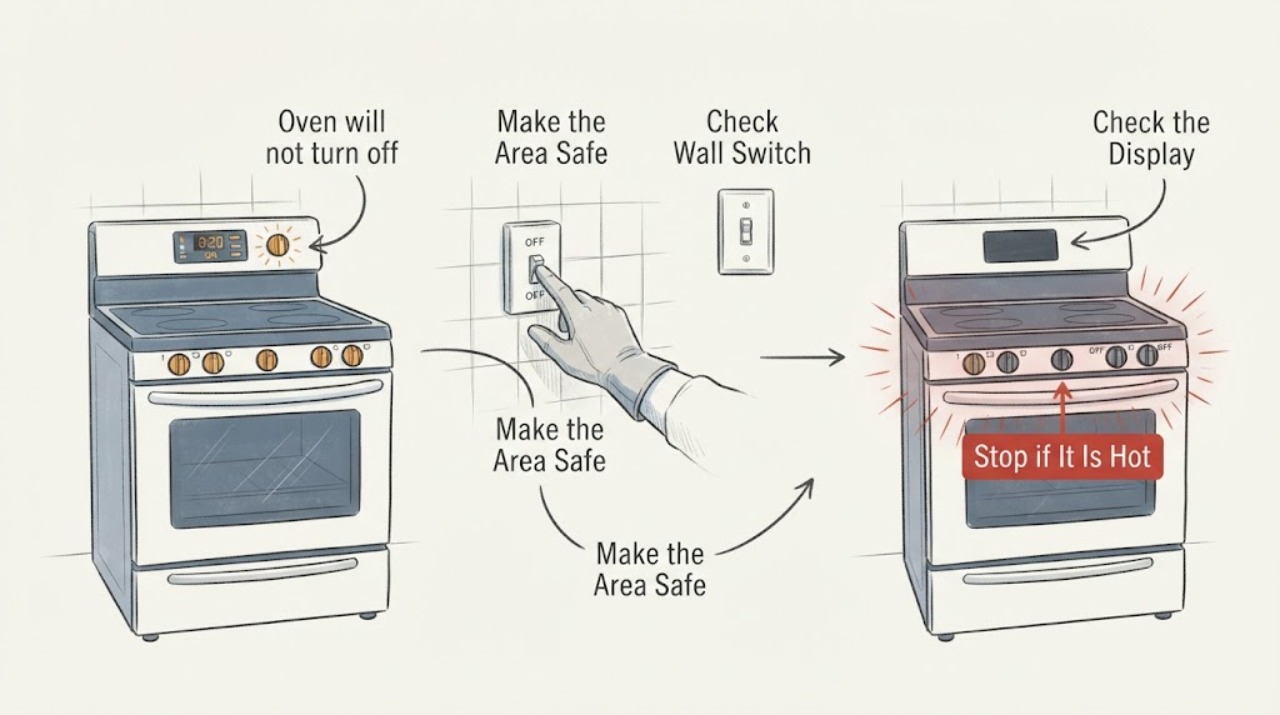
Work through in order
Diagnostic checks
Use only checks that match the exact appliance or system and its official guide.
-
Check 1
From a safe distance, observe whether the oven is actively heating, whether smoke or flame is visible, whether a burning odor or gas odor is present, and whether the controls or surrounding area show abnormal heat, sparks, melted material, water, or damaged insulation. Do not touch a suspected hot control or open the oven door to investigate a fire.
Expected result: There is no immediate hazard, the oven is hot or still heating without an obvious fire, or smoke, flame, gas odor, sparks, water, or abnormal heat is present.
Next step: For smoke or flames, leave the area and use emergency help if flames escape or anyone is at risk. For gas odor, leave without operating electrical switches and contact local emergency or gas authorities. For a hot, sparking, wet, or damaged electrical condition, keep clear and obtain urgent qualified help.
Stop if: Do not press more keys, reset the appliance, inspect wiring, or approach the oven when smoke, flames, gas odor, sparks, or unsafe heat is present.
Why this matters
Why: An oven that will not turn off while heating needs a shutdown decision; smoke, flame, gas odor, and electrical signs override code research. The fuel type is not known, so the safe branch must remain conditional.
-
Check 2
If there is no smoke, flame, gas odor, water, or electrical danger and the control is responding normally, press the model's visible Cancel, Clear, or Off control once. Watch from a safe position to see whether heating stops; do not keep pressing controls or start another cooking or cleaning cycle.
Expected result: The oven stops heating and the display changes normally, the control does not respond, the display still shows F1 while heating continues, or a different hazard appears.
Next step: If heat continues or the control is unresponsive, move to the safe-disconnect branch and keep the oven out of service. If a hazard appears, stop all interaction and follow the emergency branch; do not attempt a second control sequence.
Stop if: Do not test Bake, Broil, Self Clean, or any other heating function to see whether the oven will stop later.
Why this matters
Why: A single normal stop response is not proof that F1 is resolved. Continued heating or an unresponsive control means the oven is not under reliable user control, regardless of the code's eventual meaning.
-
Check 3
If heating continues after the one normal stop attempt and there is no immediate hazard, identify the dedicated oven circuit from a dry, safe position and switch that breaker off. Do not enter water, reach around a hot appliance, remove a cover, or approach the electrical panel if doing so is unsafe; never use an extension cord or improvised disconnect.
Expected result: The breaker is safely accessible and the oven loses its display or heating, the breaker trips again, or the disconnect cannot be reached without approaching danger.
Next step: Leave the breaker off and arrange qualified Kenmore appliance service; arrange qualified electrical help if the breaker or connection is hot, damaged, or trips again. If the disconnect is unsafe to reach, leave the area and use emergency or professional help instead of entering the hazard.
Stop if: Do not repeatedly reset the breaker, bypass protection, open the control console, or perform a live voltage test.
Why this matters
Why: Removing supply from a safe location stops an uncontrolled heating appliance without claiming that F1 has a particular cause. A repeated trip or inaccessible disconnect is an electrical/service boundary rather than a cue to keep trying.
-
Check 4
Only after the oven is safely off and cool, photograph or transcribe the display exactly: F1 versus F-1, added digits or letters, flashing or steady state, beeps, and whether the code appeared at idle, during heating, after a power event, or during Self Clean. Record whether Cancel responded and whether heat actually stopped.
Expected result: The display is a stable F1, an alternate code or message, an incomplete approximation, or no longer visible after power was removed.
Next step: Keep the photo and timeline for service. Do not restore power merely to reproduce the code, and do not interpret a blank display after disconnect as proof of a repaired oven.
Stop if: Do not enter diagnostic/service mode, run Self Clean, or repeatedly power the oven to capture another code.
Why this matters
Why: Exact characters and timing are needed to match the correct manual. An approximate F1 from an unknown platform cannot distinguish a user message from a control, sensing, latch, or heating fault.
-
Check 5
Find the complete Kenmore model number from the normal rating-label location or existing purchase/service records without moving a built-in oven or removing a panel. Enter the complete number into Kenmore's official manual library and confirm that the result is an oven/range manual for the same control layout and fuel type.
Expected result: The complete model is readable and matches one manual, the number is shorter/incomplete, or multiple platform documents appear.
Next step: Use only the manual matching the complete model. If no exact manual can be confirmed, leave the oven out of service and give the code photo, fuel type if known, and model-label evidence to Kenmore support or qualified appliance service.
Stop if: Do not infer the missing characters, choose a manual by appearance, or order a control, sensor, latch, or keypad from F1 alone.
Why this matters
Why: Kenmore's manual lookup is model-driven; the Kenmore brand and a partial number do not establish the F1 table, reset procedure, fuel system, or compatible part.
-
Check 6
With the exact manual available and the oven cool, read its F1 entry and its user-level instructions for Cancel/Clear, lock state, power interruption, or service. Compare the manual's wording with the recorded stop response, heating state, door state, keypad response, and any breaker event; do not use an online code list from another model.
Expected result: The manual identifies a user-clear condition, allows one limited reset, directs service, or does not contain the exact F1 format.
Next step: Follow a user step only if the exact manual explicitly permits it and there is no heat, gas, odor, or electrical warning. Otherwise keep the oven off and arrange qualified service with the complete model and event record.
Stop if: Do not substitute a platform-specific F1 definition, enter service mode, repeat a reset, or open the control console to confirm a suspected board or sensor.
Why this matters
Why: Only the matching manual can establish whether a user step is allowed. A code that returns, an oven that will not stop, or a manual mismatch remains unresolved even if the display temporarily clears.
Use your observations
Decision map
Find the observation that best matches what you see, then follow the next safe action.
-
PATH 01Next step
What you see
The oven continues heating after one normal Cancel/Clear/Off attempt, the keypad is unresponsive, or the display still shows F1 while heat continues.
Do this next
If safe and dry to reach, switch off the dedicated breaker and leave it off; arrange qualified appliance service. Do not restore power to test another cycle.
Why this path and its safety boundary
Why it matters: The oven is not under reliable user control. F1 remains an unresolved symptom and cannot be used to select a part.
-
PATH 02Next step
What you see
Smoke, flames, gas odor, sparks, water near electrical parts, abnormal heat, or damaged insulation is present.
Do this next
Leave the area. For an oven fire, keep the door closed and call emergency services if flames escape; for gas odor, do not operate switches and contact emergency or gas authorities from outside; for electrical danger, use only a safe remote disconnect or qualified help.
Why this path and its safety boundary
Why it matters: This is an immediate fire, gas, burn, or electrical hazard, not a code-reset problem.
-
PATH 03Next step
What you see
The oven is cool and disconnected, the exact display is documented, and the complete model number matches an official Kenmore oven manual.
Do this next
Follow only the matching manual's explicitly permitted user step, if any. If F1 returns or the not-turning-off symptom recurs, stop and provide the complete record to qualified service.
Why this path and its safety boundary
Why it matters: The identity and event record are now sufficient to check whether F1 has a documented user action or is service-only for that platform.
-
PATH 04Next step
What you see
The code is only approximately remembered, the model number is incomplete, or the available manual is for a different fuel type, control layout, or platform.
Do this next
Keep the oven disconnected and obtain the complete model through Kenmore support or qualified service. Do not order parts or retry the oven to improve the match.
Why this path and its safety boundary
Why it matters: The F1 meaning and any reset or part implication are unverified; applying another platform's instructions could leave an uncontrolled oven energized.
-
PATH 05Next step
What you see
The oven stops normally, no hazard is present, the exact model manual says the display was a temporary/user-cleared condition, and F1 does not return.
Do this next
Do not run a long or high-heat confirmation cycle. Record the event, keep the manual and code photo, and arrange service if any F1, heating, control, door, or breaker symptom returns.
Why this path and its safety boundary
Why it matters: The event may have cleared, but a single clear does not prove the control, sensor, latch, or heating system is healthy after a not-turning-off complaint.
Helpful context
Understand the symptom
F1 cannot be decoded safely from the Kenmore name alone
Kenmore's official manual page says to enter the appliance model number and notes that model numbers are at least 11 characters long. The task does not provide a complete model, fuel type, or control platform. F1 is therefore a display clue, not a universal Kenmore meaning. A code list for another Kenmore platform, a Frigidaire-family appliance, or a similar-looking range cannot establish what this oven's F1 means or which part fits.
The inability to turn off changes the order of work
The first decision is whether heat, gas, smoke, or electrical danger is active. A normal Cancel or Off response is different from an oven that continues heating, and both are different from a fire or gas leak. All checks below are deliberately external and model-neutral. Do not open the control console, enter a service mode, remove a latch, test wiring, or run self-clean while the F1 identity remains unresolved.
When checks do not resolve it
Need a professional?
Keep the Kenmore oven out of service and arrange qualified appliance service when it will not stop heating, F1 returns, the keypad or display is unresponsive or unstable, the door is locked or will not latch, the exact model manual cannot be confirmed, or the breaker trips again. Switch off the dedicated circuit only from a safe, dry location and only when no gas, smoke, flame, water, or electrical danger makes access unsafe. Leave immediately for gas odor or escaping flames, and use emergency help for smoke, fire, sparks, or immediate electrical danger. Do not run Self Clean, enter service mode, remove the control console, bypass a latch, test live wiring, or choose a part from F1 alone.
Common questions
FAQ
What does F1 mean on a Kenmore oven?
There is no safe universal answer without the complete model number and fuel/control platform. Kenmore directs owners to its model-driven manual library. Treat F1 as an unresolved display symptom, especially when the oven will not turn off, and do not use another model's code table.
What should I do if the oven keeps heating after I press Cancel?
If there is no smoke, flame, gas odor, water, or electrical danger and the dedicated circuit is safely accessible, switch off that breaker and leave it off. Do not keep pressing keys or restore power to test it. If access is unsafe or a hazard is present, leave the area and obtain emergency or qualified help.
Can I reset the oven or enter a diagnostic mode to clear F1?
Only follow a reset that the exact Kenmore manual explicitly permits after the oven is safely off and cool. Do not enter service mode, repeat power cycles, run Self Clean, or open the control console while the model and F1 format are unverified.
What if I smell gas while the oven shows F1?
Do not operate electrical switches or try to relight or diagnose the appliance. Leave the building and contact local emergency or gas authorities from outside. Do not return until authorities say it is safe.
Read the exact guide
Official sources
- Find Your Manual | Kenmore Appliance Manuals & GuidesTransform SR Brands LLC (Kenmore) · Official Kenmore manuals page covering ovens and ranges; it requires the model number and states that model numbers are at least 11 characters long, so an F1 code must be matched to the complete model rather than generalized.
- Appliance and Electrical Fire SafetyU.S. Fire Administration, FEMA · Official USFA guidance covers major-appliance direct connection, damaged cords, outlet safety, and avoiding extension-cord workarounds.
- Guidelines for Cleaning Safely After a DisasterCenters for Disease Control and Prevention · Official CDC guidance says to leave immediately for gas odor or suspected leak, avoid lights/switches/sparks, and avoid electrical operation while standing in water.
- Pictographs: CookingU.S. Fire Administration, FEMA · Official USFA guidance says to turn off an oven for an oven fire, let contents cool before cleaning, and leave/call 911 if flames escape.
- Customer Care & Support | Kenmore AppliancesTransform SR Brands LLC (Kenmore) · Official Kenmore customer-care page routes owners to support, product manuals, safety/compliance, and appliance repair; it does not publish an F1 definition.
Community feedback
Share a repair observation
Share a plain-text repair observation. Accepted observations are published automatically; this page may take a moment to update.