
On this page
Start here
Quick answer
Do not force a Kenmore freezer drawer that stops after 6–8 inches, and do not pry at ice with a knife, heat the cabinet, or keep pulling against the rails. First stop and look only at the visible drawer opening for a package, ice, frost, water or a displaced gasket that is physically blocking the travel. Moisture can be a clue, but without the refrigerator's full model number it does not identify a drain, seal, rail or defrost fault. Keep the drawer closed as much as possible to protect food, identify the model, and use the matching Kenmore manual or service route before removing panels or rails.
Before you begin
Safety first
- Do not force the drawer, chip ice with sharp tools, use boiling water or improvised heat, remove rails/panels, bypass a gasket or switch, or work on wiring, refrigerant or sealed cooling components.
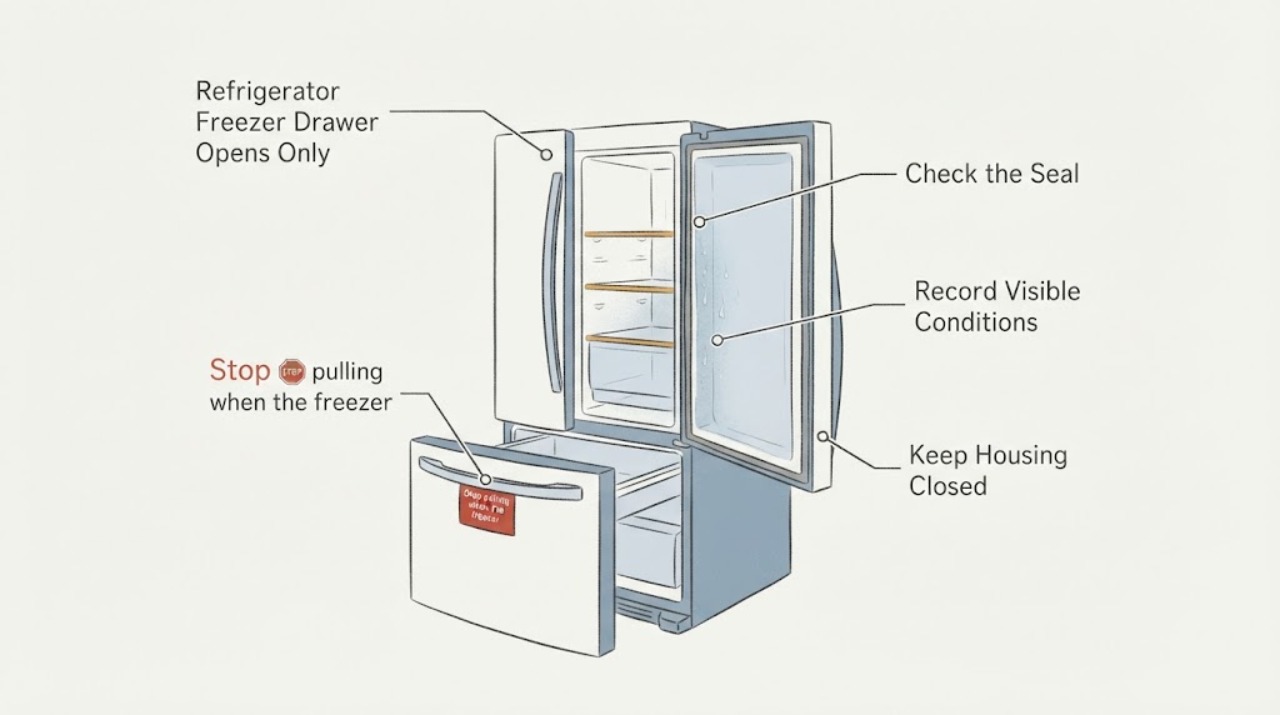
Work through in order
Diagnostic checks
Use only checks that match the exact appliance or system and its official guide.
-
Check 1
Stop pulling when the freezer drawer reaches the 6–8 inch bind point. Do not pry ice, use a sharp tool, pour boiling water, remove an unknown rail, or repeatedly pull against the handle.
Expected result: The drawer binds hard, the front twists, the rail is visibly bent, or the gasket is being pulled out of position.
Next step: Keep the drawer closed as much as possible, preserve food temperature, and use the exact Kenmore manual or appliance-service route before further access.
Why this matters
Why: Force can turn an obstruction or ice condition into rail, drawer-front or gasket damage; the symptom does not identify a specific failed component.
-
Check 2
With the drawer stopped, inspect only the visible opening for a package, loose bin, liner, frost, pooled water or folded gasket. Remove a plainly loose package only if it can be lifted without force and without reaching behind panels.
Expected result: A visible item or ice sheet blocks the front path, or nothing visible explains the stop.
Next step: Correct only the plainly loose obstruction. If ice, water or an unexplained stop remains, stop access and use the exact model manual/service route.
Why this matters
Why: A visible obstruction may explain the limited travel, while no visible obstruction means the internal layout cannot be inferred from the symptom.
-
Check 3
Record where moisture or frost appears and whether the drawer can close fully: front edge, gasket, side wall, floor, under food, or behind the visible opening. Note any temperature warning or softening food.
Expected result: Moisture is isolated to a package/condensation area, or there is recurring frost/water, a closure gap or rising temperature.
Next step: Keep the drawer closed and arrange service promptly for recurring frost/water, a closure gap, damaged gasket or temperature loss; do not defrost with improvised heat.
Why this matters
Why: The pattern helps service distinguish a loading/closure observation from a model-specific ice, drain or sealing issue, but it does not prove a drain or rail failure.
-
Check 4
Locate the refrigerator model and serial label without removing panels, then search the exact model through Kenmore's manual and customer-care route.
Expected result: The full model is readable, or the label is missing/illegible.
Next step: Follow only the matching manual or schedule Kenmore/appliance service. If the identity cannot be confirmed, do not order a rail, gasket or drawer assembly from a generic symptom.
Why this matters
Why: A full model is required because drawer rails, seals, access points and moisture paths vary across Kenmore configurations.
Use your observations
Decision map
Find the observation that best matches what you see, then follow the next safe action.
-
PATH 01Next step
What you see
The drawer twists, the gasket tears, the drawer cannot close, or frozen food is softening while the opening remains restricted.
Do this next
Stop handling the drawer, keep the refrigerator closed, protect food temperature safely and contact appliance service with the model label.
Why this path and its safety boundary
Why it matters: Continuing to pull can damage the drawer/seal and a closure or temperature problem needs prompt attention.
-
PATH 02Next step
What you see
A package, bin, loose liner, frost sheet, water or folded gasket is visible at the first 6–8 inches.
Do this next
Remove only a plainly loose item without force; otherwise stop and use the exact model manual/service route.
Why this path and its safety boundary
Why it matters: The visible item may be limiting travel, but the observation does not prove a rail, drain or defrost component fault.
-
PATH 03Next step
What you see
Nothing visible blocks the drawer, or moisture/frost returns, the drawer still stops, the gasket has a gap, or temperatures rise.
Do this next
Keep the drawer closed and schedule Kenmore or qualified appliance service; do not remove panels, rails or refrigerant-system components based on a guess.
Why this path and its safety boundary
Why it matters: The cause is beyond a safe generic visual check and may depend on the refrigerator's model-specific drawer, seal, drainage or cooling design.
Helpful context
Understand the symptom
Stop before the drawer or rails are damaged
Release the handle and let the drawer stop. Do not yank it past the point where it binds, use a screwdriver or knife to chip ice, pour boiling water into the compartment, or remove a rail or panel while the model is unknown. If the drawer cannot close, keep the refrigerator closed as much as possible and protect perishable food using a safe, temperature-preserving plan; a rising temperature or damaged gasket needs prompt service.
Inspect only what is visible at the opening
With the drawer stopped, use a flashlight to look at the first 6–8 inches: a food package, bin, loose liner, sheet of frost, pooled water or gasket folded into the path. Check whether the drawer front is square and whether the gasket is visibly displaced. Do not assume the obstruction is a drain, rail, evaporator or motor, and do not reach behind a panel to prove a theory.
Treat moisture as evidence to record, not a diagnosis
Record where moisture is seen—on the drawer front, floor, side wall, gasket or under food—and whether there is frost, an open gap or a package holding the drawer ajar. Note the refrigerator and freezer temperatures if they are available. These observations help a technician choose the correct manual; they do not establish that one drain, seal or drawer rail has failed.
Find the exact model before any removal step
Photograph or transcribe the rating label without moving the refrigerator or opening cabinet panels. Kenmore's official site provides product manuals, customer care and repair links, but Kenmore refrigerators use different layouts. Search the exact model in Kenmore's manual route and follow only that guide; if the drawer still stops, the gasket is torn, frost returns, or the refrigerator cannot hold temperature, schedule appliance service.
When checks do not resolve it
Need a professional?
Arrange service when the drawer still stops after a plainly loose front obstruction is removed, when frost or moisture recurs, the gasket is damaged, the drawer cannot close, food temperature is rising, or the model cannot be identified for a safe manual procedure.
Safety scope: Do not force the drawer, chip ice with sharp tools, use boiling water or improvised heat, remove rails/panels, bypass a gasket or switch, or work on wiring, refrigerant or sealed cooling components.
Have this ready
- Provide the complete model and serial label, drawer opening distance, moisture/frost location, whether the drawer closes and seals, temperature observations, photos of visible conditions, and whether any item was found blocking the opening.
Common questions
FAQ
Can I pull harder to get past the 6–8 inch point?
No. Stop when the drawer binds. Look only for a plainly visible package, frost, water or gasket obstruction; forcing the drawer can damage the rails, front or seal.
Does moisture prove that the defrost drain is blocked?
No. Moisture may be relevant, but without the exact model and a view of the affected area it does not distinguish condensation, a closure gap, ice, drainage or another path. Use the matching manual or service route.
Where do I find the correct drawer-removal instructions?
Use the full model number in Kenmore's official product-manual route or contact customer care. Do not transfer rail or drawer steps from another Kenmore configuration.
Read the exact guide
Official sources
- Refrigerators | Refrigeration | KenmoreKenmore · Opened official Kenmore refrigerator category. It demonstrates that Kenmore offers multiple refrigerator configurations and links to manuals/repairs; it does not establish a universal drawer or moisture layout.
- Customer Care & Support | Kenmore AppliancesKenmore · Opened official Kenmore customer-care page. It supports model lookup and service escalation, not a model-independent drawer-removal or moisture diagnosis.
Community feedback
Share a repair observation
Share a plain-text repair observation. Accepted observations are published automatically; this page may take a moment to update.