
On this page
Start here
Quick answer
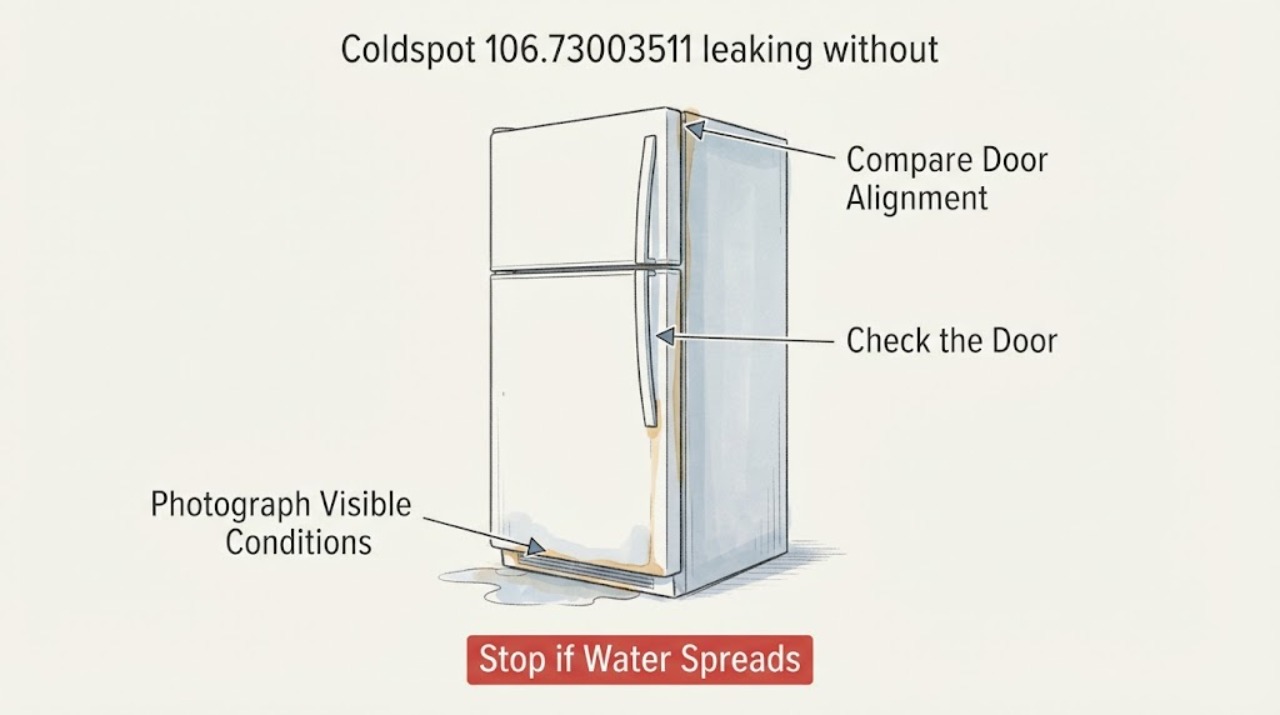
If a Kenmore Coldspot 106.73003511 is not connected to a household water line, do not start by blaming an inlet valve, filter, dispenser, or ice-maker supply. First dry the area and identify the first wet point: a shelf or container, the freezer floor or rear interior, under the front, or behind the cabinet. Water on a shelf can be a spill or condensation from a warm container; freezer-floor water or repeated puddling with no connected water line makes a defrost-drain or drain-pan path more relevant; water behind the refrigerator still requires checking for an unrelated external source. Kenmore says to use the complete model number to find the matching manual, while the official refrigerator guidance used here is general and does not establish this old model's hidden layout. Keep the appliance off if water reaches electrical parts, do not tip it or remove panels, and arrange qualified service when the water returns or the source is inaccessible.
Work through in order
Diagnostic checks
Use only checks that match the exact appliance or system and its official guide.
-
Check 1
Keep people and food clear of the water. If water reaches an outlet, cord, plug, or other electrical part, or there is smoke, burning odor, sparking, or a repeated breaker trip, stop using the refrigerator and isolate power only from a dry, safe position. Otherwise dry the floor and compartments, photograph the model label as 106.73003511 with any suffix, and do not move the appliance yet.
Expected result: The model is confirmed, the refrigerator is not connected to household water lines, and water is present without an electrical hazard, or a hazard/identity uncertainty is present.
Next step: For a hazard, keep the appliance isolated and arrange prompt qualified appliance or electrical help. For a confirmed model without a hazard, continue with a first-wet-point and timing map.
Stop if: Do not touch a wet plugged-in appliance, repeatedly restore power, tip a heavy refrigerator, or open a panel.
Why this matters
Why: The no-hookup condition removes a connected supply line as the first assumption, but it does not identify the remaining source. A hazard changes the task from leak tracing to immediate safety response.
-
Check 2
Place dry tissue or a towel at separate accessible points without pulling the refrigerator out: inside the refrigerator compartment, on the freezer floor, under the front edge, and beside any visible rear edge. Note which point wets first and whether water returns while the unit simply sits, after a door was left open, after a defrost period, or after a spill.
Expected result: Water first appears on a shelf or container, inside the freezer, beneath the front, behind the cabinet, or at no repeatable point.
Next step: Photograph the first wet point and use the corresponding branch below. Do not run extra defrosts, pour water into a drain, or repeatedly open doors to provoke another leak.
Stop if: Keep water away from outlets and wiring, and stop if the first wet point is behind a panel or beneath the cabinet.
Why this matters
Why: A shelf/container point supports a spill or condensation branch; freezer or under-front recurrence supports a drain or pan investigation; a rear point needs an external-source check even if the refrigerator itself is not connected to water; an unrepeatable point may be a room or cleaning source.
-
Check 3
For water on a shelf or in a drawer, remove only the container or package after the appliance is dry and inspect it for a crack, spill, warm contents, uncovered liquid, or condensation. Check the visible door gasket and closure for an obstruction, but do not pull the seal, adjust hinges, or remove interior panels.
Expected result: The water stays limited to one container or shelf and does not return after drying, or water returns without that container/event and the seal appears normal or damaged.
Next step: Correct only the container, cover liquids, and let hot food cool before storage. If water returns with no spill/condensation explanation, keep the refrigerator dry and arrange model-specific service.
Stop if: Do not use chemicals, pry a drain, reshape a gasket with heat, or continue if water reaches electrical parts.
Why this matters
Why: Whirlpool's official refrigerator guidance says condensation can accumulate on a container after warm food is added and drip on a shelf. Recurrence without a container explanation makes an internal drain, seal, or other source more likely, but not a specific part.
-
Check 4
If water returns inside the freezer or at the front underside, note any frost on the rear wall, water or ice on the freezer floor, dripping sound during a defrost period, or a pan overflow visible without moving the refrigerator. Follow only an accessible care step in the exact Kenmore manual; do not remove the rear wall, chip ice, pour boiling water or chemicals, use a hair dryer, or probe a drain.
Expected result: Frost or water repeatedly gathers at the freezer floor or under-front area, the visible pan is cracked/overflowing, the area is dry after a one-time humidity event, or the source is hidden.
Next step: Protect food and flooring, use only the exact manual's natural-defrost or cleaning instruction if explicitly provided, and arrange appliance service when the drain/pan is hidden, returns, or requires panel access.
Stop if: Do not remove evaporator covers, chip ice, apply direct heat, pour unapproved liquids, or access energized parts.
Why this matters
Why: Repeated meltwater at a freezer floor or under-front area makes a blocked/frozen drain or drain-pan path more plausible than a disconnected water supply. A one-time light condensation event may be normal, while a hidden or recurring source needs service diagnosis.
-
Check 5
Inspect only the room-side and visible rear area that can be seen without pulling the appliance: wall condensation, a nearby sink or plumbing source, floor slope, a wet container, or a visibly damp cabinet edge. Do not assume a rear puddle is an appliance water line when the refrigerator has no hookup, and do not move the refrigerator alone.
Expected result: A nearby external source is wet, the cabinet is wet with no external source, water is reaching flooring, or the rear area cannot be safely viewed.
Next step: Correct only the plainly visible external source. Otherwise keep the refrigerator off or dry as appropriate and provide the model, first-wet-point photo, timing, and frost observations to qualified service.
Stop if: Do not pull, tip, slide, or disconnect the refrigerator, and do not work near the power cord or rear electrical components.
Why this matters
Why: An unrelated room or plumbing source can mimic a refrigerator leak. A cabinet-side or inaccessible source remains an appliance-service problem even without a water hookup; it cannot be safely assigned to a valve, pan, drain, or seal from outside.
Use your observations
Decision map
Find the observation that best matches what you see, then follow the next safe action.
-
PATH 01Next step
What you see
Water is limited to a shelf or container and stops after the container is removed and the area is dried, with no water returning while the refrigerator sits.
Do this next
Correct the container or moisture habit and monitor. Reclassify it as an appliance leak if water returns without that event.
Why this path and its safety boundary
Why it matters: A spill, cracked container, or condensation from a warm item is more likely than an appliance water leak. Official guidance specifically identifies warm-container condensation as a shelf-drip source.
-
PATH 02Next step
What you see
Water or ice repeatedly appears on the freezer floor or under the front, while no household water line is connected and no shelf spill explains it.
Do this next
Protect food and flooring and arrange qualified Kenmore refrigerator service. Follow an internal drain or pan procedure only if the exact manual explicitly authorizes it; otherwise do not remove panels or apply heat.
Why this path and its safety boundary
Why it matters: A defrost-drain or drain-pan path is more plausible than an inlet valve, filter, dispenser, or ice-maker supply. The exact hidden layout and access for 106.73003511 are not established by the general guidance.
-
PATH 03Next step
What you see
Water is first found behind the refrigerator even though it is not connected to household water, or a nearby wall/floor source is also wet.
Do this next
Correct only a clearly visible external source. Do not pull the refrigerator alone; have qualified service inspect an appliance-side source or a plumber inspect a room-side source.
Why this path and its safety boundary
Why it matters: An unrelated plumbing, cleaning, condensation, or room source is possible, and the absence of a hookup makes a refrigerator supply-line explanation less likely. If the cabinet itself is wet, an internal appliance source still needs service.
-
PATH 04Next step
What you see
The exact first wet point cannot be found, water returns after drying, or frost/ice buildup is recurrent or affects airflow.
Do this next
Keep the appliance dry and food protected, stop improvised defrost or movement, and request model-specific service with photos, timing, and the full model label.
Why this path and its safety boundary
Why it matters: The leak has crossed the safe external-observation boundary. The exact-model public report also shows that frost and airflow symptoms can coexist on this model, but does not prove a drain or fan diagnosis.
-
PATH 05Next step
What you see
Water reaches an outlet or electrical component, or there is smoke, burning odor, sparking, exposed wiring, repeated breaker operation, flooding, or an unusually hot cabinet.
Do this next
Stop using the refrigerator, isolate power only from a dry safe position, keep clear, protect food, and seek prompt qualified appliance or electrical help.
Why this path and its safety boundary
Why it matters: This is an electrical, fire, water-damage, or injury emergency rather than an ordinary refrigerator leak check.
Helpful context
Understand the symptom
The supplied identity is Kenmore Coldspot 106.73003511. Kenmore's official manuals page requires the complete model number to retrieve the matching literature, so do not borrow a drain or panel procedure from another Kenmore refrigerator. The report that this unit is not hooked to household water is a meaningful boundary: an inlet line, dispenser, filter, or ice-maker feed is not the default source until a connected or stored water source is actually found.
Start by finding where the water first appears and what event precedes it. Official refrigerator guidance separates water on a shelf, normal condensation, floor leaks, and water-supply connections. On a unit with no water hookup, a shelf spill, warm-container condensation, defrost meltwater, drain-pan overflow, or an unrelated room or plumbing source should be tested by observation before any internal part is named.
An exact-model public report for 106.73003511 describes freezer ice buildup and a fan affected by ice, but the thread does not confirm a repair or prove that every leak on this model has the same cause. It is a reason to document frost and water timing carefully and to avoid hair dryers, sharp tools, panel removal, or a guessed drain repair.
When checks do not resolve it
Need a professional?
Arrange qualified Kenmore refrigerator service when water returns after a safe container/condensation check, appears on the freezer floor or under the front, the source is inside or behind an inaccessible panel, frost recurs or affects airflow, the visible cabinet or drain pan is damaged, or the refrigerator must be moved or opened. Use plumbing or building service when a separate room-side source is confirmed. Stop immediately for water near electrical parts, smoke, burning odor, sparking, exposed wiring, flooding, repeated breaker trips, an unusually hot cabinet, or unsafe food. Do not tip or pull the appliance alone, remove panels, chip ice, use a hair dryer or direct heat, pour chemicals or boiling water into a drain, or name a valve, filter, pan, drain, or ice-maker part from the symptom alone.
Common questions
FAQ
If my Kenmore 106.73003511 is not connected to water, what can still leak?
Water can still come from a spill or warm-container condensation, defrost meltwater, a drain or pan path, cabinet condensation, or an unrelated room source. Map the first wet point and timing before considering a water-supply component.
Does water on the freezer floor prove the ice maker is leaking?
No. Repeated freezer-floor water without a connected water line makes defrost drainage or a pan path more relevant, but the exact hidden layout and cause require the matching Kenmore manual or qualified service. Do not force-fill the ice maker or remove panels.
How do I check the exact Kenmore manual?
Use Kenmore's official manuals page and enter the complete model number exactly as shown on the rating label. Do not rely on a generic Coldspot or another 106-series procedure for drain access, pan location, or cabinet movement.
Can I use a hair dryer or boiling water to clear suspected ice?
Do not use improvised heat, sharp tools, chemicals, or boiling water. The exact-model public report itself warns that a hair dryer can damage plastic and that diagnosis remains difficult; use only an explicit natural-defrost instruction in the exact manual or arrange service.
Read the exact guide
Official sources
- What's Normal Condensation or Frost - Product Help | WhirlpoolWhirlpool Product Help · General official refrigerator guidance; it does not establish the hidden drain or pan design of Kenmore 106.73003511.
- Water Inside of Refrigerator - Product Help | WhirlpoolWhirlpool Product Help · General official guidance, not an exact Kenmore model procedure; used to distinguish shelf/container condensation from a returning appliance leak.
- What to Do if There is Water on the Floor - Product Help | WhirlpoolWhirlpool Product Help · General official refrigerator guidance used only for source mapping; it is not a model-specific Kenmore 106.73003511 manual.
- Kenmore ManualsKenmore · Official Kenmore manual lookup; enter the complete model number for the applicable refrigerator documentation.
- Kenmore refrigerator constantly runningReddit r/appliancerepair · Exact model and frost/airflow observations only; the thread contains user attempts and cautions, not a confirmed leak repair or manufacturer-approved procedure.
Community feedback
Share a repair observation
Share a plain-text repair observation. Accepted observations are published automatically; this page may take a moment to update.