
On this page
Start here
Quick answer
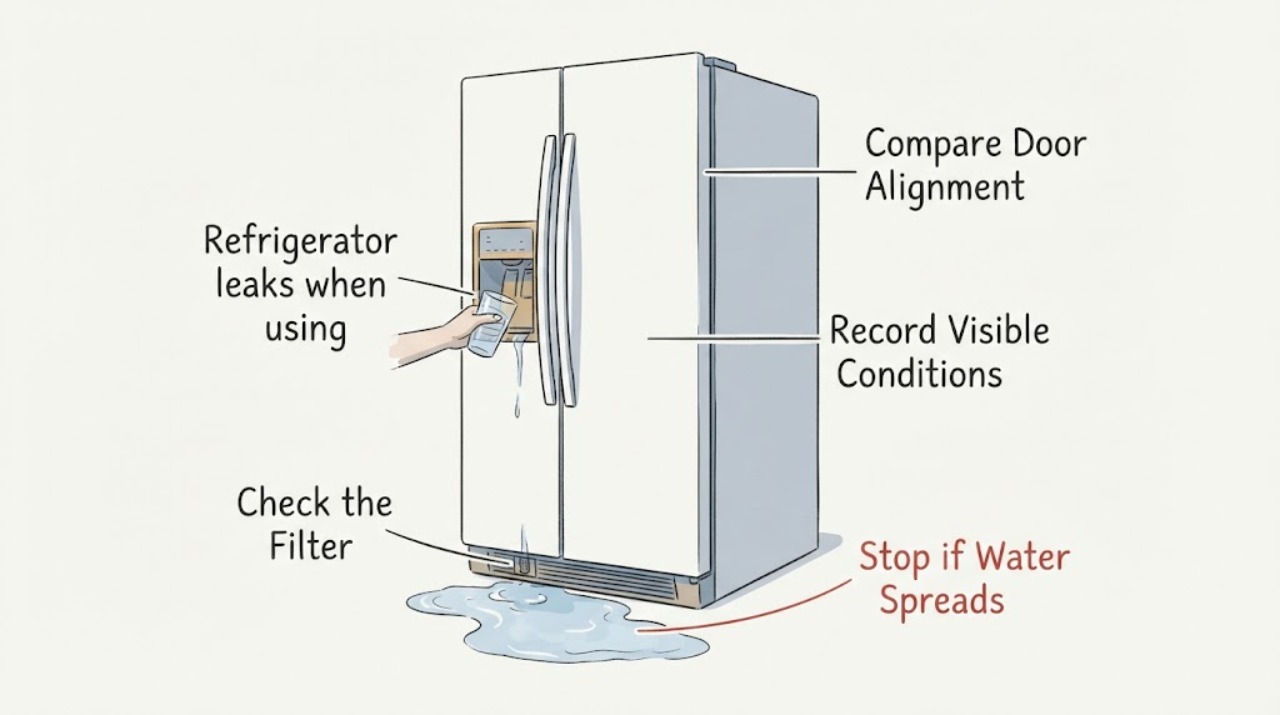
Kenmore Elite is a product family, not a complete refrigerator model, so do not choose a filter, water valve, tube, or housing from the name alone. First stop using the water dispenser and, if water is actively escaping, close the refrigerator's household water shutoff. Dry the area, then map the first wet point: the dispenser cup/nozzle, the door or lower front, the filter area, behind the refrigerator, or inside/under the cabinet. A drip only after dispensing points to the dispenser path; a leak while the refrigerator sits points to a pressurized connection or internal water path; water inside the freezer or under the cabinet may be a drain or pan issue. Do not pull the refrigerator, remove the door or panels, or disconnect a pressurized line. Obtain the complete model number from the label and arrange service when the source is hidden, persistent, or near electrical parts.
Work through in order
Diagnostic checks
Use only checks that match the exact appliance or system and its official guide.
-
Check 1
Stop dispensing water and close the accessible refrigerator water shutoff if a leak is active or returns immediately. Wipe the floor, dispenser cup, door edge, filter area, and accessible cabinet surfaces dry, then place separate dry towels at the cup/nozzle, lower front, and floor edges without moving the refrigerator.
Expected result: Water continues with the dispenser unused, stops when the shutoff is closed, or appears only as a small residual drop at the cup/nozzle.
Next step: Keep the dispenser and ice maker off while the source is uncertain. Record the exact first wet point and proceed without pulling the refrigerator or opening a connection.
Why this matters
Why: Continued water with the dispenser idle suggests a pressurized supply or internal water path rather than a spill from the cup. A leak that stops with the shutoff confirms that the refrigerator water circuit is involved, but not which component. A single residual drop does not explain pooling or a returning wet trail.
-
Check 2
Map the first wet point from the front and sides that are already accessible: dispenser tray/nozzle, door bottom or hinge-side edge, filter housing area, under the front, behind the refrigerator if visible without moving it, or inside the fresh-food/freezer compartment. Photograph the dry-to-wet boundary before wiping it again.
Expected result: The water is confined to the dispenser cup/nozzle, tracks down a door, surrounds the filter area, appears behind/under the cabinet, or begins inside a compartment.
Next step: Use the matching branch and give the photograph to service. Do not remove the door, kickplate, rear cover, or filter head to chase the trail.
Why this matters
Why: A cup/nozzle pattern keeps the dispenser outlet or residual-drip path in view. A door or filter-area pattern keeps door tubing, filter seating, or a housing in view. Rear/under-cabinet water makes a supply connection, inlet area, drain pan, or internal leak possible. Interior water makes condensation, defrost drainage, or an internal water assembly possible. None of these locations selects a part without the complete model.
-
Check 3
Record the event that precedes the leak without provoking it: dispensing water, making ice, a recent filter change, the refrigerator sitting unused, a defrost period, or no identifiable event. Do not repeatedly press the dispenser or force an ice-making cycle.
Expected result: The leak follows dispensing only; follows ice making or a filter change; occurs while idle; follows defrost/frost; or has no clear timing.
Next step: Keep the water supply closed for an active leak and record the timing for the technician. Do not continue operating a water dispenser that is wetting the floor or electrical area.
Why this matters
Why: Dispensing timing makes the user-operated water path more relevant; filter timing makes seating or seal evidence relevant; idle leakage keeps a pressurized connection or internal valve path in view. Defrost timing makes a drain or pan possible. Timing narrows the investigation but does not prove a component.
-
Check 4
If the filter area or visible household connection can be seen without moving the refrigerator, inspect only for moisture, a crack, a kink, or an obviously displaced filter. Do not loosen a fitting, remove the filter under pressure, cut tubing, or reach behind the appliance near wiring.
Expected result: The accessible filter or connection is visibly wet/damaged, appears dry and correctly seated, or cannot be reached without moving the refrigerator or removing a cover.
Next step: Leave the water shutoff closed and arrange appliance or plumbing service for a wet/damaged connection. Use the complete model number before any filter or housing decision.
Why this matters
Why: Visible moisture or damage at an accessible water connection supports that path, but the part and fit remain model-dependent. A dry accessible area does not rule out a door tube, hidden valve, drain, pan, or internal leak. Inaccessible areas are a service boundary, not an invitation to move the machine.
-
Check 5
Obtain the complete Kenmore model number and serial information from the appliance label or existing paperwork, then use the official Kenmore manual search rather than the word Elite alone. Compare the manual's actual dispenser, filter, drain, and access layout with the photograph; do not infer the layout from another Elite refrigerator.
Expected result: The complete model is available and matches the refrigerator; only Elite is known; or the label/layout conflicts with the suspected dispenser configuration.
Next step: If only Elite is known, give the label photo and leak evidence to service and ask for model identification. If the model has no dispenser, reclassify the observation instead of assuming the dispenser is the source.
Why this matters
Why: Kenmore's official portal says model numbers are at least 11 characters and are needed to locate the correct manual. Elite units can have different refrigerator types and water-system layouts, so a family name cannot establish a compatible part or safe access step.
Use your observations
Decision map
Find the observation that best matches what you see, then follow the next safe action.
-
PATH 01Next step
What you see
Water is limited to the dispenser cup or nozzle immediately after use, with no returning trail after the area is dried and the dispenser remains unused.
Do this next
Keep the area dry and observe without repeated dispensing. If water returns or runs down the door, keep the water supply off and arrange model-specific service.
Why this path and its safety boundary
Why it matters: A residual drip or dispenser-outlet path is more plausible than a confirmed rear supply leak, but pooling or recurrence is not normalised by the family name.
-
PATH 02Next step
What you see
Water follows dispensing and forms a trail down the door or appears around the filter/dispenser area while the rear of the refrigerator remains dry.
Do this next
Stop using the dispenser, close the water shutoff, document the first wet point, and arrange appliance service. Do not remove the door or filter housing.
Why this path and its safety boundary
Why it matters: The door/dispenser/filter water path is more likely than a defrost drain, but the exact tube, seal, or housing cannot be selected without the full model.
-
PATH 03Next step
What you see
Water returns while the dispenser is idle, appears behind or under the refrigerator, or is associated with a visible wet household connection.
Do this next
Keep the refrigerator water shutoff closed, protect the floor, and obtain appliance or plumbing service. Do not move the refrigerator alone or disconnect a pressurized line.
Why this path and its safety boundary
Why it matters: A pressurized supply connection or internal water path is more likely than a cup spill; a drain-pan issue remains possible if the water is unrelated to the water circuit.
-
PATH 04Next step
What you see
Water begins inside the fresh-food/freezer compartment, after frost/defrost, or under the cabinet while accessible water connections are dry.
Do this next
Follow only a complete-model manual's accessible care instruction. If the drain or pan is hidden, water returns, or flooring is wet, stop and arrange qualified service without removing covers.
Why this path and its safety boundary
Why it matters: A defrost drain, drain pan, condensation path, or hidden internal water assembly is more likely than the dispenser outlet.
-
PATH 05Next step
What you see
The complete model cannot be recovered, the suspected source is behind a panel or door, or water reaches electrical components, outlets, wiring, or the floor repeatedly.
Do this next
Stop using the dispenser and, for an active leak, close the water shutoff. Disconnect power only when it is safely accessible and dry, then arrange qualified appliance/electrical service with photographs and the label information.
Why this path and its safety boundary
Why it matters: The family-level evidence is insufficient for safe part selection or access, and continued use can cause water or electrical damage.
Helpful context
Understand the symptom
The assigned identity is Kenmore Elite refrigerator, but Elite alone does not identify the refrigerator's layout, filter arrangement, dispenser tubing, or drain access. Kenmore's official manual portal asks for the complete model number and says model numbers are at least 11 characters long. Treat the family name as an identity lead, not as a parts or repair specification.
For a dispenser-related leak, the highest-value observation is where the water first appears and whether it returns when the dispenser is idle. A wet cup or nozzle, a front/door trail, a filter housing, a rear connection, and water inside the cabinet are different decision branches. The location does not by itself prove a valve, tube, filter head, drain, or pan failure.
Keep the dispenser off while the source is unknown. If water reaches an outlet, cord, floor, or other electrical area, stop using the refrigerator and obtain qualified appliance or electrical help. Do not pull the unit out, remove a door, open a panel, or break a pressurized water connection to keep testing.
When checks do not resolve it
Need a professional?
Arrange qualified service when water returns with the dispenser idle, the first wet point is behind a panel, the door or filter housing appears damaged, water is inside the cabinet or under the refrigerator, the source cannot be reached without moving the appliance, or the complete Kenmore model is unavailable for a safe model-specific check. Stop immediately for water near outlets or wiring, a damaged cord, repeated pooling, or any electrical symptom. Do not pull the refrigerator, remove the door or panels, disconnect a pressurized line, or order a filter, valve, tube, housing, drain, or pan from the word Elite alone.
Common questions
FAQ
Is Kenmore Elite a complete model number?
No. Kenmore's official manual page says model numbers are at least 11 characters long. Elite is a product family label; recover the complete model before selecting parts or access instructions.
What should I replace when a Kenmore Elite dispenser leaks?
Do not choose a filter, tube, valve, seal, or housing from the family name or leak location alone. First isolate the water supply, document the first wet point and timing, obtain the complete model, and have the water path diagnosed.
Can I pull the refrigerator out to inspect the leak?
Not as a solo troubleshooting step. A heavy refrigerator can damage flooring or water/electrical connections, and moving it can change the leak. Keep the water supply off for an active leak and arrange appliance or plumbing help for rear access.
Read the exact guide
Official sources
- Find Your Manual | Kenmore Appliance Manuals & GuidesKenmore · Official Kenmore manual portal opened for the Kenmore Elite family issue; it states that manual lookup requires the appliance model number and that model numbers are at least 11 characters. It does not identify a dispenser leak part without that model.
- Refrigerators | Refrigeration | KenmoreKenmore · Official Kenmore refrigerator category page opened to confirm that the brand spans multiple refrigerator configurations; it is not used to claim a model-specific leak cause or part fit.
Community feedback
Share a repair observation
Share a plain-text repair observation. Accepted observations are published automatically; this page may take a moment to update.