
On this page
Start here
Quick answer
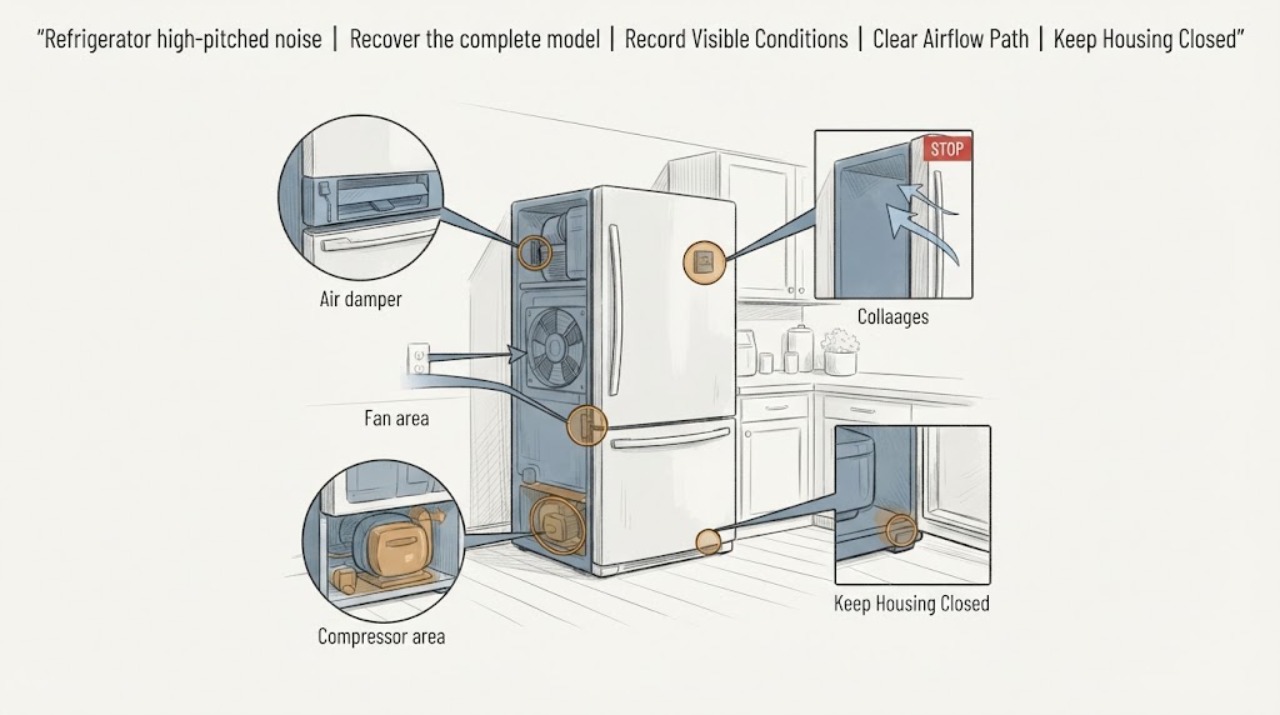
Do not identify the pictured Kenmore 60212 refrigerator part or call it a bad damper from a high-pitched tone alone. Kenmore's official manuals page says its model search expects model numbers at least 11 characters long, so 60212 is not enough to select an exact manual or part list; read the complete rating-plate model first. Then record where and when the tone occurs, whether it is brief and soft during cooling cycles, and whether cooling remains normal. Manufacturer refrigerator-noise guidance says short, regular high-pitched sounds can come from air movement, fans, compressor speed changes, or refrigerant pressure, while hard apartment floors, walls, and cabinets can amplify normal vibration. Check only visible vents, clearance, level, and loose objects. If the tone is new, persistent, scraping, worsening, tied to cooling loss, or accompanied by water, heat, odor, or an electrical trip, stop trying to localize it and arrange qualified service without touching the damper, fan, interior panel, or wiring.
Work through in order
Diagnostic checks
Use only checks that match the exact appliance or system and its official guide.
-
Recover the complete Kenmore model identity
Read the rating plate from the normal accessible area inside the fresh-food compartment or on the door frame. Record every character, punctuation mark, and suffix, plus the serial number if visible. Treat 60212 as an incomplete clue and do not use the photograph to choose a damper, fan, or control part.
Expected result: A complete model number is legible, only 60212 is available, or the label cannot be read without moving the refrigerator or removing a panel.
Next step: Use the complete label to obtain the matching manual before applying any model-specific sound or service instruction. If it remains unknown, stay with the visible checks below and tell service that the identity is incomplete.
Stop if: Do not move the refrigerator, remove an interior cover, or open a rear panel to find a label after an unusual noise.
Why this matters
Why: Kenmore's official manuals page says model numbers used in its search are at least 11 characters and are used to locate manuals and resources. The short label therefore cannot establish the refrigerator platform, damper design, fan arrangement, or compatible part.
-
Record the tone and its cooling-cycle timing
From a safe standing position, note whether the tone is brief or continuous, soft or harsh, steady or pulsing, and whether it starts with cooling, defrost, a door opening, or a water/ice event. Note whether food temperatures and airflow otherwise remain normal. Do not place a hand on the vent, fan, damper, tubing, or cabinet while the refrigerator is running.
Expected result: The tone is brief and soft with a repeatable cycle and normal cooling, or it is persistent, getting louder, scraping, or associated with a cooling change.
Next step: For a brief regular tone with normal cooling, continue with visible clearance checks and monitor. For a continuous, harsher, or cooling-related tone, stop trying to reproduce it and prepare the observations for qualified service.
Stop if: Stop immediately for scraping or grinding, burning odor, visible heat, smoke, water near electrics, or a repeated electrical trip.
Why this matters
Why: Whirlpool's official refrigerator guidance says high-frequency sounds commonly relate to air movement, fast-spinning fans, compressor speed changes, or refrigerant pressure; short, soft, regular sounds can be normal. A persistent or changing sound is not classified by pitch alone.
-
Check visible airflow and apartment contact points
Without opening a panel or moving the refrigerator, check that food and containers are not covering visible interior air vents. Visually check that the sides and rear are not pressed against a wall or cabinet and that loose objects on top are not touching the cabinet. Confirm that the appliance appears stable and level from its normal position; do not reach behind it.
Expected result: A vent is blocked, the cabinet touches a wall or cabinet, an item is vibrating on top, the unit is visibly unstable, or no visible contact or blockage is present.
Next step: Move only a loose item or visible food obstruction that can be reached safely without disturbing the appliance. If the refrigerator must be pulled out, leveled, or re-spaced, follow the exact manual or use qualified service.
Stop if: Stop if the sound source is behind a panel, the refrigerator would need to be pulled by a cord or water line, or cooling and frost problems are present.
Why this matters
Why: Official refrigerator guidance says vents move air between compartments and that blocked airflow can create louder fan sounds and uneven temperatures. It also identifies surrounding cabinets, floors, loose items, and an unlevel refrigerator as ways normal vibration can sound louder.
-
Use door and airflow changes only as clues
At normal intervals, note whether the tone changes after a door is opened and closed or after the cooling demand changes, without repeatedly cycling the doors or holding a switch. Record whether the sound seems to come from an interior vent, the freezer area, the top, the rear, or a wall/cabinet contact point. Do not touch or manually move a damper door or fan.
Expected result: The tone changes with airflow or cooling demand, seems tied to a cabinet contact, or remains unchanged and cannot be localized from outside.
Next step: Use the sound location and timing to brief service, not to order a component. If the sound is persistent or the refrigerator cools unevenly, request model-specific diagnosis.
Stop if: Do not remove an air grille, reach through a vent, hold an interior door switch, or spin a fan by hand.
Why this matters
Why: A change with airflow can keep a fan or air-control path in consideration, while a change with cabinet contact supports acoustic amplification. Neither observation proves a damper or fan failure, especially with an incomplete model number.
-
Escalate when the noise is no longer an acoustic nuisance
Keep the complete model record, a short audio/video clip made from a safe distance, the timing notes, and any cooling or frost observation for service. Do not enter a diagnostic mode, remove an interior or rear panel, test energized wiring, or manually operate the suspected part.
Expected result: The tone remains after visible checks, cooling changes, frost or water appears, the source cannot be localized, or a safety sign is present.
Next step: Arrange qualified appliance service with the complete label and sound record. If there is water near electrics, burning odor, smoke, heat damage, or repeated trips, stop using the refrigerator if safe and obtain urgent electrical/appliance help.
Stop if: Do not keep running the refrigerator solely to reproduce a harsh or unsafe sound, and do not bypass a fan, damper, door switch, or protective control.
Why this matters
Why: The remaining possibilities include an internal fan or air-control issue, obstruction, compressor-related sound, refrigerant-flow sound, or a cabinet/install condition. The available general guidance cannot select one component for Kenmore 60212.
Use your observations
Decision map
Find the observation that best matches what you see, then follow the next safe action.
-
PATH 01Next step
What you see
The tone is brief, soft, repeats with ordinary cooling, and the refrigerator maintains normal temperatures with no visible contact or blockage.
Do this next
Monitor the timing and keep vents and clearance visible. Request service if the tone becomes continuous, harsher, or is joined by cooling trouble.
Why this path and its safety boundary
Why it matters: Normal airflow, fan, compressor, or refrigerant operation is more plausible than a proven damper failure; apartment surfaces may make it more noticeable.
-
PATH 02Next step
What you see
The sound is strongest at an interior vent or changes with airflow, while cooling becomes uneven or frost appears.
Do this next
Clear only visible food or container obstructions. Leave the vent, damper, fan, and interior panel alone and arrange model-specific service if the condition persists.
Why this path and its safety boundary
Why it matters: An airflow obstruction or internal fan/air-control path is more relevant than a purely acoustic apartment vibration, but pitch and a picture still cannot identify the component.
-
PATH 03Next step
What you see
The tone changes when the cabinet touches a wall/cabinet or when a loose object on top is removed, and cooling remains normal.
Do this next
Remove only the loose object or visible obstruction. Use the complete model manual or qualified service for leveling or clearance work that requires moving the refrigerator.
Why this path and its safety boundary
Why it matters: Mechanical or acoustic transmission from the apartment installation is more likely than a failed internal damper or fan.
-
PATH 04Next step
What you see
The label remains only 60212, the tone is persistent or worsening, or the sound comes with scraping, cooling loss, water, heat, odor, or an electrical trip.
Do this next
Stop user troubleshooting and obtain qualified appliance service; add a qualified electrician when the outlet, cord, circuit, or electrical protection is involved. Do not restart merely to reproduce the sound.
Why this path and its safety boundary
Why it matters: The evidence is outside safe model-agnostic observation. A pictured damper or fan cannot be treated as the diagnosis, and continued operation may increase damage or safety risk.
Helpful context
Understand the symptom
The photograph may show a damper-like or sound-damping area, but it does not prove which assembly is installed in this Kenmore refrigerator. Kenmore treats the model number as the key to manuals and resources and states that its search expects a longer model number than 60212. Keep the pictured part as a clue only until the rating label is confirmed.
In an apartment, a quiet room and hard surrounding surfaces can make a normal fan, compressor, airflow, or vibration sound seem unusually sharp. The useful decision is whether the tone is brief and repeatable with normal cooling, or persistent and accompanied by a change in cooling, airflow, contact, or safety condition.
When checks do not resolve it
Need a professional?
Call qualified appliance service if the sound is persistent, worsening, scraping, tied to cooling or frost, or remains unexplained after visible checks; call urgent electrical help for smoke, burning odor, heat damage, water near electrical areas, arcing, or repeated trips.
Have this ready
- Provide the complete Kenmore rating-plate model rather than only 60212, the apartment installation details, sound timing and location, whether doors or cooling demand change it, visible clearance/vent findings, and a safe-distance recording.
Common questions
FAQ
Is Kenmore 60212 a complete refrigerator model number?
It is not enough for a reliable model-specific lookup. Kenmore's official manuals page says model numbers entered for manuals are at least 11 characters, so recover the full rating-plate model before selecting a part or button sequence.
Does a high-pitched tone prove the air damper is failing?
No. Official refrigerator guidance lists airflow, fans, compressor speed changes, and refrigerant pressure as possible sources of high-pitched sound. A damper-like picture and pitch alone cannot distinguish those possibilities.
Can I remove the grille or manually move the suspected damper to confirm it?
No. Keep the check external. Do not remove an interior panel, reach through a vent, manually move a damper or fan, or test wiring. Give service the complete model and the timing/location pattern instead.
Why does the sound seem louder in an apartment?
Whirlpool's official noise guidance says hard floors, walls, and cabinets can amplify normal refrigerator vibration. Check visible contact and loose objects without moving the appliance or disturbing its lines.
Read the exact guide
Official sources
- Refrigerator Noise - High-Pitched or PulsatingWhirlpool Product Help · Manufacturer guidance for general refrigerator acoustics: air movement, fans, compressor speed, refrigerant pressure, and the distinction between brief regular sounds and persistent noise. It is not an exact Kenmore 60212 parts diagnosis.
- Find Your Manual | Kenmore Appliance Manuals & GuidesKenmore · Kenmore's official manuals page states that manual searches use model numbers at least 11 characters long and provides manuals for refrigerators and other appliances. It establishes that 60212 alone is incomplete; it does not identify this refrigerator's damper or fan.
- Refrigerator Noise - BuzzingWhirlpool Product Help · Manufacturer guidance identifying fans, compressor, water valve, loading, leveling, and temperature demand as possible sound contexts, while directing unresolved noise to manuals and service. It does not establish a Kenmore 60212-specific fault.
- Refrigerator Noise - Rattling or VibratingWhirlpool Product Help · Manufacturer guidance for external or normal causes of rattling/vibration, including refrigerant/water flow, objects on top, and leveling. It supports the apartment contact branch but not a part replacement.
- How to Check the Air Vents for Blockage-Ensuring Proper Air FlowWhirlpool Product Help · Manufacturer guidance that vents circulate cold air, blocked vents can cause temperature and fan-sound symptoms, and the vent locations vary by model. It supports only external checks for an incompletely identified Kenmore refrigerator.
- Refrigerator Normal Sounds and NoisesWhirlpool Product Help · Manufacturer guidance describing normal fan/compressor/airflow sounds and how floors, walls, cabinets, loose items, vents, and leveling affect perceived noise. Use as general refrigerator acoustics, not as Kenmore model identity evidence.
Community feedback
Share a repair observation
Share a plain-text repair observation. Accepted observations are published automatically; this page may take a moment to update.