
On this page
Start here
Quick answer
Treat F0E2, F7E1, and F7E7 as a sequence to document, not as three automatic replacement-part diagnoses. Whirlpool's opened top-load guidance identifies F0E2 with excess suds that can reduce spin and leave a load wet; its current top-load pages label F7E1 as a motor or rotor sensor condition and F7E7 as a motor-sensor condition, with power cycling followed by service if a code returns. Those pages are not a substitute for the exact Kenmore 110.21492310 manual, so first confirm the model label and the exact display order. With the washer idle and safe, note whether water remains, whether the load was tightly packed or sudsy, whether the basket can be seen to move normally, and whether the lid-lock indication behaves normally. Do not enter service diagnostics, bypass the lid lock, open the cabinet, or keep rerunning spin tests. If a clean, correctly sized load still stops with F7E1/F7E7, arrange model-specific service rather than choosing a motor, actuator, clutch, belt, or control from the code list alone.
Before you begin
Safety first
- User checks stop at the label, display, load history, lid-lock observation, and safe external hose or standpipe observation. Do not enter service diagnostics, bypass the lid lock, reach into a moving basket, open the cabinet or pump, tip the washer, perform live electrical tests, or select a motor, rotor sensor, clutch, actuator, belt, or control board from these codes alone.
Work through in order
Diagnostic checks
Use only checks that match the exact appliance or system and its official guide.
-
Check 1
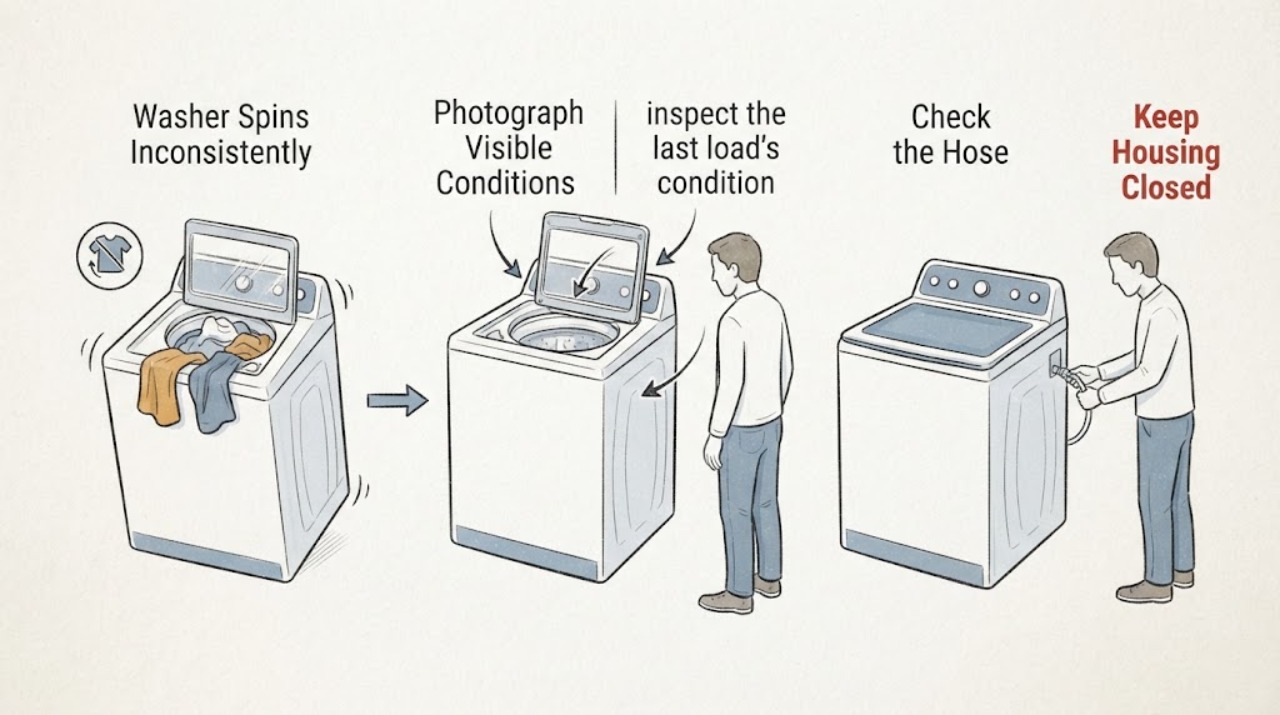
Photograph the complete Kenmore model label and record the display exactly as F0E2, F7E1, F7E7, or another pattern. Write the order in which the codes were stored, the cycle phase when each appeared, whether the code came from the normal console or a prior diagnostic visit, and whether the lid-lock indication changed.
Expected result: The label is 110.21492310 and the same sequence repeats, the display characters are ambiguous, the sequence changes between attempts, or the code was obtained from a diagnostic procedure rather than the ordinary console.
Next step: Use the exact Kenmore manual once identified and give the photo, code order, cycle phase, and lid-lock behavior to service. Do not enter or repeat service diagnostics to obtain more codes.
Stop if: Stop immediately for a moving basket that does not stop, a damaged lid lock, water near electrical parts, smoke, burning odor, sparks, a hot plug, or repeated breaker trips.
Why this matters
Why: Kenmore directs owners to use the exact model number for the matching manual. The Whirlpool pages identify these code families on top-load products, but a code-looking display from another test or platform cannot be assumed to have the same meaning.
-
Check 2
With the washer off and the lid closed, inspect the last load's condition without reaching into a moving basket: note whether it was tightly packed, a single heavy or absorbent item, visibly very sudsy, or left with a large amount of water. Check only that the lid and its visible strike area are not obstructed; do not defeat or hold the lock.
Expected result: The load was packed tightly or was one bulky item, suds were obvious, the basket stopped with water still present, or the load was modest and water had drained before the spin stopped.
Next step: Follow the exact model manual for detergent type and amount, and do not run repeated high-speed experiments. If water remains or the symptom is load-independent, keep the washer out of use until the drain and drive behavior can be assessed safely by service.
Stop if: Do not open the lid while the basket is moving, bypass the lid lock, add water to reproduce the fault, or continue using the washer when it walks, bangs, leaks, or smells hot.
Why this matters
Why: Whirlpool's F0E2 guidance says excess suds can reduce spin speed and leave clothes wet. A load-specific failure therefore does not prove a motor or drive failure; persistence with a modest, low-suds load changes the decision toward the F7 codes or a mechanical/service issue.
-
Check 3
Separate a drain/timing symptom from a spin-speed symptom using the safe history of the failed load. Record whether the washer had visibly pumped out, whether the drain hose or household standpipe had backed up, whether the spin light stopped or flashed, and whether the basket ever reached a stable spin before stopping. Do not remove a panel or reach into the pump.
Expected result: Water remains or the drain path backed up, the washer drains but never reaches spin, the basket starts and stops within the spin phase, or the washer completes spin but leaves only unusually wet clothing.
Next step: For a visible hose or household-drain restriction, leave the washer off and use only the model-authorized external correction or a plumber. For a drained basket that repeatedly stops with F7E1/F7E7, provide the timing record to a qualified appliance technician.
Stop if: Do not tip the washer, open the pump or cabinet, manually spin a powered machine, or run another cycle to locate an inaccessible leak or obstruction.
Why this matters
Why: Residual water and a drain-path event can prevent a useful spin and should not be confused with a speed-sensing code. A repeat start-then-stop pattern after water is gone is more consistent with the motor-sensor/drive branch named by the F7 guidance, but it still does not identify which internal part is responsible.
-
Check 4
Compare the code sequence with the safely observed load pattern: F0E2 during a sudsy or wet-load event, F7E1 when the washer cannot establish the expected spin, and F7E7 when the displayed motor-sensor condition returns. Do not translate these labels into a guessed actuator, clutch, belt, motor, or control-board replacement.
Expected result: F0E2 appears alone and the load was sudsy, F7E1/F7E7 appear after a normal load has drained, both F7 codes recur, or the display no longer returns after the washer is left idle.
Next step: Correct only the model-manual detergent/load issue that is plainly present. If either F7 code recurs or the spin remains inconsistent with a normal load, stop troubleshooting at the user level and arrange service with the complete sequence and timing.
Stop if: Do not clear codes by repeated cycling, enter the service mode, bypass the lid lock, or order a part based only on F0E2/F7E1/F7E7.
Why this matters
Why: The opened manufacturer guidance gives F0E2 a concrete excess-suds path, while the top-load F7 pages use motor/rotor-sensor wording and direct service when the code returns. The combination is a triage sequence, not proof that all three conditions are simultaneously failed.
-
Check 5
Make a service handoff record instead of another test: include the exact model, serial if available, used-purchase timeline, load type and detergent, whether water remained, visible lid-lock behavior, code order and photographs, and any walking, noise, leak, electrical odor, or breaker event.
Expected result: The record shows a one-off load/suds event, a clean repeat of F7E1/F7E7, an unresolved drain condition, or a safety symptom.
Next step: Arrange qualified Kenmore/Whirlpool-platform appliance service for recurring codes or no-spin behavior; use plumbing service for a household drain problem. Keep the washer off until the appointment if the fault is repeatable or any safety symptom occurred.
Stop if: Do not continue operating after smoke, burning odor, sparks, a hot plug, water near electrical parts, violent movement, a lid-lock failure, or a tub that will not stop.
Why this matters
Why: A complete timeline lets a technician distinguish a recoverable load/suds condition from a repeat motor-sensor/drive complaint without the owner guessing at internal parts. A safety symptom changes the task from diagnosis to immediate isolation and service.
Use your observations
Decision map
Find the observation that best matches what you see, then follow the next safe action.
-
PATH 01Next step
What you see
F0E2 appears with visible suds, a tightly packed or absorbent load, and very wet clothing, while F7E1/F7E7 do not recur on the record.
Do this next
Use the exact Kenmore manual's detergent and load guidance, allow the washer to remain idle between decisions, and request service if F0E2 returns with proper use or the tub does not drain.
Why this path and its safety boundary
Why it matters: The manufacturer describes F0E2 as over-suds detection that can reduce spin speed and leave water in the load; this pattern supports a detergent/load branch rather than a confirmed drive-part failure.
-
PATH 02Next step
What you see
The washer has drained, the load is ordinary and not visibly sudsy, and F7E1 or F7E7 returns when the spin symptom occurs.
Do this next
Stop user-level testing and arrange model-specific service with the code order, phase, and load history. Do not buy or install a guessed drive component.
Why this path and its safety boundary
Why it matters: Whirlpool's opened top-load pages associate F7E1 with a motor or rotor sensor and F7E7 with a motor sensor, but neither page proves a failed motor, sensor, harness, actuator, or control on this Kenmore.
-
PATH 03Next step
What you see
Water remains after the failed attempt or the drain hose/household standpipe visibly backs up, and the spin symptom cannot be separated from incomplete pump-out.
Do this next
Keep the washer off, make only a safe external hose observation authorized by the exact manual, and use a plumber for a household backup. Escalate to appliance service if the washer itself retains water or codes recur.
Why this path and its safety boundary
Why it matters: A drain or household plumbing condition can leave the washer unable to complete a useful spin; the F7 combination alone cannot establish that the drive system is defective.
-
PATH 04Next step
What you see
The lid-lock indication is abnormal, the basket will not stop, the washer walks violently, or there is smoke, burning odor, sparking, a hot plug, a leak near electrical parts, or repeated breaker operation.
Do this next
Stay clear, stop using the washer, isolate water and power only from a dry and safely reachable location, and arrange qualified appliance service; use emergency help for an active electrical or fire hazard.
Why this path and its safety boundary
Why it matters: This is a safety stop, not a code-reading exercise. A lid-lock bypass or continued spinning can expose the user to moving parts, while water or overheating can create an electrical hazard.
Helpful context
Understand the symptom
This used Kenmore is a symptom-and-sequence problem. A single wet load can be explained by excess suds or an overloaded/unbalanced basket, while a repeat stop during spin with F7E1 or F7E7 needs service-level diagnosis. Do not turn the three stored codes into three failed parts: the manufacturer guidance gives fault families and a service boundary, not permission to buy a motor or lid-lock assembly.
The exact model number matters. Kenmore's manual lookup instructs owners to enter the model number to retrieve the matching washer resources. The opened Whirlpool pages are manufacturer top-load guidance, but they do not expose a model-specific Kenmore manual for this exact number; use their meanings only as scoped clues and preserve the complete 110.21492310 label and exact code formatting for service.
Because the washer is used, keep the history: how long it worked after purchase, whether the problem follows one load type or every load, whether the tub drains before stopping, and whether the lid-lock light or breaker changes. Stop before any check if the tub will not stop, the lid lock is defeated or damaged, water reaches electrical parts, there is a burning smell, smoke, sparking, a hot plug, or repeated breaker operation.
When checks do not resolve it
Need a professional?
Arrange qualified appliance service when F7E1 or F7E7 returns after a normal, low-suds load; when the washer repeatedly starts and stops in spin; when drainage cannot be confirmed externally; when the exact code sequence remains ambiguous; or when the lid-lock, basket, wiring, water, or electrical condition is unsafe. Provide the complete Kenmore 110.21492310 model, serial if available, photographs, code order, load and detergent history, drain result, and cycle phase.
Safety scope: User checks stop at the label, display, load history, lid-lock observation, and safe external hose or standpipe observation. Do not enter service diagnostics, bypass the lid lock, reach into a moving basket, open the cabinet or pump, tip the washer, perform live electrical tests, or select a motor, rotor sensor, clutch, actuator, belt, or control board from these codes alone.
Common questions
FAQ
Does F0E2 mean the washer needs a new drive part?
No. Whirlpool's top-load guidance describes F0E2 as excess suds; the washer may reduce spin and leave clothing wet while it handles the suds. Correct the model-authorized detergent/load issue first, and treat a recurring F7 code or persistent no-spin symptom as a service decision rather than a part order.
What do F7E1 and F7E7 prove on Kenmore 110.21492310?
The opened Whirlpool top-load pages use motor/rotor-sensor wording for F7E1 and motor-sensor wording for F7E7, then direct the owner to cycle power and schedule service if the code returns. They do not prove which internal component failed on this exact Kenmore, so preserve the exact model and sequence for the technician.
Should I run diagnostic mode to see whether the basket spins?
No. The task's safe boundary is ordinary external observation only. Do not enter service diagnostics, bypass the lid lock, or repeat high-speed tests. Record what happened during the failed cycle and arrange model-specific service if the F7 sequence returns.
Read the exact guide
Official sources
- F7E7 - Error Code - Product Help | WhirlpoolWhirlpool Corporation · Opened manufacturer top-load page. It labels F7E7 as a motor-sensor condition and advises a five-minute power cycle followed by service if the code returns; it does not establish an internal Kenmore part failure.
- F0E2 - Error Code - Product Help | WhirlpoolWhirlpool Corporation · Opened manufacturer top-load page. It defines F0E2 as over-suds detection and warns that excess suds can reduce spin speed and leave loads wet; it is used as family-level guidance, not as an exact-model Kenmore service manual.
- Error Codes or Flashing Lights - Product Help | WhirlpoolWhirlpool Corporation · Opened Whirlpool's top-load error index. It lists F0E2, F7E1, and F7E7 as top-load code pages and directs owners toward model-specific manuals; it is not proof that every code meaning is identical on every Kenmore 110 model.
- Find Your Manual | Kenmore Appliance Manuals & GuidesKenmore / Transform SR Brands LLC · Opened official Kenmore manuals page. It requires the complete model number to retrieve model-specific washer manuals; it does not define F0E2, F7E1, or F7E7.
- F7E1 - Error Code - Product Help | WhirlpoolWhirlpool Corporation · Opened manufacturer top-load page. It labels F7E1 as a motor or rotor sensor condition and advises a five-minute power cycle followed by service if the code returns; it does not select a part for Kenmore 110.21492310.
Community feedback
Share a repair observation
Share a plain-text repair observation. Accepted observations are published automatically; this page may take a moment to update.