
On this page
Start here
Quick answer
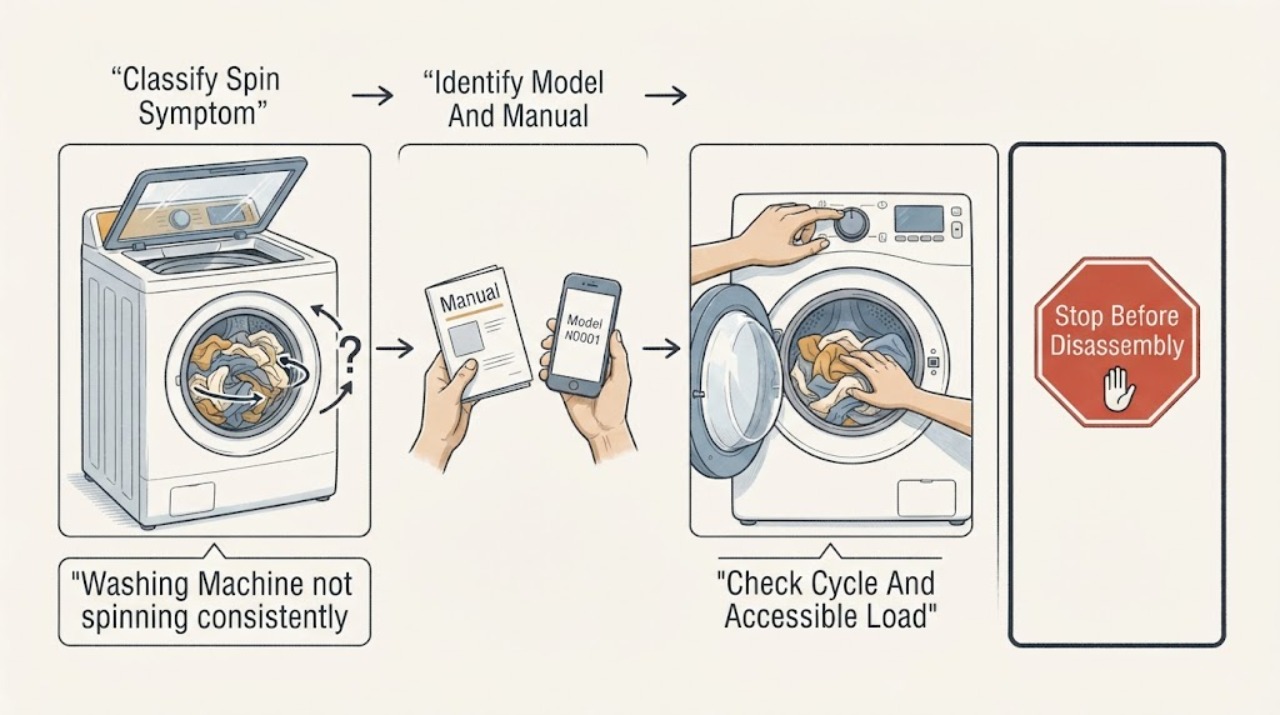
Do not start by replacing a motor, belt or control. First record what “inconsistent” means: the washer never reaches spin, skips spin only on a particular cycle or load, stops with water still present, or spins after a restart. Kenmore lists multiple front-load and top-load washer families, and its official manual lookup requires the exact model, so the correct cycle, lid/door condition and user checks must come from that model's manual. Check only the accessible load, selected cycle, lid/door and visible water condition; if the problem remains or the washer is leaking, smoking, tripping power or making severe mechanical noise, stop using it and use Kenmore's repair/support path.
Work through in order
Diagnostic checks
Use only checks that match the exact appliance or system and its official guide.
-
Check 1
Watch one affected cycle from a safe distance and record the exact stage: the washer never begins spin, it spins on some cycles but not others, it stops with standing water, or it spins only after a restart. Do not repeatedly restart a noisy or leaking washer.
Expected result: The failure is cycle-specific, load-dependent, accompanied by retained water, or present on every spin attempt.
Next step: Use the exact model manual and the matching branch below. If water is leaking, power is tripping or the washer is making severe noise, leave it off and arrange service.
Why this matters
Why: These are different diagnostic paths. The observation does not by itself prove a motor, belt, pump, lid/door switch or control failure.
-
Check 2
Read the full Kenmore model number from the accessible rating label without removing panels, then enter it in Kenmore's Manuals page. Keep all letters, numbers and suffixes exactly as printed.
Expected result: The model is matched to a manual, or the label is missing/ambiguous and no exact manual can be found.
Next step: If matched, follow only that manual's cycle, lid/door and user-level spin checks. If not matched, stop at the identity boundary and use Kenmore support rather than borrowing another model's repair procedure.
Why this matters
Why: Kenmore states that the manuals lookup uses the model number and provides washer manuals/resources. The catalog also includes both front-load and top-load families, so a generic spin procedure may not apply.
-
Check 3
With the washer stopped, verify the selected cycle includes a spin step according to the exact manual, note whether the problem occurs with one type of load or every load, and confirm the lid or door is fully closed without defeating its lock.
Expected result: The issue follows one cycle/load, the washer recognizes the closed lid/door, or the issue occurs across cycles with the correct setting.
Next step: Use the model manual's permitted user correction once if it describes one. If the correct cycle and safe closed condition are confirmed but spin still fails, move to service rather than opening the cabinet.
Why this matters
Why: A cycle or load-specific pattern is different from a washer that cannot spin under any documented condition. A closed lid/door observation still does not diagnose an internal component.
-
Check 4
After the washer is fully stopped, observe whether water remains in the tub and whether the issue is a failed spin, a cycle that has not finished draining, or both. Do not reach into the tub or remove hoses/panels to test a pump.
Expected result: The tub is empty, water remains, or the water level is unsafe/uncertain.
Next step: If water remains or there is a leak, keep the washer off and arrange qualified service unless the exact manual provides a clearly accessible user check. Do not force a spin cycle with standing water.
Why this matters
Why: Retained water changes the service description and should not be treated as proof of a failed spin motor. The model manual is required for any drain or cleanout procedure.
-
Check 5
Stop using the washer for smoke, burning odor, arcing, a hot or damaged cord, water near electrical parts, repeated breaker trips, cabinet movement or severe grinding/impact. Disconnect normal power only if safe and accessible; do not open the console or test exposed wiring.
Expected result: The hazard is present, clears after shutdown, or its source is uncertain; alternatively the washer simply continues to miss spin after the model manual's external checks.
Next step: Leave the washer off and use Kenmore Customer Care/qualified appliance service. Provide the model, cycle, load, water condition and exact timing of the missed spin.
Why this matters
Why: A hazard or persistent failure is outside a model-free user check and does not establish which internal part has failed.
Use your observations
Decision map
Find the observation that best matches what you see, then follow the next safe action.
-
PATH 01Next step
What you see
Spin is missing only on one cycle or one load pattern, while other documented cycles complete normally.
Do this next
Use the exact model manual to confirm the cycle's expected spin behavior and permitted load/user checks. Arrange service if the same condition persists with the documented setup.
Why this path and its safety boundary
Why it matters: The behavior is conditional and may be tied to the selected cycle or load state; it does not establish an internal component failure.
-
PATH 02Next step
What you see
The washer reaches the end of a cycle with water still in the tub.
Do this next
Keep the washer off if water remains or leaks and use the model manual or qualified service. Do not remove internal hoses or force the spin cycle.
Why this path and its safety boundary
Why it matters: The symptom includes a water-retention/drain condition, so calling it a spin-motor failure would be premature.
-
PATH 03Next step
What you see
The correct cycle, safe closed lid/door and model-specific external checks are confirmed, but the washer still misses spin across loads.
Do this next
Arrange qualified Kenmore service and provide the complete model, cycle stage and repeatability details. Do not order a part by appearance.
Why this path and its safety boundary
Why it matters: A persistent appliance fault needs diagnosis; no motor, belt, pump, lid/door switch or control is confirmed from the supplied evidence.
-
PATH 04Next step
What you see
Smoke, burning odor, arcing, damaged power parts, water near electrics, repeated breaker trips or severe impact is present.
Do this next
Leave the washer off and obtain qualified appliance/electrical help. Do not continue cycling it or open the cabinet.
Why this path and its safety boundary
Why it matters: This is a safety stop condition rather than a spin troubleshooting branch.
Helpful context
Understand the symptom
Define what “not spinning consistently” means
Record whether the washer never reaches spin, misses it only on a particular cycle or load, stops with water still present, or resumes only after a restart. These observations change the next safe check. They do not prove a motor, belt, pump, lid/door switch or control failure.
Use the exact Kenmore manual
Kenmore's official manuals page asks for the model number and provides washer manuals and resources. The Kenmore washer catalog includes both front-load and top-load products, so do not transfer another model's cycle, lid/door or service procedure. Record the full model without removing panels.
Check only accessible conditions
With the washer stopped, confirm the selected cycle is expected to include spin, note whether the problem follows a load, and observe whether water remains in the tub. Do not defeat the lid/door lock, reach into a moving basket, remove internal hoses or open the console. Use the matched manual for any permitted user check.
Escalate persistent or hazardous symptoms
Leave the washer off for leaks near electrical parts, smoke, burning odor, arcing, repeated breaker trips, a hot or damaged cord, cabinet movement or severe grinding. Kenmore Customer Care provides warranty, manual and repair/service routes; provide the model and the exact spin behavior to qualified service.
When checks do not resolve it
Need a professional?
Arrange qualified Kenmore appliance service when the washer misses spin across documented cycles, stops with water, the model cannot be identified, or any smoke, burning odor, arcing, damaged cord, water near electrical parts, repeated breaker trip or severe mechanical noise is present. Supply the full model, cycle and option settings, load description, whether water remained and when the failure occurred.
Common questions
FAQ
Does inconsistent spinning prove the Kenmore washer motor failed?
No. The cycle, load, lid/door state and water remaining in the tub must be separated first. Kenmore lists multiple washer families, and the exact model manual is required before a component is named.
Can I use a different Kenmore washer's spin procedure?
No. Kenmore's catalog includes both front-load and top-load models, and its manuals page requires the exact model. Use only the matched manual and stop if the model cannot be confirmed.
When should I stop trying to make the washer spin?
Stop for retained water with a leak, smoke, burning odor, arcing, damaged power parts, repeated breaker trips or severe grinding/impact. Also arrange service when the washer continues to miss spin after the exact manual's external checks.
Read the exact guide
Official sources
- Customer Care & Support | Kenmore AppliancesKenmore · Official support hub for warranty, manuals and repair/service routes.
- Washers | Laundry | KenmoreKenmore · Official washer catalog showing front-load and top-load model families; used to establish procedure variation, not to diagnose this unspecified unit.
- Find Your Manual | Kenmore Appliance Manuals & GuidesKenmore · Official model-based manual lookup; requires the exact model number and provides washer manuals/resources.
Community feedback
Share a repair observation
Share a plain-text repair observation. Accepted observations are published automatically; this page may take a moment to update.