
On this page
Start here
Quick answer
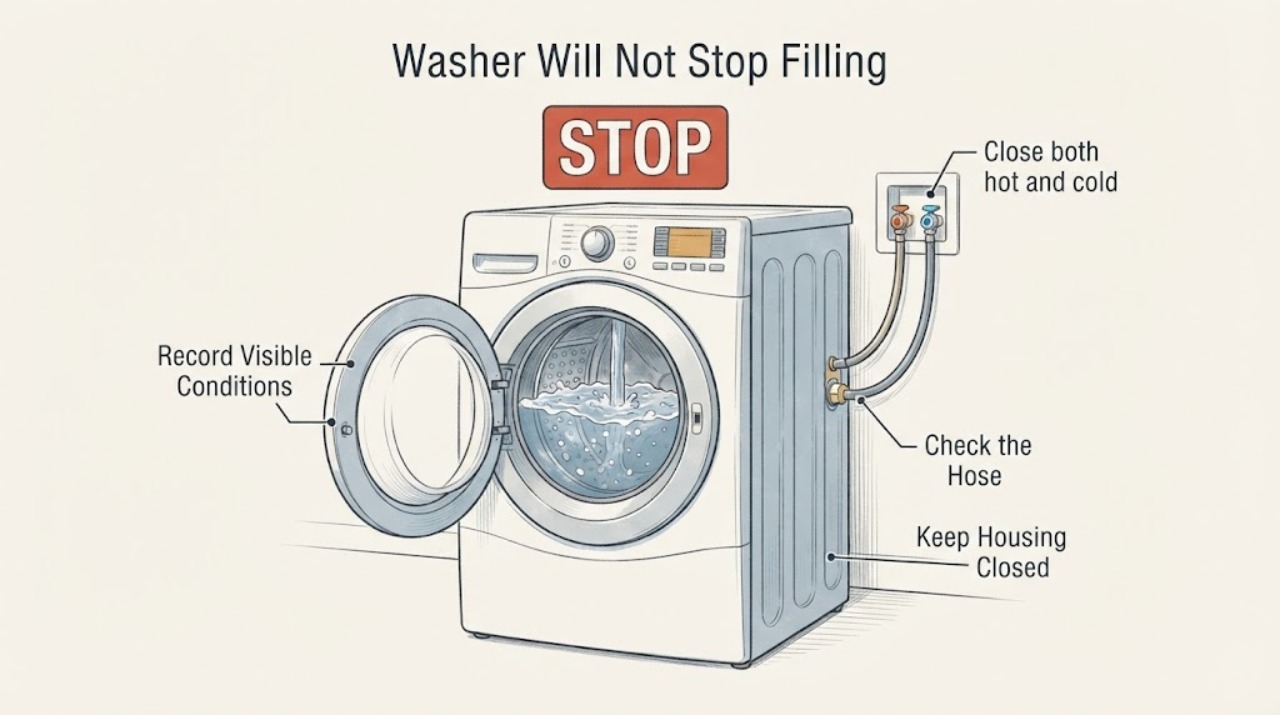
If a Kenmore washer keeps taking in water or is leaking, close the hot and cold wall supply valves first and stop the washer; if power can be disconnected safely from a dry, undamaged point, isolate it as well. Do not keep running a fill cycle, repeatedly reset the controls, remove the cabinet, or blind-test and replace the inlet valve. Kenmore's official site says a washer water-inlet valve controls water flow and that even a genuine valve listing fits only specified models; use the full model number to find the correct manual and service route. Record whether water continued after the controls were off, whether the tub overflowed or the drain hose was siphoning, and arrange qualified repair if water cannot be controlled or there is any leak or electrical hazard.
Work through in order
Diagnostic checks
Use only checks that match the exact appliance or system and its official guide.
-
Check 1
Close both hot and cold washer supply valves at the wall and stop the cycle. If the plug, receptacle, cord and floor are dry and undamaged, disconnect power; if they are wet, hot, arcing or damaged, do not touch them and leave the area for qualified help.
Expected result: Water stops at the wall valves, water continues because a valve was not fully closed, or water/electrical conditions are unsafe to touch.
Next step: Keep both supplies off and do not reconnect power or restart the washer. Use emergency or qualified service for active flooding, smoke, arcing or electrical contact risk.
Why this matters
Why: The immediate flood risk is controlled only when the supply is shut off. An unsafe electrical area makes user isolation or testing hazardous.
-
Check 2
Without restoring water or power, record whether water had continued when the washer controls were off, whether it filled only during a selected cycle, and whether the tub was draining at the same time. Do not deliberately repeat any of these conditions.
Expected result: The washer had been taking water with controls off, filling only while energized, or filling while water was visibly leaving the tub.
Next step: Give the observed pattern to the servicer and keep the supplies closed. Do not blind-test the valve, pressure hose or control by opening the cabinet.
Why this matters
Why: These patterns separate an uncontrolled incoming-water symptom from a cycle/control or drain-routing symptom, but they do not prove a failed inlet valve, pressure system or control board.
-
Check 3
With water and power isolated, look only at accessible hoses, the wall valves, the visible drain hose and the floor for a kink, loose connection, overflow path or standing water. Do not pull the washer out across wet flooring or remove hose screens while the area is unsafe.
Expected result: There is a visible hose/connection leak, a kink or unusual drain-hose position, no visible external issue, or water has reached electrical equipment.
Next step: Leave the supply off, dry or isolate the area only if safe, and arrange qualified appliance/plumbing service. Do not open the washer to inspect the valve or wiring.
Why this matters
Why: An external leak or drain-routing issue may require plumbing or installation correction, while no visible issue leaves internal fill-control causes unresolved. Water near electrical equipment increases the safety risk.
-
Check 4
Find the complete Kenmore model number from the appliance identification label without removing panels, then use Kenmore's official manuals search. Record washer style, region, error display if any, and the fill symptom.
Expected result: The model number is complete and readable, or the label is missing, unreadable or different from the assumed washer family.
Next step: Give the complete model and history to Kenmore/customer care or a qualified servicer. Do not order or install a generic valve, pressure switch or control.
Why this matters
Why: Kenmore says its manuals search uses the model number, and its official valve listing demonstrates that a water-inlet valve fits only specified models. A brand name alone cannot verify a part or procedure.
-
Check 5
Tell the servicer whether the water was hot, cold or both, whether the tub overflowed, where water reached the floor, whether a breaker or GFCI operated, and whether the problem followed a move or installation change. Keep both water valves closed until service confirms safe operation.
Expected result: The event was isolated without overflow, or there is repeated filling, leakage, electrical exposure or a damaged hose/valve area.
Next step: Do not return the washer to service until qualified repair confirms the water path and safety boundary. Protect flooring and nearby property from further water damage.
Why this matters
Why: Repeated or uncontrolled fill needs model-specific repair and possibly plumbing/electrical assessment; a reset or temporary stop does not establish that the washer is safe.
Use your observations
Decision map
Find the observation that best matches what you see, then follow the next safe action.
-
PATH 01Next step
What you see
If closing both wall supply valves stops the incoming water and there is no active electrical hazard
Do this next
Keep the valves closed, leave the washer unused, and arrange model-specific service.
Why this path and its safety boundary
Why it matters: The immediate flood risk is reduced, but the washer's fill-control fault remains unresolved.
-
PATH 02Next step
What you see
If water continues despite fully closed wall valves or is coming from a hose, connection or building pipe
Do this next
Keep away from unsafe water/electrical contact and obtain qualified plumbing or emergency assistance.
Why this path and its safety boundary
Why it matters: The problem may be external plumbing or a shutoff failure rather than a washer control diagnosis.
-
PATH 03Next step
What you see
If the tub filled while the washer was off versus only during a cycle
Do this next
Report the pattern and model to service; do not reopen or power the appliance to test a valve or sensor.
Why this path and its safety boundary
Why it matters: The observation changes the diagnostic path, but neither pattern alone proves which internal component failed.
-
PATH 04Next step
What you see
If the washer overflowed, leaked onto electrical equipment, tripped protection, smoked or arced
Do this next
Keep water and power isolated if safe, leave the area if necessary, and use qualified or emergency service before any further handling.
Why this path and its safety boundary
Why it matters: This is a combined water/electrical safety event, not a reset-and-retry problem.
Helpful context
Understand the symptom
Stop the water before diagnosing the cause
A washer that keeps filling can overflow quickly. Close the hot and cold supply valves at the wall, stop the cycle, and keep people away from standing water near electrical equipment. If the plug, receptacle, cord or floor is wet or damaged, do not touch it; use qualified help. Do not turn the water back on just to repeat the symptom.
The symptom does not identify one part
Water that continues after the controls are off, water that appears only during a cycle, and a tub that fills while water is draining are different observations. A Kenmore water-inlet valve controls incoming flow, but Kenmore's official product page lists fitment for only specific models. Pressure sensing, drain routing, controls and the inlet assembly must therefore be matched to the exact model rather than guessed from the brand.
Record safe external clues
After the water is shut off, note whether the tub is overfilled, where any water is on the floor, whether the drain hose is visibly kinked or positioned unusually, and whether the problem began after installation or moving the washer. Do not remove hoses, screens, panels or wiring while the machine is wet or without the exact manual and qualified service boundary.
Use the exact Kenmore manual and repair route
Kenmore's manuals page requires the model number and says its manuals cover washers and parts/resources. Its customer-care page provides manuals, parts literature and repair/service routes. Use those resources with the full model tag; do not use a valve, pressure-switch or control procedure from another Kenmore, Whirlpool or Maytag family.
When checks do not resolve it
Need a professional?
Arrange qualified Kenmore appliance service immediately for uncontrolled filling, a tub that overflows, repeated leaks, water near electrical equipment, a suspected inlet valve or pressure-sensing fault, or any need to open the cabinet. Use qualified plumbing help for wall valves or building-pipe leaks.
Have this ready
- Provide the full model number, washer style, hot/cold/both fill behavior, whether water continued with controls off, visible hose/standpipe observations, leak location, overflow amount, electrical protection events and any recent installation or move.
Common questions
FAQ
What should I do first if my Kenmore washer will not stop filling?
Close both hot and cold supply valves, stop the cycle, and keep the washer off. If power can be disconnected safely from a dry, undamaged point, isolate it; otherwise do not touch wet or damaged electrical parts. Do not restart to test the cause.
Does nonstop filling prove the water inlet valve is bad?
No. Kenmore confirms that an inlet valve controls water flow, but a fill symptom can also involve cycle control, water-level sensing, drain routing or an external leak. The exact model and observed timing are required before a part can be considered.
Can I use a valve from another Kenmore or Whirlpool washer?
Do not assume compatibility. Kenmore's official valve listing names only specific Kenmore models and says the part fits some Whirlpool and Maytag models as well. Use the full Kenmore model number and official manual/parts lookup or have service identify the part.
When is nonstop water an emergency?
Treat it as urgent when the tub is overflowing, water reaches electrical equipment, a breaker/GFCI trips, there is smoke or arcing, or the wall supply cannot be shut off. Isolate water and power only when safe and obtain qualified or emergency help.
Read the exact guide
Official sources
- Customer Care & Support | Kenmore AppliancesKenmore · Opened Kenmore's official customer-care page. It provides contact, manuals, parts literature and repair/service resources for appliance issues.
- W10175893 Washer Water Inlet Valve and W89503 Washer Fill Hose BundleKenmore · Opened the official Kenmore product page. It says the water-inlet valve controls washer water flow and lists only specified Kenmore models plus specified Whirlpool/Maytag models; no compatibility is generalized here.
- Find Your Manual | Kenmore Appliance Manuals & GuidesKenmore · Opened Kenmore's official manuals page. It requires the model number to access washer manuals and resources, and says manuals provide appliance, parts and use information.
- Washers | Laundry | KenmoreKenmore · Opened Kenmore's official washer catalog. It shows front-load and top-load families and model labels, supporting the need to identify the exact washer before applying controls or parts guidance.
Community feedback
Share a repair observation
Share a plain-text repair observation. Accepted observations are published automatically; this page may take a moment to update.