
On this page
Start here
Quick answer
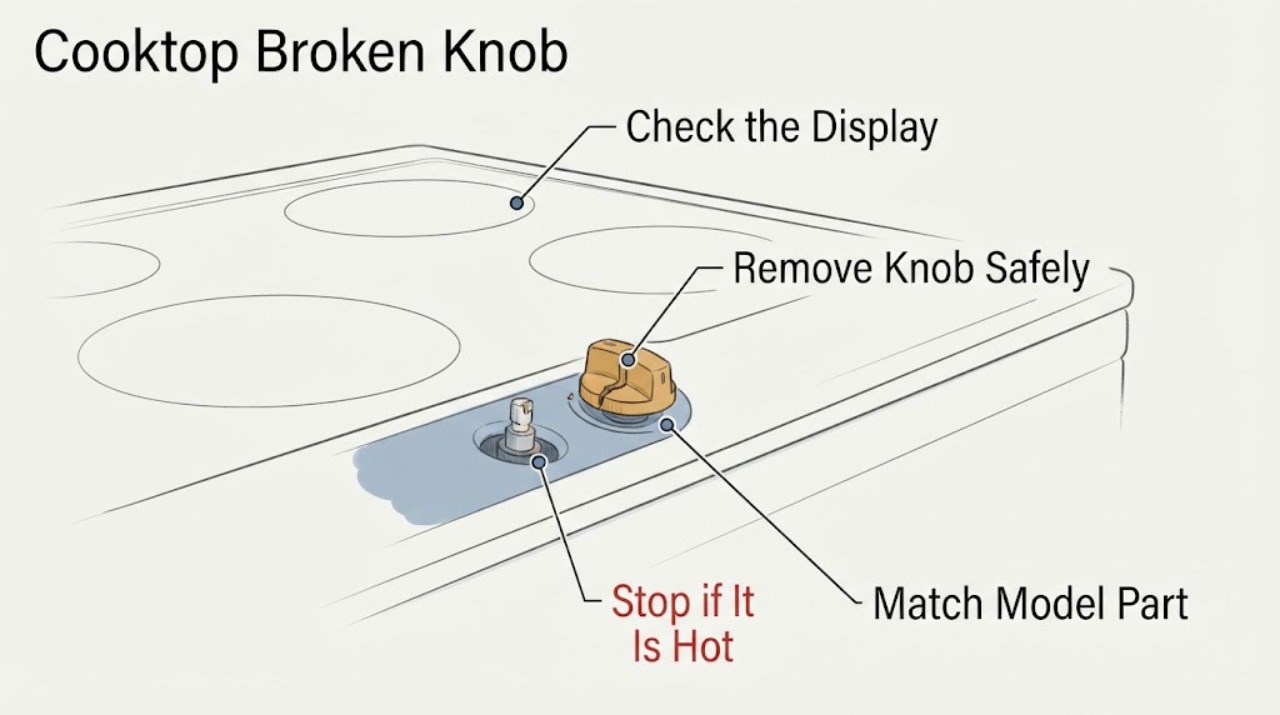
Do not glue a broken KitchenAid cooktop knob, force the stem with pliers or install a generic knob by appearance. First record the exact model and whether the cooktop is gas, electric or induction, then turn every control off and let the cooktop cool. KitchenAid says removable knobs should pull straight off and replacements should be installed with the control in Off; its support pages also make the control behavior fuel/type-specific. If the knob is the only damaged piece and the stem is intact, use the exact model manual or official parts lookup to identify the matching knob. If the stem or valve is cracked, the control cannot return to Off, a burner or element activates unexpectedly, there is gas odor, or electrical damage is visible, stop using the cooktop and arrange qualified service with gas/power isolation handled safely.
Work through in order
Diagnostic checks
Use only checks that match the exact appliance or system and its official guide.
-
Check 1
Record the complete KitchenAid model, identify gas/electric/induction type, and note whether the affected knob is cracked, missing, loose or broken at the stem. With the surface cool, confirm every control is Off without forcing a damaged shaft.
Expected result: The knob is damaged but the stem appears intact and the control remains Off, or the stem/control is damaged, stuck, loose or unable to return to Off.
Next step: Use the removable-knob branch only when the stem and Off position are normal; otherwise stop using the cooktop and arrange service.
Why this matters
Why: A removable knob and a damaged control mechanism are different repair paths. The generic knob guidance does not diagnose a valve, shaft, switch or element-control fault.
-
Check 2
After all controls are Off and the cooktop is cool, pull the damaged knob straight away from the panel. Do not twist, pry, glue, soak or use pliers on the shaft.
Expected result: The knob comes off cleanly, the stem is visibly intact, or the knob/stem resists removal or shows cracking, bending or looseness.
Next step: If it does not pull off normally or the stem is damaged, stop and request service; do not escalate force or improvise a handle.
Why this matters
Why: KitchenAid’s cleaning guidance supports a straight-off removable knob. Resistance or visible stem damage means the generic removal instruction is no longer sufficient.
-
Check 3
Use the exact model number and the official KitchenAid manual/literature or parts route to identify the replacement knob and control position. Compare only the model-documented fit; do not buy a generic knob based on color, shape or a similar KitchenAid cooktop.
Expected result: The exact model documentation identifies a matching removable knob, or the model is missing/unreadable or no match is found.
Next step: Use only a model-matched part. If the model or fit cannot be confirmed, leave the control unused and ask KitchenAid service to identify the part.
Why this matters
Why: KitchenAid provides model-number documentation and replacement-part access, but the opened generic pages do not prove compatibility for an unknown model.
-
Check 4
With the control in Off, align the model-matched replacement knob to the stem and press it straight on only as far as the manual or part instructions indicate. Do not use adhesive, drill the knob or turn a bare stem to test fit.
Expected result: The knob seats without force and points to Off, or it does not seat, is loose, or points away from Off.
Next step: Remove a misaligned knob without force and stop. Confirm the model/part with KitchenAid service rather than operating the cooktop.
Why this matters
Why: KitchenAid says replacement knobs should be in the Off position; a poor fit can leave the control position ambiguous and is not corrected by glue or pressure.
-
Check 5
For gas, use only the exact manual’s push-and-turn Ignite operation and do not test if the knob cannot return to Off or a gas odor is present. For electric/induction, do not energize a cooktop if a control shaft, bezel or wiring is damaged; follow the exact model’s control instructions.
Expected result: The control operates normally and returns to Off, or ignition/heating is uncontrolled, the lock state is unclear, or electrical/gas damage is present.
Next step: Use the cooktop only when the model-matched control is seated and normal. Otherwise leave it off and arrange qualified service.
Why this matters
Why: KitchenAid’s gas and electric pages describe different control actions. A broken knob can conceal a damaged control and must not be bypassed with a temporary tool.
-
Check 6
Stop using the cooktop if a burner or element activates unexpectedly, a control cannot return to Off, the stem/valve is cracked, gas odor is present, or electrical insulation/wiring is damaged. Isolate gas or power only when safe and do not open the cooktop.
Expected result: The damaged knob was replaced with a confirmed matching part and the control remains normal, or the hazard/persistent control fault remains.
Next step: Keep the cooktop off and arrange qualified KitchenAid service; use emergency gas procedures if a leak is suspected.
Why this matters
Why: A successful removable-knob replacement does not prove the underlying control is safe if the stem or valve was damaged. Gas-line and electrical work require qualified service.
Use your observations
Decision map
Find the observation that best matches what you see, then follow the next safe action.
-
PATH 01Next step
What you see
The knob pulls straight off with controls Off and the stem is intact and stays at Off.
Do this next
Identify a replacement by exact model and install it only in the Off position; do not use a generic knob or adhesive.
Why this path and its safety boundary
Why it matters: This matches KitchenAid’s removable-knob cleaning/replacement scope.
-
PATH 02Next step
What you see
The knob will not pull off normally, the stem is cracked/bent, or the control cannot return to Off.
Do this next
Leave the cooktop off and arrange qualified KitchenAid service; do not use pliers, glue or a temporary handle.
Why this path and its safety boundary
Why it matters: The issue is beyond a removable knob and may involve the control mechanism.
-
PATH 03Next step
What you see
The cooktop is gas and the knob/control is not able to perform the documented push-and-turn Ignite action or a gas odor is present.
Do this next
Do not attempt ignition or relight. Keep the cooktop off and use qualified gas-appliance service; follow emergency gas procedures for suspected leaks.
Why this path and its safety boundary
Why it matters: The gas ignition/control path is unsafe to test from a broken-knob condition.
-
PATH 04Next step
What you see
The cooktop is electric or induction and a control shaft, bezel or wiring is damaged or the element activates without normal control.
Do this next
Stop using the cooktop, isolate power only when safe and arrange qualified appliance/electrical service.
Why this path and its safety boundary
Why it matters: This is an electrical/control hazard, not a cosmetic knob replacement.
-
PATH 05Next step
What you see
The exact model or replacement fit cannot be confirmed.
Do this next
Keep the affected control unused and obtain model-matched documentation or service before buying or installing a part.
Why this path and its safety boundary
Why it matters: KitchenAid’s generic knob guidance does not establish compatibility across cooktop families.
Helpful context
Understand the symptom
Separate a cosmetic knob break from a control failure
Record the complete KitchenAid model, whether the cooktop is gas, electric or induction, which knob is affected, whether it still turns the control, and whether the corresponding burner or element is off when the knob is at Off. A cracked knob can be a removable control piece, but a split stem, valve damage or an element that remains energized is a service issue.
Remove only the knob, with controls off and the surface cool
KitchenAid says to make sure all controls are Off and the cooktop is cool, then pull the knob straight away from the control panel. Do not twist, pry, soak or glue the knob, and do not use a tool to turn a bare control stem. The generic guidance does not establish how a particular bezel, seal or shaft is secured.
Use the exact model for the replacement part
KitchenAid’s support pages direct owners to manuals and literature by model number, and the control-knob guidance says replacement parts are available. That does not make every KitchenAid knob interchangeable. Match the exact model, control position, fuel/type and stem shape through the official model documentation; do not select a generic knob from appearance or force a mismatched part onto the stem.
Keep gas and electric controls within their own instructions
For a gas cooktop, KitchenAid says the knob must be pushed in and turned to Ignite for the spark system, and some models can have a Cooktop Lock. For an electric coil cooktop, KitchenAid says the knob must be pushed down before turning. Do not bypass either action with pliers or a temporary handle, and do not test a damaged control by repeatedly energizing it.
Stop for a damaged stem, uncontrolled heat or gas/electrical danger
If the knob cannot return the control to Off, the stem or valve is damaged, a burner or element activates unexpectedly, gas odor is present, or wiring/insulation is visibly damaged, leave the cooktop off and arrange qualified service. KitchenAid’s installation guidance treats gas-line and electrical work as professional tasks; do not open the cooktop or attempt a control repair from a broken-knob symptom.
When checks do not resolve it
Need a professional?
Request qualified KitchenAid service when the control stem/valve is damaged, the knob cannot return to Off, the replacement fit is uncertain, a gas burner cannot be safely controlled, an electric/induction element activates unexpectedly, or gas/electrical damage is visible. Do not select a valve, switch, stem or generic knob from this symptom alone.
Common questions
FAQ
Can I glue a broken KitchenAid cooktop knob?
No. A glued or improvised knob can leave the control position unclear and cannot repair a damaged stem or valve. KitchenAid’s guidance supports removing a knob straight off with the controls Off and the cooktop cool, then matching the replacement to the exact model.
Are KitchenAid cooktop knobs interchangeable?
Do not assume so. The opened generic KitchenAid pages direct owners to model-number manuals and replacement-part routes but do not establish compatibility for an unknown cooktop. Confirm the exact model and control position before ordering.
What if the knob broke but the cooktop still turns on?
Stop using the affected control if it cannot reliably return to Off or if a gas burner/element activates unexpectedly. A removable knob can be replaced only after the exact model and control stem are confirmed; a damaged stem or valve needs service.
Read the exact guide
Official sources
- Nothing Will Work - Gas CooktopKitchenAid Product Help · Official KitchenAid gas-cooktop support for grounded power, main gas supply and Cooktop Lock behavior. It supports model-specific service escalation, not a broken-control repair.
- Cleaning Control Knobs or Control PanelKitchenAid Product Help · Official KitchenAid guidance that controls must be Off and the cooktop cool before knob removal; it supports pulling knobs straight away and model documentation/parts routing but does not establish a universal replacement fit.
- Lighting the Burners - Electronic IgnitionKitchenAid Product Help · Official KitchenAid gas-cooktop guidance that the knob is pushed and turned to Ignite for spark ignition; it supports normal control behavior and does not authorize bypassing a damaged control.
- Coil Element(s) - Not Working - Electric CooktopKitchenAid Product Help · Official KitchenAid electric-cooktop guidance that the knob must be pushed before turning and that coil appearance may cycle normally; it does not support live testing of a damaged control.
- How to Install a Cooktop: Gas, Electric or InductionKitchenAid · Official KitchenAid installation overview that distinguishes gas/electric/induction and recommends professional help for electrical wiring or gas-line work; it is not a model-specific repair manual.
- Caring for the Control Knobs and the Control PanelKitchenAid Product Help · Official KitchenAid cooktop care page. It supports cool/off conditions, straight-off removal, no soaking and model-number literature lookup; it does not identify an unknown knob’s compatibility.
Community feedback
Share a repair observation
Share a plain-text repair observation. Accepted observations are published automatically; this page may take a moment to update.