
On this page
Start here
Quick answer
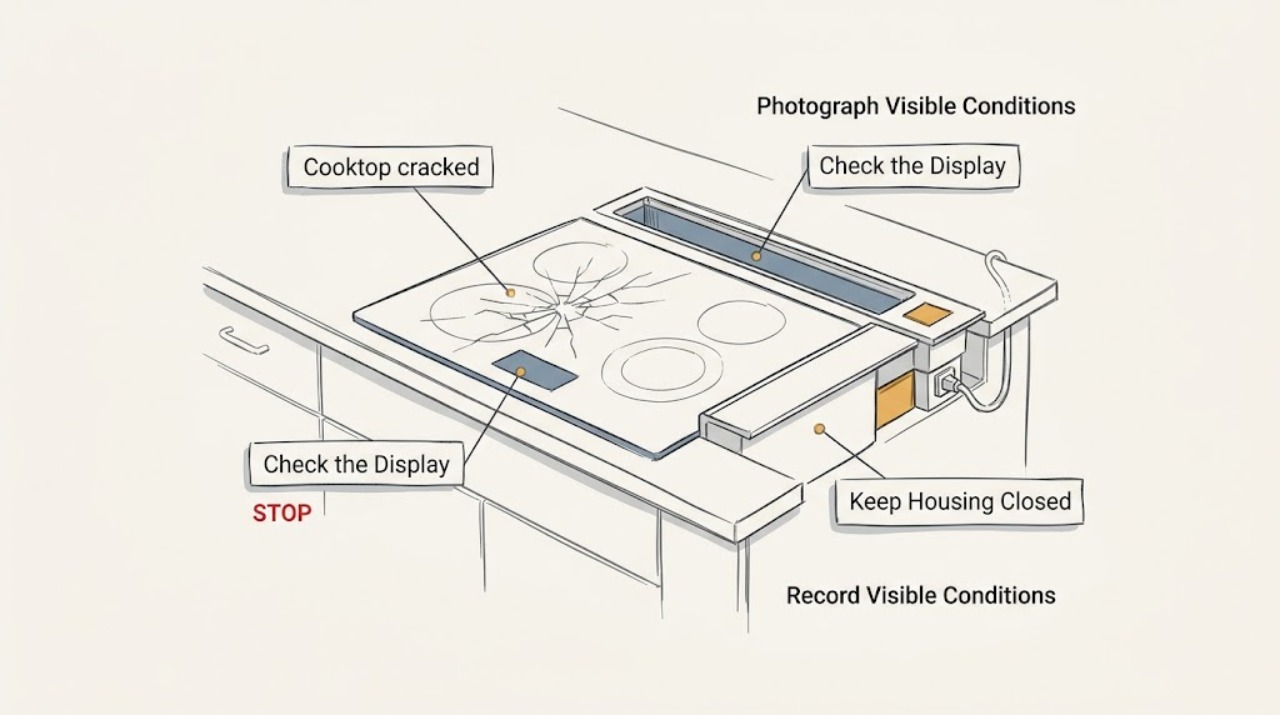
Do not cook on a cracked KitchenAid KECD806 glass surface. KitchenAid's safety instructions say a broken cooktop can allow cleaning solutions or spills to penetrate and create an electric-shock risk, and direct the owner to a qualified technician. Turn all controls off, keep the island cooktop out of use, and isolate power only from a safe, dry location if the crack is near controls, wiring, or a spill. The opened KitchenAid dimension guide lists KECD806R in the 30-inch electric built-in ceramic downdraft family and specifies a 29 1/2-inch by 21-inch countertop opening for the 30-inch model; it also says the shown opening dimensions must be used and the countertop must be supported near the cutout. Because the task identity omits the finish/suffix, confirm the full rating-label model before treating those dimensions as yours. Measure the existing opening, depth, countertop thickness/support, downdraft path, junction-box location, and clearances without enlarging, filling, shimming, or adapting the hole. A qualified installer must decide whether an exact replacement, a code-compliant structural repair, or a different appliance layout is possible; this article does not select a product or endorse a retrofit.
Before you begin
Safety first
- Owner checks stop at turning controls off, safe dry power isolation when reachable, cool visual documentation, complete model-label identification, and non-invasive measurement of the countertop opening and accessible installation context. Do not cook on a cracked surface, scrape or patch the glass, lift the unit, disconnect conduit, open the junction box, alter the cutout, add a filler/collar/shim, or perform live electrical tests.
Work through in order
Diagnostic checks
Use only checks that match the exact appliance or system and its official guide.
-
Check 1
Turn every control off and stop cooking immediately. Keep cookware, cleaning liquid, and people away from the damaged glass; wait for any hot surface to cool. From a safe, dry position, isolate the cooktop's power only if the disconnect or breaker can be reached without touching wet, hot, damaged, or exposed electrical areas.
Expected result: The crack is a line through the glass, a chip has missing material, loose fragments are present, liquid reached the crack or controls, a zone will not turn off, or there is smoke, odor, sparking, shock, or a breaker event.
Next step: Keep the entire cooktop out of service and arrange qualified appliance service; use qualified electrical or emergency help for the corresponding electrical, smoke, shock, fire, or breaker hazard.
Stop if: Do not test another zone, wipe liquid into the break, tape or glue the glass, scrape the crack, or touch exposed wiring or loose shards.
Why this matters
Why: KitchenAid warns that a broken cooktop can admit spills and create electric-shock risk. Uncontrolled heat, liquid exposure, or electrical symptoms are stricter safety stops than a dry, stable crack, but every confirmed crack means the surface must not be used.
-
Check 2
After the cooktop is off and cool, photograph the crack from above and record whether it reaches an edge, control area, heating zone, downdraft opening, or any missing glass. Do not press, flex, lift, or clean across the suspected break.
Expected result: The mark appears to be a full-depth crack, a chip, a loose fragment, a superficial scratch/residue, or an uncertain line that cannot be classified without force or heat.
Next step: Send the photos and full model label to KitchenAid or qualified service and keep the cooktop unused until it is cleared or repaired.
Stop if: Do not use a scraper, abrasive cleaner, hot pan, water test, or temporary patch to decide whether the line is safe.
Why this matters
Why: A crack or missing glass cannot be made safe by proving that another zone still heats. An uncertain mark also should not be tested by cooking; only a qualified assessment can distinguish cosmetic damage from a structural break without increasing risk.
-
Check 3
Read the rating label without moving the built-in unit and record the complete model and serial identity, including the finish suffix. Confirm whether the label corresponds to KECD806R or another KECD806-family suffix, and obtain the matching installation instructions before treating any historical dimensions as a replacement specification.
Expected result: The label confirms a KECD806-family model, shows a different model or suffix, is unreadable, or the cooktop has a different width or installation type than the opened guide.
Next step: Have a qualified installer or KitchenAid service confirm the exact literature and approved replacement path. Do not order a glass or complete cooktop from the prefix alone.
Stop if: Do not lift the cooktop, disconnect its conduit, search beneath the glass, or pull it out by the cable to find the label.
Why this matters
Why: KitchenAid model literature and cutout requirements are model-specific. The opened guide identifies KECD806R but the task lacks the suffix, so an apparent 30-inch match does not establish electrical, downdraft, support, or replacement compatibility.
-
Check 4
With the appliance untouched and power isolated, measure the existing countertop opening from the top: clear width, front-to-back depth, corner shape, countertop thickness, and support distance around the opening. Also record the downdraft duct route, blower clearance, junction-box or conduit position, and nearby drawers or cabinet obstructions. Do not enlarge, narrow, fill, or shim the cutout.
Expected result: The opening is approximately 29 1/2 by 21 inches, materially larger or smaller, has damaged stone or unsupported edges, or has a downdraft/electrical obstruction that the dimension guide does not accommodate.
Next step: Give the measured drawing and photos to a qualified appliance installer and countertop professional for a code-compliant feasibility decision. Do not make a field modification based on a retailer dimension or a forum suggestion.
Stop if: Do not cut stone, add an unapproved collar or filler, place a smaller appliance over the gap, or move the built-in unit while it is damaged or connected.
Why this matters
Why: The opened KitchenAid guide gives 29 1/2 by 21 inches for the 30-inch model, says the shown opening dimensions must be used, and requires countertop support within 3 inches of the cutout. An oversized hole is not solved by width alone; support, depth, venting, clearances, and electrical access affect safe installation.
-
Check 5
Prepare an installation handoff rather than a live test: provide the model label, crack photos, measured opening, countertop material, island cabinet dimensions, downdraft duct path, electrical disconnect/junction-box location, and any zone, control, breaker, or spill history. Ask the installer to verify the complete installation instructions and local electrical/building requirements.
Expected result: The exact model and opening dimensions are confirmed, the opening is too large or unsupported, the downdraft path conflicts, the countertop is damaged, or the electrical connection cannot be safely verified.
Next step: Keep the cooktop off and obtain an on-site feasibility assessment from qualified KitchenAid appliance and electrical/countertop professionals. Separate appliance diagnosis from any countertop fabrication decision.
Stop if: Do not resume cooking because another zone works, the crack appears stable, or a proposed replacement is only slightly smaller than the opening.
Why this matters
Why: A qualified installer must evaluate structural support, appliance frame fit, downdraft clearance, grounding and circuit requirements, and countertop work together. The evidence does not justify naming a replacement product, part, or retrofit method.
Use your observations
Decision map
Find the observation that best matches what you see, then follow the next safe action.
-
PATH 01Next step
What you see
The glass is confirmed cracked or missing material, but the controls are off, the surface is dry, and there is no active heat, smoke, odor, spark, shock, or breaker event.
Do this next
Keep the cooktop off, protect people from loose glass without touching the break, and arrange qualified KitchenAid service with the complete model and photos.
Why this path and its safety boundary
Why it matters: This is still a no-use condition even without an active electrical symptom; KitchenAid says not to cook on a broken cooktop because spills can penetrate and create shock risk.
-
PATH 02Next step
What you see
The label confirms the KECD806R/30-inch family and the measured opening is close to the guide's 29 1/2-inch width by 21-inch depth, with sound support and no unresolved duct or electrical obstruction.
Do this next
Have a qualified installer match the complete model literature, support, downdraft, circuit, and countertop condition before any replacement is selected or installed.
Why this path and its safety boundary
Why it matters: The opening may be compatible in planning terms, but the guide's dimensions are not a clearance to reuse a cracked unit or a substitute for full installation verification. The exact finish/suffix and all clearances still control.
-
PATH 03Next step
What you see
The opening is larger than the model guide, the stone edge is unsupported or damaged, the downdraft path conflicts, or the full model suffix cannot be confirmed.
Do this next
Do not alter the opening or install a substitute. Obtain an on-site assessment from qualified appliance installation and countertop professionals using the complete model identity and measurements.
Why this path and its safety boundary
Why it matters: This is an unresolved installation-compatibility problem, not evidence that a smaller cooktop, filler, collar, shim, or countertop alteration is safe. The appliance may require a different approved layout or professional structural work.
-
PATH 04Next step
What you see
A zone stays energized, controls are unresponsive, liquid entered the crack or controls, or there is smoke, burning odor, sparking, shock, exposed wiring, or repeated breaker action.
Do this next
Keep away from the cooktop and isolate power only from a safe, dry position; obtain qualified appliance or electrical help and emergency help for active fire or shock conditions.
Why this path and its safety boundary
Why it matters: This is an immediate electrical, fire, or shock stop in addition to the broken-glass hazard. A replacement-size discussion must wait until the appliance and supply are made safe.
Helpful context
Understand the symptom
The cracked surface and the oversized island opening are two separate decisions. The crack is an immediate use-and-safety stop; the opening is an installation-compatibility question. A cooktop that seems close in width can still fail because its frame, glass overhang, downdraft blower, depth, electrical connection, or required support does not match the existing opening. Do not use the present cooktop as a template while it is cracked or make the opening larger to force a replacement.
The exact model is not fully resolved by KECD806 alone. KitchenAid's opened historical dimension guide lists KECD806R and KECD866R as product model numbers in the 30-inch/36-inch electric downdraft family, while the community post matching the task describes a 30-inch KECD806 with a 21-inch-deep opening. Treat the finish/suffix, actual width, and installation as facts to verify on the rating label and in the model's installation literature, not as assumptions for a new appliance.
When checks do not resolve it
Need a professional?
Request qualified KitchenAid appliance service for the cracked glass and any zone/control damage. Request qualified electrical service for supply, grounding, conduit, junction-box, shock, or breaker concerns. Request a qualified countertop/appliance installer to assess the oversized island opening, support, downdraft route, clearances, and an approved installation plan.
Safety scope: Owner checks stop at turning controls off, safe dry power isolation when reachable, cool visual documentation, complete model-label identification, and non-invasive measurement of the countertop opening and accessible installation context. Do not cook on a cracked surface, scrape or patch the glass, lift the unit, disconnect conduit, open the junction box, alter the cutout, add a filler/collar/shim, or perform live electrical tests.
Have this ready
- Provide the complete KECD806-family model and serial label, crack photos and location, countertop material, measured opening width/depth/thickness, edge support, cabinet and drawer obstructions, downdraft duct route, electrical disconnect location, and any spill, impact, heating, control, odor, or breaker history.
Common questions
FAQ
Can I keep using another burner if only one area of the KECD806 glass is cracked?
No. KitchenAid says not to cook on a broken cooktop because spills or cleaning solutions can penetrate the break and create an electric-shock risk. Keep the entire cooktop off until qualified service assesses it.
What cutout size does the KitchenAid KECD806 use?
The opened KitchenAid historical dimension guide lists KECD806R in the 30-inch electric built-in ceramic downdraft family and shows a 29 1/2-inch by 21-inch countertop opening for the 30-inch model. The task omits the finish/suffix, so confirm the rating label and exact installation instructions before relying on those dimensions. The guide also calls for countertop support near the cutout and specific duct/electrical clearances.
Can I use a smaller cooktop, a filler, or a trim collar in the oversized island opening?
Do not install or fabricate one based on a forum or retailer suggestion. An opening must support the frame and preserve required clearances, downdraft airflow, electrical safety, and countertop integrity. Have a qualified appliance installer and countertop professional determine whether any proposed structural solution is approved and code-compliant; this article does not recommend a product or retrofit.
Does a stable hairline crack need immediate service if the cooktop still works?
Yes. A crack is a no-use condition even if the zones still heat. Do not press, scrape, tape, glue, or heat-test the line. Photograph it after the surface is cool, record the exact model, and arrange qualified service.
Read the exact guide
Official sources
- KitchenAid service & supportKitchenAid · The opened KitchenAid service page directs owners to appliance support, manuals, parts, and service and emphasizes having model and serial information. It supports the professional handoff, not a product or price recommendation.
- Dimension GuideKitchenAid · The opened KitchenAid guide lists KECD806R and KECD866R as product model numbers and gives 30-inch and 36-inch overall/cutout dimensions, including a 29 1/2-inch by 21-inch opening for the 30-inch model. It also states that the shown opening dimensions must be used and gives support, duct, clearance, and electrical planning requirements. Confirm the full suffix before applying the guide.
- KITCHENAID® MANUALS & LITERATUREKitchenAid · KitchenAid's opened manuals page directs owners to enter the appliance model number to locate installation, use, maintenance, and repair literature. It is used to enforce the full-suffix identity boundary, not to claim an exact KECD806 document was exposed on the page.
- IMPORTANT SAFETY INSTRUCTIONSKitchenAid · The opened KitchenAid owner's manual is a brand cooktop safety source, not a claim that every control or dimension belongs to KECD806. It explicitly says not to cook on a broken cooktop because spills can penetrate and create an electric-shock risk, and directs immediate qualified technician help.
- Need to replace cooktop, cutout too large for any model I can findReddit / r/Appliances · Community evidence only. The post matches the KECD806 prefix, cracked cooktop, island installation, and 21-inch cutout depth. Replies about collars or replacement options are unverified and are not used as installation instructions.
- Ceramic Glass Cooktop - Electric CooktopKitchenAid Product Help · The opened KitchenAid product-help page supports the distinction between a cool, intact surface and a suspected break; its cleaning directions are not used to authorize scraping or cleaning a cracked surface.
Community feedback
Share a repair observation
Share a plain-text repair observation. Accepted observations are published automatically; this page may take a moment to update.