
On this page
Start here
Quick answer
Do not use a damaged KitchenAid cooktop until you identify what is damaged. A crack or break in a ceramic-glass cooking surface is a stop-use condition: KitchenAid says not to cook on a broken cooktop because spillovers or cleaning solution can penetrate and create an electric-shock risk. A gas odor, a damaged gas or ignition part, exposed wiring, scorching, or sparking with the controls off also requires stopping and qualified service; do not ignite burners or operate switches to test it. If the mark is only on intact exterior trim and there is no gas, electrical or functional symptom, document the model and damage and use only the model-approved care guidance rather than guessing a repair or part.
Work through in order
Diagnostic checks
Use only checks that match the exact appliance or system and its official guide.
-
Check 1
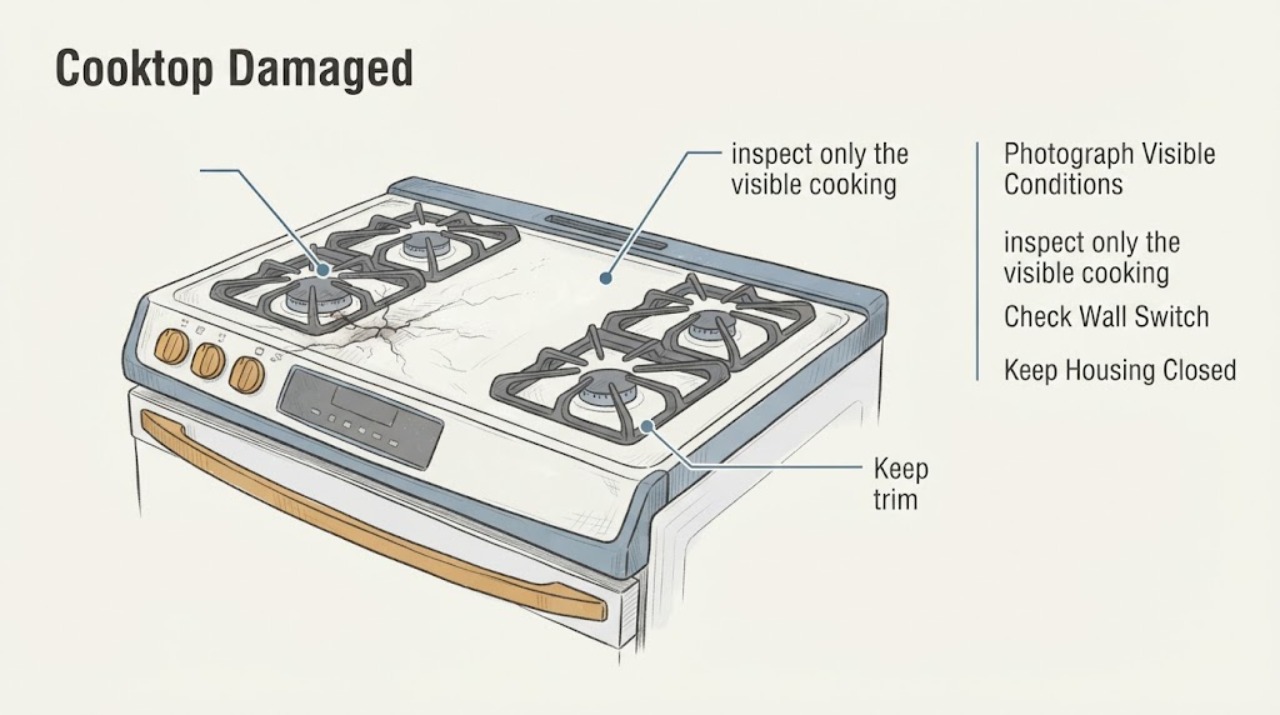
Leave the cooktop off and cool, then record the complete KitchenAid model number and photograph the damage from a safe distance. Classify its location as cooking-surface glass, burner/gas/ignition area, electrical/control area, or exterior trim; do not remove panels or knobs to find a hidden number.
Expected result: The mark is visibly on the ceramic-glass surface, near a burner or gas fitting, near a control or wiring area, or only on intact trim; the model is confirmed or still unknown.
Next step: Use the matching branch below. If the class or model cannot be confirmed, keep the cooktop out of service and give the photographs and identity information to KitchenAid or a qualified technician.
Why this matters
Why: The damage class determines whether the first decision is stop-use/emergency gas action, qualified service, or a model-specific cosmetic-care check. A model-free part or procedure cannot establish fit or safe access.
-
Check 2
With the cooktop cool and controls off, inspect only the visible cooking surface for a crack, chip, broken edge or opening. Do not wipe liquid across a suspected break and do not test a burner to see whether it still works.
Expected result: A crack or break reaches the cooking surface, or the visible mark is only residue or an unbroken surface mark.
Next step: For a crack, chip or break, stop using the cooktop and arrange qualified service. For an unbroken mark, use only the exact model’s care instructions and stop if cleaning exposes a crack or damage beneath the residue.
Why this matters
Why: KitchenAid treats a broken cooktop as unsafe to cook on because spillovers or cleaning solution can penetrate and create an electric-shock risk. A mark that is not a break is not enough to diagnose the underlying surface or authorize use.
-
Check 3
For a gas KitchenAid cooktop, if gas is smelled while no burner should be on or if a gas component appears damaged, do not light any appliance, touch an electrical switch, use a phone in the building, or operate the burner for a test.
Expected result: The odor persists after confirming that no surface burner was accidentally left on, or there is no gas odor and the concern is limited to a visible non-gas area.
Next step: Leave the building/area as appropriate and call the gas supplier from a neighbor’s phone; call the fire department if the supplier cannot be reached. For suspected gas-part damage without an odor, leave the cooktop off and arrange qualified service rather than igniting it.
Why this matters
Why: KitchenAid treats unexplained gas odor as a possible gas-safety emergency. No odor does not prove that a damaged gas component is safe, so a suspected line, burner base or ignition-area damage still needs qualified assessment.
-
Check 4
If damage is near controls, wiring, an ignition area or the power connection, make only a cool, de-energized visual check of accessible exterior surfaces for scorching, melted material, liquid entry or exposed conductors. Do not remove the cooktop, open the control area or make an energized measurement.
Expected result: Scorching, melted material, exposed wiring, liquid entry or sparking with controls off is visible, or no electrical damage is visible.
Next step: Keep the appliance out of service and arrange qualified appliance or electrical service. Do not bypass an interlock, reconnect a damaged cord, or repeatedly energize the cooktop to reproduce a spark.
Why this matters
Why: Visible electrical damage or unexplained sparking is a stop-use condition; no visible damage does not clear hidden wiring, controls or the appliance’s safety systems.
-
Check 5
If the mark appears limited to intact trim or another exterior finish, compare it with the exact model’s care instructions and record whether the glass, burner behavior, controls, odor and heat pattern are unchanged. Do not sand, scrape, polish aggressively or use an unapproved coating to hide the mark.
Expected result: There is no crack, gas odor, spark, scorch, exposed wiring or change in operation, and the visible mark remains confined to trim; or any safety/functional symptom is present.
Next step: For a genuinely cosmetic mark, provide the model and photos to KitchenAid or a qualified service provider before ordering a finish or trim part. For any crack, odor, spark, heat damage or changed operation, stop using the cooktop and use the corresponding service/emergency branch.
Why this matters
Why: The first pattern is consistent with a cosmetic concern but does not prove the appliance is safe if the damage is misidentified. Any safety or functional symptom moves the issue out of cosmetic-only handling.
Use your observations
Decision map
Find the observation that best matches what you see, then follow the next safe action.
-
PATH 01Next step
What you see
The cooking surface is cracked, chipped through, or broken, even if the burners still appear to work.
Do this next
Do not cook or clean across the break. Keep the cooktop out of service and arrange qualified service using the complete model number.
Why this path and its safety boundary
Why it matters: KitchenAid identifies a broken cooktop as an electric-shock risk because spillovers or cleaning solution can penetrate the break.
-
PATH 02Next step
What you see
Gas is smelled when the cooktop is not in use, or the odor remains after confirming that no burner was accidentally turned on.
Do this next
Do not light an appliance, touch electrical switches or use a phone in the building. Leave and call the gas supplier from a neighbor’s phone; call the fire department if the supplier cannot be reached.
Why this path and its safety boundary
Why it matters: The situation must be treated as a possible gas leak rather than a burner-adjustment or damage test.
-
PATH 03Next step
What you see
Damage includes scorching, melted insulation, exposed wiring, liquid entry, sparking with controls off, a damaged gas/ignition area, or an unexplained change in burner operation.
Do this next
Leave the cooktop off and arrange qualified appliance service; do not open the housing, bypass a control or repeatedly energize the unit.
Why this path and its safety boundary
Why it matters: The visible symptom does not identify a safe user repair and may involve electrical, gas or ignition protection.
-
PATH 04Next step
What you see
The surface is intact, there is no gas odor or electrical warning sign, and the mark is confined to exterior trim with normal documented operation.
Do this next
Photograph the area, confirm the model, and use KitchenAid’s model-specific manual or service channel before applying cleaners, coatings or ordering parts.
Why this path and its safety boundary
Why it matters: The issue may be cosmetic, but a model-specific care or trim decision is still needed; the mark alone does not prove a replacement part will fit.
Helpful context
Understand the symptom
Classify the damage before deciding whether the cooktop can be used
“Damaged” does not identify one repair. First separate a crack or chip in the cooking surface, a gas or burner/ignition problem, electrical or control damage, and a mark limited to trim or another exterior surface. KitchenAid’s support center uses the complete model number to select the applicable manual, so record it before looking for a replacement surface, burner part or procedure. A model number is commonly found inside the burner box or on the underside of the cooktop.
A broken ceramic-glass surface is a stop-use condition
If the cooking surface is cracked, broken or chipped in a way that reaches the cooktop surface, leave the cooktop off and do not pour cleaner or water over the area. The KitchenAid manual says not to cook on a broken cooktop because spillovers or cleaning solutions can penetrate the break and create an electric-shock risk. Do not tape the break, polish it, or keep cooking while waiting for a part; arrange qualified service using the exact model.
Gas odor, sparking and visible electrical damage need a professional boundary
For a gas model, a gas smell when the cooktop is not being used is not a reason to light a burner for diagnosis. KitchenAid says not to light any appliance, touch an electrical switch or use a phone in the building; move away and call the gas supplier from a neighbor’s phone, or the fire department if the supplier cannot be reached. If the damage includes scorching, exposed wiring, liquid entry, or sparking when controls are off, keep the cooktop out of service and arrange qualified repair rather than opening the housing or making an energized test.
An intact exterior mark is a different decision
A scratch, stain or dent confined to trim is not evidence that the glass, gas path or electrical system is safe, but it may be cosmetic if the surface remains intact and there is no odor, spark, heat damage or change in operation. Photograph the mark and identify the exact model. Use the model’s own care instructions; do not sand, buff, scrape or fit a guessed coating or replacement part.
When checks do not resolve it
Need a professional?
Use emergency gas guidance for an unexplained gas odor: do not ignite appliances or operate electrical switches; call the gas supplier from outside/another building or the fire department if needed., Arrange qualified KitchenAid or appliance service for a cracked cooktop, damaged burner/gas or ignition area, exposed wiring, scorching, sparking, liquid entry or changed operation., For a mark limited to intact trim, provide the complete model and photos before choosing a finish or replacement part; do not assume a part from another KitchenAid cooktop fits.
Have this ready
- complete KitchenAid model number
- photos showing the damage and its location
- whether the cooktop is gas, electric or induction
- whether there was a gas odor, spark, scorch, exposed wiring or change in burner/control behavior
- when the damage was noticed and whether the cooktop was hot or in use
Common questions
FAQ
Can I keep using a KitchenAid cooktop with a small crack?
No. KitchenAid says not to cook on a broken cooktop because spillovers or cleaning solution can penetrate and create an electric-shock risk. Leave it off and arrange qualified service.
Is a scratch or stain the same as a cracked cooktop?
Not necessarily. A mark confined to an intact surface or trim may be cosmetic, but do not assume that from a photo or word alone. Let the surface cool, inspect without spreading liquid over a suspected break, and use the exact model’s care instructions.
What should I do if the damaged KitchenAid gas cooktop smells like gas?
Do not light any appliance, touch an electrical switch, use a phone in the building or operate a burner for testing. Leave and call the gas supplier from a neighbor’s phone; if the supplier cannot be reached, call the fire department.
Can I replace the damaged burner or glass myself?
Do not choose a part or open the cooktop from a generic description. Record the complete model and have KitchenAid or a qualified technician confirm the applicable service procedure and fit, especially for gas, ignition, electrical or broken-glass damage.
Read the exact guide
Official sources
- Burner(s) Sparking or Clicking - Gas Cooktop | KitchenAidKitchenAid · Opened official KitchenAid Product Help guidance for gas cooktops. It distinguishes expected clicking while a burner is in LITE, damp-burner behavior and continued sparking that needs service; it is not used to map an unspecified damaged cooktop to a failed component.
- KitchenAid Cooktop Owner’s Manual and Safety InstructionsKitchenAid · Official KitchenAid cooktop owner/safety manual opened from the KitchenAid domain; used for the explicit broken-cooktop and service-safety instructions, not for an unconfirmed model-specific repair.
- KitchenAid Owners CenterKitchenAid · Opened official KitchenAid Owners Center. It requires the model/serial for product resources and identifies model-number locations for cooktops; it is used to obtain the exact manual rather than to support a universal repair step.
- Odors or Smells - Product Help | KitchenAidKitchenAid · Opened official KitchenAid Product Help page for gas cooktops. Its emergency instructions apply when gas is smelled outside normal burner use; they are not a diagnosis of the unspecified damage.
- KitchenAid Ceramic Glass and Cooktop Control GuideKitchenAid · Official KitchenAid control guide opened from the brand domain. It says ceramic-glass surfaces can be damaged by heavy/hard objects and gives surface-care boundaries; the guide is used only for ceramic-glass surface classification and care, not to infer the task’s missing model.
Community feedback
Share a repair observation
Share a plain-text repair observation. Accepted observations are published automatically; this page may take a moment to update.