
On this page
Start here
Quick answer
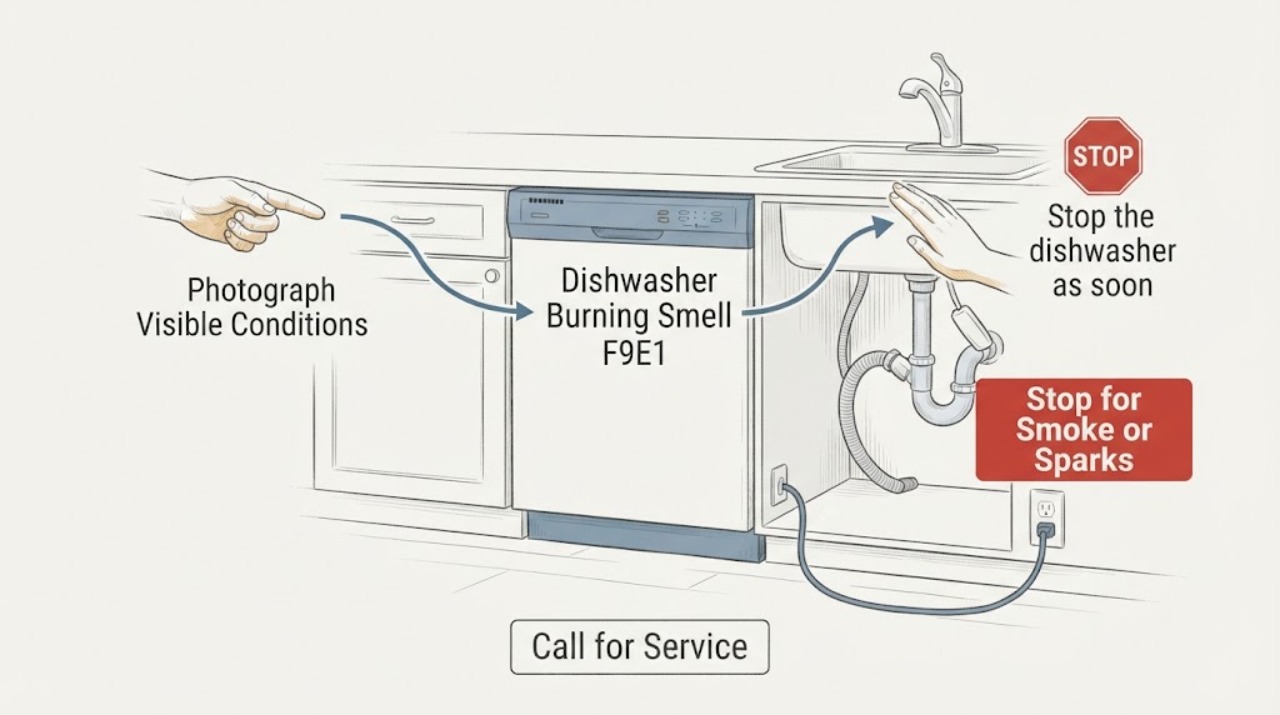
Stop using the KitchenAid KDTM404KPS0 if the smell is genuinely burning, hot plastic, or electrical, and do not run another cycle to reproduce the fault. From a dry, accessible position, leave the dishwasher without power if you can do so safely, keep clear of wet or exposed electrical areas, and arrange qualified service. KitchenAid documents F9E1 as a long-drain condition and F8E2 as a fill-valve electrical error, but its general dishwasher code table does not establish F7E1 or F10E2 for this model. Record the display exactly and give the technician the full combination; do not infer a pump, valve, vent motor, heater, or control-board replacement from the codes alone.
Work through in order
Diagnostic checks
Use only checks that match the exact appliance or system and its official guide.
-
Check 1
Stop the dishwasher as soon as a true burning, hot-plastic, or electrical odor is noticed. Do not start another cycle, enter diagnostic mode, remove panels, or reach into standing water. From a dry, accessible position, leave power isolated if that can be done without touching wet or exposed electrical parts.
Expected result: The odor is electrical, acrid, hot plastic, or accompanied by smoke, a hot area, sparking, a tripped breaker, or water near electrical parts; or the smell is only stale food/sewage with no heat or electrical warning.
Next step: For any electrical or burning indication, keep the dishwasher off and arrange qualified service. If the odor is clearly ordinary food/sewage odor and no hazard is present, continue only with the external, model-permitted observations below; do not restart this unit merely to test the distinction.
Stop if: Do not handle wet plugs, exposed wiring, the breaker with wet hands, or any internal component.
Why this matters
Why: A burning smell or damaged wiring is a KitchenAid service trigger. A stale-food or sewage smell can accompany drainage problems, but it must not be used to dismiss an electrical odor.
-
Check 2
After the unit is safely off, photograph or write down the complete display exactly as shown, including every F/E pair and its order. Confirm the full model label as KDTM404KPS0 and note whether the codes were on the display together or were read from a diagnostic history.
Expected result: The display consistently shows F9E1, F7E1, F8E2, and F10E2; only some codes recur; or the characters or source of the codes are uncertain.
Next step: Give the image or written sequence, model, burning-odor description, standing-water status, and any breaker event to the service provider. If the sequence cannot be reproduced or read clearly, request model-specific documentation rather than substituting a similar code.
Stop if: Do not press hidden keys, bridge terminals, or reopen power to obtain a code.
Why this matters
Why: KitchenAid says its dishwasher code format and meanings vary by model. A complete record distinguishes a stable display from a recalled or misread diagnostic sequence, but it does not identify a failed part.
-
Check 3
Interpret only the two codes that KitchenAid publicly documents for dishwashers: F9E1 and F8E2. Treat F9E1 as a long-drain indication and F8E2 as a fill-valve electrical-error indication, not as proof that the drain pump or inlet valve needs replacement.
Expected result: F9E1 is present with water remaining; F8E2 is present; both are present; or neither is confirmed in the current display.
Next step: Because this report includes a burning smell, do not use the normal code-page reset or restart instructions. Keep the unit off and let qualified service decide whether any internal inspection is safe.
Stop if: Do not order a drain pump, inlet valve, vent motor, heater, or control solely from a code label.
Why this matters
Why: F9E1 points to a drain-path condition in the official guide, while F8E2 points to an electrical issue associated with the fill valve. Either can have multiple causes, and the official pages do not establish that the reported code combination identifies one component.
-
Check 4
Only if there was no electrical or burning warning and power remains safely isolated, look from outside the appliance at the accessible drain hose under the sink, disposer connection, and air-gap area for an obvious kink, disconnected hose, or visible obstruction. Do not pull the built-in dishwasher out or disassemble the drain system.
Expected result: A visible hose kink, disposer connection issue, air-gap obstruction, or excessive suds is present; or the visible drain path looks normal while water remains inside.
Next step: Record the observation for the technician. If the path is visibly abnormal, have it corrected by a qualified installer or technician; do not run a test cycle on a unit that produced a burning smell.
Stop if: Do not reach through standing water, remove an internal filter or pump cover, clear a hard blockage inside the machine, or perform a live drain test.
Why this matters
Why: KitchenAid lists these as possible external contributors to F9E1. A normal visible path does not rule in a pump or other internal part, especially when an odor hazard is also reported.
-
Check 5
Tell the technician that F7E1 and F10E2 were reported, but do not assign meanings to them from another appliance or another KitchenAid platform. The exact-model Reddit post reports F7E1 as wash-motor related and F10E2 as vent-wax-motor related, while the opened KitchenAid dishwasher code catalog does not confirm those two labels.
Expected result: A service document for KDTM404KPS0 confirms those codes; the technician identifies a different display sequence; or no model-specific documentation is available.
Next step: Keep the appliance out of service until the technician verifies the model-specific meanings and inspects the source of the smell. Do not restart it to reproduce the combination.
Stop if: Do not use undocumented diagnostic sequences, bypass the door or float protection, or perform energized wiring tests.
Why this matters
Why: The Reddit case is a matching community observation, not sufficient evidence for a component diagnosis. The discrepancy is itself a service finding and should be resolved with the exact model's technical sheet or service procedure.
Use your observations
Decision map
Find the observation that best matches what you see, then follow the next safe action.
-
PATH 01Next step
What you see
The burning odor was electrical or hot-plastic, or it occurred with smoke, sparking, a hot area, a breaker trip, or water near electrical parts.
Do this next
Keep the KDTM404KPS0 off, isolate accessible power only when dry and safe, and arrange qualified service. Do not restart it to confirm the smell.
Why this path and its safety boundary
Why it matters: The safety symptom overrides the normal F9E1 drain checklist and any attempt to interpret the other codes as a parts list.
-
PATH 02Next step
What you see
The only confirmed code is F9E1, the odor is clearly ordinary food or sewage odor, and a visible external drain-path problem is found with no electrical warning.
Do this next
Document and correct the external installation issue through the appropriate qualified person; if water remains, the code returns, or any burning odor appears, stop and request service.
Why this path and its safety boundary
Why it matters: The official F9E1 path makes an external drain condition plausible, but it does not prove a pump or motor failure and does not explain a genuine burning smell.
-
PATH 03Next step
What you see
F8E2 is confirmed, or F7E1/F10E2 appear without a model-specific KitchenAid document that matches the KDTM404KPS0.
Do this next
Provide the complete code record and exact model to qualified service, keep the dishwasher off because of the odor, and do not order or install a part based on the display alone.
Why this path and its safety boundary
Why it matters: The record needs model-specific service interpretation; the available public sources cannot safely collapse the combination into one valve, motor, vent, heater, or control diagnosis.
-
PATH 04Next step
What you see
The model label or code sequence cannot be verified, or the dishwasher has standing water after a safe external observation.
Do this next
Do not resume operation. Give the model label, display photo, odor description, and visible water/drain observations to qualified service.
Why this path and its safety boundary
Why it matters: The identity or remaining fault path is unresolved. A generic KitchenAid table cannot establish the correct procedure for an exact appliance with a burning-smell report.
Helpful context
Understand the symptom
Why this combination should not be treated as a parts list
The exact-model community report is useful for matching the reported display, but it is not a manufacturer diagnosis. KitchenAid's public dishwasher table lists F7E2, not F7E1, and lists F10E4/F10E5 rather than F10E2. That mismatch matters: a code copied from another appliance, a diagnostic sequence read incorrectly, or a model-specific code not published in the general table can lead to the wrong repair. The burning smell changes the priority from code interpretation to safe shutdown and service.
Do not use odor-cleaning guidance as an electrical repair
Food, filter, or drain residue can cause ordinary spoiled or sewage-like odors, but KitchenAid separately lists a burning smell or damaged wiring among the reasons to contact a qualified technician. Cleaning or a reset cannot prove that an electrical, heating, vent, fill, or drain component is safe to operate.
When checks do not resolve it
Need a professional?
The burning-smell report alone is sufficient to keep the dishwasher out of service while arranging qualified inspection; the unresolved F7E1/F10E2 identity makes code-based parts replacement unsafe.
Common questions
FAQ
Is F9E1 enough to prove that the drain pump is bad?
No. KitchenAid labels F9E1 as Long Drain and first points to visible drain-path conditions. A code alone does not prove a pump failure, and the burning smell means the dishwasher should remain off for qualified service.
Can I keep running the dishwasher if it drained after the smell appeared?
No. KitchenAid lists a burning smell or damaged wiring as a reason to contact a qualified technician. Do not run another cycle to reproduce or clear the combination.
What do F7E1 and F10E2 mean on this model?
The opened KitchenAid common dishwasher table does not establish those two codes for this model. An exact-model community report uses those labels, but it has no confirmed repair outcome, so provide the full display record to service rather than transferring meanings from another platform.
Read the exact guide
Official sources
- Repair Parts List - W11438784 - Rev BKitchenAid · The PDF identifies models KDTM404KPS0 (Stainless) and KDTM404KBS0 (Black Stainless).
- Why Does My Dishwasher Smell? Possible Causes & FixesKitchenAid · The guide distinguishes ordinary odors from service triggers and lists a burning smell or damaged wiring among reasons to contact a qualified technician.
- F8E2- Dishwasher - Product Help | KitchenAidKitchenAid Product Help · The page labels F8E2 as Fill Valve Electric Error and directs service if the error returns.
- KitchenAid KDTM404KPS0 Dishwasher - Burning Smell and Error CodesReddit r/appliancerepair · The post reports the exact KDTM404KPS0, burning smell, standing water, and the four-code combination, but no confirmed repair outcome.
- Dishwasher Error Codes - Reading - Product Help | KitchenAidKitchenAid Product Help · The page states exact codes vary by model; when compared with the reported F9E1, F7E1, F8E2, and F10E2, its common table contains F9E1 but not F7E1 or F10E2, while F8E2 has a separate official page.
- F9E1 - Dishwasher - Product Help | KitchenAidKitchenAid Product Help · The page labels F9E1 as Long Drain and describes visible filter, hose, disposer, air-gap, and suds checks.
Community feedback
Share a repair observation
Share a plain-text repair observation. Accepted observations are published automatically; this page may take a moment to update.