
On this page
Start here
Quick answer
If a KitchenAid dishwasher leaves food or film on dishes, start with the water path rather than replacing a part: check that the racks and dishes do not block the spray arms or detergent dispenser, confirm the selected cycle matches the soil, and use fresh automatic-dishwasher detergent in the correct dispenser. With the machine off, spin the accessible spray arms by hand and clean the filter only as the exact model manual allows. If the arms cannot rotate freely, the filter is blocked, a Top Rack Only cycle was selected, or detergent was not released, correct that condition and rewash once. If spray coverage is still weak, the filter and pump area are clear, the machine is not filling, or a service light persists, stop repeated testing and arrange qualified appliance service.
Before you begin
Safety first
- This article supports only ordinary-access observation, loading correction, model-approved spray-arm and filter checks, detergent checks, and safe external supply observation. Do not move the appliance, open panels, disconnect hoses, touch wiring, or continue operation with leaks, electrical symptoms, or standing water.
Work through in order
Diagnostic checks
Use only checks that match the exact appliance or system and its official guide.
-
Check 1
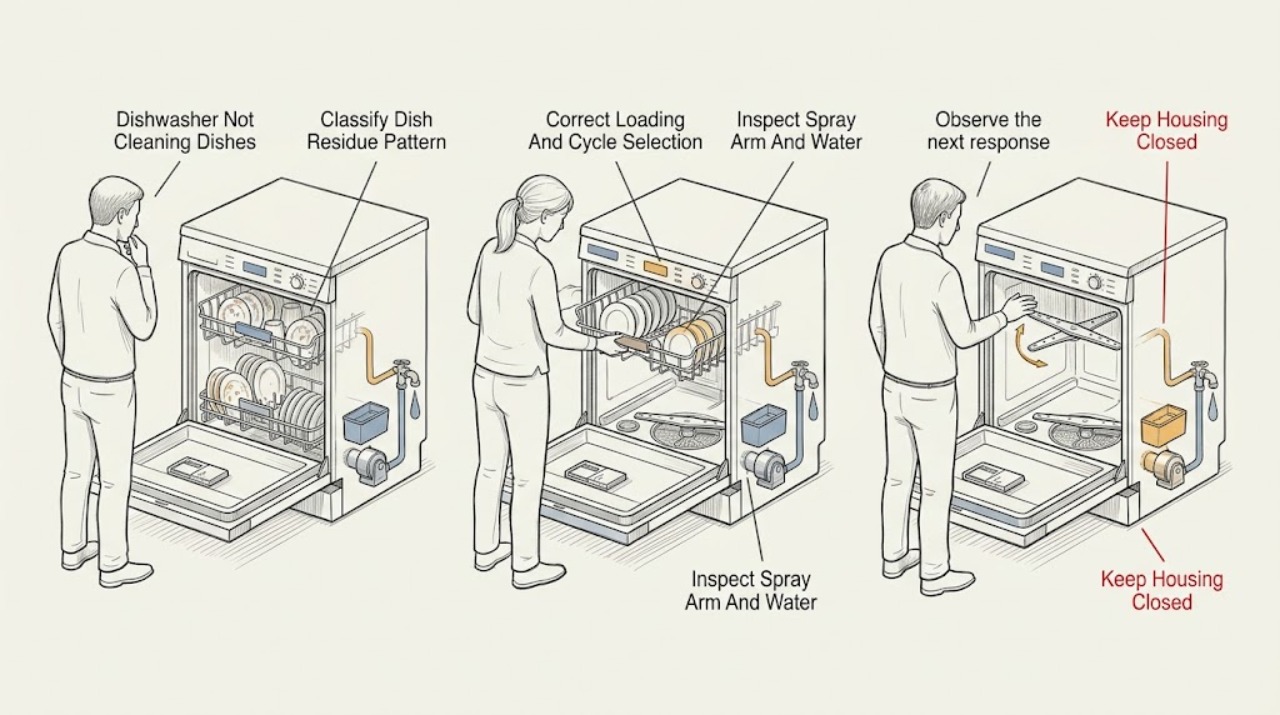
Inspect a representative group of dishes after the cycle without running another load: note whether food remains on nearly everything, only the upper or lower rack, one side, or mainly as white film or cloudy spots.
Expected result: Record the residue pattern, the selected cycle and options, whether dishes were overloaded, and whether the dispenser opened or still contains detergent.
Next step: Use the pattern to select the loading, spray-arm, filter, or detergent check below, and avoid repeated cycles until the cause is addressed.
Stop if: Do not taste food residue, handle sharp debris carelessly, or run a new cycle while a leak, standing water, smoke, or electrical problem is present.
Why this matters
Why: Widespread soil makes water circulation, filter, detergent, or cycle selection more likely; one-rack soil makes spray-arm coverage or a rack obstruction more likely; film or cloudiness points toward detergent or water-hardness factors.
-
Check 2
With the dishwasher off, rearrange items so soiled surfaces face down and inward, leave space between dishes, keep tall items from blocking the detergent dispenser or spray arms, and verify that the selected cycle and options fit the load.
Expected result: Spin each accessible spray arm by hand and note whether it turns freely or strikes a dish, rack, or utensil; also note whether a Top Rack Only or rinse-only cycle was selected.
Next step: Correct the obstruction and select a suitable wash cycle from the exact model manual; if the arms still resist or the load was not the cause, continue with the filter and detergent checks.
Stop if: Do not force an arm past an obstruction, bend rack parts, or reach into the tub around sharp broken items.
Why this matters
Why: A blocked arm or overcrowded rack prevents water from reaching surfaces. A Top Rack Only or rinse-only selection can leave the lower rack or heavily soiled items underwashed even when the dishwasher is operating normally.
-
Check 3
After confirming the racks are not blocking the arms, inspect the accessible spray-arm openings for visible mineral or food buildup and confirm the arm is seated as the model manual shows; do not remove a secured arm unless the manual permits it.
Expected result: Record whether an arm is blocked, loose, misaligned, visibly clogged, or free to rotate, and whether dirty dishes are concentrated beneath that arm.
Next step: Clean or reseat only as the exact manual directs and recheck the loading. If spray coverage remains weak or the arm cannot be restored without disassembly, arrange service.
Stop if: Do not poke deep into nozzles with metal objects, disassemble water-delivery parts, or run the machine with a loose arm.
Why this matters
Why: A blocked or clogged spray arm can delay detergent release and reduce soil removal. A free-moving arm with one-rack soil makes water delivery, filter, pump, or diverter problems more likely than loading alone.
-
Check 4
With the dishwasher off and the lower rack removed only if the model manual allows, inspect the filter for food soil or mineral buildup and verify that it is seated and locked; some KitchenAid models use maintenance-free filtration, so do not remove a filter that the manual does not identify as user-serviceable.
Expected result: Record whether the filter is dirty, damaged, missing, loose, correctly locked, or not accessible under the model instructions, and whether standing water or sharp debris is present.
Next step: Rinse and reinstall a user-serviceable filter exactly as the manual directs, then check detergent and loading; if the filter is damaged, cannot lock, or the pump area is not safely accessible, arrange service.
Stop if: Do not reach into standing water, handle sharp debris with bare hands, remove a pump cover without model instructions, or operate without correctly installed filters.
Why this matters
Why: KitchenAid links filter condition to circulation and cleaning performance, but a dirty filter is not proof that the wash pump has failed. Standing water, sharp debris, a damaged filter, or an inaccessible internal blockage raises the service boundary.
-
Check 5
Check that the dispenser was dry before detergent was added, that only automatic-dishwasher detergent was used, that the dispenser lid was not blocked by a dish, and that the amount and freshness follow the detergent label and model manual.
Expected result: Record whether the dispenser opened, detergent remained stuck, suds or bubbles were present, rinse aid was spilled, or a dish or rack blocked the lid.
Next step: Correct the obstruction or detergent choice and use a suitable wash cycle once. If suds are present, stop the dishwasher and let them dissipate rather than adding another chemical or repeatedly cycling it.
Stop if: Do not add dish soap, bleach, improvised cleaners, or extra detergent, and do not continue if foam or water is escaping.
Why this matters
Why: A blocked or damp dispenser can delay detergent release; dish soap or excessive detergent can create suds that reduce wash performance and may push water out. No dispenser or foam issue makes spray coverage, filter, water supply, or service causes more likely.
-
Check 6
If loading, spray arms, filter, and detergent are correct, observe whether the dishwasher fills, makes a normal wash-spray sound, and leaves the tub with unusual standing water; use only the exact manual's external water-supply and reset checks.
Expected result: Record no fill, weak or absent spray, repeated drain noise, standing water, a service light, or a cycle that completes while dishes remain dirty.
Next step: Stop repeated operation and arrange qualified service when the dishwasher does not fill, spray, drain, or clean after the safe user checks. Provide the model, cycle, residue pattern, and observations.
Stop if: Do not pull the built-in dishwasher out, disconnect water or drain hoses, open panels, measure live power, or keep running cycles with a leak, electrical symptom, or standing water.
Why this matters
Why: No fill can make cleaning impossible; absent or weak spray after the arms are clear makes water-delivery, filter, pump, or diverter faults more likely; standing water shifts attention toward drain blockage. A service light or recurring failure needs diagnosis rather than more test cycles.
Use your observations
Decision map
Find the observation that best matches what you see, then follow the next safe action.
-
PATH 01Safety boundary
What you see
Dishes are dirty mainly on one rack or one side, and an arm strikes a dish, rack, or utensil or was blocked by a loading position.
Do this next
Rearrange the load, ensure the arm spins freely, confirm the selected cycle addresses that rack, and rewash once; service is needed if the arm remains loose, clogged, or unable to rotate.
Why this path and its safety boundary
Why it matters: Restricted spray coverage is more likely than a whole-machine detergent or pump fault.
Safety stop: Do not force the arm or run the dishwasher with a loose spray component.
-
PATH 02Safety boundary
What you see
Most dishes retain food soil, the filter is dirty or not locked, or the dispenser did not release fresh automatic-dishwasher detergent.
Do this next
Clean and reseat a user-serviceable filter according to the model manual, correct the dispenser and detergent, and run one suitable cycle; persistent poor cleaning needs service.
Why this path and its safety boundary
Why it matters: Reduced circulation, soil recirculation, or delayed detergent release is more likely than a single rack obstruction.
Safety stop: Do not operate without filters, remove a model-specific pump cover blindly, or add extra chemicals.
-
PATH 03Safety boundary
What you see
Bubbles or foam are present when the dishwasher is opened, especially after dish soap, excess detergent, or spilled rinse aid was involved.
Do this next
Stop the dishwasher, allow suds to dissipate, record the product used, and follow the exact manual or qualified service guidance before another cycle.
Why this path and its safety boundary
Why it matters: Over-sudsing can push water out and interfere with wash performance; it does not prove the door seal or pump is faulty.
Safety stop: Do not add bleach, more detergent, or another product to counteract the foam, and do not operate while water is escaping.
-
PATH 04Safety boundary
What you see
The dishes are free of large food particles but have a white film, spots, or cloudy glass rather than obvious unwashed soil.
Do this next
Follow KitchenAid's detergent and water-hardness guidance, use fresh automatic-dishwasher detergent, and consult the model manual; service is appropriate if circulation or heating symptoms are also present.
Why this path and its safety boundary
Why it matters: Detergent amount, rinse aid, water hardness, or etching is more likely than a blocked spray arm; permanent etching cannot be cleaned away by changing the cycle.
Safety stop: Do not use abrasive cleaners or unapproved chemicals inside the dishwasher.
-
PATH 05Safety boundary
What you see
Loading, arm clearance, filter seating, detergent, and cycle selection are correct, but spray is weak or absent, the dishwasher does not fill or drain normally, or a service indicator persists.
Do this next
Keep operation to a minimum and arrange qualified dishwasher service with the model, residue pattern, cycle, and observations.
Why this path and its safety boundary
Why it matters: A water-supply, wash-pump, diverter, filter, drain, control, or heating fault is more likely than a user setting issue.
Safety stop: Do not pull out the appliance, disconnect hoses, open panels, test live wiring, or replace a pump based only on dirty dishes.
Helpful context
Understand the symptom
Read the pattern on the dishes
Food left on nearly every dish suggests a circulation, filter, water-supply, detergent-release, or cycle issue. Soil concentrated on one rack or one side makes blocked or misdirected spray coverage more likely. A white film or cloudy glass can instead involve detergent amount or water hardness, while greasy residue may point toward a cycle or temperature limitation. The pattern helps choose the next safe check; it does not identify a failed pump or valve by itself.
Loading controls where water can reach
KitchenAid advises leaving space between items, facing soiled surfaces downward and inward toward the spray arms, and keeping projecting items from blocking the dispenser or arms. Some models include a Top Rack Only cycle; when it is selected, lower spray arms do not clean the lower rack. Check the installed manual because rack layouts and cycle names vary.
Filter and detergent are linked to wash performance
A filter that is blocked or not seated can reduce circulation or allow food soil to recirculate. KitchenAid says filter instructions vary and that some models have maintenance-free filtration, so use the model manual before removing one. Use only fresh automatic-dishwasher detergent and keep the dispenser dry and unobstructed. Do not use dish soap; suds can push water out and create a leak as well as poor cleaning.
Safety boundary
Stop conditions
- Stop using the dishwasher for smoke, sparking, burning smell, an active leak, standing water near electrical parts, or hot water or steam that cannot be safely avoided.
- Do not pull out the built-in dishwasher, disconnect water or drain hoses, open enclosure panels, measure live power, or reach into an unsafe or water-filled area.
- Do not operate without correctly installed filters, remove a pump cover or spray assembly without the exact model manual, or handle sharp debris with bare hands.
- Do not use dish soap, bleach, abrasive cleaners, or improvised chemicals to correct poor cleaning or foam; do not keep running cycles to test a suspected fault.
- Arrange qualified service when spray remains weak, the dishwasher does not fill or drain, a filter or arm is damaged, a service indicator persists, or dishes remain dirty after the safe user checks.
Only after diagnosis
Potential parts
- dishwasher filter assembly
Consider only if the exact model has a user-replaceable filter and inspection confirms damage or failure to seat, rather than ordinary soil that can be cleaned.
Confirm the exact KitchenAid model and filter design through the model manual or qualified service before ordering. - spray arm or water-delivery component
Consider only if service confirms a cracked, loose, clogged, or model-specific arm or feed component after loading clearance is corrected.
Match the exact model and arm or feed-tube configuration; do not substitute by appearance or assume a free-spinning arm is serviceable. - wash pump, diverter, inlet valve, or control
These are diagnostic categories only when filling or spray remains weak or absent after user checks and a technician confirms the affected assembly.
A qualified technician must diagnose and match the exact model and revision before any internal component is ordered or replaced.
When checks do not resolve it
Need a professional?
Arrange qualified dishwasher service when KitchenAid dishes remain dirty after correct loading, spray-arm clearance, model-approved filter care, detergent, and cycle checks; when the machine does not fill, spray, or drain normally; when a filter or spray arm is damaged; or when a service indicator persists. Seek urgent help for smoke, sparking, burning smell, active leaks, or water near electrical connections. Provide the exact model and serial information if safely visible, residue pattern, selected cycle, filter and arm observations, detergent history, standing-water status, and any indicator or error message.
Safety scope: This article supports only ordinary-access observation, loading correction, model-approved spray-arm and filter checks, detergent checks, and safe external supply observation. Do not move the appliance, open panels, disconnect hoses, touch wiring, or continue operation with leaks, electrical symptoms, or standing water.
Common questions
FAQ
Why are my KitchenAid dishwasher dishes still dirty after a full cycle?
Start by checking loading, spray-arm clearance, filter seating, detergent release, and cycle choice. Food on one rack or side often points to blocked spray coverage; food on nearly everything makes circulation, filter, detergent, or water-supply issues more likely.
Can an obstructed spray arm make a KitchenAid dishwasher clean poorly?
Yes. KitchenAid says items that stop an arm from rotating can delay detergent release and soil removal. With the dishwasher off, spin the accessible arm by hand, rearrange anything it strikes, and follow the exact model manual for any cleaning or reseating.
Can a dirty filter cause dirty dishes?
It can reduce water circulation or allow food soil to recirculate. Filter access and design vary, and some KitchenAid models use maintenance-free filtration, so consult the exact manual before removing one and confirm it is correctly seated after any approved cleaning.
Does dish soap cause poor cleaning in a KitchenAid dishwasher?
Yes. KitchenAid says dish soap creates suds, which can push water out and interfere with cleaning. Stop the dishwasher if foam is present, do not add another chemical, and do not run another cycle until the correct detergent and recovery procedure are clear.
When does a KitchenAid dishwasher need service for poor cleaning?
Arrange service when correct loading, spray-arm, filter, detergent, cycle, and model-approved water checks do not restore cleaning; when spray is weak or absent; when the unit does not fill or drain; or when an indicator persists. Do not pull out the built-in unit or open its panels.
Read the exact guide
Official sources
- Dishes are not Clean - Product HelpKitchenAid · KitchenAid Product Help guidance for dishwasher wash performance when dishes are not clean; exact model manuals control specific cycles and parts.
- Dishwasher Leaking Troubleshooting Guide - Product HelpKitchenAid · KitchenAid Product Help page used here only for the leak and suds safety boundary associated with poor cleaning; the exact model manual controls service work.
- Spray Arm Not Working - Dishwasher - Product HelpKitchenAid · KitchenAid Product Help guidance for dishwasher spray arms; exact model layout and removal instructions vary.
- Owner's ManualKitchenAid · KitchenAid dishwasher owner manual with model-specific examples; the installed dishwasher's manual controls the applicable cycle, rack, filter, and maintenance procedure.
- How to Clean a Dishwasher Filter Quickly & EasilyKitchenAid · KitchenAid owner guidance for dishwasher filters; filter type, access, and cleaning frequency vary by model.
Community feedback
Share a repair observation
Share a plain-text repair observation. Accepted observations are published automatically; this page may take a moment to update.