
On this page
Start here
Quick answer
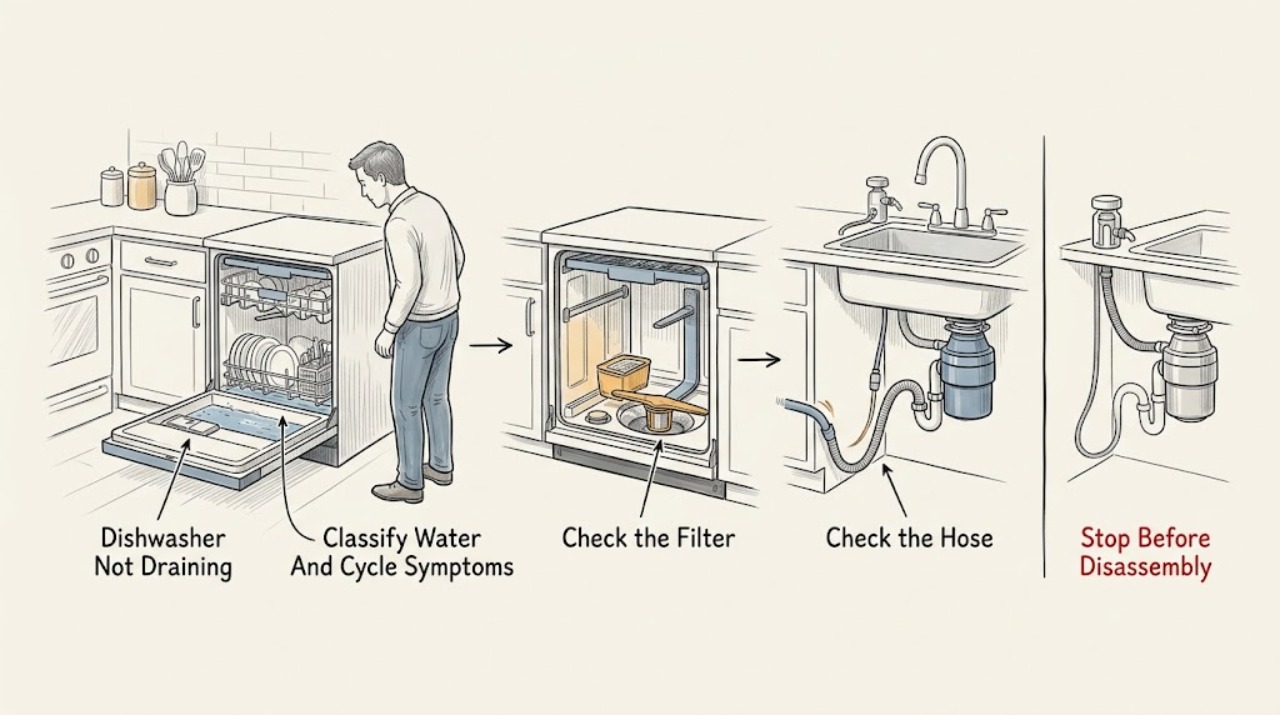
A KitchenAid dishwasher that leaves water behind most often has a restricted filter or sump, a blocked sink or garbage-disposer connection, an obstructed air gap, a kinked or poorly routed drain hose, excess suds from the wrong soap, or a drain-pump problem. First distinguish the small amount of water that KitchenAid says can remain in the filter area from water spread across the tub or returning from the sink. With the appliance stopped, clean only the filter system your model manual identifies, inspect the accessible drain path and air gap, and check the detergent type and visible suds. If the dishwasher was newly installed, the disposer inlet knockout plug and hose routing deserve special attention. Persistent standing water, a leak, a failed drain cycle, an error that returns, or an internal pump or control concern is a professional-service boundary; do not use drain chemicals or open electrical covers to force a diagnosis.
Work through in order
Diagnostic checks
Use only checks that match the exact appliance or system and its official guide.
-
Check 1
Stop the KitchenAid dishwasher and inspect the tub without reaching into the pump. Note whether water is only in the recessed filter area or spread across the tub, whether it is clean or dirty, whether it is near the door, and whether it returns after the sink drains. Record any display message, unusual drain sound, leak, suds, or recent installation or disposal work.
Expected result: Only a small amount remains in the filter area, broad standing water remains, water backs up from the sink or air gap, the water is sudsy, or an error or unusual sound appears.
Next step: Continue with filter and visible drain-path checks for ordinary standing water. If there is a leak, smoke, burning odor, damaged wiring, or other immediate hazard, stop using the appliance and arrange qualified service or emergency help as appropriate.
Stop if: Do not restart the dishwasher to compare an unsafe smell, active leak, smoke, or electrical symptom.
Why this matters
Why: A small filter-area amount can be normal. Broad or returning water favors a restriction, hose-routing, sink connection, air-gap, or pump concern; suds can push water out; an error or unusual sound helps a technician distinguish a drain fault from a control or motor issue.
-
Check 2
With the appliance off and the lower rack removed, use the KitchenAid manual to identify the filtration system. For a removable filter system, rinse the filter under running water and use only a soft brush for stubborn soil; inspect the accessible filter area for food or foreign objects and reinstall the filters so they are flat and locked. If the model has a maintenance-free foreign-object cup, clean it only as its manual describes.
Expected result: The filter or cup contains food, grease, mineral soil, or a foreign object; a filter is damaged or will not lock; or the model has no user-removable filter and the accessible area is clear.
Next step: Clean and correctly reinstall the model-approved filter or cup, then observe the next drain attempt. If debris is deep in the pump, a filter will not lock, or water remains after safe filter care, stop and arrange qualified appliance service.
Stop if: Do not use a wire brush, scouring pad, sharp tool, or force, and do not operate the dishwasher without filters that the model requires.
Why this matters
Why: KitchenAid links dirty filters and filter-area debris with poor drainage and cleaning performance. A damaged or unsecured filter can allow debris into the pump or reduce flow. Some models use a maintenance-free system, so forcing a removable-filter procedure onto the wrong model can create damage.
-
Check 3
Look under the sink and behind the toe area for a drain hose that is kinked, pinched, crushed, sharply bent, sagging, or visibly disconnected. Confirm the hose rises in the model-required high loop or connects through an air gap, and look for an obstruction at the air-gap vent. If the dishwasher drains to a garbage disposer, note whether the disposer is blocked and, especially after a new installation, whether its dishwasher inlet knockout plug was removed. Use only the installation instructions for any correction; do not disconnect a wet hose as a first test.
Expected result: The hose has a visible routing defect, the air gap or sink connection is blocked, the disposer is newly installed or obstructed, the knockout plug may remain, or the visible drain path looks normal.
Next step: Correct only a clearly identified installation issue within the model instructions or arrange qualified plumbing help for the sink, disposer, air gap, or hose. If the path looks normal but the dishwasher still will not drain, arrange appliance service for the pump and internal drain path.
Stop if: Do not reach into a disposer, remove a knockout plug without the correct isolation and installation procedure, disconnect plumbing with water or power present, or open the dishwasher cabinet to inspect wiring.
Why this matters
Why: A low or kinked hose can allow water to return to the tub, while an air-gap or sink/disposer obstruction can prevent the dishwasher from emptying. A retained disposer knockout plug is especially likely when the problem began immediately after installation. A normal visual path does not rule out an internal pump or valve failure.
-
Check 4
Inspect the tub for bubbles or foam and review the detergent used in the last load. If hand dish soap or another non-automatic product was used, stop the dishwasher and allow the suds to dissipate; follow the KitchenAid manual for safe cleanup rather than adding another chemical. For future cycles, use only detergent made for automatic dishwashers and keep the product and amount consistent with the model guidance.
Expected result: Suds or bubbles are present, water or foam escaped onto the floor, the wrong soap was used, or there are no suds and the detergent is intended for an automatic dishwasher.
Next step: Keep the appliance stopped until the suds have dissipated and the model instructions permit the next step. If leaking continues, the wrong soap was used repeatedly, or the dishwasher still will not drain after correct detergent use, arrange qualified service.
Stop if: Do not add bleach, drain cleaner, dishwasher detergent, or another product to counteract suds, and do not run repeated cycles while foam is escaping.
Why this matters
Why: KitchenAid explains that hand dish soap creates suds that can push water out, cause leaking, and interfere with draining or wash performance. No suds makes a detergent error less likely and returns attention to the filter, drain path, pump, or installation.
-
Check 5
After the filter is secured and any clearly visible hose, sink, air-gap, disposer, or suds condition is addressed, use the model's cancel or drain function if provided and observe whether water exits without a leak or backflow. Then check the tub and filter area again. If a drain-related message or code returns, record it with the model number instead of repeatedly resetting the control.
Expected result: The tub empties, only the normal filter-area water remains, water returns or remains broad, the pump hums without moving water, no pump sound occurs, a leak appears, or an error returns.
Next step: If the dishwasher drains normally, follow the model's routine filter and cleaning care. If it does not, stop further test cycles and arrange qualified KitchenAid appliance or plumbing service with the symptom pattern, model, and checks completed.
Stop if: Do not probe the pump, bypass a control, repeatedly reset a returning error, or restore power to a dishwasher with a leak or damaged electrical parts.
Why this matters
Why: Successful draining after a safe correction supports a restriction or installation condition. Humming without movement, no pump sound, returning water, a leak, or a recurring code points toward a pump, valve, control, hose, or plumbing fault that cannot be confirmed safely from the outside.
-
Check 6
If the dishwasher still will not drain, document the model number, where the water sits, whether it is dirty or sudsy, the drain sound, any air-gap or sink backflow, and whether the issue began after installation or disposal work. Leave the appliance unused until service if water remains, a leak is present, or an internal component is suspected.
Expected result: The symptom is resolved, the symptom returns after a normal cycle, or persistent water, leaks, a recurring error, unusual motor sound, or an unknown internal restriction remains.
Next step: Provide the recorded pattern and completed checks to a qualified KitchenAid appliance or plumbing professional. Do not order a pump or hose solely from the symptom; the model and diagnosis must identify the correct component.
Stop if: Do not remove panels, disconnect hard-wired power, work on live wiring, or dismantle the pump or plumbing to continue troubleshooting.
Why this matters
Why: A resolved symptom supports an external obstruction, filter, hose, sink, or detergent condition. Recurrence or an unresolved internal symptom makes a drain pump, valve, control, hose check valve, or installation fault more likely and requires model-specific diagnosis.
Use your observations
Decision map
Find the observation that best matches what you see, then follow the next safe action.
-
PATH 01Next step
What you see
Only a small amount of water remains in the recessed filter area, the tub is otherwise empty, and the next cycle drains normally.
Do this next
Leave the filter correctly installed and monitor the next cycle. If water spreads across the tub, returns from the sink, or drainage slows, continue with the filter and drain-path checks.
Why this path and its safety boundary
Why it matters: KitchenAid describes this filter-area water as normal because it helps keep seals from drying; it is not by itself evidence of a clog.
-
PATH 02Next step
What you see
The filter or accessible filter area contains food, grease, mineral soil, or a foreign object and drainage improves after model-approved cleaning.
Do this next
Maintain the filter according to the KitchenAid manual and scrape large food particles before loading. If broad standing water returns despite a clean, locked filter, arrange service.
Why this path and its safety boundary
Why it matters: The improvement makes a removable filtration or accessible debris restriction more likely than a failed pump.
-
PATH 03Next step
What you see
Water backs up at the sink or air gap, the hose is kinked or routed too low, the disposer is blocked, or the issue began after installation or disposal replacement.
Do this next
Use the model installation guidance for a clearly visible routing issue or arrange qualified plumbing help. Do not disconnect wet plumbing or open the dishwasher to reach a hidden restriction as a first step.
Why this path and its safety boundary
Why it matters: The pattern favors a downstream restriction, hose-routing problem, air-gap blockage, or retained disposer knockout plug.
-
PATH 04Next step
What you see
Bubbles or foam are present, especially after hand dish soap or another non-automatic product was used, and water or suds escaped.
Do this next
Stop the dishwasher and let suds dissipate under the model's guidance. Use only automatic-dishwasher detergent afterward; arrange service if leaking or poor drainage continues.
Why this path and its safety boundary
Why it matters: KitchenAid says hand dish soap creates suds that can push water out and cause leaking or poor performance, so the foam itself can mimic a drain failure.
-
PATH 05Next step
What you see
The filter is clean and secured, the visible hose, air gap, sink, and disposer are clear, there are no suds, but water remains or a drain error, pump hum, no-pump sound, or leak returns.
Do this next
Stop test cycles and arrange qualified KitchenAid appliance service. Give the technician the model number, water pattern, sounds, displayed code, and every check already completed.
Why this path and its safety boundary
Why it matters: An internal pump, valve, control, check valve, or hidden hose restriction becomes more likely; the symptom cannot identify the failed component safely.
-
PATH 06Next step
What you see
There is an active leak near electricity, smoke, a burning odor, damaged wiring, a repeated breaker trip, or another immediate hazard.
Do this next
Stop using the dishwasher and keep people away from the hazard. Use local emergency guidance for smoke, fire, or immediate electrical danger, and arrange qualified appliance, electrical, or plumbing help as appropriate.
Why this path and its safety boundary
Why it matters: This is a safety or installation boundary rather than an ordinary drain blockage.
Helpful context
Understand the symptom
First decide whether the water is actually abnormal
KitchenAid says a small amount of water in the filter area can protect the seals and be drained when the next cycle starts. Water spread across the tub, water near the door, water returning from the sink or air gap, or a dishwasher that never completes its drain is a different pattern. Record whether the issue began after installation, a disposal replacement, a load with broken glass or food debris, or the use of hand dish soap. That history changes which check should come first.
Keep plumbing and electrical work within the safe boundary
The user-level checks are visual and model-guided: filter care, accessible debris, air-gap condition, hose routing, the sink or disposer connection, and detergent or suds. Do not pour drain-opening chemicals into the dishwasher, reach into a hidden pump, probe wiring, or remove panels. A leak, smoke, burning odor, damaged wiring, or repeated breaker trip needs qualified help before any further drain test.
Only after diagnosis
Potential parts
- KitchenAid dishwasher filter assembly or foreign-object cup
Consider this only when the exact model uses a removable filter or cup and inspection confirms damage, missing hardware, or a filter that will not lock after cleaning.
KitchenAid filtration systems vary by model, including maintenance-free designs. Confirm the model manual and diagnosis before selecting a replacement. - KitchenAid dishwasher drain hose or air-gap component
Consider this only after a qualified diagnosis finds a split, crushed, blocked, or incorrectly routed hose or a failed air-gap component rather than a household sink obstruction.
Drain routing and connections are installation- and model-specific. Confirm the exact model and required routing before ordering or installing. - KitchenAid dishwasher drain pump or valve
Consider this only when service diagnosis confirms the pump or valve is the cause after the filter, sump, hose, air gap, sink connection, and detergent checks are complete.
Pump and valve access involves water and electrical components and varies by model. Have a qualified technician identify the failed component and confirm compatibility.
When checks do not resolve it
Need a professional?
Arrange qualified KitchenAid appliance service when the dishwasher still will not drain after model-approved filter care and safe visible drain checks; when a pump, valve, check valve, control, or hidden hose restriction is suspected; when a drain error returns; or when water remains across the tub. Arrange plumbing help for a blocked sink, disposer, air gap, or downstream drain. Stop immediately for an active leak near electricity, smoke, burning odor, damaged wiring, or repeated breaker trips, and use local emergency guidance for immediate danger. Do not pour drain-opening chemicals into the dishwasher, use hand dish soap, reach into the pump, open electrical covers, disconnect wet plumbing as a first test, or repeatedly reset an unsafe appliance.
Common questions
FAQ
Is a little water in the bottom of a KitchenAid dishwasher normal?
A small amount in the recessed filter area can be normal because KitchenAid says it helps protect seals and is removed when the next cycle starts. Water across the tub, near the door, returning from the sink, or remaining after repeated drain attempts is a different symptom and needs the filter, drain-path, and service checks.
What should I check first if my KitchenAid dishwasher will not drain?
First identify whether the water is only in the filter area or across the tub. Then check the model-appropriate filter, accessible debris, the visible drain hose and high loop or air gap, and the sink or disposer connection. A new installation especially warrants checking the disposer knockout plug and hose routing.
Can a garbage disposal cause a KitchenAid dishwasher not to drain?
Yes. KitchenAid identifies a blocked disposer or a retained dishwasher-inlet knockout plug after installation as possible causes. It also notes that a blocked air gap or sink connection can prevent draining. Use the installation guidance or qualified plumbing help rather than disconnecting a wet hose as a first test.
Can hand dish soap make a KitchenAid dishwasher overflow or stop draining?
Yes. KitchenAid says hand dish soap creates suds, and the foam can push water out, cause leaking, and interfere with performance. Stop the appliance and let the suds dissipate under the model's guidance; use only detergent intended for automatic dishwashers afterward.
When should I call for KitchenAid dishwasher service?
Arrange service when safe filter and visible drain checks do not restore drainage, a drain error or unusual pump sound returns, a leak is present, or a pump, valve, control, or hidden hose restriction is suspected. Arrange plumbing help for a sink, air-gap, disposer, or downstream blockage. Stop immediately for smoke, burning odor, damaged wiring, or an active electrical hazard.
Read the exact guide
Official sources
- Newly Installed Dishwasher Not DrainingKitchenAid Product Help · KitchenAid dishwasher installation-related drainage, disposer knockout plug, high-loop or air-gap routing, and hose checks
- Not Draining - Water Remain at End of Cycle - DishwasherKitchenAid Product Help · KitchenAid dishwasher end-of-cycle drain symptoms, disposer and air-gap checks, suds from wrong soap, routine cleaning, and service guidance
- Dishwasher Error Codes - ReadingKitchenAid Product Help · KitchenAid dishwasher error interpretation, long-drain symptoms, drain hose and filter checks, leak indications, and service escalation
- Water Remains In Filter Area - DishwasherKitchenAid Product Help · KitchenAid dishwasher normal filter-area water, filter cleaning signs, and filter installation safety
- Cleaning the Removable Filtration System - DishwasherKitchenAid Product Help · KitchenAid dishwasher removable and maintenance-free filtration systems, filter cleaning tools, foreign-object handling, and filter locking
Community feedback
Share a repair observation
Share a plain-text repair observation. Accepted observations are published automatically; this page may take a moment to update.