
On this page
Start here
Quick answer
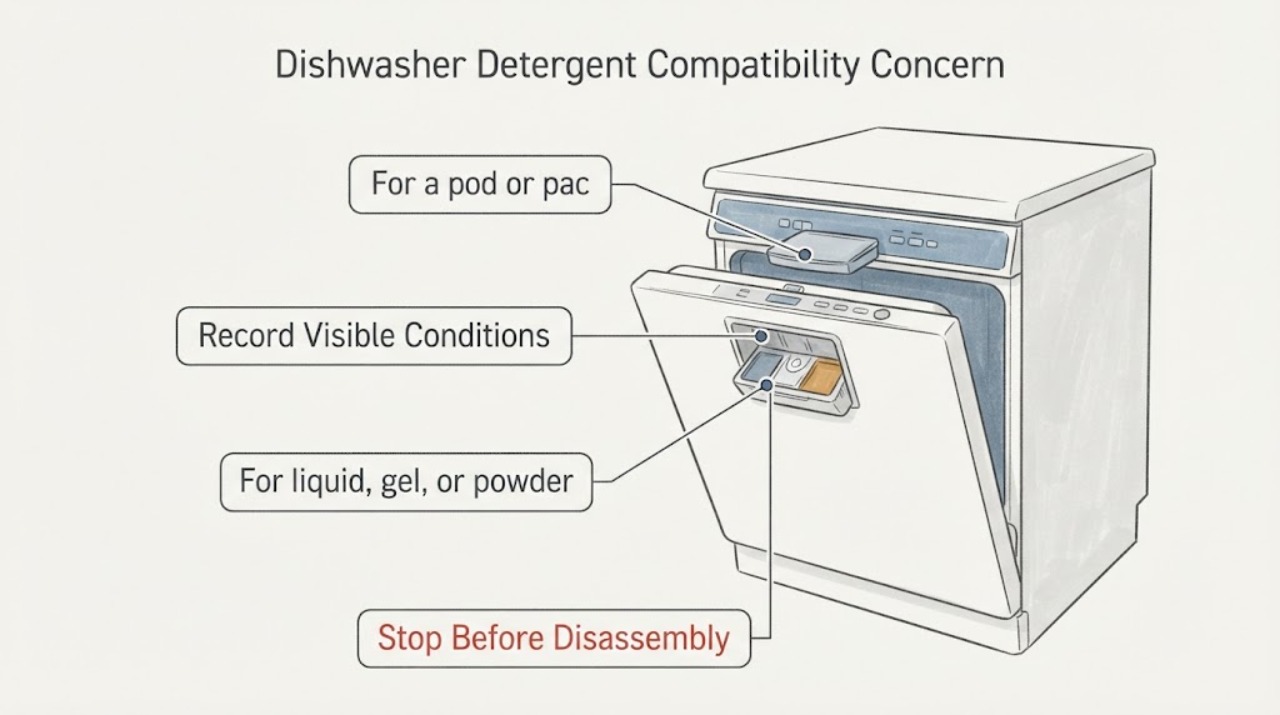
KitchenAid's detergent guidance covers automatic dishwasher detergents in tablet or pac, liquid or gel, and powder forms, but the exact model manual and the product label control the dose and dispenser arrangement. Use detergent made for automatic dishwashers only. Put one pod or pac in the main detergent compartment unless the manual says otherwise, keep the compartment dry, and do not put a pod in the silverware caddy or loose in the tub. If detergent remains, cakes, creates excess suds, or leaves filming, identify the detergent type, dose, water hardness, dispenser condition, and cycle before changing products; do not use a non-dishwasher detergent or assume the dispenser or dishwasher has failed.
Work through in order
Diagnostic checks
Use only checks that match the exact appliance or system and its official guide.
-
Check 1
Read the detergent package and the exact KitchenAid owner's manual, recording whether the product is labeled for automatic dishwashers and whether it is a pac/tablet, liquid/gel, or powder.
Expected result: The label identifies automatic dishwasher use and a detergent form supported by the manual, or it is a hand-dish, laundry, multipurpose, or otherwise unclear product.
Next step: Use only a clearly labeled automatic dishwasher detergent and follow the exact model manual and product label. If the product is not clearly intended for automatic dishwashers, do not add it to the machine.
Why this matters
Why: KitchenAid's compatibility guidance is for automatic dishwasher detergent. The form alone does not establish the correct dose or dispenser position for an unknown model.
-
Check 2
For a pod or pac, place one dose in the main detergent compartment with dry hands and close the lid; use a designated pod compartment only when the exact manual identifies one.
Expected result: The pod sticks in a wet or crusted dispenser, the lid cannot close, or the pod was placed in the silverware caddy or loose on the tub floor.
Next step: Clean and dry the accessible dispenser, remove old residue, and use the main compartment unless the manual says otherwise. Do not add a second pod to compensate for a stuck one.
Why this matters
Why: KitchenAid says the main compartment delays dissolving until the wash stage, while the silverware caddy or tub can expose the pod to water too early. A wet or caked dispenser can also make the pod stick.
-
Check 3
For liquid, gel, or powder, measure only as directed by the detergent label and model manual, and keep the dispenser's main and optional pre-wash sections distinct.
Expected result: The load has excess suds or residue, dishes remain dirty, the dispenser is overfilled, or the dose and water-hardness setting match the documented instructions.
Next step: Correct the dose only within the package and model-manual instructions. If results remain poor with a documented dose and fresh detergent, continue with the dispenser and service branch rather than increasing detergent at random.
Why this matters
Why: KitchenAid says too much detergent can create excessive suds and residue, while too little can leave dishes dirty; the amount also depends on soil and water conditions. A generic fixed dose is not safe to transfer across models.
-
Check 4
With the dispenser empty and the dishwasher off, check for caked detergent, moisture, a blocked lid, or an upper rack position that prevents the lid from opening; do not pry the dispenser or alter its latch.
Expected result: The dispenser is wet or crusted, the lid is obstructed by the rack, or the lid opens and closes normally with no residue.
Next step: Wipe the accessible cup dry, remove only loose residue, and adjust the rack only as the manual allows. If the lid still will not operate, stop forcing it and arrange model-specific service.
Why this matters
Why: KitchenAid says old detergent can clump, moisture can make detergent stick, and a low upper rack can block the dispenser. A clean, unobstructed dispenser makes product handling less likely as the remaining explanation but does not identify an internal failure.
-
Check 5
After one correctly dosed cycle, compare the result with the original concern—detergent left in the cup, white film, spots, excess suds, or poor cleaning—and record the cycle and rinse-aid setting.
Expected result: The detergent dissolves and cleaning improves, or the same residue/film/suds or dispenser failure returns.
Next step: If the issue persists, provide the model number, product label, dose, water-hardness information if known, cycle, and photos of the dispenser or residue to KitchenAid service. Do not open the dishwasher or replace a dispenser from this symptom alone.
Why this matters
Why: Improvement after correcting product placement or dose supports a use-condition explanation. A persistent problem after fresh automatic dishwasher detergent, a dry dispenser, correct placement, and model-supported dosing needs a service assessment rather than an unsupported compatibility claim.
Use your observations
Decision map
Find the observation that best matches what you see, then follow the next safe action.
-
PATH 01Next step
What you see
The product is clearly labeled for automatic dishwashers and the manual supports its form, with a dry dispenser and correct placement.
Do this next
Run one cycle using the package and model-manual instructions, then compare the result without adding an extra dose.
Why this path and its safety boundary
Why it matters: The basic compatibility and placement evidence is satisfied; remaining results depend on dose, soil, water conditions, cycle, and rinse-aid settings.
-
PATH 02Next step
What you see
A pod or pac was placed in the silverware caddy, on the tub floor, or in a wet/caked dispenser.
Do this next
Clean and dry the dispenser, use one pod in the main compartment unless the manual says otherwise, and do not double-dose.
Why this path and its safety boundary
Why it matters: KitchenAid says premature contact with water or a sticky dispenser can cause poor release and wash performance.
-
PATH 03Next step
What you see
Powder, liquid, or gel leaves suds/residue, or dishes remain dirty after the dose was changed without checking the model manual.
Do this next
Return to the package and exact manual, use fresh detergent, and adjust only within documented guidance.
Why this path and its safety boundary
Why it matters: The dose or product handling is unresolved; too much and too little detergent can both produce poor results, and water hardness matters.
-
PATH 04Next step
What you see
The dispenser is dry and unobstructed, product placement and dose follow the manual, but the lid still fails or the detergent remains after repeated correct cycles.
Do this next
Stop forcing the dispenser, document the model and detergent, and arrange KitchenAid or qualified dishwasher service.
Why this path and its safety boundary
Why it matters: The public guidance no longer supports a simple compatibility correction and does not identify an internal dispenser or control failure.
Helpful context
Understand the symptom
Compatibility means the appliance and the detergent label must agree
A KitchenAid dishwasher is designed for automatic dishwasher detergent, not an arbitrary household cleaner. KitchenAid's general guidance recognizes pacs or tablets, liquid or gel, and powder, but it also says model-specific detergent and rinse-aid requirements belong in the owner's manual. Therefore a product can be a dishwasher detergent yet still need different dosing or dispenser placement on a particular model.
Separate product compatibility from a dispenser problem
Detergent left in the cup does not automatically mean the detergent is incompatible. KitchenAid says an old product can cake, a wet dispenser can make detergent stick, and a low upper rack can block the dispenser lid. Check those observable conditions before treating the concern as a component fault or changing to an unverified product.
When checks do not resolve it
Need a professional?
Arrange KitchenAid or qualified dishwasher service if the dispenser will not open or close after the documented external checks, detergent remains after fresh automatic dishwasher detergent is correctly placed and dosed, or the dishwasher develops leaks, electrical odor, or another appliance fault. Do not order a dispenser or control part from a general compatibility concern.
Common questions
FAQ
What detergent is compatible with a KitchenAid dishwasher?
KitchenAid's guidance covers automatic dishwasher detergents in pac/tablet, liquid/gel, and powder forms. The exact model manual and detergent label control the dose and placement; use automatic dishwasher detergent only.
Where should a KitchenAid dishwasher pod go?
KitchenAid says to place one pod in the main detergent compartment unless the owner's manual says otherwise. A pod in the silverware caddy or loose on the tub can dissolve too early and reduce wash performance.
Why is detergent left in the dispenser after a cycle?
KitchenAid lists old caked detergent, moisture in the cup, a blocked dispenser lid, and incorrect product placement as checks. Clean and dry the accessible dispenser, use fresh automatic dishwasher detergent, and follow the exact manual before treating the dispenser as a repair fault.
Read the exact guide
Official sources
- Detergent Remains at End of Cycle - DishwasherKitchenAid Product Help · KitchenAid dishwasher dispenser residue, caked/old detergent, wet dispenser, detergent-only compatibility, model-specific placement, and service boundary
- How to use dishwasher pods: a step-by-step guideKitchenAid · KitchenAid dishwasher pod placement, one-pod guidance, main-compartment/manual boundary, dry dispenser handling, and avoidance of silverware-caddy or loose-tub placement
- Detergent Usage GuidelinesKitchenAid Product Help · KitchenAid dishwasher detergent forms, dose/model-manual boundary, dispenser placement, excess/insufficient detergent observations, and pac quantity guidance
Community feedback
Share a repair observation
Share a plain-text repair observation. Accepted observations are published automatically; this page may take a moment to update.