
On this page
Start here
Quick answer
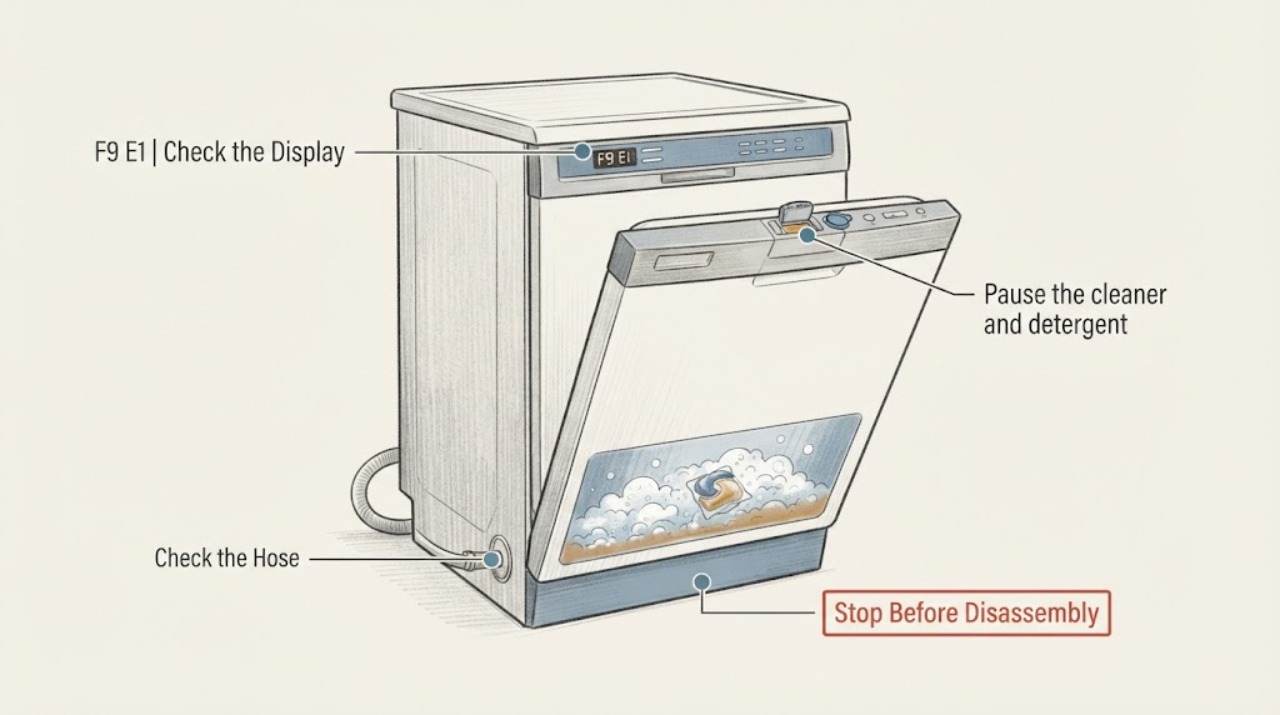
On the KitchenAid KDTM604KPS0, treat F9 E1 as a long-drain indication, not proof that the drain pump has failed. First separate two patterns: visible foam after a pod or dishwasher-cleaner cycle versus F9 E1 with no foam. If foam is present, turn the dishwasher off and let the suds dissipate; do not add more detergent or cleaner. If there is no foam, inspect the accessible filter, drain hose, disposer connection or knockout plug, and air gap as applicable. After the foam is gone and the visible path is checked, one 30-second power reset is reasonable. A returning code, persistent water, a leak, or any electrical warning needs qualified service rather than a guessed pump or control-board replacement.
Work through in order
Diagnostic checks
Use only checks that match the exact appliance or system and its official guide.
-
Check 1
When F9 E1 appears, stop the dishwasher using its normal controls and look only from a safe position for persistent foam or bubbles in the tub; do not reach into a running machine.
Expected result: Foam remains after a detergent pod or cleaner was used, or the tub has no unusual foam.
Next step: For visible foam, leave the dishwasher off until the suds dissipate and stop adding detergent or cleaner while investigating. With no foam, continue to the accessible drain-path check.
Why this matters
Why: Foam temporally associated with a product supports an oversudsing contribution, while no foam keeps a physical drain restriction in the foreground. Neither observation proves a pump or control failure.
-
Check 2
With the dishwasher off and the area dry, perform only the accessible checks named by KitchenAid: remove and rinse the filter, inspect the visible drain hose for a kink or clog, and if connected to a disposer check the connection and knockout plug; check an installed air gap according to its own instructions.
Expected result: The filter or visible drain path has debris, a kink, a blocked disposer connection or air gap, or all accessible areas look normal.
Next step: Clear only what is safely accessible, restore the connection as documented, and do not remove the pump, heater, panels or energized wiring. If the visible path is normal, use the reset-and-observe step once.
Why this matters
Why: A matching obstruction can explain a long drain and is a safer first correction than naming an internal part. A normal visible path does not clear an internal fault, especially if water remains.
-
Check 3
Pause the cleaner and detergent experiment: use only detergent made for automatic dishwashers and follow the exact model instructions and product label for the amount; do not add dish soap, extra detergent or another cleaner to force a drain test.
Expected result: The error and foam stop when the cleaner is not repeated and the correct automatic-dishwasher detergent amount is used, or F9 E1 returns with the same detergent practice and no foam.
Next step: Do not treat a cleaner-related improvement as proof that the drain system is healthy; monitor one normal cycle after the tub is clear. If F9 E1 returns without foam, stop repeating products and continue toward service.
Why this matters
Why: A repeatable product-to-foam-to-code pattern makes oversudsing the leading explanation for that episode. A return without foam weakens that explanation and points back to the documented long-drain path.
-
Check 4
Only after foam has dissipated and the accessible drain checks are complete, disconnect power for 30 seconds as KitchenAid documents, restore power, and observe one restart without repeatedly cycling the breaker.
Expected result: The code clears and the next operation completes, or F9 E1 returns, water remains, or the dishwasher cannot safely restart.
Next step: Record whether foam was present, what visible checks showed, and when the code returned. Arrange qualified service for a persistent result rather than performing live electrical or internal pump testing.
Why this matters
Why: A clear cycle supports a transient condition; a returning code or remaining water means the reset did not establish a repair and does not identify a replacement part.
-
Check 5
If F9 E1 persists after the model-matched external checks and one reset, stop troubleshooting and provide the technician the full model suffix, code, foam timing, standing-water observation and checks already completed.
Expected result: The code persists with no foam, water remains, a leak is found, or diagnosis would require a panel, pump, heater, wiring or live measurement.
Next step: Keep the dishwasher off for a leak or electrical/fire warning and arrange qualified appliance service. Do not bypass the latch or leak protection, and do not order a pump or control board from F9 E1 alone.
Why this matters
Why: The remaining possibilities are model-specific internal or electrical conditions that the public F9E1 checklist cannot distinguish safely.
Use your observations
Decision map
Find the observation that best matches what you see, then follow the next safe action.
-
PATH 01Next step
What you see
F9 E1 appears only when substantial foam is visible after a pod or dishwasher-cleaner cycle, and the dishwasher can drain after the suds settle.
Do this next
Stop repeating the cleaner or adding detergent, allow the foam to dissipate, use only automatic-dishwasher detergent at the documented amount, and monitor a normal cycle. Escalate if the code returns without foam.
Why this path and its safety boundary
Why it matters: This pattern makes oversudsing a more likely contributor than a continuously failed drain pump, but it is not proof that the drain path is perfect.
-
PATH 02Next step
What you see
F9 E1 occurs with no foam and there is standing water, or an accessible filter, hose, disposer connection, knockout plug or air gap is visibly restricted.
Do this next
Correct only the accessible restriction named in the KitchenAid article, then use one documented 30-second reset. If draining remains poor or the code returns, call service.
Why this path and its safety boundary
Why it matters: The official long-drain checks fit better than the oversudsing explanation; the exact obstruction still must be confirmed by what is visibly found.
-
PATH 03Next step
What you see
The tub has no foam, the accessible drain path looks normal, and F9 E1 returns after one reset or the dishwasher cannot complete a drain.
Do this next
Stop repeated tests and arrange qualified service with the exact model suffix and observations. Do not open panels or perform live tests.
Why this path and its safety boundary
Why it matters: An internal, installation or model-specific condition remains possible, but this evidence does not identify a pump, motor or control board.
-
PATH 04Next step
What you see
Water is leaking toward electrical parts, the cord or controls are hot, smoke or sparking occurs, or the unit behaves unpredictably.
Do this next
Stop using the dishwasher. From a dry, safe position isolate power only if that can be done without touching water or exposed wiring, and obtain qualified service.
Why this path and its safety boundary
Why it matters: A safety hazard overrides drain troubleshooting; foam or F9 E1 no longer determines the next action.
Helpful context
Understand the symptom
KitchenAid's F9E1 article labels this code a long-drain condition. Its checklist covers the filter, the drain hose, a connected sink disposer and its knockout plug, and an air gap. The same article treats excessive suds as a separate cause: the foam can interfere with drainage and can push water out of the dishwasher. That makes the foam observation more useful than the code alone for this detergent-heavy situation.
The KDTM604KPS0 Owner's Center URL resolves to KitchenAid's KDTM604KPS product record, whose page identifies the dishwasher platform as KDTM604KPS. Use the rating-label suffix and the exact manual for any suffix-specific difference. Do not use the product page's filtration description to skip an F9E1 drain-path check, and do not infer a failed pump from a code that appears only while the tub is full of foam.
When checks do not resolve it
Need a professional?
Call qualified appliance service when F9 E1 returns after the accessible drain checks and one 30-second reset, when water remains or leaks, when the exact model/manual does not match, or when the next diagnostic step would require removing panels, reaching the pump or heater, testing wiring live, or bypassing a safety device. Stop immediately for smoke, sparking, a hot cord or water near electrical parts.
Have this ready
- The complete KDTM604KPS0 identity as shown on the rating label, the exact F9 E1 display, whether foam was present and when it appeared, detergent/cleaner timing, and the accessible checks performed.
Common questions
FAQ
Does frequent dishwasher-cleaner use prove that the drain pump is bad?
No. F9 E1 is a long-drain indication, and visible foam can interfere with drainage. Use the foam timing and the accessible drain checks to choose the next branch; do not infer a pump failure from the code alone.
Should I run another cleaner or add more detergent when F9 E1 appears?
No. Stop adding products while foam is present, let the suds dissipate, and use only automatic-dishwasher detergent at the documented amount. Repeating a product that correlates with foam can obscure whether a physical drain problem remains.
What should I record before calling for service?
Record the complete model suffix, the exact F9 E1 display, whether foam was visible, whether water remained, the detergent or cleaner used and when, and what the filter, hose, disposer connection, knockout plug and air gap checks showed.
Read the exact guide
Official sources
- KDTM604KPS | KitchenAidKitchenAid · The assigned KDTM604KPS0 URL was opened directly. Its page displays Model KDTM604KPS and the KitchenAid 360° Max Jets Third Rack Dishwasher; suffix-specific instructions should be checked against the rating label and exact manual.
- F9E1 - DishwasherKitchenAid Product Help · The opened KitchenAid support article labels F9E1, or F9 E1 as displayed in the task, as Potential Cause: Long Drain, lists the filter, drain hose, disposer/knockout plug and air gap checks, documents a 30-second power reset, and separately explains excessive suds and automatic-dishwasher detergent.
Community feedback
Share a repair observation
Share a plain-text repair observation. Accepted observations are published automatically; this page may take a moment to update.