
On this page
Start here
Quick answer
Seven flashes alone is not a complete KitchenAid dishwasher error code. KitchenAid says flashing LED models use a two-part pattern: count the first group for the F number, pause, count the second group for the E number, then wait for the longer pause before the pattern repeats. Thus, 7 flashes followed by 1 is F7-E1, while 7 flashes followed by 2 is F7-E2; these are different codes and their handling can vary by model. Record the full repeating pattern and the dishwasher model before choosing a repair path. KitchenAid's official F7E2 page identifies that complete code as a wash-motor error and allows a control power cycle, with service if it returns. Do not call seven flashes by itself a wash-motor diagnosis or perform live tests under the dishwasher.
Before you begin
Safety first
- Do not open panels, probe live wiring, bypass a door or control, or repeatedly run the dishwasher with water, smoke, burning odor, or electrical damage. Shut off water for a leak if safe and use qualified service.
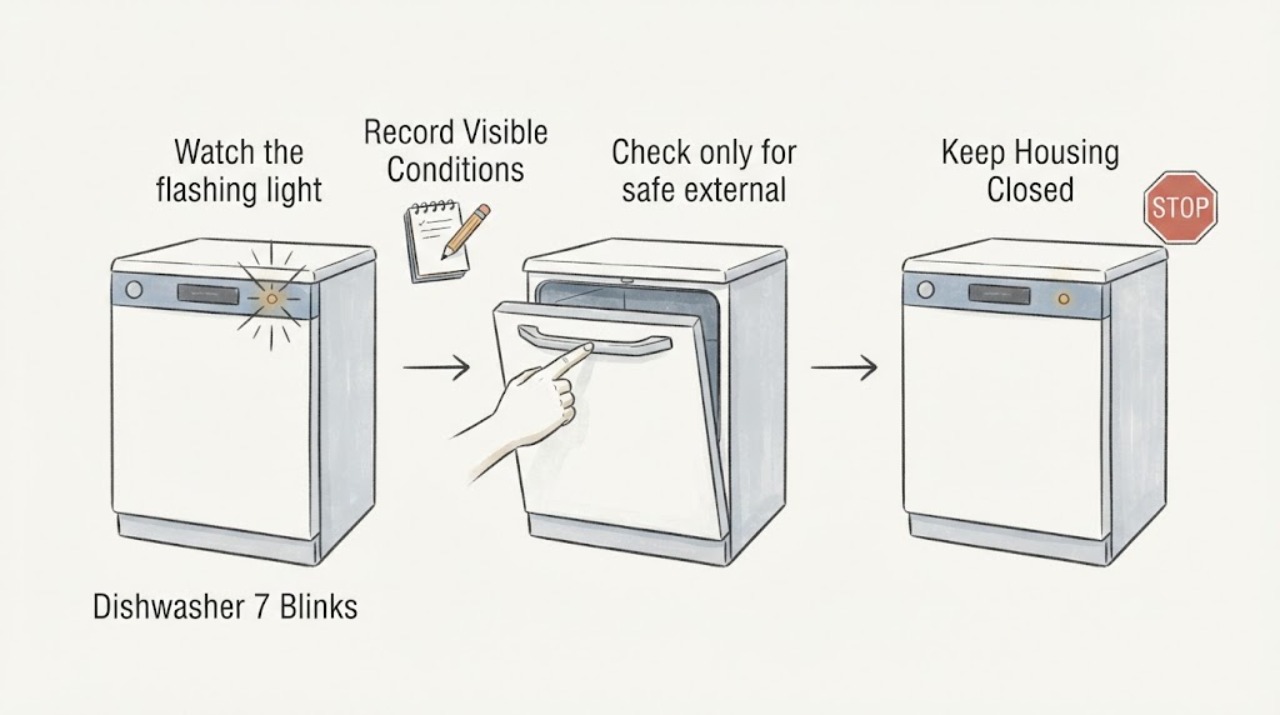
Work through in order
Diagnostic checks
Use only checks that match the exact appliance or system and its official guide.
-
Check 1
Watch the flashing light for a full repetition and count both rapid groups separated by the short pause.
Expected result: The sequence is 7 pause 1, 7 pause 2, another second group, or only a repeating group of 7 with no clear second group.
Next step: Write down the complete pattern exactly, including pause order. Do not label it F7-E1 or F7-E2 unless the second group was actually observed.
Why this matters
Why: Seven is the first F number in KitchenAid's format; the second group determines the E number. A missing second group means the code is not yet identified.
-
Check 2
Record the dishwasher model number, the flashing light name, and whether the unit has a digital display or front-panel LEDs.
Expected result: The model and light identity are readable, or the model/indicator cannot be confirmed.
Next step: Use the model-specific manual or provide the model and full sequence to KitchenAid service. If the model remains unknown, stay at code-reading and safety guidance.
Why this matters
Why: KitchenAid says exact codes vary by model and directs owners to model literature; a count without the model cannot select a code-specific procedure.
-
Check 3
Check only for safe external symptoms: water on the floor, a burning smell, smoke, damaged cord, or a breaker that will not stay on.
Expected result: A leak, smoke, burning odor, electrical damage, or persistent breaker trip is present; or the area is dry and there is no electrical warning.
Next step: Keep the dishwasher off. Shut off the water supply for a leak if it is safe to reach, isolate power only from a safe location, and arrange qualified service. If no hazard is present, continue code recording without opening the unit.
Why this matters
Why: A physical water or electrical hazard takes priority over decoding the light and must not be tested by repeatedly starting the dishwasher.
-
Check 4
Note the cycle state when the pattern appears: stopped, paused with the door open, unable to start, water remaining, or a normal-looking cycle after a brief interruption.
Expected result: The door was opened, the cycle resumed after firmly closing it, water remains, the unit will not start, or the complete code returns after a reset.
Next step: Close the door firmly if it was opened and follow the exact manual. If the complete pattern returns or the machine remains stopped, arrange service rather than forcing a cycle.
Why this matters
Why: A paused cycle or transient control state is not equivalent to a complete F7 code. A returning complete code is the condition for model-specific service, not proof of a particular part from the first group alone.
-
Check 5
If a complete F7-E pattern persists, give KitchenAid service the model, full flash sequence, light name, cycle state, water status, and any safe external observations.
Expected result: The complete pattern returns after the model-supported reset, the second group cannot be counted, or the dishwasher remains unable to operate.
Next step: Stop repeated resets and schedule KitchenAid service. Do not replace a motor, pump, control, or wiring from seven flashes alone and do not perform live electrical tests.
Why this matters
Why: The code-specific meaning and repair boundary remain model dependent. For F7E2, KitchenAid identifies a wash-motor error and directs service if a reset does not resolve it; that meaning cannot be transferred to an unknown second group.
Use your observations
Decision map
Find the observation that best matches what you see, then follow the next safe action.
-
PATH 01Next step
What you see
The light flashes 7 times, pauses, then flashes 1 or 2 times before the longer repeat pause.
Do this next
Record the full code and model before using a code-specific manual or service page. Do not call either code simply 7 blinks.
Why this path and its safety boundary
Why it matters: The first group is F7 and the second group is the E number; F7-E1 and F7-E2 are different complete codes.
-
PATH 02Next step
What you see
Only a group of seven flashes is visible, or the pause pattern is unclear.
Do this next
Watch another full repetition and count the second group. If it still cannot be identified, give service the video or written timing and model number rather than guessing.
Why this path and its safety boundary
Why it matters: The KitchenAid F-E code has not been fully read, so no component or fault meaning is established.
-
PATH 03Next step
What you see
There is water, smoke, a burning smell, electrical damage, or a breaker trip associated with the flashing pattern.
Do this next
Keep the dishwasher off, shut off water for a leak if safe, isolate power from a safe location, and arrange qualified service. Do not restart to see whether the seven flashes change.
Why this path and its safety boundary
Why it matters: The physical hazard outweighs a control-code experiment.
-
PATH 04Next step
What you see
The complete code is recorded, the unit is dry and safe, and the model's general reset is appropriate, but the same sequence returns.
Do this next
Stop repeated resets and schedule KitchenAid service with the model and complete pattern. Do not open the dishwasher or replace a component based only on F7.
Why this path and its safety boundary
Why it matters: A persistent complete code needs model-specific diagnosis. KitchenAid's F7E2 page identifies a wash-motor error only for F7E2, not for an isolated seven-flash report.
Helpful context
Understand the symptom
Treat 7 blinks as an incomplete observation, not a complete diagnosis. KitchenAid's flashing-light format has an F number and an E number separated by a short pause, followed by a longer pause before repetition. The same first group can therefore lead to different complete codes.
Count the full repeating sequence
Watch the clean or fault light through at least one complete repetition. Count the first rapid group, note the short pause, count the second rapid group, and then note the longer pause. Write the pattern as F-number, E-number—for example, 7 pause 1 is F7-E1. If the light never gives a distinct second group, record that fact instead of guessing the E number.
Do not transfer F7-E1 or F7-E2 across models
KitchenAid states that exact codes vary by model. Its public example uses F7-E1 only to demonstrate how to read the pattern, while the separate F7E2 page identifies F7E2 as a wash-motor error. That distinction is why a title or note saying only 7 blinks cannot identify a motor, filter, control, or other component.
Collect the model and safe operating observations
Record the complete model number, whether the dishwasher is plugged in or hard-wired, which light is flashing, whether water is left inside, whether the pump runs, and whether the cycle stopped or merely paused. Do not remove panels or probe wiring. KitchenAid's support pages direct owners to use the model number for manuals and to arrange service when the complete code returns.
Use a control reset only after recording the code
If the dishwasher is not leaking, smoking, or otherwise unsafe, KitchenAid's general reset page describes canceling the cycle, disconnecting power, waiting at least one minute, restoring power, and retrying with the door firmly closed. A reset can clear a transient control state; it cannot turn an incomplete seven-flash observation into a confirmed code or prove that a wash motor is bad. If the same complete pattern returns, stop repeated resets and schedule service.
When checks do not resolve it
Need a professional?
Schedule KitchenAid service when the complete code returns after the model-supported reset, the second flash group cannot be identified, the dishwasher will not resume, or any leak/electrical hazard is present.
Safety scope: Do not open panels, probe live wiring, bypass a door or control, or repeatedly run the dishwasher with water, smoke, burning odor, or electrical damage. Shut off water for a leak if safe and use qualified service.
Have this ready
- Complete repeating flash pattern, light name, model number, digital versus LED display, cycle state, water remaining, door state, whether a reset was attempted, and any safe external leak or electrical observations.
Common questions
FAQ
What does 7 blinks mean on a KitchenAid dishwasher?
By itself, it does not identify a complete code. KitchenAid uses a two-part pattern: the first group is the F number and the second group after a short pause is the E number. Seven followed by one is F7-E1; seven followed by two is F7-E2.
Is seven blinks the wash-motor error?
Not by itself. KitchenAid's F7E2 page identifies the complete F7E2 code as a wash-motor error, but an isolated seven-flash observation lacks the E number and cannot support that diagnosis.
Can I reset the dishwasher after seven flashes?
First record the complete pattern and confirm there is no leak or electrical hazard. KitchenAid's general reset guidance describes canceling the cycle, disconnecting power, waiting at least one minute, restoring power, and retrying; if the complete pattern returns, schedule service.
What if the light never shows a second group?
Treat the code as incomplete. Record the timing, light name, and model and give those details to KitchenAid support. Do not infer F7-E1, F7-E2, or a failed component from seven flashes alone.
Read the exact guide
Official sources
- Clean Light Flashing - DishwasherKitchenAid Product Help · Official KitchenAid dishwasher guidance used to distinguish the first and second flash groups and the pause timing. It does not assign a component meaning to an isolated seven-flash observation.
- Dishwasher Error Codes - ReadingKitchenAid Product Help · Official KitchenAid family-level code-reading guidance. It says exact codes vary by model and should be read as a complete F-E sequence; it is not used to transfer a code meaning across models.
- Resetting the Dishwasher's Controls (Cycle Power)KitchenAid Product Help · Official general reset guidance used only after recording the complete code and confirming the appliance is safe and dry; it does not replace model-specific error interpretation.
- F7E2 - DishwasherKitchenAid Product Help · Official page for the complete F7E2 code only. It identifies a wash-motor error and a reset/service path; it is not evidence that every 7-blink report is F7E2.
- Error Code or Flashing LightsKitchenAid Product Help · Official KitchenAid support category used to verify that code pages are model/service scoped and to route owners to code-specific pages after obtaining the complete sequence.
Community feedback
Share a repair observation
Share a plain-text repair observation. Accepted observations are published automatically; this page may take a moment to update.