
On this page
Start here
Quick answer
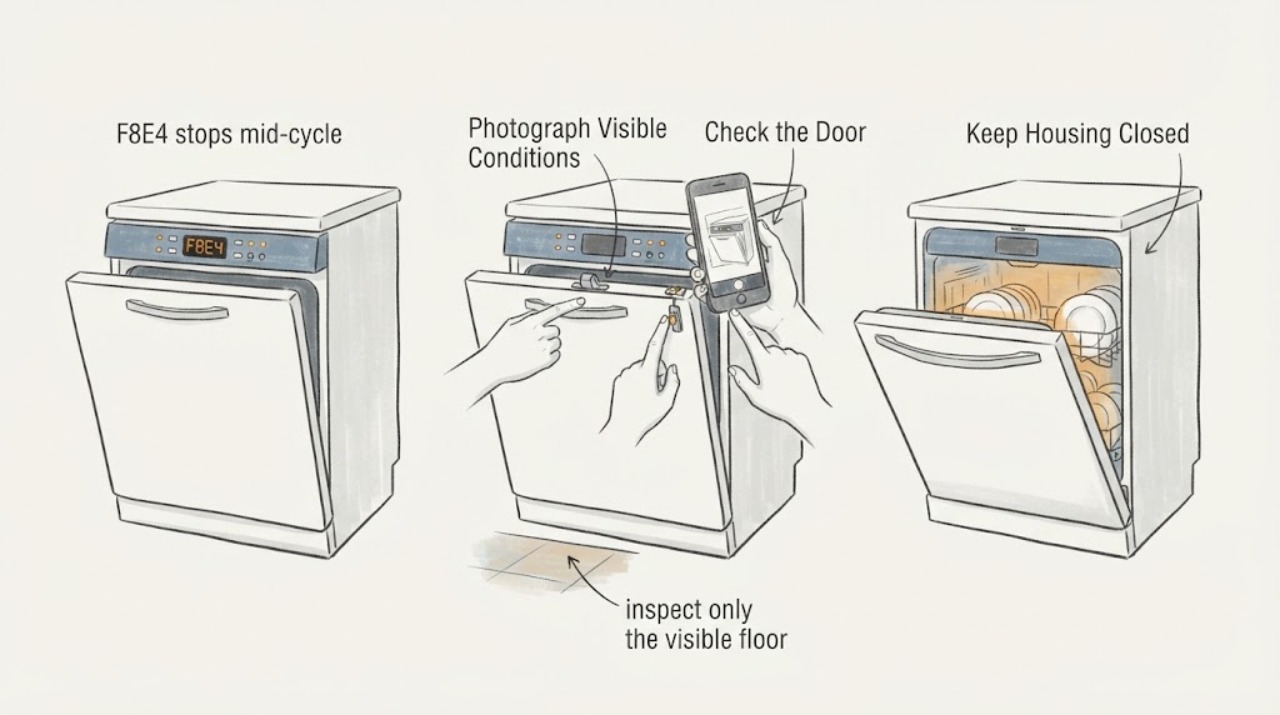
On the assigned KitchenAid KDTM404KPS2, treat F8E4 as a water-containment stop until the exact model manual says otherwise. KitchenAid's F8E4 guidance identifies the code as water detected in the dishwasher drip tray and points to the drip tray, float-switch connection, visible water-supply connections, and excessive suds as the safe first checks. If this professionally installed dishwasher is in the F8E4 drain sequence, KitchenAid says to turn off the water supply and press Cancel once to silence the alarm; if the water cannot be turned off, keep the door closed and do not turn off power. Do not keep restarting a unit that stops mid-cycle after multiple service calls. Record where water or suds are seen, the cycle stage, and the exact model, then arrange qualified service for a returning code or any internal access, leak, or electrical concern.
Work through in order
Diagnostic checks
Use only checks that match the exact appliance or system and its official guide.
-
Check 1
Stop pressing Start and record the exact KDTM404KPS2 model, the complete F8E4 display, when the cycle stopped, whether the unit was draining, and whether the code returns after the door is closed. Take a photo of the display and the floor area without moving the dishwasher.
Expected result: F8E4 repeats at a similar point in the cycle, appears only after the unit has filled or drained, or is accompanied by water, suds, or an interrupted drain sequence.
Next step: Keep the record with the service history and proceed to the dry external observations below. If there is smoke, sparking, a hot cord, or water near electrical parts, stop using the dishwasher and isolate it only from a dry, accessible position if safe.
Stop if: Do not start another cycle merely to reproduce F8E4, enter an undocumented diagnostic mode, or remove a panel to read a hidden code.
Why this matters
Why: A repeatable F8E4 makes KitchenAid's water-in-drip-tray path more relevant than a generic control reset. The cycle stage helps service distinguish a fill, leak, suds, or drain-related recurrence, but it does not identify an internal part by itself.
-
Check 2
From a dry position, inspect only the visible floor, toe-kick edge, and accessible water-supply connection points for fresh water, a damp trail, mineral residue, or a loose-looking connection. Do not pull the KDTM404KPS2 out or reach into the base.
Expected result: Water or residue is visible, the supply connection is damp, or the surrounding area is dry with no accessible leak evidence.
Next step: If water is visible, stop the cycle, turn off the dishwasher water supply if it can be reached safely, and arrange service. If the area is dry, continue to the float and suds checks rather than declaring the code false.
Stop if: Do not tighten fittings by force, disconnect a hose, move a hard-wired dishwasher, or touch wet wiring or an energized component.
Why this matters
Why: Visible water or connection residue supports the F8E4 containment path, but a dry exterior does not rule out water in the drip tray or an intermittent internal leak. KitchenAid specifically directs checking all connection points and the seated rubber washer.
-
Check 3
Look through the door for unusual foam or suds and identify whether regular dish soap, hand soap, or too much detergent may have entered the tub. If safe, leave the dishwasher off with the door closed while suds dissipate; do not add another chemical to force a drain.
Expected result: Foam remains in the tub, the wrong detergent was used, an excessive dose is plausible, or the tub is not unusually sudsy.
Next step: Let documented suds dissipate and use only automatic dishwasher detergent at the model's stated dose on a later attempt. If F8E4 returns without suds, preserve the observation for service instead of increasing detergent or repeating cycles.
Stop if: Do not use hand dish soap, add bleach or other cleaners to counteract suds, or reach into a running or foamy tub.
Why this matters
Why: KitchenAid lists wrong or excessive detergent and dish soap as a cause of excessive suds that can trigger the F8E4 path. No visible suds makes a water-in-drip-tray, float, connection, or recurring leak explanation more important, but still does not prove a part failure.
-
Check 4
If the exact KDTM404KPS2 documentation makes the float-switch area accessible to the owner, compare the connector and visible wiring with that manual while power is safely isolated. Otherwise, only note whether the dishwasher was newly installed or recently serviced; do not pull the drip tray or float wiring.
Expected result: The unit is newly installed or recently serviced, the visible float-switch connection is not seated as the manual shows, or there is no user-accessible connection to inspect.
Next step: Photograph the accessible condition and ask the installer or qualified service provider to verify the float switch, drip tray, water connections, and leak source against the exact model. Do not bypass or bridge the float switch.
Stop if: Do not remove panels, pull the appliance from cabinetry, tug the tray, unplug internal wiring, or perform a live continuity or voltage test.
Why this matters
Why: KitchenAid calls out the float-switch connection and warns that its wire can be damaged if the drip tray is pulled too far or too hard. A recent installation or service visit makes an installation/connection issue worth documenting, but it does not authorize internal access.
-
Check 5
Only after the water/suds issue has been corrected and the exact model instructions permit clearing the code, press Cancel once to silence the alarm and again to clear it as KitchenAid describes. Treat this as one controlled clear attempt, not a repair; for the professional-installation instruction, turn off water first and keep the door closed when water cannot be turned off.
Expected result: F8E4 clears and the next operation completes, or F8E4 immediately returns or the dishwasher remains stopped.
Next step: For a returning code—especially after multiple service calls—stop using the dishwasher and provide service with the model, display photo, cycle stage, water/suds observations, installation/service dates, and previous repair findings.
Stop if: Do not repeatedly cycle power, defeat the door latch, keep running cycles with water present, or order a pump, valve, float, sensor, or control solely from F8E4.
Why this matters
Why: A clear followed by normal operation can indicate a transient condition, while a recurrence means the underlying water-containment or sensing condition remains unresolved. A reset cannot establish which internal component is at fault.
Use your observations
Decision map
Find the observation that best matches what you see, then follow the next safe action.
-
PATH 01Next step
What you see
Water, damp residue, or a drip-tray/containment symptom is visible, or the F8E4 drain sequence starts and operation is prevented.
Do this next
Turn off the dishwasher water supply if it is safely accessible, press Cancel once only as the KitchenAid guidance states, keep the door closed when water cannot be turned off, and arrange qualified service. Do not restart the cycle to test it.
Why this path and its safety boundary
Why it matters: The water-in-drip-tray branch is active. An external connection, installation issue, suds event, or internal/intermittent leak is more plausible than a generic display fault, but the observation does not identify a replacement part.
-
PATH 02Next step
What you see
Foam is present or dish soap/wrong detergent/excess detergent was used, while there is no electrical hazard.
Do this next
Leave the unit off until suds dissipate, use only automatic dishwasher detergent at the model's documented dose, and escalate if F8E4 returns without a suds trigger or after the documented correction.
Why this path and its safety boundary
Why it matters: Excessive suds can explain the stop and can also leave water where it should not be. The likely next decision is detergent and suds control, not a guessed pump or board.
-
PATH 03Next step
What you see
The exterior is dry, no excess suds are seen, and the code returns after a service visit or one model-supported clear attempt.
Do this next
Stop repeated cycles and reopen the service case with the exact model and a structured recurrence log: cycle stage, timing, photos, water/suds findings, and what each prior provider inspected or replaced. Request a leak/containment and float-switch assessment before any part recommendation.
Why this path and its safety boundary
Why it matters: A hidden or intermittent leak, float-switch/connection issue, or unresolved installation fault remains possible. The absence of visible water does not certify that the drip tray is dry.
-
PATH 04Next step
What you see
There is water near electrical parts, smoke, sparking, a hot cord, a tripped breaker, a damaged door/latch, or the next proposed check requires panel or live electrical access.
Do this next
Keep the dishwasher out of service and obtain qualified appliance service; use an electrician for a house-circuit problem. Do not bypass the float or latch, test live wiring, or energize the unit to reproduce the fault.
Why this path and its safety boundary
Why it matters: The issue has crossed the user troubleshooting boundary. F8E4 cannot be safely resolved by a generic reset when an electrical, water-containment, or door-safety hazard is present.
Helpful context
Understand the symptom
F8E4 is more specific than a generic mid-cycle failure. KitchenAid's dishwasher support identifies it as water detected in the drip tray. That means the first decision is whether there is water, a leak or connection problem, a float-switch connection issue, or excessive suds—not which pump or control board to order. The public F8E4 page is a KitchenAid dishwasher-family article; use the KDTM404KPS2 manual for exact access and control details, and do not borrow a code meaning from another appliance or model.
A unit that has already had multiple service calls deserves a documented recurrence path rather than repeated resets. A clean-looking floor does not prove that the drip tray is dry, that the float switch is connected, or that an intermittent leak has been resolved. Keep the checks external and dry; anything involving a panel, wiring, a float bypass, a live test, or a hidden leak belongs with qualified appliance service.
KitchenAid also distinguishes the professionally installed situation: the drain sequence can begin and dishwasher operation can be prevented. Its guidance is to turn off the water supply and press Cancel once to silence the alarm. If the water cannot be turned off, the instruction is to keep the door closed and not turn off power. Follow that safety instruction for the current condition, and do not assume that a power cycle fixes the cause.
When checks do not resolve it
Need a professional?
Arrange qualified KitchenAid or appliance service when F8E4 returns after the documented external checks or one controlled clear attempt, especially after multiple prior service calls; when water remains or leaks; when the float-switch or drip-tray area requires access; or when diagnosis would require moving the dishwasher, removing a panel, touching wiring, or performing a live test. Keep the unit out of service for smoke, sparking, a hot cord, water near electrical parts, a damaged door or latch, or a breaker that trips with the dishwasher.
Have this ready
- Provide the exact model KDTM404KPS2, serial number and market, the complete F8E4 display, cycle stage and time of stoppage, whether the unit began a drain sequence, photos of the display and any water or residue, detergent used and dose, installation/service dates, water-supply observations, and a list of what earlier providers inspected or replaced.
Common questions
FAQ
What does KitchenAid F8E4 mean on a dishwasher?
KitchenAid's dishwasher support identifies F8E4 as water detected in the drip tray. Check for visible water or connection residue, excessive suds, and the float-switch path only as the exact model documentation permits; do not assume the code names a particular pump or control board.
Why does F8E4 stop the cycle even when I cannot see a leak?
KitchenAid's guidance treats the drip tray and float-switch connection as relevant even when a floor leak is not obvious. A dry exterior can coexist with water in the tray, an intermittent connection or leak, or a prior suds event, so record the cycle stage and have service assess the containment path if the code returns.
What should I do if F8E4 returns after several service calls?
Stop repeating cycles and reopen the service case with the exact KDTM404KPS2 model, display photo, cycle stage, water and suds observations, installation/service dates, and prior findings. Ask for a documented leak/containment and float-switch assessment rather than selecting a part from the code alone.
Read the exact guide
Official sources
- F8E4 - DishwasherKitchenAid Product Help · Official KitchenAid dishwasher support page for F8E4; use the exact KDTM404KPS2 manual for model-specific access and controls.
- Dishwasher Error Codes - ReadingKitchenAid Product Help · Official KitchenAid dishwasher code-reading guidance; exact code meanings and access steps remain model-dependent.
Community feedback
Share a repair observation
Share a plain-text repair observation. Accepted observations are published automatically; this page may take a moment to update.