
On this page
Start here
Quick answer
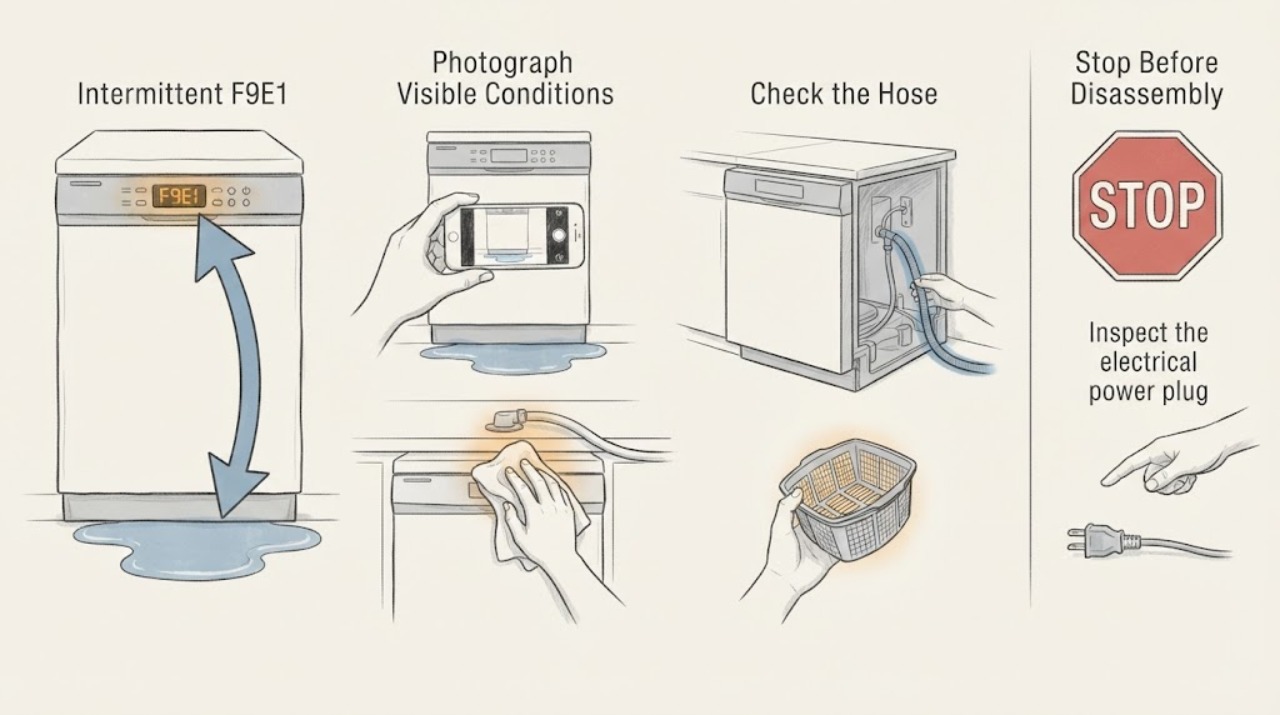
KitchenAid identifies F9E1 on the KDTE204KPS dishwasher as a long-drain/not-draining condition. Do not treat a clean filter and air gap as proof that the pump or control is bad, and do not confuse a garbage-disposal knockout plug with the dishwasher's electrical power plug being bumped loose. First photograph the complete code and note when it appears, how much water remains, whether suds are present, and whether the machine lost power. From a dry, safe position, check the visible drain routing and the under-sink connection, then make sure the power plug and receptacle are stable and undamaged without repeatedly unplugging the machine. If F9E1 returns after the documented external checks or the unit has water near electrics, a loose/hot outlet, leakage, or an intermittent supply, stop using it and arrange qualified appliance or electrical service rather than replacing a pump or board from the code alone.
Work through in order
Diagnostic checks
Use only checks that match the exact appliance or system and its official guide.
-
Check 1
Photograph the entire display or count the complete repeating clean-light pattern, and record the cycle phase when F9E1 appears: immediately after start, during drain, at the end, or after the dishwasher has lost power. Note whether the tub has a shallow film of water or standing water covering the filter, whether the pump can be heard, and whether the unit is otherwise powered.
Expected result: F9E1 repeats during a drain phase with water remaining, appears only after the plug was bumped, or the display/pattern is incomplete or different.
Next step: If the code is incomplete or the power timeline is unclear, keep the dishwasher off and obtain a stable photo before any further check. If there is water near the receptacle, sparking, heat, or a damaged cord, isolate the area from a dry safe position and arrange service.
Why this matters
Why: A repeatable F9E1 during drain supports the official long-drain branch. A code appearing only after an electrical interruption is a timeline clue, not evidence that the drain pump failed; an incomplete code cannot be safely mapped.
-
Check 2
With the dishwasher stopped and the area dry, inspect only the visible drain hose from the dishwasher to the sink or disposer. Look for a kink, pinch, crushing, a loose connection, or a routing change under the sink. If connected to a disposer, determine whether the reference is to the disposer inlet knockout plug; do not dismantle the dishwasher or disconnect a water-filled hose.
Expected result: The hose is visibly kinked or loose, the disposer connection still has its inlet knockout plug, or the visible drain path is routed correctly and unobstructed.
Next step: Correct only a visible routing or installation problem that can be reached without moving the dishwasher or opening a wet connection. If the path is clear, continue to the power and suds checks rather than buying a drain part.
Why this matters
Why: KitchenAid lists hose restrictions, incorrect routing, and an unremoved disposer knockout plug as external long-drain causes. A clear hose does not prove the internal drain system is healthy.
-
Check 3
Inspect the electrical power plug and receptacle from outside without touching wet surfaces. Confirm the plug is fully seated, is not being pulled sideways by the cord, and has no heat discoloration, looseness, crack, scorch, or repeated loss of contact. Do not use an extension cord, wedge, adapter, or repeated unplug/replug cycles to hold the connection or test it.
Expected result: The plug is stable and the receptacle is cool and undamaged, or the plug is easily bumped loose, the outlet is loose/hot, or power drops during a cycle.
Next step: If the connection is loose, hot, scorched, or repeatedly loses power, stop operating the dishwasher and have an electrician or qualified installer make the receptacle/cord safe. Do not keep unplugging it to clear F9E1.
Why this matters
Why: A stable supply makes an intermittent power interruption less likely; a loose or heat-damaged connection is an electrical installation problem that can interrupt the cycle and create a fire risk, independent of the F9E1 drain path.
-
Check 4
Look for persistent bubbles or dish-soap foam when the door is opened after the machine has stopped, and record whether the event follows a particular detergent, load, or an unusually dirty item. Do not add chemicals, run extra cycles to flush foam, or reach into a running dishwasher.
Expected result: Suds are present at the time of F9E1, or the tub is free of foam and the same code returns on ordinary loads.
Next step: If foam is present, turn the dishwasher off and allow it to dissipate before following the model's normal safe recovery guidance. If there is no foam and F9E1 recurs, stop repeated cycling and arrange service with the timing and water-level record.
Why this matters
Why: KitchenAid says excessive suds can cause poor drainage or leakage and advises automatic-dishwasher detergent only. Foam is a separate external branch; no foam with recurring F9E1 makes a persistent drain-path or appliance fault more concerning, but still does not name a part.
-
Check 5
Only after the plug/receptacle is stable, the floor is dry, and the visible drain checks are complete, use KitchenAid's documented reset at most once: disconnect power for 30 seconds, reconnect it, and observe one normal operation without touching wet or exposed wiring. Do not pull a plug that is loose, hot, wet, or under strain.
Expected result: F9E1 clears and the dishwasher completes the next operation, or the code/standing water returns after the one reset.
Next step: If F9E1 returns, keep the dishwasher off and give service the code photo, drain-stage timing, water level, hose/air-gap/filter history, suds status, and power-plug observations. Do not repeat the reset or enter a service mode.
Why this matters
Why: A one-time clear can be transient, but a returning code means the reset did not establish a repair. Intermittent recurrence after the hose, filter, air-gap, suds, and power environment are accounted for needs professional diagnosis.
Use your observations
Decision map
Find the observation that best matches what you see, then follow the next safe action.
-
PATH 01Next step
What you see
F9E1 appears during drain with standing water, and a visible hose kink, loose connection, or disposer knockout plug is found.
Do this next
Correct only the safe visible installation condition, then make one supervised observation if the area remains dry and safe. Stop and arrange service if water remains or F9E1 returns.
Why this path and its safety boundary
Why it matters: This matches KitchenAid's documented external long-drain branch more closely than a guessed internal part failure.
-
PATH 02Next step
What you see
The filter, air gap, and visible hose are clear, but the electrical plug is loose or the receptacle is hot, damaged, or repeatedly loses contact.
Do this next
Stop using the dishwasher and have the receptacle/cord environment made safe by a qualified electrician or installer. Do not keep unplugging and reconnecting the appliance.
Why this path and its safety boundary
Why it matters: Power interruption is an independent safety and timing problem; it can stop a cycle and leave water without proving a drain-pump failure.
-
PATH 03Next step
What you see
The power connection is stable and F9E1 recurs with no visible hose, disposer, air-gap, filter, or suds explanation.
Do this next
Request qualified KitchenAid appliance service with the complete model, code timing, retained-water amount, and all external checks. Do not replace a pump or board solely from F9E1.
Why this path and its safety boundary
Why it matters: The remaining fault is inside the appliance drain or control/sensing path, but F9E1 and an intermittent symptom do not distinguish a pump, sump, wiring, or control issue.
-
PATH 04Next step
What you see
Water is leaking toward electrical parts, the unit sparks, the cord or outlet is hot/scorched, or the dishwasher cannot be safely powered or drained.
Do this next
Keep people away and isolate power only from a dry, accessible location when safe; shut off the water if a supply leak is present. Do not restart or open panels. Arrange qualified appliance service and electrical help as needed.
Why this path and its safety boundary
Why it matters: This is an immediate water or electrical/fire boundary, not a reset or drain experiment.
Helpful context
Understand the symptom
The KDTE204KPS is a KitchenAid Third Level Utensil Rack dishwasher. On KitchenAid's opened F9E1 support page, F9E1 means a long drain or not draining. That narrows the first check to the drain path, but it does not identify a failed pump, sump, sensor, or control. Intermittence makes the time and stage of the code especially important.
There are two different things people may call a dishwasher plug. The garbage-disposal knockout plug is a one-time installation obstruction that must be removed when the drain hose is connected to a new disposer. The electrical power plug can also be physically bumped loose. Record which one is meant; a loose electrical connection can interrupt a cycle and must not be mistaken for proof of a drain component failure.
The exact-model community report is useful for the symptom pattern: it names KDTE204KPS, reports F9E1 with soapy water at the bottom, and says the cycle sometimes drains and completes on a later attempt. Later replies describe service and a pump replacement without establishing a confirmed root cause. Do not copy its diagnostic-mode or electrical-testing suggestions; they are outside safe owner checks.
When checks do not resolve it
Need a professional?
Arrange KitchenAid or qualified appliance service when F9E1 returns after one documented external check/reset, water remains, the drain path is clear but the dishwasher still stops, the unit loses power intermittently, or diagnosis would require a pump, sump, control, wiring, or panel access. Stop immediately for a loose/hot/scorched receptacle, sparking, water near electrical parts, or leakage. Do not repeatedly unplug the dishwasher, enter service mode, remove the pump or bottom panel, or perform live electrical tests.
Common questions
FAQ
What does F9E1 mean on a KitchenAid KDTE204KPS?
KitchenAid's official F9E1 page labels it a long-drain or not-draining condition. Start with the documented filter, visible drain hose, disposer knockout plug, air gap, obstruction, hose-routing, and suds checks; F9E1 alone does not identify a failed drain pump or control.
Does a knocked-out plug cause F9E1?
Clarify which plug is meant. KitchenAid's drain guidance refers to the garbage-disposal inlet knockout plug being removed for a new disposer connection. A dishwasher electrical plug being bumped loose is a separate power-supply problem and should be treated as an electrical safety issue, not as a drain diagnosis.
The air gap and filter are clean. Should I replace the drain pump?
No—not from F9E1 alone. A clean external path with intermittent recurrence can still require an appliance technician to separate drain performance, sensing, wiring, control, and power interruption. The exact-model community report does not establish a confirmed pump repair.
Can I unplug the dishwasher for 30 seconds every time F9E1 appears?
KitchenAid documents a 30-second power reset, but use it at most once and only when the plug, outlet, floor, and hands are dry and safe. Repeated unplugging is not a repair and is unsafe when the plug is loose, hot, damaged, wet, or being knocked out.
Read the exact guide
Official sources
- F9E1 - DishwasherKitchenAid Product Help · The opened KitchenAid support article identifies F9E1 as Potential Cause: Long Drain and directs owners to inspect the filter, drain hose, disposer knockout plug, air gap, obstructions, hose routing, and excessive suds; it documents a 30-second power reset and service escalation.
- KitchenAid dishwasher (KDTE204KPS) intermittently giving F9E1 error codeReddit r/appliancerepair · The opened exact-model post reports intermittent F9E1, residual soapy water, a clean air gap, a cleaned hose, a filter cleaned after use, and a later service/pump-replacement attempt without a confirmed root cause. It is not authority for diagnostic-mode entry, live electrical tests, or part selection.
- KDTE204KPS Owner's CenterKitchenAid · The opened KitchenAid Owner's Center identifies model KDTE204KPS as a Third Level Utensil Rack Dishwasher with 30+ Total Wash Jets and 39 dBA, and links model-specific troubleshooting and service resources.
Community feedback
Share a repair observation
Share a plain-text repair observation. Accepted observations are published automatically; this page may take a moment to update.