
On this page
Start here
Quick answer
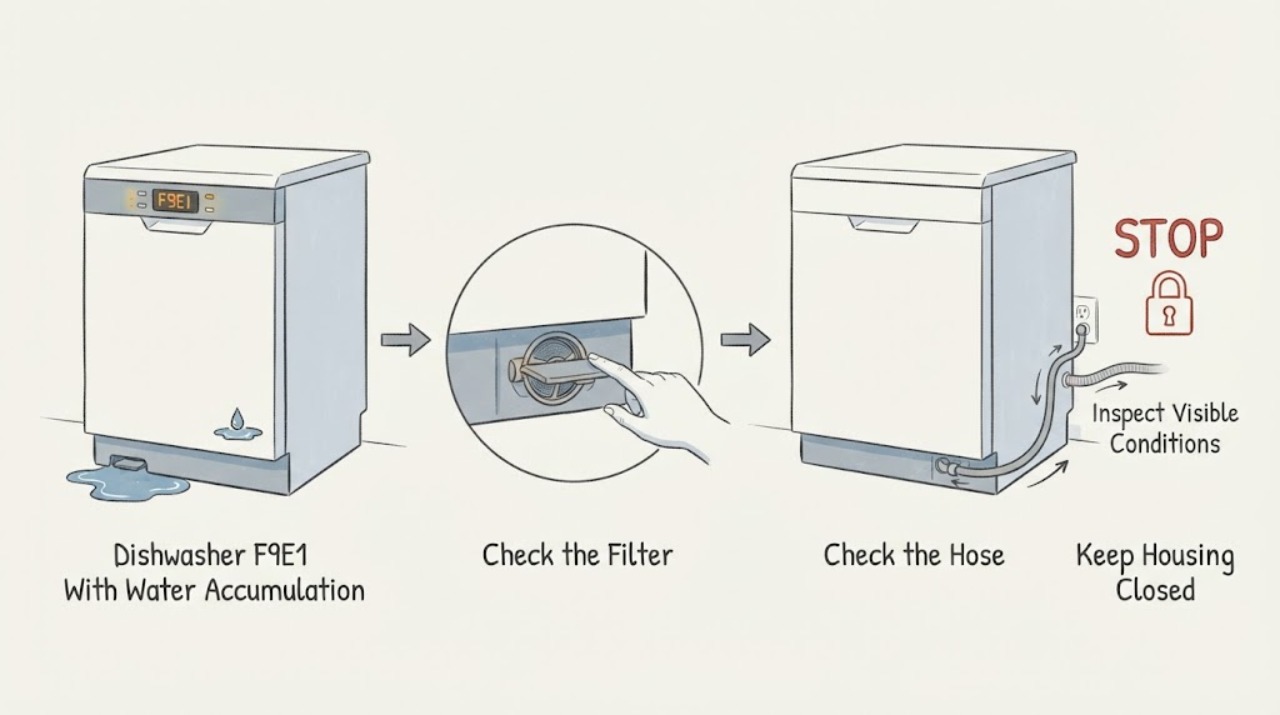
KitchenAid identifies dishwasher F9E1 as a Long Drain condition. If water remains in the tub, turn the appliance off and check the filter, drain hose routing, sink disposer or air gap, and the disposer knockout plug when that connection applies. Also check for excessive suds from the wrong detergent or too much detergent. A 30-second power reset is the documented control reset, but it does not clear a blocked drain. If the code or standing water returns after these external checks, stop repeated cycles and schedule model-specific service.
Before you begin
Safety first
- Do not open the cabinet, perform live electrical measurements, dismantle the drain pump, or continue running the dishwasher when it leaks, overflows, runs continuously or shows smoke, burning smell or electrical damage.
Work through in order
Diagnostic checks
Use only checks that match the exact appliance or system and its official guide.
-
Check 1
Stop the cycle and turn the dishwasher off before opening the door to inspect standing water, filters, hoses or suds.
Expected result: Water or foam remains, the unit is leaking or overflowing, the drain pump runs continuously, or there is smoke, burning smell or electrical damage.
Next step: Keep the dishwasher off. If safe, shut off water and power before service; do not reach into a moving pump, open the cabinet or repeat a hazardous test.
Why this matters
Why: A stopped appliance can be checked externally; a leak, continuous pump, overflow or electrical symptom needs a service boundary rather than repeated cycles.
-
Check 2
With the machine stopped, inspect and clean the filter, then look for visible food or other blockage in the accessible drain area.
Expected result: The filter is dirty or blocked, the drain area is obstructed, or both are already clear.
Next step: Reinstall the filter correctly and continue to the external drain-hose and connection checks; stop at service if the result is clear but F9E1 remains.
Why this matters
Why: KitchenAid lists the filter and drain obstructions as first-line Long Drain checks, but a clean filter does not prove that an internal pump is good or bad.
-
Check 3
Inspect the drain hose from the dishwasher to the sink for a kink, pinch, clog or incorrect routing; if connected to a disposer, verify the inlet is clear and the new-installation knockout plug was removed; check an air gap if fitted.
Expected result: A hose or connection is kinked, clogged, blocked by a disposer plug, or appears correctly routed and clear.
Next step: Correct only the accessible installation issue covered by the matching manual. Do not dismantle the pump or make plumbing changes beyond the documented connection check.
Why this matters
Why: A blocked or incorrectly installed external drain path can prevent draining and trigger F9E1. A clear path narrows the issue but does not identify a pump or control fault.
-
Check 4
If soap foam or bubbles are present, stop the dishwasher and allow them to dissipate; identify whether dish soap or too much detergent was used and return to automatic-dishwasher detergent only.
Expected result: Excessive suds are present, or there are no suds and the tub still retains water.
Next step: Do not resume until the foam has dissipated. If F9E1 or standing water remains without suds, continue to the reset/service decision.
Why this matters
Why: KitchenAid says suds can push water out and cause poor drainage or leaking. No suds means the detergent explanation is not enough to account for the F9E1 condition.
-
Check 5
After the external checks, disconnect power for 30 seconds using the documented unplug or breaker method, then record whether the next attempted normal cycle drains and whether F9E1 returns.
Expected result: The code clears and drainage is normal, or F9E1/standing water returns or the machine cannot be safely tested.
Next step: For a returning or unsafe result, keep the dishwasher off and contact KitchenAid service with the full model, code, water level, hose/disposer/air-gap findings and detergent history.
Why this matters
Why: A successful reset may clear a control state, but a returning code indicates the drain condition remains unresolved; the reset does not prove a part failure.
Use your observations
Decision map
Find the observation that best matches what you see, then follow the next safe action.
-
PATH 01Next step
What you see
Water remains and the filter, drain area, hose, disposer, or air gap has a visible obstruction or incorrect connection.
Do this next
Correct the documented external issue, reinstall the filter, and use one normal cycle only if there is no leak, overflow or electrical hazard.
Why this path and its safety boundary
Why it matters: The result matches KitchenAid's documented Long Drain checks and supports an accessible drain-path correction.
-
PATH 02Next step
What you see
Foam or bubbles are present when the door is opened, especially after dish soap or excessive detergent was used.
Do this next
Turn the dishwasher off, let the suds dissipate, use only automatic-dishwasher detergent, and call service if F9E1 or retained water returns.
Why this path and its safety boundary
Why it matters: KitchenAid says suds can push water out and cause leaking or poor wash performance, so the immediate issue is over-sudsing rather than a confirmed pump defect.
-
PATH 03Next step
What you see
The filter and external drain path are clear, no suds or hazard is present, and a single 30-second power reset is followed by normal drainage.
Do this next
Monitor the next normal cycle and keep the model number and findings recorded; stop and seek service if F9E1 returns.
Why this path and its safety boundary
Why it matters: The control reset may have cleared a temporary state, but it does not establish that the drain system is repaired.
-
PATH 04Next step
What you see
F9E1 or standing water returns after the documented external checks and reset, or the appliance leaks, overflows, runs the pump continuously, or shows electrical damage.
Do this next
Keep power and water off when safe and schedule KitchenAid or qualified appliance service. Do not open the cabinet or perform live measurements.
Why this path and its safety boundary
Why it matters: The generic F9E1 page no longer provides a safe user-level fix; a model-specific drain or safety diagnosis is required.
Helpful context
Understand the symptom
F9E1 is not a generic KitchenAid “water accumulation” diagnosis: KitchenAid labels it a Long Drain condition. The useful distinction is whether the drain path is visibly obstructed, the hose or disposer connection is wrong, suds are present, or the code returns after the external checks. The code does not identify a particular pump, motor or control-board part.
Stop the cycle and document what remains
Note whether water is above the filter, whether the cycle ended early, whether the drain pump keeps running, and whether soap bubbles or foam are present. Do not scoop around a moving pump or keep restarting a machine that is leaking, overflowing, smoking or showing electrical damage.
Check the internal filter and external drain path
KitchenAid directs users to clean the filter, inspect the drain hose for kinks, pinches or clogs, and check the sink disposer or air gap when those connections are used. Perform only the accessible checks described by the matching manual; do not infer an internal pump failure from standing water alone.
Verify the disposer connection and detergent situation
If the dishwasher drains into a garbage disposer, KitchenAid says the disposer inlet knockout plug must be removed on a new installation and the disposer must be clear. If foam is present, KitchenAid attributes it to dish soap or excess detergent and says to turn the dishwasher off and allow the suds to dissipate; use only automatic-dishwasher detergent.
Reset once, then use the result
KitchenAid documents disconnecting power for 30 seconds, by unplugging or switching off the dishwasher breaker, as a control reset. If F9E1 clears and the dishwasher drains normally, monitor the next normal cycle. If water remains or the code returns, the reset did not resolve the drain condition and service is the safer next step.
Escalate a returning code or unsafe symptom
Use the exact model number to retrieve the matching manual and provide it with the F9E1 history. KitchenAid directs users to contact support or schedule service when the dishwasher still will not drain. Do not remove panels or run technician-only electrical tests from a generic article.
When checks do not resolve it
Need a professional?
Contact KitchenAid service when the dishwasher still will not drain after the filter, hose, disposer/air-gap, suds and one documented reset check, or immediately for leaks, overflow, continuous pump operation or electrical hazards.
Safety scope: Do not open the cabinet, perform live electrical measurements, dismantle the drain pump, or continue running the dishwasher when it leaks, overflows, runs continuously or shows smoke, burning smell or electrical damage.
Have this ready
- Full KitchenAid model, F9E1 timing, standing-water level, filter result, drain-hose routing, disposer/air-gap connection, knockout-plug status, suds or detergent history, reset result and any leak or electrical symptom.
Common questions
FAQ
What does KitchenAid dishwasher F9E1 mean?
KitchenAid Product Help identifies F9E1 as a Long Drain condition. Check the filter, drain hose, disposer or air gap, knockout plug when applicable, obstructions and excessive suds before arranging service.
Can a 30-second reset fix F9E1?
KitchenAid documents disconnecting power for 30 seconds as a control reset. It can clear a temporary control state, but it will not remove a kink, clog, disposer plug or suds problem; a returning code needs service.
Why is there water in the KitchenAid dishwasher with F9E1?
F9E1 is associated with a long drain, so water may remain when the drain path does not clear. Check the filter and accessible hose/disposer/air-gap path, and treat foam as a separate over-sudsing cause. Do not diagnose a pump from standing water alone.
Read the exact guide
Official sources
- KitchenAid Manuals & LiteratureKitchenAid · KitchenAid official manuals portal; used to require exact model lookup before model-specific procedures or internal service claims.
- F9E1 - Dishwasher - Product HelpKitchenAid · KitchenAid Product Help page for dishwashers; used for the F9E1 Long Drain definition, filter/hose/disposer/air-gap checks, 30-second reset, suds warning and service escalation.
Community feedback
Share a repair observation
Share a plain-text repair observation. Accepted observations are published automatically; this page may take a moment to update.