
On this page
Start here
Quick answer
For a KitchenAid KDTE104ESS1 that washes inconsistently, first compare the failed loads: confirm the water valve is fully open, use automatic dishwasher detergent, load soiled surfaces toward the spray paths without blocking a spray arm, and verify the selected cycle is appropriate for the soil. With power off and the racks removed, check that the accessible spray arms spin freely and clean the filter according to the model instructions. KitchenAid also identifies water pressure, hard-water buildup, detergent condition, suds, rinse aid and rack loading as wash-performance variables. If these external checks do not change the result, or if the dishwasher leaks, repeatedly fails to fill, makes abnormal noises or leaves the tub with a fault indication, stop repeating cycles and arrange model-matched service rather than guessing a circulation pump or control part.
Before you begin
Safety first
- Do not remove the sump, circulation pump, wiring or control panel, bypass leak detection or safety switches, disconnect pressurized water lines, or continue cycles that leak, trip protection or make abnormal noises.
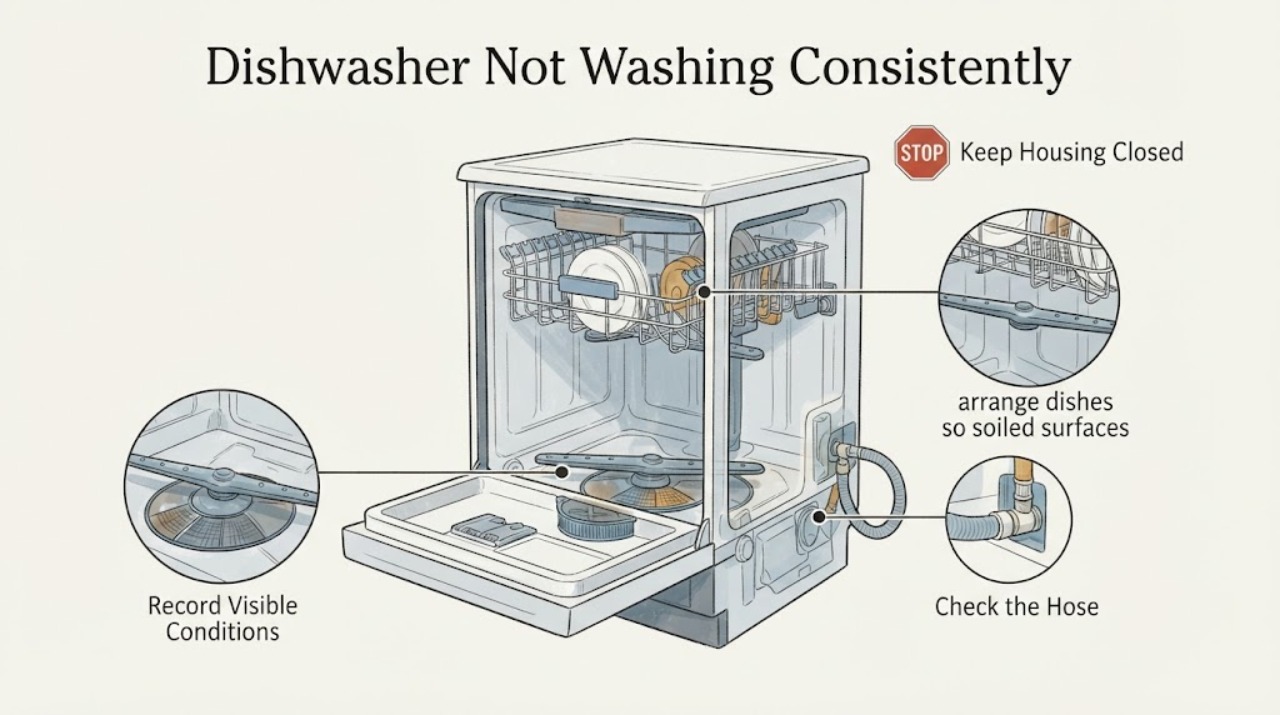
Work through in order
Diagnostic checks
Use only checks that match the exact appliance or system and its official guide.
-
Check 1
For two or three comparable loads, record the cycle and options, which rack and dishes remain dirty, whether the dishwasher fills and sprays, and whether the problem affects all loads or only heavily soiled or tightly packed loads.
Expected result: Only one rack or one loading pattern fails, heavy soil fails on a light cycle, or every rack and cycle gives the same poor result.
Next step: Use the pattern to choose the matching checks below. Do not replace a pump or control solely because the result varies between loads.
Why this matters
Why: A rack-specific or soil-specific pattern makes loading, spray-arm clearance or cycle selection more likely than an immediately proven internal component failure. A repeatable all-load failure warrants service after the external checks.
-
Check 2
Before starting a cycle, verify that the under-sink water valve is fully open and that the supply hose is not visibly restricted. If the dishwasher is newly installed or intermittently under-filling, note whether the symptom changes after the valve is corrected; do not disconnect the water line or measure pressure yourself.
Expected result: The valve is partly closed, the hose is visibly kinked or restricted, or the external supply looks normal but cleaning remains inconsistent.
Next step: Open only a clearly partly closed valve and remove only an obvious external hose bend. If the symptom persists, water pressure or the internal fill/wash system needs model-matched service; do not infer which valve or pump is at fault.
Why this matters
Why: KitchenAid says the water supply must be fully open for the dishwasher to fill, wash and rinse; its wash-performance guidance also identifies insufficient water pressure as a possible reason for poor cleaning.
-
Check 3
With the dishwasher stopped and safe to access, arrange dishes so soiled surfaces face the spray paths, leave clearance around the spray arms, and avoid nesting bowls or overloading a rack. Before a cycle, spin the accessible middle spray arm by hand only to check for contact with a dish or rack; do not force it or reach into a moving machine.
Expected result: A dish, rack or utensil contacts the spray arm, a spray arm has resistance, or all arms have clearance and spin freely when the machine is off.
Next step: Rearrange the load or adjust the rack only as the owner's instructions allow, then retest with a comparable load. If an arm remains restricted without a visible loading cause, stop at the external check and request service.
Why this matters
Why: KitchenAid says blocked spray arms can delay detergent release and soil removal, while overloading restricts water circulation. A Top Rack Only selection can also leave the lower rack without the expected lower-arm wash action.
-
Check 4
Check the filter installation and clean the filter using the KDTE104ESS1 owner's instructions. Inspect the tub and door seal for food residue or mineral film, and use only an automatic dishwasher detergent. If foam or suds are present, stop the cycle and allow them to dissipate instead of adding more detergent.
Expected result: The filter is dirty or mis-seated, the tub has visible buildup, the detergent is old or incorrect, or suds are present; otherwise the accessible filter and interior look clean.
Next step: Correct only the accessible filter seating and cleaning steps in the model guide, use fresh automatic-dishwasher detergent as directed on its package, and clean the interior with the official method. If the filter is damaged, the tub leaks or the symptom remains after a comparable retest, arrange service rather than selecting a generic filter or pump.
Why this matters
Why: KitchenAid identifies a dirty filter, food and mineral residue, incorrect detergent and suds as conditions that can reduce wash performance or cause water to leave the tub. Hard-water deposits can also build on spray components.
-
Check 5
Match the cycle and options to the load. For baked-on or heavy soil, use a documented heavier or high-temperature option when available; confirm that Top Rack Only, Delay, Control Lock or another special mode was not selected accidentally. Confirm that rinse aid is filled if the issue is mainly filming or poor final results.
Expected result: The failed loads used a light or restricted cycle, an option that excludes the affected rack, incorrect detergent or no rinse aid; or the same problem occurs on an appropriate cycle with correct supplies.
Next step: Run one comparable load with the correct cycle, automatic detergent and properly loaded racks. If all racks remain dirty despite normal fill/spray behavior and clean filters, stop user troubleshooting and provide the documented pattern to KitchenAid service.
Why this matters
Why: KitchenAid says cycle choice, high-temperature washing, rinse aid, detergent type and rack-only options affect cleaning and drying. These observations do not prove a failed heater or circulation motor.
Use your observations
Decision map
Find the observation that best matches what you see, then follow the next safe action.
-
PATH 01Next step
What you see
Only dishes under one spray arm or one crowded rack remain dirty, and the arm contacts a dish or rack when the machine is stopped.
Do this next
Rearrange the rack and retest with the same cycle. If the arm still has resistance with no loading obstruction, request service without forcing it.
Why this path and its safety boundary
Why it matters: The observed pattern is consistent with blocked water coverage or loading rather than a proven circulation-pump failure.
-
PATH 02Next step
What you see
The supply valve is not fully open, the hose is visibly restricted, or the dishwasher is not consistently filling.
Do this next
Correct only the visible valve or hose issue. If filling remains inconsistent, keep the dishwasher out of repeated test cycles and arrange model-matched service.
Why this path and its safety boundary
Why it matters: Insufficient or intermittent water supply can affect filling, washing and rinsing, so the dirty dishes do not by themselves identify a wash motor or valve part.
-
PATH 03Next step
What you see
The filter and spray paths are clean and clear, water supply is normal, the load is correctly arranged and an appropriate cycle still leaves every rack dirty.
Do this next
Stop repeating cycles and contact KitchenAid or qualified appliance service with the full KDTE104ESS1 model, cycle/options, fill/spray observations and photos of the loading or residue pattern. Do not open the sump or electrical compartments.
Why this path and its safety boundary
Why it matters: The user-accessible wash-performance causes have been narrowed, but the opened KitchenAid guidance does not support naming a failed pump, motor, valve, heater or control from this result alone.
-
PATH 04Next step
What you see
Foam, leaking water, a flashing leak-related indication, abnormal noise, repeated failure to fill or a breaker trip appears during the test.
Do this next
Stop the cycle, protect the floor and leave the dishwasher off if the condition persists. Do not bypass a leak system, remove electrical covers or continue testing; use model-matched service.
Why this path and its safety boundary
Why it matters: The condition has crossed the normal cleaning-performance boundary and may involve a water, leak-detection or electrical safety issue.
Helpful context
Understand the symptom
Treat inconsistent results as a pattern problem first
A load that is clean one time and dirty the next can change with rack position, blocked spray-arm clearance, cycle choice, soil level, detergent, water supply or mineral buildup. Record which rack and dishes fail, the cycle and options used, whether the tub fills and sprays, and whether the failure affects every load. This separates a repeatable loading or wash-performance condition from a fault that needs service.
Keep the model-specific boundary
The official KitchenAid owner page is indexed under KDTE104ESS, while the assigned nameplate includes the KDTE104ESS1 suffix. Use that complete suffix when retrieving literature or arranging service. The checks below are supported by KitchenAid dishwasher guidance, but a suffix-specific service procedure or part cannot be inferred from a dirty load alone.
Do not turn a cleaning symptom into a part diagnosis
If water, loading, spray-arm clearance, filter and detergent checks do not produce a stable improvement, the remaining possibilities include service-level components, but the opened guidance does not identify which component failed on this symptom. Stop short of removing the pump, wiring or control and give the technician the cycle history and observations.
When checks do not resolve it
Need a professional?
Safety scope: Do not remove the sump, circulation pump, wiring or control panel, bypass leak detection or safety switches, disconnect pressurized water lines, or continue cycles that leak, trip protection or make abnormal noises.
Have this ready
- Provide the complete KDTE104ESS1 model and serial if requested, the cycles and options tested, which rack or dishes failed, whether the tub filled and sprayed, filter and detergent observations, water-supply status, and any leak, foam, noise or display indication.
Common questions
FAQ
Could inconsistent cleaning prove that the circulation pump is failing?
No. KitchenAid's user guidance first lists water supply, loading, spray-arm clearance, cycle selection, detergent, suds, filters and mineral buildup. If those checks do not restore consistent cleaning, give service the observed pattern instead of ordering a pump based on the symptom alone.
Why are the lower dishes dirty when the upper rack is clean?
Check whether a Top Rack Only option was selected and whether the lower spray arm is blocked by a dish, rack or utensil. KitchenAid says that option does not engage the lower spray arms, and blocked arms can delay soil removal.
Should I keep running cycles to see whether the dishwasher improves?
Run a controlled comparison only after correcting a visible loading, supply, filter, detergent or cycle issue. Stop if there is leaking, foam, a repeated fill failure, abnormal noise or a protection trip, and use service instead of repeatedly stressing the dishwasher.
Read the exact guide
Official sources
- Spray Arm Not Working - DishwasherKitchenAid Product Help · Opened KitchenAid's official spray-arm help page. It supports cleaning/mineral and user-accessible spray-arm clearance checks and the Top Rack Only scope; it does not authorize pump disassembly or a component diagnosis.
- Dishes are not CleanKitchenAid Product Help · Opened KitchenAid's official wash-performance page. It supports external checks for water supply, flood-prevention behavior, rinse aid, high-temperature cycle choice, loading, detergent, suds and mineral buildup; it does not diagnose a specific KDTE104ESS1 internal part.
- KDTE104ESS | KitchenAidKitchenAid · Opened KitchenAid's official owner page. It identifies the KDTE104ESS platform as a 46 dBA dishwasher with ProWash and links product help, model literature and service. The assigned KDTE104ESS1 suffix remains the complete nameplate identity for service and document lookup.
- Will Not Fill With Water - DishwasherKitchenAid Product Help · Opened KitchenAid's official fill troubleshooting page. It supports checking a fully open water valve, visible supply/drain conditions and a flashing Start/Resume state; it does not support internal valve or pump testing by the owner.
- Cleaning the Dishwasher InteriorKitchenAid Product Help · Opened KitchenAid's official interior-cleaning guide. It supports cleaning the accessible filter, door seals and tub using the documented method, with a warning that repeated vinegar use can damage the appliance; it does not establish a model-specific replacement part.
Community feedback
Share a repair observation
Share a plain-text repair observation. Accepted observations are published automatically; this page may take a moment to update.