
On this page
Start here
Quick answer
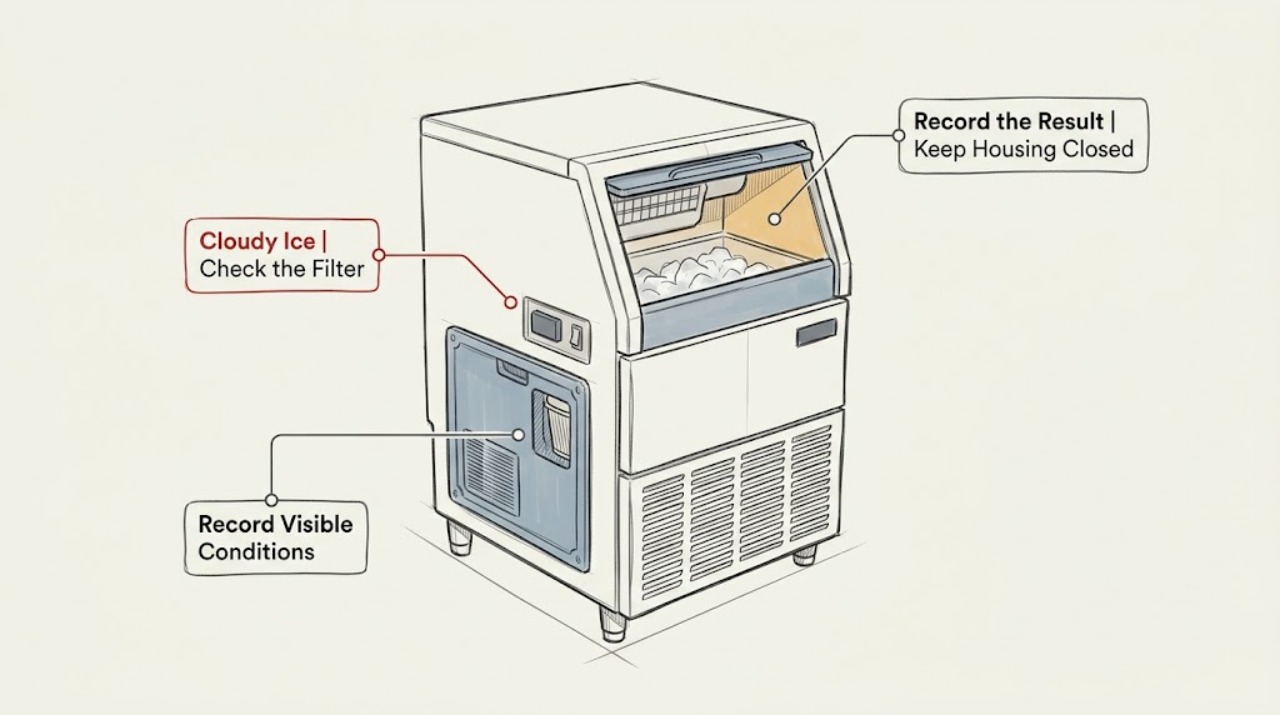
Cloudy ice from a KitchenAid KUIX535HPA00 undercounter ice maker does not by itself prove contamination or a failed part. First record whether the ice is uniformly cloudy, has white particles, or has an odor or taste, and whether it started after filter work. KitchenAid says air and excess carbon after a filter change can produce a cloudy appearance, while its water guidance says visible white particles can be minerals such as calcium carbonate. Confirm the exact model suffix and use its manual for the filter; complete the model-approved cleaning and rinse cycle with only the approved ice-maker cleaner. Do not mix chemicals, remove hoses, or promise perfectly clear ice. Stop serving ice and arrange service if odor, debris, leaking, low production, or persistent cloudiness remains after one correct filter or cleaning process.
Before you begin
Safety first
- Do not mix cleaning chemicals, use improvised acid or disinfectant, disconnect water lines, remove hoses, pull the built-in unit, enter service mode, open electrical panels, or replace a valve, pump, filter housing, or control from cloudy ice alone. Keep questionable ice out of service until the quality and leak concern is resolved.
Work through in order
Diagnostic checks
Use only checks that match the exact appliance or system and its official guide.
-
Check 1
With the ice maker idle and your hands dry, document when the cloudiness began, whether it affects the whole cube or appears as white particles, and whether there is an odor or taste. Note any recent filter change, first-use/installation event, cleaning cycle, reduced production, clumping, or visible leak without opening the water path.
Expected result: The ice is uniformly hazy and began after filter work; particles remain visible while melting; an odor or taste is present; or cloudiness occurs with low production, clumping, or water outside the machine.
Next step: If odor, unusual taste, visible debris, or a leak is present, stop serving the ice and isolate the appliance safely. Otherwise continue with exact model identification and the filter/cleaning branch that matches the observation.
Stop if: Do not taste questionable ice to test it, run the unit to reproduce a leak, or reach into the bin, drain, or water path while the appliance is operating.
Why this matters
Why: These patterns choose different next checks. Post-filter uniform cloudiness is compatible with trapped air or excess carbon, white particles are compatible with dissolved minerals, and odor/taste or a leak is not something to diagnose from appearance alone.
-
Check 2
Read the rating label and record the complete model, including the KUIX535HPA00 suffix, then retrieve the matching KitchenAid manual. Confirm that the appliance is the undercounter ice-maker platform rather than a refrigerator ice maker and do not copy a control sequence from another KitchenAid model.
Expected result: The label and manual confirm KUIX535HPA00, or only the KUIX535HPA family is confirmed and the final suffix or market remains unknown.
Next step: Use only instructions that the exact manual supports. If the suffix or manual cannot be confirmed, keep the advice to external observation and arrange model-specific support for any control, water-path, or internal work.
Stop if: Do not remove a panel or trim to find the label, pull the built-in unit out, or substitute refrigerator instructions for this undercounter machine.
Why this matters
Why: KitchenAid publishes separate refrigerator and freestanding/undercounter guidance. The opened specification and dimension documents support the KUIX535HPA family identity and installation context, but they do not prove every suffix-specific control step.
-
Check 3
If cloudiness began after a filter replacement, follow the exact KUIX535HPA00 filter instructions for ordinary user access and confirm the filter is the model-approved type, fully seated, locked, and not visibly leaking. Flush the water system only in the manner the matching manual specifies; do not disconnect tubing or improvise a bypass.
Expected result: Cloudiness diminishes after the documented flush, the filter was not fully locked, or the filter housing leaks or the cloudiness remains unchanged.
Next step: If the filter is visibly leaking or will not lock, stop using the ice maker and arrange service. If the flush improves the ice, monitor the next normal production period; if it does not, proceed to the approved cleaning branch rather than replacing an unverified part.
Stop if: Do not work on pressurized plumbing, remove the filter housing, or keep operating with a leak.
Why this matters
Why: KitchenAid says flushing removes excess air and carbon after filter replacement and links an improperly installed or clogged filter with poor water flow and ice quality. Improvement supports a filter-installation/air explanation; persistence does not prove an internal valve or control failure.
-
Check 4
For persistent cloudiness or a hard-water history, inspect the ice and accessible surfaces for a removable white scale film versus particles embedded in melting ice. Keep the unit closed and use only the current KUIX535HPA00 manual's approved cleaning method; do not infer water safety or diagnose a health issue from the appearance.
Expected result: A removable scale film or cleaning-needed indication is present, or particles continue despite a correctly installed filter and documented flush with no obvious machine leak.
Next step: Run the model-approved cleaning and rinse cycle once with the approved ice-maker cleaner, then reassess appearance and odor without promising clear ice. If particles persist or the source water is suspect, consult the water provider or a qualified technician rather than adding chemicals.
Stop if: Do not mix cleaners, add acid or bleach outside the exact documented sequence, scrape internal surfaces, remove hoses, or open the water circuit.
Why this matters
Why: KitchenAid states that minerals removed during freezing can form hard, scaly deposits and that hard water may require more frequent cleaning. Its separate water guidance describes white particles as commonly calcium carbonate, but that page is not a KUIX535HPA00-specific laboratory or health assessment.
-
Check 5
If the exact manual calls for the ice-maker cleaning cycle, turn the unit off as directed, remove accessible ice, drain the water pan only as the manual shows, and secure the drain cap before starting the cycle. Use one approved cleaner and allow the full clean/rinse process to finish; follow the manual and cleaner label for any repeat required by severe scale.
Expected result: The clean/rinse completes with no cleaner residue, or the cycle cannot start, leaves residue, produces a leak, or cloudiness and odor continue afterward.
Next step: If residue remains, follow the exact manual's fresh-cleaner repeat instruction only; otherwise stop serving ice and arrange KitchenAid or qualified appliance service for a persistent problem, leak, or inaccessible water-path issue.
Stop if: Do not combine cleaning products, run an unapproved chemical cycle, remove hoses, pull the built-in machine, or open electrical or water-line components.
Why this matters
Why: KitchenAid's cleaning guidance says mineral scale can require cleaning, describes a dedicated cycle and rinse, and warns that a loose drain cap can affect operation. Failure to complete the cycle or persistent quality change moves the issue beyond a simple appearance check.
-
Check 6
After the documented filter flush or clean/rinse is complete, record whether production, cube shape, clumping, odor, and cloudiness return to the prior baseline. Check only accessible ice-bin and drain-cap seating; do not enter a service mode or test an internal valve, pump, sensor, or control.
Expected result: Cloudiness improves and production is normal; cloudiness remains but there are no other symptoms; or quality changes remain accompanied by low production, clumping, odor, debris, or a leak.
Next step: Use the appropriate service boundary: consult the water provider for persistent source-water mineral or taste concerns, and arrange KitchenAid or qualified appliance service for leaks, low production, recurring odor, or a machine-side fault.
Stop if: Stop immediately for water near electrical parts, smoke, arcing, damaged wiring, repeated breaker trips, or a burning odor.
Why this matters
Why: Improvement after filter or cleaning work supports an air, carbon, mineral, or maintenance path. Persistent or combined symptoms do not identify a particular component from these sources and need model-specific diagnosis.
Use your observations
Decision map
Find the observation that best matches what you see, then follow the next safe action.
-
PATH 01Next step
What you see
Ice is evenly cloudy, there is no odor or visible debris, and the change started immediately after a filter replacement.
Do this next
Use the exact filter instructions and documented flush, then observe the next normal ice production. If the filter leaks or cloudiness persists, stop serving ice and obtain model-specific help.
Why this path and its safety boundary
Why it matters: KitchenAid's filter guidance makes trapped air or excess carbon a reasonable explanation; this pattern does not establish a failed ice-maker part.
-
PATH 02Next step
What you see
White particles or a scale film are visible, especially with hard-water history, and there was no recent filter change.
Do this next
Use only the approved KUIX535HPA00 cleaning/rinse process and filter guidance. If particles or taste persist, ask the water provider about source quality and use qualified appliance service for any machine-side symptom.
Why this path and its safety boundary
Why it matters: KitchenAid describes minerals in the source water, often calcium carbonate, and says hard water can create scaly deposits and increase cleaning frequency. This is not a health diagnosis.
-
PATH 03Next step
What you see
Cloudy ice also has an odor or taste, visible debris, or a leaking filter or water connection.
Do this next
Stop serving ice, isolate water or power only from a safe accessible control as needed, and arrange KitchenAid/appliance service; use a water-quality professional when the source water itself is in question.
Why this path and its safety boundary
Why it matters: Quality and leakage concerns cannot be cleared by appearance alone. A leak also creates an appliance and possible electrical hazard.
-
PATH 04Next step
What you see
Cloudiness remains after one correct filter flush and one manual-approved clean/rinse, or it is accompanied by low production, clumping, an unsecured drain cap, or recurring water outside the machine.
Do this next
Stop serving ice and book model-specific appliance service with the complete model, filter history, clean-cycle result, photos, and whether the water source is hard or softened. Do not pull out the built-in unit or open hidden plumbing.
Why this path and its safety boundary
Why it matters: The quality symptom is now persistent or combined with an operating fault. KitchenAid's public guidance does not support naming a valve, pump, sensor, or control from this pattern.
-
PATH 05Next step
What you see
The rating label, final suffix, market, filter arrangement, or cleaning sequence cannot be confirmed.
Do this next
Keep the ice maker out of service if quality or leakage is concerning, retrieve the exact manual, and use KitchenAid or qualified service for the unresolved identity.
Why this path and its safety boundary
Why it matters: The KUIX535HPA family evidence is not enough to migrate a button sequence, filter part, or water-line procedure to an unconfirmed variant.
Helpful context
Understand the symptom
Uniformly cloudy ice is a quality observation, not a diagnosis. The most useful first split is timing and appearance: cloudiness after a filter change can reflect air or excess carbon that has not been flushed, while discrete white particles that remain as ice melts fit KitchenAid's general mineral explanation. Odor or taste changes are a separate reason to stop serving the ice; do not infer that an appliance is safe or unsafe to consume from appearance alone.
The opened KitchenAid documents identify the KUIX535HPA family as a 15-inch undercounter, panel-ready clear-ice machine with a cleaning cycle, filter-ready water path, and built-in drain pump. They do not establish every control sequence for the KUIX535HPA00 suffix. Confirm the rating label and use that exact manual before following any filter, clean, or rinse instruction.
For a confirmed scale or maintenance concern, use the model-approved cleaning cycle and approved ice-maker cleaner exactly as KitchenAid describes. Do not mix products, use an improvised acid or disinfectant, disconnect water lines, or remove hoses. A correct cleaning and filter flush may improve the observation, but no source here supports a promise of perfectly transparent ice or a health conclusion.
When checks do not resolve it
Need a professional?
Call KitchenAid or qualified appliance service for leaks, persistent quality symptoms, combined low-production symptoms, inaccessible cleaning or drain work, or an unconfirmed KUIX535HPA00 procedure. Use a water-quality professional for a source-water question rather than treating cloudiness as a medical result.
Safety scope: Do not mix cleaning chemicals, use improvised acid or disinfectant, disconnect water lines, remove hoses, pull the built-in unit, enter service mode, open electrical panels, or replace a valve, pump, filter housing, or control from cloudy ice alone. Keep questionable ice out of service until the quality and leak concern is resolved.
Have this ready
- Provide the complete rating-label model and market, photos of the ice and any particles or leak, the date and type of filter work, whether the manual-approved flush and clean/rinse completed, odor or taste observations, production/clumping changes, and any cleaning indication.
Common questions
FAQ
Does cloudy ice mean the KitchenAid ice maker is contaminated?
No. Cloudiness alone is not a contamination or health diagnosis. KitchenAid says post-filter air or excess carbon can affect appearance, and its general water guidance says white particles can be dissolved minerals. Stop serving the ice for odor, taste, debris, or leakage and obtain the appropriate service or water-quality assessment.
Why did the ice become cloudy after I changed the filter?
KitchenAid recommends flushing after filter replacement because the water system can contain excess air and carbon; its guidance says these may cause cloudy water quality or small or hollow ice. Use the exact KUIX535HPA00 filter instructions and do not disconnect the water line.
Can I use vinegar, bleach, or another cleaner to make the ice clear?
Do not improvise a cleaner or mix products. KitchenAid's ice-maker guidance specifies an approved cleaner and a dedicated cleaning and rinse cycle; follow the exact model manual and cleaner label, and do not remove hoses. A cleaning cycle is not a promise of perfectly transparent ice.
Should I replace a valve or pump because the ice is cloudy?
Not from cloudiness alone. First separate filter-related air, mineral particles, odor or taste, and quality symptoms combined with low production or leakage. If the correct external checks and cleaning do not resolve the problem, give the complete model and observations to qualified service instead of choosing a part by symptom.
Read the exact guide
Official sources
- Particles in Water - Cloudy Water - Side by Side RefrigeratorKitchenAid Product Help · Opened KitchenAid water-quality page used only as a bounded explanation that visible white particles can be dissolved minerals, often calcium carbonate; it is not a KUIX535HPA00-specific health, laboratory, or repair diagnosis.
- KUIX535H Specification SheetKitchenAid · Opened KitchenAid feature sheet used to verify the KUIX535H family, panel-ready undercounter architecture, Clear Ice Technology, filter-ready design, self-cleaning cycle, and built-in drain pump; the final 00 suffix still requires rating-label confirmation.
- Thin, Cloudy or Clumpy Ice - Freestanding Ice MakerKitchenAid Product Help · Opened KitchenAid ice-quality page used for filter, drain-cap, cleaning, condenser, and room-condition context. It is a family-level freestanding page, not a claim that every control or component fits KUIX535HPA00.
- Changing the Water Filter - Freestanding Ice MakerKitchenAid Product Help · Opened KitchenAid filter page used only for ordinary filter seating, lock, replacement, and water-flow boundaries; exact filter compatibility must be checked against the KUIX535HPA00 manual.
- Undercounter Ice Maker Dimension GuideKitchenAid · Opened KitchenAid dimension guide used to corroborate the KUIX535HPA base family and undercounter installation context; it is not a cleaning or repair procedure for every suffix.
- everydrop Water Filter QuestionsKitchenAid Product Help · Opened KitchenAid filter FAQ used for the bounded explanation of post-filter air and excess carbon causing cloudy water quality or small/hollow ice; it is refrigerator filter guidance, not a suffix-specific KUIX535HPA00 control sequence.
- Cleaning the Ice MakerKitchenAid Product Help · Opened KitchenAid ice-maker cleaning guidance used for scale, cleaning-cycle, drain-cap, rinse, and hose-removal boundaries; exact controls remain model-specific.
Community feedback
Share a repair observation
Share a plain-text repair observation. Accepted observations are published automatically; this page may take a moment to update.