
On this page
Start here
Quick answer
KitchenAid lists the KSRG22FK family as a side-by-side refrigerator with a water line serving both the water dispenser and ice maker. First distinguish an empty ice-maker mold from a front dispenser that also has no water. For an ice maker that is not filling, confirm the refrigerator's water valve is fully open, the external line is not kinked, the freezer is set in KitchenAid's 0–5°F ice-production range, and the ice maker is on. If water flow changed after a filter replacement, make sure the filter is locked and sealed; KitchenAid says a filter-flow check with the filter removed can separate an installation restriction from a wider supply problem. If the front dispenser is also dry, check the dispenser lock, water selection and paddle engagement. Do not open the ice maker, jump a valve, probe wiring or order a valve from the symptom. If the line, filter, controls and temperature are correct but no water enters the mold, arrange KitchenAid service with the exact KSRG22FKBT15 model and the observed flow pattern.
Before you begin
Safety first
- Do not jump the inlet valve, probe live wiring, force the ice-maker mechanism, pierce a frozen fill tube, disconnect pressurized tubing, or order a valve, tube or ice-maker assembly from no water alone. Use the exact owner manual and qualified KitchenAid service for internal diagnosis.
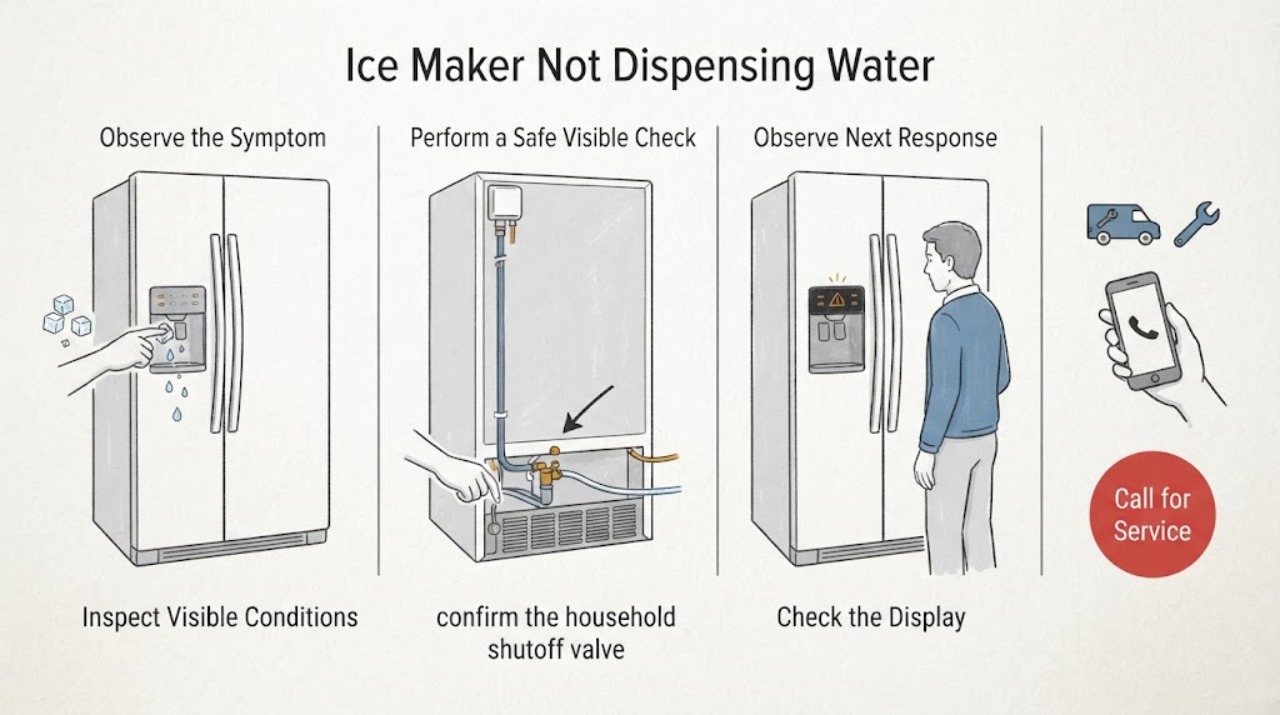
Work through in order
Diagnostic checks
Use only checks that match the exact appliance or system and its official guide.
-
Check 1
Look at the ice-maker mold and the front dispenser separately. Note whether the mold is empty, whether the water dispenser produces a normal stream, and whether the ice maker is switched on. Do not reach into the ice-maker mechanism or force its shutoff arm.
Expected result: The mold is empty but front water works, both ice and front water are dry, or the front dispenser works while the ice maker is off or not cycling.
Next step: Continue with the matching branch below and record the model KSRG22FKBT15. Use the exact owner manual for the ice-maker on/off control and any reset location.
Stop if: Stop if the ice maker is frozen into place, wiring is exposed, water is leaking into electrical areas, or the test would require opening the assembly.
Why this matters
Why: A working front dispenser makes a whole-house supply restriction less likely but does not prove the ice-maker fill valve or tube is good. No flow at both points supports checking shared supply, filter and controls first; a turned-off ice maker cannot fill.
-
Check 2
From behind the refrigerator without disconnecting tubing, confirm the household shutoff valve is fully open and the visible water line is connected, dry and free of kinks. Do not push the refrigerator farther back while the line is under tension.
Expected result: The valve is partly closed, the line is kinked or restricted, a connection leaks, or the external supply looks normal.
Next step: Fully open the valve or straighten only a clearly accessible soft line without tools, then allow the appliance to request water normally. For a leak, wet connection or damaged line, shut off the household supply and arrange qualified service or plumbing help.
Why this matters
Why: KitchenAid says a restricted or turned-off supply can prevent the ice maker from functioning and that a kink can reduce water flow. A normal external line does not rule out the filter, inlet valve, fill tube or ice-maker assembly.
-
Check 3
Read the freezer setting and verify the ice-maker control is ON using the exact owner manual. KitchenAid's general refrigerator guidance places optimal ice production at 0–5°F; do not repeatedly lower the setting or run a forced cycle to compensate for a warmer freezer.
Expected result: The freezer is warmer than the 0–5°F range, the ice maker is off, or both temperature and on/off state are appropriate.
Next step: Correct only the documented temperature or on/off setting and allow normal time for ice production. If the freezer is already in range and the ice maker is ON, continue with filter and dispenser observations.
Why this matters
Why: KitchenAid says freezer temperature and an accidentally turned-off ice maker can stop ice production. Correct temperature and an ON state move the check toward water supply, filter or service diagnosis; they do not prove that water should already be entering the mold.
-
Check 4
If the symptom began after a filter change or flow is slow, verify from the outside that the filter is the correct type, locked into its housing and sealed. KitchenAid's filter guidance allows a brief flow comparison with the filter removed only when the refrigerator's exact instructions support it; do not leave an unfiltered setup as a permanent repair.
Expected result: Water flow improves with the filter removed, the filter was not seated or sealed, or flow remains absent with the filter path checked.
Next step: Reinstall or replace the filter with the exact model-compatible instructions and flush as directed. If flow remains absent, stop changing parts and arrange KitchenAid service.
Stop if: Stop if the filter housing leaks, will not lock, or removal exposes a damaged fitting.
Why this matters
Why: A noticeable increase with the filter removed supports a clogged or incorrectly installed filter restriction. No improvement points toward supply, valve, tubing, fill tube or ice-maker diagnosis, not automatically a bad ice maker.
-
Check 5
If the front dispenser also does not dispense water, unlock the dispenser if needed, select water on the display when the model requires it, and press a sturdy glass firmly against the paddle or pad. Do not hold a finger or sharp object in the chute and do not use the dispenser as a valve test if water is leaking.
Expected result: The dispenser was locked, water was not selected, the glass did not engage the paddle, or the dispenser remains dry while the ice maker also lacks water.
Next step: Correct the visible control or engagement issue and retest once. If both points remain dry, keep the refrigerator connected only if there is no leak and arrange service for the water path.
Why this matters
Why: KitchenAid says the lock disables dispenser controls and that incomplete paddle engagement prevents ice or water dispensing. Continued no-flow at both points after these checks supports a shared supply/filter/service branch, not a confirmed ice-maker-only failure.
Use your observations
Decision map
Find the observation that best matches what you see, then follow the next safe action.
-
PATH 01Next step
What you see
The front dispenser produces water, the freezer is within KitchenAid's 0–5°F range and the ice maker is ON, but the ice mold remains empty.
Do this next
Use the exact model manual for one permitted reset if available, then arrange KitchenAid service if the mold still does not fill. Do not open or electrically test the ice maker.
Why this path and its safety boundary
Why it matters: Shared household supply and some filter flow are less likely, but the ice-maker fill valve, fill tube, wiring or ice-maker assembly has not been separated.
-
PATH 02Next step
What you see
Neither the front water dispenser nor the ice maker receives water, or the visible supply line is kinked or the household valve is closed.
Do this next
Open the valve or correct only a safe external kink, check filter seating, and arrange plumbing or KitchenAid service for leaks, damaged tubing or persistent no-flow.
Why this path and its safety boundary
Why it matters: KitchenAid's shared supply path, filter and external tubing checks take priority over an ice-maker component diagnosis.
-
PATH 03Next step
What you see
Water flow improves when the filter is removed, or the filter was just replaced and was not locked or sealed.
Do this next
Install the exact replacement filter according to the model instructions and flush the system. If the housing leaks or flow remains absent, stop and request service.
Why this path and its safety boundary
Why it matters: The filter installation or filter restriction is a supported explanation for reduced or stopped flow to both the ice maker and dispenser.
-
PATH 04Next step
What you see
The ice maker is OFF, the freezer is warmer than the supported range, or the dispenser is locked/not engaged.
Do this next
Correct only the visible setting or paddle engagement and allow normal operation. If the ice maker still does not fill after the exact manual's waiting period, arrange service.
Why this path and its safety boundary
Why it matters: A documented control, temperature or dispenser-engagement condition can explain the symptom without identifying a failed part.
Helpful context
Understand the symptom
Confirm which part is not dispensing
The assigned topic says the ice maker is not dispensing water, but this KSRG22FK family also has a through-the-door water dispenser. An empty ice-maker mold points to the ice-maker fill path, while a dry front dispenser adds a shared supply, filter or dispenser-control branch. The official KitchenAid pages support both observations without proving an internal valve or motor failure.
Check supply and filter before internal parts
KitchenAid identifies a closed or restricted water supply, kinked line, warm freezer, turned-off ice maker and filter installation or clog as common causes of no ice or slow water flow. These are external checks. They do not justify opening the ice maker, bypassing a valve or naming a replacement part.
A reset is conditional, not a diagnosis
KitchenAid says some ice makers can be reset with the model's reset control or, when no reset button exists, a one-minute power cycle. Reset only after supply, filter, temperature and on/off checks, and use the exact owner manual to locate any control. If water still does not reach the mold, service must distinguish the inlet valve, fill tube, wiring and ice-maker assembly.
When checks do not resolve it
Need a professional?
Arrange KitchenAid service when the external supply is open and sound, the filter is correctly seated, the freezer is in the ice-production range, the ice maker is ON, and the mold still does not receive water; also call for leaks, a damaged filter housing, a frozen or inaccessible fill tube, exposed wiring or a failed dispenser control.
Safety scope: Do not jump the inlet valve, probe live wiring, force the ice-maker mechanism, pierce a frozen fill tube, disconnect pressurized tubing, or order a valve, tube or ice-maker assembly from no water alone. Use the exact owner manual and qualified KitchenAid service for internal diagnosis.
Have this ready
- Provide the complete model KSRG22FKBT15, whether the front water dispenser works, freezer temperature, ice-maker ON/OFF state, filter replacement date and seating, supply-valve/line observations, any leak, and whether a model-approved reset was attempted.
Common questions
FAQ
Why is my KitchenAid KSRG22FKBT15 ice maker not getting water?
Start by separating an empty ice-maker mold from a dry front dispenser. Check that the water valve is open, the visible line is not kinked, the freezer is set for ice production, the ice maker is ON and the filter is locked and sealed. If the front dispenser works but the mold stays empty, the ice-maker fill path still needs model-specific service diagnosis.
Can a water filter stop the KitchenAid ice maker from filling?
Yes. KitchenAid says a clogged or incorrectly installed filter can reduce or stop flow to the ice maker and dispenser. If the exact refrigerator instructions permit a comparison with the filter removed and flow improves, reseat or replace the filter as directed; do not treat filter removal as a permanent solution.
What freezer temperature does KitchenAid recommend for ice production?
KitchenAid's general refrigerator ice-maker troubleshooting guide gives 0–5°F (-17 to -15°C) as the optimal freezer range. A warmer freezer can reduce or stop ice production, but a correct temperature does not prove that the water valve or fill tube is working.
Why does the water dispenser work while the ice maker stays empty?
The two functions share parts of the refrigerator's water supply but do not prove the same downstream path. If the dispenser works, continue with the ice-maker ON state, freezer temperature and exact manual reset guidance; persistent no-fill at the mold needs service to distinguish the ice-maker fill path from a valve, tube or control problem.
Should I replace the ice-maker water valve?
Not from no water alone. KitchenAid's public checks first cover supply, filter, freezer temperature, ice-maker state and dispenser controls. A valve, fill tube, wiring or ice-maker part requires model-specific diagnosis, so arrange service if those checks do not restore filling.
Read the exact guide
Official sources
- Side by Side Refrigerator Dimension GuideKitchenAid · Opened the official KitchenAid dimension guide listing KSRG22FK, the family prefix of assigned model KSRG22FKBT15. It confirms side-by-side refrigerator identity and that a cold water line serves both the water dispenser and ice maker; it does not establish the exact suffix's internal part layout.
- Ice Maker Not Working - TroubleshootingKitchenAid · Opened official KitchenAid refrigerator ice-maker guidance. It supports general full-size refrigerator checks for water supply, freezer temperature, ice-maker ON state, filter seating and filter flow; exact reset controls remain model-manual dependent and it does not diagnose a specific internal part for KSRG22FKBT15.
- Not Dispensing Ice or Water - RefrigeratorKitchenAid · Opened official KitchenAid side-by-side guidance. It supports the front-dispenser lock, selection, paddle, cold-water-line and filter branches; it is used to separate a dispenser symptom from an ice-maker fill symptom and does not identify an internal valve failure.
- Does the Water Filter Need to be Replaced?KitchenAid · Opened official KitchenAid filter guidance. It supports checking flow with the filter removed when the refrigerator has a water dispenser, interpreting a noticeable flow increase as filter restriction or installation, and flushing after replacement; it does not establish fitment for an unverified filter or an internal valve diagnosis.
Community feedback
Share a repair observation
Share a plain-text repair observation. Accepted observations are published automatically; this page may take a moment to update.