
On this page
Start here
Quick answer
KitchenAid KBFS20EVMS8 is a refrigerator model, with the ice maker as the affected subsystem. First separate two observations: cubes that eject soft or partly frozen, versus water that reaches the bin and forms a block or puddle. Check the freezer temperature using the exact model instructions, confirm the ice maker is enabled and the bin is seated, and inspect only the accessible water line, shutoff and filter for a restriction or leak. Keep the bin and chute level and clear of clumps. Do not jumper test terminals, defeat a drawer or door switch, open the ice-maker housing, or guess an inlet-valve or ice-maker replacement. If water is actively leaking, the freezer is not maintaining its documented temperature, or the symptom persists after the model-matched external checks and normal production interval, stop using the ice maker and arrange qualified service.
Work through in order
Diagnostic checks
Use only checks that match the exact appliance or system and its official guide.
-
Check 1
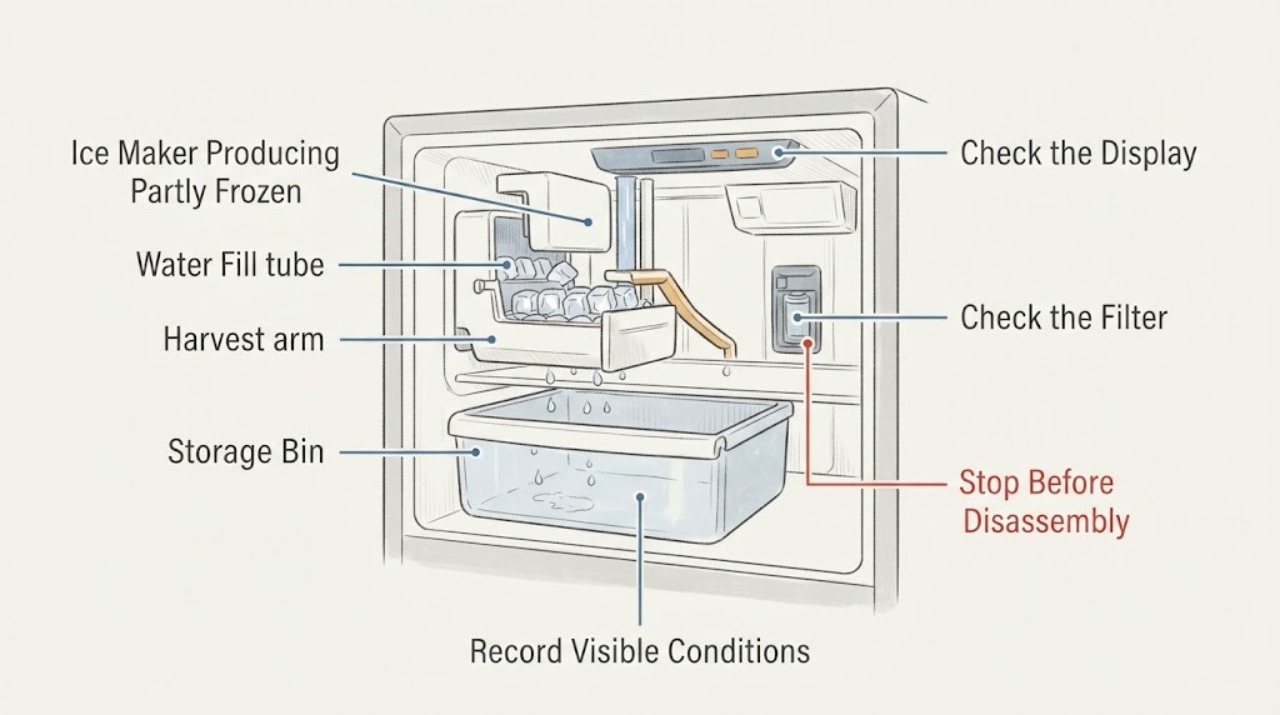
Empty or safely separate the ice bin and record what is actually happening: cubes are soft when ejected, water is visible in the bin, a single sheet or clump forms, or the bin is dry. Do not reach into a moving mechanism or use a sharp object to break ice.
Expected result: The bin contains a puddle or sheet of ice, or cubes are partly frozen before they reach the bin.
Next step: Continue with the external water, temperature, enabled-state and bin checks. Keep the ice maker off if water is actively leaking or the bin cannot be cleared safely.
Why this matters
Why: The symptom involves a fill/freezing/storage decision, but the observation does not identify an inlet valve, temperature sensor, mold heater or complete ice-maker failure.
-
Check 2
Check the freezer temperature display or setting against the exact KBFS20EVMS8 owner instructions, and verify that the freezer door or drawer closes fully and the bin is seated as the manual shows. Do not borrow a temperature threshold or reset sequence from another KitchenAid model.
Expected result: The freezer is outside the model's documented range, the door/drawer does not close, or the bin is mis-seated; otherwise the freezer and bin appear normal.
Next step: Correct only the accessible closure, bin or model-approved setting identified by the manual and allow the documented stabilization/production interval. Escalate a freezer that cannot hold temperature.
Why this matters
Why: A warm compartment or mis-seated bin can delay freezing or interfere with normal ice-maker operation; a normal external state does not rule in a particular internal component.
-
Check 3
Inspect the accessible water supply without disconnecting tubing: the shutoff should be fully open, the visible line should not be kinked or damaged, the filter should be installed as the exact manual specifies, and there should be no leak around the connection. If the refrigerator has a water dispenser, note whether it delivers water normally without dismantling anything.
Expected result: The valve is partly closed, the line is kinked, the filter is mis-seated/overdue, the dispenser flow is abnormal, or a connection leaks.
Next step: Restore only the accessible valve, line or filter condition permitted by the manual. Close the water shutoff for a leak and arrange qualified plumbing or appliance service if the restriction or leak remains.
Why this matters
Why: A restricted or leaking supply can change fill volume and ice formation, but these observations do not identify the specific internal water component.
-
Check 4
Confirm the ice maker is enabled and the storage bin/chute is correctly seated and free of an accessible clump. Use only the exact model instructions for any switch or arm; do not insert a jumper, hold a door switch closed, manually cycle the mechanism or open the housing.
Expected result: The ice maker is off, the bin is not seated, the chute is blocked by clumped ice, or the control position does not match the model manual.
Next step: Restore the model-approved control/bin position or clear only accessible ice with a safe plastic utensil as the manual allows. If the clump returns or the control is damaged, leave the ice maker off and arrange service.
Why this matters
Why: The automatic cycle may be disabled or physically obstructed, so partly frozen output cannot yet be used to diagnose an internal part.
-
Check 5
After the external conditions are correct, allow the model's documented production interval and observe the next normal batch without opening the mechanism. Keep the first batches separate as the owner's instructions require.
Expected result: The ice becomes normal after the interval, or it remains partly frozen/continues leaking into the bin despite correct external conditions.
Next step: If the symptom persists or water is leaking, stop using the ice maker and arrange model-specific service with the exact model, temperature observation, water-flow result and bin condition.
Why this matters
Why: Improvement supports a startup, water-flow or setup condition; persistence means the general checks did not resolve the symptom and still does not prove a particular part.
Use your observations
Decision map
Find the observation that best matches what you see, then follow the next safe action.
-
PATH 01Next step
What you see
The freezer temperature or door/drawer closure is outside the exact model's documented condition.
Do this next
Correct only the accessible setting or closure issue in the model manual and allow stabilization; obtain refrigerator service if temperature cannot be maintained.
Why this path and its safety boundary
Why it matters: The ice maker may not be reaching or retaining the conditions needed to freeze a complete batch.
-
PATH 02Next step
What you see
The valve is not fully open, the visible line is kinked, the filter is mis-seated, or the water connection leaks.
Do this next
Close the water shutoff for a leak, correct only the accessible condition allowed by the manual, and use qualified plumbing/appliance service if unresolved.
Why this path and its safety boundary
Why it matters: An external water-supply problem can change fill volume or create water in the bin, but it does not identify the internal failed component.
-
PATH 03Next step
What you see
The ice maker is enabled, the bin is seated, the freezer and supply pass external checks, and the first batches normalize after the documented interval.
Do this next
Continue normal use and monitor; do not apply a generic reset or replacement part.
Why this path and its safety boundary
Why it matters: The original symptom is more consistent with startup, setup or temporary water-flow conditions than a proven failed part.
-
PATH 04Next step
What you see
Water continues to leak, the ice maker remains partly freezing after the model-matched external checks, the bin/chute repeatedly freezes into a block, or visible housing/control damage is present.
Do this next
Turn the ice maker off using the exact model control, close the water shutoff for a leak, protect food and flooring, and arrange qualified service.
Why this path and its safety boundary
Why it matters: The problem needs model-specific diagnosis and continued operation could worsen a water or electrical issue.
Helpful context
Understand the symptom
The model in this task is a KitchenAid refrigerator, while “ice maker” identifies the subsystem being troubleshot. The exact Reddit lead describes KBFS20EVMS8 ice that appears not fully frozen or water dripping into the catcher and then clumping. That report does not prove a particular valve, thermostat, mold heater or ice-maker assembly. KitchenAid's official guidance supports external water, temperature, enable, filter, bin and level checks, while the exact owner's manual remains the authority for controls and configuration.
Partly frozen cubes and a puddle in the bin are different observations. A weak or interrupted freeze can leave soft cubes, while excess or misdirected fill water can freeze the bin into a block. Since the exact model support page was not accessible and the official family material warns that controls vary, this page avoids a reset sequence, jumper test or part diagnosis.
When checks do not resolve it
Need a professional?
Arrange service when water leaks, the freezer cannot maintain the model's documented temperature, partly frozen ice persists after the external setup and production interval, the bin repeatedly freezes into a block, or the ice-maker housing/control is damaged. Use qualified plumbing help for an unresolved external water-line leak or restriction.
Common questions
FAQ
Does partly frozen ice prove the KitchenAid ice-maker assembly is bad?
No. Separate soft cubes from water dripping into the bin, then check the exact model's temperature, enabled state, bin seating, visible supply line, shutoff and filter. Persistent symptoms after those checks require service, but they do not identify a particular part by themselves.
Can I manually cycle the ice maker or jumper its terminals to watch the fill?
Do not do that from this model-unspecified evidence. The exact model support path was not accessible, and a jumper or defeated door/drawer switch can create an electrical, mechanical or water hazard. Use the owner's instructions and qualified service instead.
What should I check if water freezes into a block in the bin?
Check the accessible bin/chute, freezer temperature, door or drawer closure, water shutoff, visible line and filter. If water continues to leak or the block returns after the model-matched checks, turn the ice maker off and arrange service rather than guessing a valve or heater.
How long should I wait after correcting an ice-maker setup issue?
Use the exact owner instructions for KBFS20EVMS8. The opened KitchenAid refrigerator instructions use a 24-hour first-batch and 72-hour full-production reference for the covered family, but do not treat those figures as permission to override a model-specific manual or continue operating with a leak.
Read the exact guide
Official sources
- Ice Maker Not Working - TroubleshootingKitchenAid Product Help · KitchenAid refrigerator family guidance used for external checks only; it does not assign a universal reset, temperature procedure or failed part to KBFS20EVMS8.
- Refrigerator Ice Maker TroubleshootingKitchenAid · KitchenAid refrigerator family article used for water, level, bin/chute and leak branches; it is not used to assign a specific KBFS20EVMS8 part or internal procedure.
- Refrigerator User InstructionsKitchenAid · Opened KitchenAid refrigerator-family instructions used for external supply, filter, enable-state and startup timing categories. The PDF is not presented as the exact KBFS20EVMS8 manual; the exact model's owner instructions control any model-specific control or procedure.
Community feedback
Share a repair observation
Share a plain-text repair observation. Accepted observations are published automatically; this page may take a moment to update.