
On this page
Start here
Quick answer
Do not treat E2 as a universal KitchenAid no-water code when the model is missing. An opened KitchenAid service sheet for one refrigerator ice-maker platform defines E2 as a motor-lost-position condition during harvest, while a dry-cycle/no-water condition is listed separately as E4 on that platform. First photograph the exact display and complete model number, then check the ice maker's on/off state, the freezer temperature, the household water supply, dispenser flow, filter installation, and only visible fill-tube ice. If the model cannot be matched, E2 returns, water leaks, or any test would require panels, live voltage, or a service mode, leave the ice maker off and arrange qualified service.
Before you begin
Safety first
- Do not open the ice maker or refrigerator panels, bypass a shutoff arm or door interlock, perform live voltage tests, disconnect pressurized tubing, chip or heat frozen fill parts, or work on refrigeration circuits. Stop for a leak, uncontrolled filling, water near electrical parts, smoke, sparking, burning odor, damaged cord, repeated breaker operation, or a stuck/grinding mechanism.
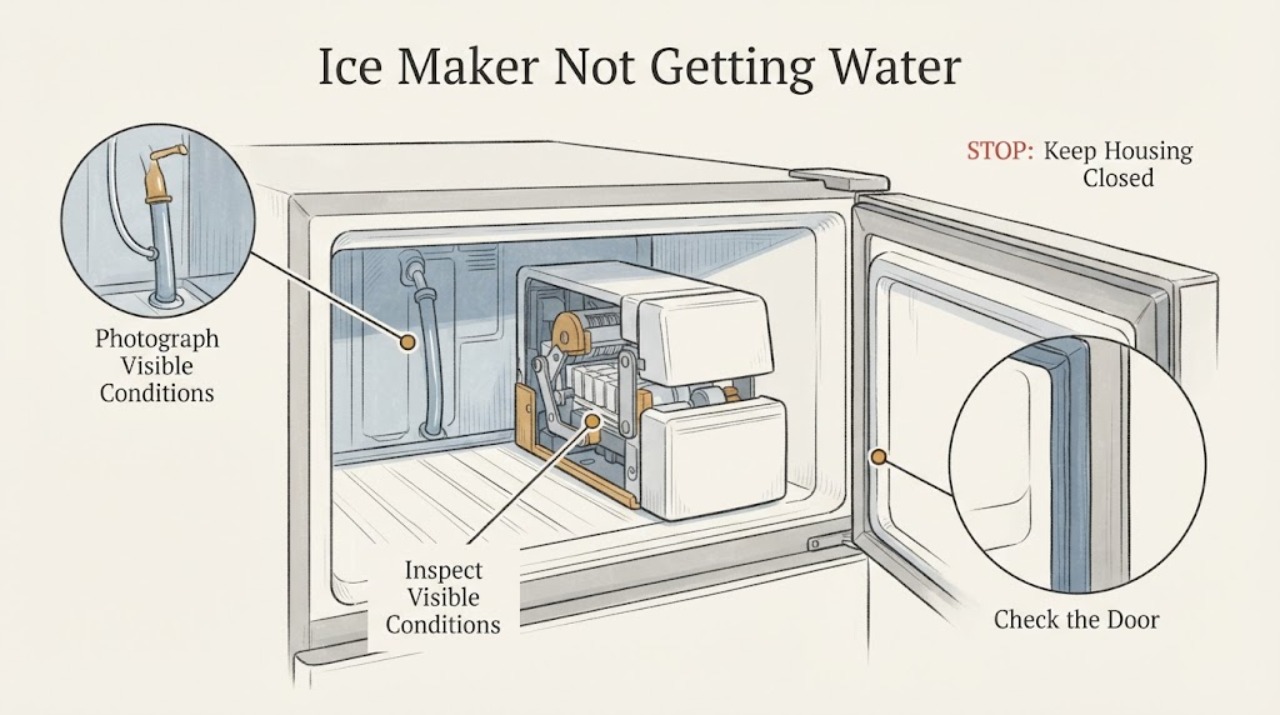
Work through in order
Diagnostic checks
Use only checks that match the exact appliance or system and its official guide.
-
Check 1
Photograph the complete model and serial label, the control panel, and the exact E2 display before resetting anything. For a refrigerator ice maker, look inside the refrigerator compartment at the model-label location; for a freestanding ice maker, check the area identified by KitchenAid. Record whether E2 came from a normal display or from a model-specific service test, and whether the symptom is no water, no ice, or both.
Expected result: A complete model is readable and the display context is known, or only a family name/partial label is available and the source of E2 is uncertain.
Next step: Use the complete model in KitchenAid's manuals and Product Help lookup. If it remains unavailable, continue only with the external symptom checks below and do not use a copied diagnostic sequence.
Stop if: Do not remove panels, enter technician diagnostics, or order a part from E2 alone.
Why this matters
Why: The model and display context determine which KitchenAid manual and code table apply. Without them, E2 cannot be safely assigned to the water inlet, motor, harvest mechanism, or another control.
-
Check 2
With the appliance closed and safe to approach, verify that the ice maker is enabled and not paused. If it uses a wire shutoff arm, observe whether the arm is down for on and up for off; if it uses a switch or digital setting, use only the control described for the matched model. Do not force the arm or reach into the mechanism.
Expected result: The ice maker is off/paused, the arm is raised, the control is obstructed, or the model-specific control appears enabled and unobstructed.
Next step: If the control was off, enable it using the matching manual and observe a normal cycle. If it was enabled or cannot be safely operated, continue to the water and temperature checks without forcing a reset.
Stop if: Do not bypass a shutoff arm, hold a switch closed, or use a service-mode harvest test without the exact manual.
Why this matters
Why: An off state can explain no ice without proving a water or E2 fault. A normal-looking control leaves water supply, temperature, fill, and harvest branches open.
-
Check 3
Check the freezer temperature setting and, if available, verify the compartment with an independent appliance thermometer placed where the model manual recommends. Keep the doors closed long enough to obtain a meaningful reading and note recent power loss, heavy loading, or a warm-freezer condition.
Expected result: The freezer is around KitchenAid's published 0°F (-18°C) target, materially warmer, or the actual temperature cannot be confirmed.
Next step: If warm, correct settings and airflow only as the exact manual permits and monitor temperature before interpreting E2. If temperature is appropriate and the maker remains dry, continue to the water-flow split.
Stop if: Do not remove evaporator covers, chip frost, use a heat source, or attempt refrigeration-system work.
Why this matters
Why: KitchenAid identifies freezer temperature as a key condition for ice production; a warm freezer can prevent water from becoming ice and can complicate interpretation of a reported code. Temperature alone does not prove a failed ice-maker motor or valve.
-
Check 4
From the front or another dry, accessible position, check that the household water supply is on, the visible line behind the appliance is connected and not kinked, and the dispenser produces water if the appliance has one. Note whether flow is normal, weak, or absent; do not pull the refrigerator out or disconnect a pressurized line.
Expected result: The dispenser has no flow, weak flow, or normal flow, and the visible supply line is kinked/blocked or appears correctly routed.
Next step: Correct only an obvious visible kink or closed shutoff from a dry position. If flow is absent or remains weak, use the exact model's water-supply/filter guidance or request service; if flow is normal, continue without assuming the ice-maker inlet is proven good.
Stop if: Do not disconnect tubing, test a valve with live voltage, or place water near the outlet or control wiring.
Why this matters
Why: No or weak dispenser flow makes a household supply, shutoff, visible line, or filter restriction more likely. Normal dispenser flow narrows the question toward the ice-maker fill path or its control, but does not identify a valve or motor.
-
Check 5
If the water filter was recently replaced or the model uses one, inspect only its visible seating and lock position. Use the matched KitchenAid instructions for removal or replacement; if the product documentation allows the manufacturer's filter-flow check, compare dispenser flow only as directed. Look at the exposed fill-cup or fill-tube area for loose ice, but do not probe, puncture, or heat it.
Expected result: The filter is not fully seated, flow changes only after the model-approved filter check, the visible fill area is iced, or no restriction is visible.
Next step: Reinstall or replace the filter only with the exact model-approved procedure. If visible ice is safely reachable, follow the exact manual's natural-defrost instruction; otherwise leave the maker off and arrange service. If no restriction is found, preserve the model, display context, temperature, and flow observations for diagnosis.
Stop if: Do not bypass the filter, use a hair dryer or heat gun, chip ice with a tool, or remove an ice-maker cover.
Why this matters
Why: KitchenAid says a wrongly installed or clogged filter can reduce or stop water flow, while a visible frozen fill tube can prevent filling on some platforms. Neither observation proves that this assigned E2 is a fill code, and an unseen restriction remains unresolved.
-
Check 6
Compare the recorded E2 with the exact model's manual or service documentation. On the opened W11203256C platform only, E2 is tied to a harvest motor losing its home position and E4 is the separate dry-cycle code; do not run that platform's service tests on an unidentified appliance. If E2 returns after the safe external checks, record whether the maker ever harvests, whether the dispenser remains normal, and whether any leak, grinding, or abnormal noise appears.
Expected result: The exact manual matches the code, the code cannot be found for the model, or the code returns with no water after identity, temperature, control, supply, and filter observations.
Next step: Arrange qualified KitchenAid appliance service with the complete model, display context, photos, temperature, dispenser flow, filter history, and visible fill-area observations. Keep the ice maker off if the code recurs or water behavior is abnormal.
Stop if: Do not perform live voltage tests, open the cabinet, bypass interlocks, or replace a component without model-specific confirmation.
Why this matters
Why: A matched code may point to a model-specific harvest/control branch rather than a water-supply branch. An unmatched or recurring code is an identity and service boundary, not evidence for replacing a guessed inlet valve, motor, or control board.
Use your observations
Decision map
Find the observation that best matches what you see, then follow the next safe action.
-
PATH 01Next step
What you see
The complete model is missing, E2 was not confirmed as an ice-maker diagnostic result, or the code table cannot be matched to the appliance.
Do this next
Photograph the label and display context, use KitchenAid's model lookup, and restrict the work to external symptom checks until the platform is identified. Arrange service if the model cannot be recovered.
Why this path and its safety boundary
Why it matters: The code identity gate has failed. KitchenAid documents model-specific controls and service information, and an E2 meaning from one platform cannot be generalized to every KitchenAid ice maker or refrigerator.
-
PATH 02Next step
What you see
The freezer is warm, the ice maker is off/paused, or the dispenser has weak/no flow with a closed, kinked, or restricted visible supply path.
Do this next
Correct only the documented user-level condition for the matched model, then observe temperature and water flow. Use service when the supply remains restricted or the ice maker stays dry after the external condition is corrected.
Why this path and its safety boundary
Why it matters: A temperature, control-state, household supply, filter, or visible-line condition is more likely than a proven harvest-motor failure; the E2 label alone cannot choose among them.
-
PATH 03Next step
What you see
The freezer is at the expected temperature, the ice maker is enabled, the dispenser has normal flow, and the ice maker remains dry or E2 returns.
Do this next
Stop DIY, provide the technician the full model and the recorded observations, and ask for the exact manual/service procedure rather than a part selected from a generic E2 list.
Why this path and its safety boundary
Why it matters: The remaining possibilities include the model-specific fill path, ice-maker control/harvest mechanism, or another internal fault. On the opened W11203256C sheet, E2 points to lost motor position while E4 is the dry-cycle code; that distinction requires the exact platform before diagnosis.
-
PATH 04Next step
What you see
There is an active leak, uncontrolled water entry, water near electrical parts, a damaged cord, smoke, burning odor, sparking, repeated breaker operation, grinding with a stuck mechanism, or a need to open panels or perform live tests.
Do this next
From a dry position, turn the ice maker off and close the appliance water shutoff if that can be done safely; keep clear of wet electrical areas and arrange qualified appliance service. Use emergency help for an active fire or immediate danger.
Why this path and its safety boundary
Why it matters: The situation has crossed the safe external-troubleshooting boundary and presents water, electrical, fire, or injury risk.
Helpful context
Understand the symptom
Why E2 cannot be read as a no-water diagnosis yet
The request identifies a KitchenAid ice maker and an E2 display but gives no refrigerator or freestanding-ice-maker model. KitchenAid's opened service sheet W11203256C shows that, on the platform covered by that sheet, Service Test 56 uses E2 for a motor that lost its home position during harvest; the same table gives E4 for a dry cycle and lists a possible valve or frozen fill tube. That difference matters: a report of no water does not prove that E2 is a fill fault, and a code table from another KitchenAid platform must not be copied. Confirm the model and whether E2 is an active ice-maker diagnostic result before selecting a repair path.
Use the water symptom to choose the next safe branch
Once identity is recorded, separate a water-supply problem from an ice-maker control or harvest problem. KitchenAid's refrigerator guidance names restricted water supply, freezer temperature, an ice maker that is turned off, and water-filter problems as common causes of no ice. A working dispenser does not by itself prove that the ice-maker fill path is healthy, and no dispenser flow does not identify a particular valve. These checks are meant to produce an observation for the exact manual or a service provider, not to justify replacing a part by the E2 label alone.
When checks do not resolve it
Need a professional?
Arrange qualified KitchenAid appliance service when the complete model cannot be identified, E2 cannot be matched to the exact manual, the ice maker remains dry after the safe external supply/filter/temperature checks, E2 returns, the dispenser is normal but the maker does not fill, or the suspected issue requires a valve, motor, control, wiring, or cabinet access.
Safety scope: Do not open the ice maker or refrigerator panels, bypass a shutoff arm or door interlock, perform live voltage tests, disconnect pressurized tubing, chip or heat frozen fill parts, or work on refrigeration circuits. Stop for a leak, uncontrolled filling, water near electrical parts, smoke, sparking, burning odor, damaged cord, repeated breaker operation, or a stuck/grinding mechanism.
Have this ready
- Provide the complete model and serial information, photos of the label and display, whether E2 came from a normal display or service test, freezer temperature and how it was measured, ice-maker on/off state, dispenser flow, supply-line observations, filter replacement history, visible fill-area ice, leak/noise history, and the exact steps already taken.
Common questions
FAQ
Does KitchenAid E2 mean the ice maker is not getting water?
Not safely without the model. The opened KitchenAid W11203256C service sheet uses E2 for a motor that lost its home position during harvest and lists E4 separately for a dry cycle with a possible valve or frozen fill tube. Confirm the exact model and display context before assigning a meaning.
What should I check first when the ice maker is dry?
Record the full model and exact display, then check that the ice maker is on, the freezer is at the model's required temperature, the household water supply is open and visible tubing is not kinked, the dispenser has flow if fitted, and the filter is correctly seated. These observations separate supply and setup problems from an internal ice-maker branch.
Can I use an E2 reset or diagnostic sequence found online?
Not from a missing model. KitchenAid's ice-maker controls and manuals vary, and the opened service sheet labels its diagnostic tests for the platform it covers. Use only the exact model's user documentation; do not run technician tests, bypass controls, or perform live measurements.
If the dispenser works, does that prove the ice-maker water valve is good?
No. Normal dispenser flow shows that some water path is available, but it does not prove that the ice-maker fill path, control, or harvest sequence is operating. If the freezer is cold and the maker remains dry, preserve the observations and arrange model-specific service rather than ordering a valve by symptom.
Read the exact guide
Official sources
- Tech Sheet W11203256C - Service Test Ice Maker Error CodesKitchenAid · Opened KitchenAid service sheet for one refrigerator ice-maker platform; Service Test 56 lists E2 as motor lost position and E4 as dry cycle with possible valve or frozen fill tube. The assigned topic has no model, so this source is used to establish platform-specific code identity and not a universal KitchenAid E2 definition.
- Refrigerator Ice Maker Troubleshooting | KitchenAidKitchenAid · Official KitchenAid refrigerator ice-maker guidance used only for symptom-level checks because the assigned model is missing; it does not supply a universal E2 code meaning.
- Locate Model Number | KitchenAidKitchenAid · Official KitchenAid label-location guide used to obtain the missing identity before interpreting E2; it does not establish a code meaning.
- Kitchen Appliance Manuals | KitchenAidKitchenAid · Official KitchenAid manuals portal used as the identity gate for the missing-model ice-maker topic; it supports matching the exact documentation, not a universal E2 interpretation.
- How to Turn the Ice Maker On and Off - Product Help | KitchenAidKitchenAid Product Help · Official KitchenAid guidance used to verify that ice-maker controls vary by model and to support a visual on/off check; it is not used to select an E2 diagnostic sequence.
- Ice Maker Not Working - Troubleshooting - Product Help | KitchenAidKitchenAid Product Help · Official KitchenAid refrigerator Product Help used for external checks only; exact reset/control access remains model-specific and no code meaning is generalized to the missing-model topic.
Community feedback
Share a repair observation
Share a plain-text repair observation. Accepted observations are published automatically; this page may take a moment to update.