
On this page
Start here
Quick answer
A KitchenAid ice maker that powers up after a reset and then stops needs its exact appliance type and model manual before any further reset or part diagnosis. KitchenAid says ice-maker controls vary by refrigerator model, and an ice maker left on without a water supply can buzz or cause other temperature problems. First identify whether this is a refrigerator ice maker or a freestanding/undercounter unit, confirm the control is ON, confirm water is connected and open, and check only the external drain/power conditions that apply to a freestanding unit. For a refrigerator, use the exact model guide for freezer temperature, filter and reset steps. If the unit still shuts off after about a minute, the control will not remain ON, the breaker/GFCI trips, there is a leak or burning odor, or internal access is needed, stop resetting it and arrange KitchenAid-qualified service.
Before you begin
Safety first
- Do not bypass an automatic shutoff or sensor, force a harvest cycle, remove an ice-maker module, open electrical panels, probe live wiring, pull a built-in unit without the installation procedure, or choose an internal part from this symptom alone.
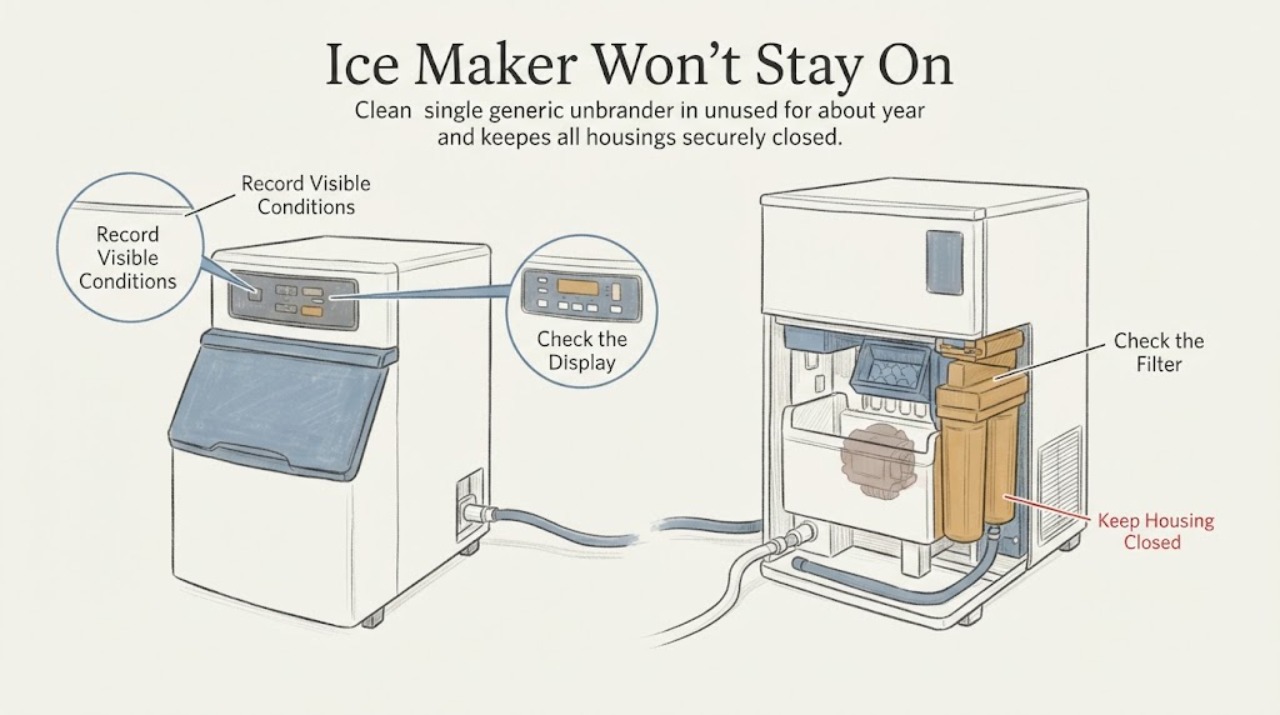
Work through in order
Diagnostic checks
Use only checks that match the exact appliance or system and its official guide.
-
Check 1
Read the appliance rating label and record the full KitchenAid model. Determine whether the ice maker is in a refrigerator/freezer or is a freestanding or undercounter unit, and locate the normal ON control without removing panels or covers.
Expected result: The unit is clearly a refrigerator ice maker, clearly freestanding/undercounter, or the type/model cannot be confirmed.
Next step: Use the exact model manual for the identified type. If the label is missing or unreadable, stop at external identification and provide the appliance details to KitchenAid service rather than borrowing a neighboring model's diagnostic steps.
Why this matters
Why: KitchenAid uses different control, temperature, water and drain guidance for refrigerator and freestanding ice makers. An unidentified type prevents a safe model-specific reset or part conclusion.
-
Check 2
With the unit safe and accessible, confirm the water supply is connected and open and that the model-specific ice-maker control remains in the ON position. If the exact manual supports a reset or one-minute power cycle, perform it once using the normal control or plug only; do not repeatedly reset a unit that shuts off.
Expected result: The water supply was off/disconnected, the control was OFF, the control remains ON after the documented reset, or the machine powers up for about a minute and then turns off again.
Next step: Correct only the clearly identified water/control condition and observe one normal operating period. If the control will not remain ON or the unit stops again, stop resetting it and arrange model-specific service.
Stop if: Do not leave an ice maker running without a confirmed water connection, bypass its shutoff, or continue if water leaks or the appliance becomes hot or noisy.
Why this matters
Why: KitchenAid identifies an accidentally OFF ice maker and missing water supply as common causes of no ice. A repeatable post-reset shutdown is outside what the general support page can diagnose and does not prove a particular internal part.
-
Check 3
Only if the appliance is a refrigerator ice maker, check the freezer temperature setting and visible water/filter conditions using the exact refrigerator manual. Confirm the water line is not visibly kinked and that a recently installed filter is locked and sealed; do not remove an ice-maker module or test live wiring.
Expected result: The freezer is warmer than the model's specified range, water flow is restricted, the filter is not seated, or these refrigerator conditions are correct.
Next step: Correct only the external setting, visible line position or exact filter installation allowed by the manual, then allow the documented ice-production interval. If the control still shuts off, use service rather than installing a guessed component.
Why this matters
Why: KitchenAid says freezer temperature, restricted water supply, ON state and filter installation can affect ice production. These checks do not explain a control that physically turns itself OFF and do not identify a valve, sensor or board fault.
-
Check 4
Only if the appliance is a freestanding or undercounter ice maker, inspect the visible drain hose for a kink, confirm the unit's water supply is fully open, and verify the cord is in the correct grounded outlet without an extension cord. Do not slide a built-in unit out or disconnect plumbing unless the exact installation guide permits it and the area is dry and safe.
Expected result: The drain hose is kinked or incorrectly routed, water is not fully open, the outlet/GFCI is off, or these external conditions are correct.
Next step: Correct only an obvious external kink, supply or outlet condition and observe one normal cycle. If the ice maker still turns off, keep it out of service and arrange qualified service; do not open panels or test the pump, control or wiring.
Stop if: Stop if the floor is wet, the cord or outlet is damaged, the unit must be pulled from a cabinet, or water reaches electrical components.
Why this matters
Why: KitchenAid's freestanding guidance links drain and supply restrictions with low/no ice and intermittent power, and identifies outlet/GFCI conditions as power checks. A correct external path with repeated shutdown still needs diagnosis.
-
Check 5
Document the model, appliance type, time since reset, ON-control behavior, water and drain observations, freezer setting if applicable, filter history, outlet/GFCI behavior and any sound, leak or odor. Arrange KitchenAid-qualified service if the ice maker repeatedly shuts off after reset or if any internal access, live electrical test, refrigeration or pump work would be required.
Expected result: The unit resumes a normal cycle after one documented external correction, or it still stops after about a minute or shows a hazard.
Next step: For persistent shutdown or any hazard, leave the unit off and give the technician the recorded pattern and exact model. Do not bypass a shutoff, repeatedly reset a breaker/GFCI, force a harvest cycle, or order a motor, valve, sensor or board by symptom alone.
Stop if: Stop immediately for burning odor, smoke, sparking, exposed wiring, repeated breaker/GFCI trips, water near power, damaged cord or an abnormal hot motor/compressor sound.
Why this matters
Why: A restored cycle supports the corrected external condition but does not certify internal components. A repeatable shutdown after the safe checks is not safely narrowed by the generic KitchenAid pages.
Use your observations
Decision map
Find the observation that best matches what you see, then follow the next safe action.
-
PATH 01Next step
What you see
The unit is a refrigerator ice maker, the water is connected, the ON control remains ON and the freezer/filter checks match the exact manual.
Do this next
Arrange KitchenAid-qualified service and provide the model, reset timing and control behavior. Do not remove the module or test live wiring.
Why this path and its safety boundary
Why it matters: The common external causes in KitchenAid's refrigerator guide have not explained a control that shuts off after reset.
-
PATH 02Next step
What you see
The unit is freestanding/undercounter and a visible kinked drain hose, closed water supply or outlet/GFCI condition is found.
Do this next
Correct only the accessible condition allowed by the installation guide, then observe one normal cycle. Escalate if the unit still powers down.
Why this path and its safety boundary
Why it matters: KitchenAid identifies these external conditions as possible causes of no or intermittent operation in a freestanding ice maker.
-
PATH 03Next step
What you see
The ice maker powers for about a minute after reset and then turns off again despite correct water, ON-state and type-specific external checks.
Do this next
Stop repeated resets and arrange model-specific appliance service. Provide the exact model and timing; do not bypass automatic shutoff or install a part based on the symptom.
Why this path and its safety boundary
Why it matters: The repeatable shutdown is not distinguished by the public general guidance and does not prove a control, motor, valve or sensor failure.
-
PATH 04Next step
What you see
There is a leak, burning smell, sparking, damaged cord, repeated breaker/GFCI trip or water near the outlet.
Do this next
Stop using the appliance, keep clear of wet or damaged equipment, and arrange qualified appliance/electrical service; use emergency help for active fire or immediate danger.
Why this path and its safety boundary
Why it matters: The condition is an electrical or water safety issue rather than a normal ice-maker reset problem.
Helpful context
Understand the symptom
Identify the ice-maker type before repeating a reset
The task does not provide a model number or say whether the KitchenAid ice maker is inside a refrigerator, undercounter, or freestanding cabinet. KitchenAid states that control locations and ON/OFF methods vary by refrigerator model and directs owners to the model-specific manual. A reset that wakes the machine briefly is an observation, not proof of a failed board, motor, valve or sensor. Record the rating-label model and appliance type before using a diagnostic or ordering a part.
Long non-use changes the first checks, not the repair boundary
KitchenAid lists extended vacation and cleaning as reasons to turn an ice maker off, and warns that leaving an ice maker on without a water supply can cause buzzing and other temperature effects. Confirm that water is connected and fully open before leaving the control ON. A year of non-use does not establish that a filter, pump, valve or control has failed, and the accessible checks differ between refrigerator and freestanding units.
Use the correct refrigerator or freestanding branch
For a refrigerator ice maker, KitchenAid's opened guide points to water supply, freezer temperature, ON state and filter installation. For a freestanding ice maker, KitchenAid separately identifies a kinked drain hose, incorrect drain routing, outlet/GFCI and water-supply conditions as possible causes of low, absent or intermittent operation. Do not apply a freezer-temperature check to an undercounter unit or a freestanding drain specification to an unidentified refrigerator.
When checks do not resolve it
Need a professional?
Arrange KitchenAid-qualified service when the ice maker repeatedly shuts off after a documented reset, the exact model/type cannot be matched to a manual, the unit remains without ice after external water/control/type checks, or internal electrical, pump, valve, sensor or refrigeration work would be needed.
Safety scope: Do not bypass an automatic shutoff or sensor, force a harvest cycle, remove an ice-maker module, open electrical panels, probe live wiring, pull a built-in unit without the installation procedure, or choose an internal part from this symptom alone.
Have this ready
- Provide the full model, refrigerator versus freestanding/undercounter type, time unused, reset method, time until shutdown, ON-control behavior, water/filter/drain observations, freezer temperature if applicable, outlet/GFCI behavior and any leak, sound or odor.
Common questions
FAQ
Can leaving a KitchenAid ice maker off for a year cause it to shut down after reset?
The year of non-use is useful history, but it does not identify a failed part. KitchenAid recommends turning an ice maker off during extended vacation or cleaning and says the exact ON/OFF method varies by model. Confirm the water connection, type and exact manual before service diagnosis.
How long should I wait after resetting the ice maker?
KitchenAid's refrigerator guidance says to wait a couple of hours after a reset and check for ice production. The exact interval and control behavior depend on the model; a unit that powers up for about a minute and shuts off repeatedly should not be reset over and over.
Does a reset prove the ice-maker control board is bad if it shuts off again?
No. KitchenAid's public guidance does not identify a board, motor, valve or sensor from this symptom. Check only the applicable water, ON-state, filter/freezer or freestanding drain/power conditions, then arrange model-specific service if shutdown repeats.
Can I leave the ice maker ON without water while testing it?
KitchenAid says an ice maker that is ON without a water supply can buzz and cause other temperature problems. Confirm the water connection and supply before leaving the control ON.
What information should I give service?
Give the complete model, appliance type, time unused, reset method, time until shutdown, water/filter/drain observations, freezer temperature if applicable, outlet/GFCI behavior and any leak, odor, noise or display change. Do not request a part by symptom alone.
Read the exact guide
Official sources
- How to Turn the Ice Maker On and OffKitchenAid Product Help · Opened official KitchenAid refrigerator guidance. It explicitly says control methods vary by model, so it supports type/model identification, water-supply and reset boundaries rather than a universal button sequence or internal diagnosis.
- Not Powering On - Freestanding Ice MakerKitchenAid Product Help · Opened official KitchenAid freestanding ice-maker guidance. It is used only for the conditional freestanding/undercounter branch and does not establish that the assigned appliance has any specific drain, pump or electrical configuration.
- Ice Maker Not Working - TroubleshootingKitchenAid Product Help · Opened official KitchenAid refrigerator ice-maker troubleshooting. It applies to refrigerator ice makers, not automatically to a freestanding/undercounter unit; its checks are presented as a conditional refrigerator branch.
Community feedback
Share a repair observation
Share a plain-text repair observation. Accepted observations are published automatically; this page may take a moment to update.