
On this page
Start here
Quick answer
For the KitchenAid KUID508HPS00, first distinguish the normal brief water-reservoir overflow or rinse behavior from water that keeps entering, escapes the unit, or leaves the bin or floor wet. KitchenAid says reservoir overflow can purge minerals and that continuous water can occur during the initial rinse; those descriptions do not cover uncontrolled flooding. Turn the ice maker off and close its water supply from a dry, safe position if water continues or reaches electrical parts. Without opening panels, check the visible drain cap, drain hose, supply-line connections, clamps, level and—only if the complaint is too much ice rather than too much water—the bin sensor. Do not adjust an internal valve or sensor, run repeated fill tests, or assume a water-pressure reading proves a failed part. Keep it off and arrange KitchenAid service or a qualified plumber when water continues, the leak source is unclear, or an installation/drain problem remains.
Before you begin
Safety first
- Do not run repeated fill tests, open panels, alter an internal valve or sensor, bypass a control, pull the unit from cabinetry in a wet area, or change water pressure as a DIY diagnosis. Isolate water or power only from a dry, safe position.
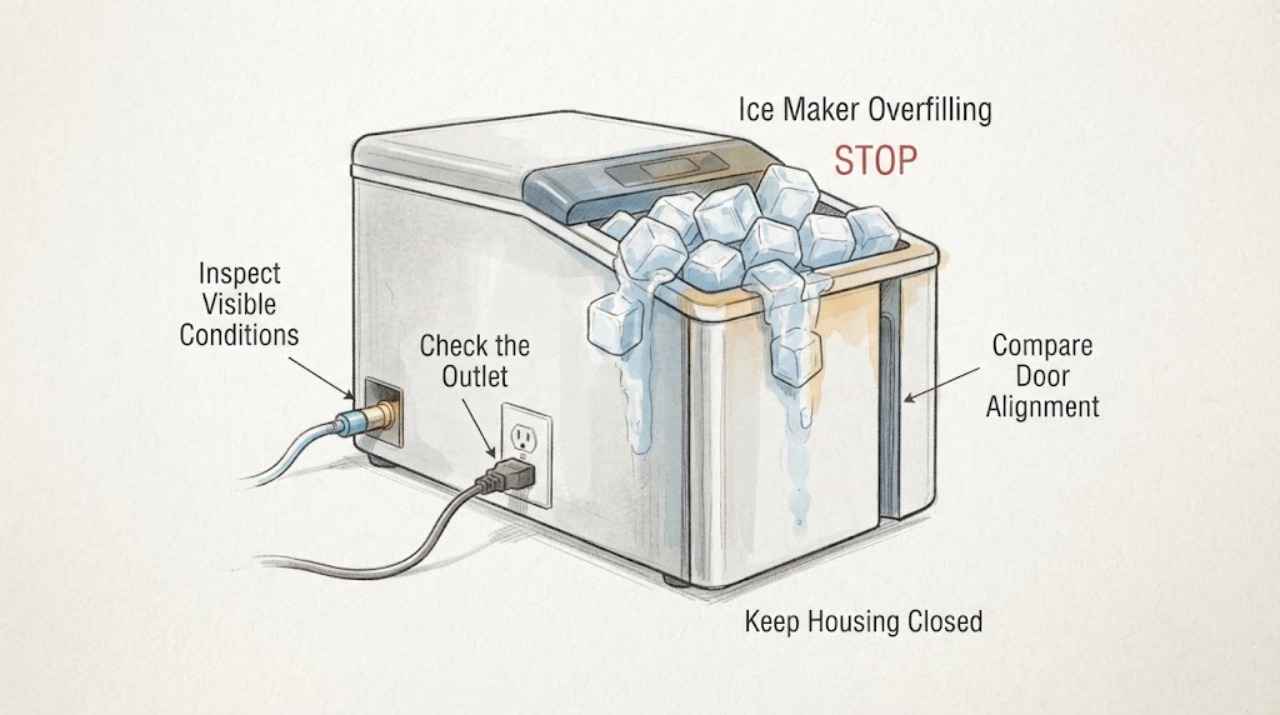
Work through in order
Diagnostic checks
Use only checks that match the exact appliance or system and its official guide.
-
Check 1
Observe the water without restarting the ice maker: note whether it is a brief, contained reservoir overflow or initial rinse, or whether water keeps entering, escapes the unit, reaches the floor, or remains after the expected behavior ends.
Expected result: The water is brief and contained, or it continues/escapes beyond the reservoir or leaves the unit wet.
Next step: If water continues or escapes, turn the ice maker off and close the water supply from a dry, safe position, then keep it off for the external checks and service branch. Do not run another fill cycle to reproduce it.
Why this matters
Why: KitchenAid describes reservoir overflow as a normal mineral-purging behavior and continuous water at first start as a rinse; continuing external water is a different symptom that the cited normal-operation description does not explain.
-
Check 2
If water has reached the floor, outlet, cord or other electrical area, stop the ice maker and isolate water or power only from a dry, safe position. Do not touch wet electrical equipment, remove panels or reach behind the unit to search for a valve fault.
Expected result: The area is dry and the shutoff and plug are safely reachable, or water has reached electrical equipment or safe isolation is not possible.
Next step: If safe, leave the ice maker off with the water supply closed. If not safe, stay clear and call qualified appliance service, a plumber or an electrician as appropriate.
Why this matters
Why: A wet or inaccessible electrical area is a safety boundary, not an invitation to perform a live or internal check.
-
Check 3
With the unit off and viewed from a safe position, inspect the visible water-pan drain cap, the drain hose route and its alignment, the household supply-line connections, and accessible hose clamps. Do not pull the ice maker out of cabinetry or loosen a pressurized connection just to inspect it.
Expected result: The drain cap is visibly loose, the hose is kinked or misaligned, a connection or clamp is wet, the supply line is damaged, or no visible issue is found.
Next step: Document the visible condition and use the model's installation instructions or qualified service for correction. If the source is unclear or water continues, leave the unit off rather than replacing a valve or pump based on the symptom.
Why this matters
Why: KitchenAid identifies a loose drain cap, drain alignment, loose clamps, connection leaks and damaged supply lines as external leak or drainage leads; a clear exterior does not rule out an internal fill fault.
-
Check 4
If the actual complaint is an overfilled ice bin rather than water in the reservoir or on the floor, check from the bin opening that the unit is level and that the ice-level sensor is not blocked by the scoop, ice or mineral buildup. Clean only the accessible sensor surface as KitchenAid describes; do not open the cabinet.
Expected result: The bin sensor is blocked or dirty, the unit is visibly out of level, or the bin sensor and level appear clear.
Next step: Remove only the visible obstruction and arrange model-appropriate leveling if safe. If the bin still overfills, or the symptom is actually water overflow, keep the ice maker off and request service instead of adjusting an internal sensor.
Why this matters
Why: KitchenAid's too-much-ice guidance links level and a blocked or dirty bin sensor to ice-production control. That evidence applies to excess ice in the bin, not to water continuing to enter the water pan.
-
Check 5
Record the exact KUID508HPS00 model suffix, the water location, whether the event occurred during first start or a later cycle, whether water stopped after the control was turned off, and any visible drain or supply condition. Give those observations to KitchenAid service or a qualified plumber.
Expected result: Water continues, the source is internal or unclear, the symptom returns after a visible installation correction, or the bin-sensor branch does not resolve excess ice.
Next step: Leave the ice maker off until qualified service has assessed it. Do not buy a replacement part, alter water pressure, bypass a sensor or run repeated fill tests from the symptom alone.
Why this matters
Why: The remaining possibilities are model- and installation-specific; the official public pages do not establish an inlet valve, sensor, control or pump diagnosis for this exact suffix.
Use your observations
Decision map
Find the observation that best matches what you see, then follow the next safe action.
-
PATH 01Next step
What you see
Water briefly overflows within the reservoir during the documented initial rinse or contained mineral-purging behavior, then stops without wetting the floor or cabinet.
Do this next
Do not repeatedly restart the unit to test it; monitor for recurrence and use the exact model documentation if the water escapes or persists.
Why this path and its safety boundary
Why it matters: That limited pattern matches KitchenAid's normal-operation description more closely than an uncontrolled fill fault.
-
PATH 02Next step
What you see
Water is outside the reservoir, remains on the floor, or is traced to a wet connection, clamp, drain-hose route or damaged supply line.
Do this next
Turn the unit off, close the water supply if safe, document the location and arrange qualified appliance or plumbing service.
Why this path and its safety boundary
Why it matters: The symptom is an external leak or drainage lead, and KitchenAid's public guidance does not make it safe to infer a failed internal valve or pump.
-
PATH 03Next step
What you see
The water pan is not overflowing, but the ice storage bin itself is filling beyond the expected level and the sensor is blocked, dirty or the unit is out of level.
Do this next
Clear only the visible obstruction and address safe leveling; if excess ice returns, keep the unit off and request service without opening the cabinet.
Why this path and its safety boundary
Why it matters: This matches KitchenAid's separate too-much-ice checks rather than a proven water-fill problem.
-
PATH 04Next step
What you see
Water keeps entering after the documented rinse, no visible drain or supply issue explains it, or water reaches electrical areas.
Do this next
Keep the ice maker off, isolate water or power only when safe, and contact KitchenAid service or a qualified plumber/electrician. Do not perform internal diagnosis or repeated fill tests.
Why this path and its safety boundary
Why it matters: The cause is unresolved and could be model-specific; no internal component is established by the public evidence opened for KUID508HPS00.
Helpful context
Understand the symptom
Confirm what “overfilling” means
KitchenAid's freestanding-ice-maker guidance says water in the reservoir can overflow as part of purging minerals, and that the first start can include a rinse with continuous water. A short, contained overflow during that documented behavior is different from water continuing after the rinse, escaping onto the floor, or filling the bin area unexpectedly. Note where the water is seen and whether it stops without repeatedly restarting the machine.
Use only visible drain and supply checks
KitchenAid's leak guidance points to supply-line connection points, clamps, the drain hose's alignment, a cracked supply line and the unit's level. Its cleaning guidance also says a loose water-pan drain cap can let water escape from the pan. These checks can identify an installation or visible leak lead; they do not prove that an inlet valve, level sensor or control has failed.
Do not confuse water overfill with too much ice
If the actual complaint is that the ice bin contains too much ice rather than that water is overflowing, KitchenAid directs owners to check that the unit is level and that the bin sensor is not blocked or dirty. That guidance is a separate ice-level branch. It does not establish a water-filling fault or authorize opening the cabinet to replace a sensor or valve.
When checks do not resolve it
Need a professional?
Arrange KitchenAid or qualified service when water continues after the documented rinse, escapes the reservoir, reaches electrical areas, returns after a visible drain or supply correction, or the ice bin remains overfilled after the accessible level/sensor checks. Use a qualified plumber for a water-supply or pressure concern.
Safety scope: Do not run repeated fill tests, open panels, alter an internal valve or sensor, bypass a control, pull the unit from cabinetry in a wet area, or change water pressure as a DIY diagnosis. Isolate water or power only from a dry, safe position.
Have this ready
- Provide KUID508HPS00, the location and duration of water, whether this was first start or a later cycle, whether the water stopped when the control was turned off, visible drain/supply conditions, and whether the bin—not the reservoir—was overfilled.
Common questions
FAQ
Is any water overflow from a KitchenAid freestanding ice maker a failure?
No. KitchenAid says a reservoir overflow can be part of mineral purging, and continuous water during the first rinse can be normal. Water that continues after that behavior, escapes onto the floor or reaches electrical areas is a different service condition.
What should I check before calling service for KUID508HPS00?
With the unit off, document the water location and inspect only visible drain-cap, drain-hose, supply-line, clamp and level conditions. If the problem is too much ice in the bin, also check that the bin sensor is not blocked or dirty. Do not open the cabinet or infer an internal part.
Does too much ice in the bin mean the water inlet valve is overfilling?
Not by itself. KitchenAid treats excess ice as a separate level/sensor and accelerated-production branch. A bin that overfills does not prove a water-valve fault, and water in the pan or on the floor needs a different leak and drain assessment.
Can I keep running the ice maker to confirm the problem?
Do not repeatedly run it when water continues or escapes. Turn it off, close the supply if safe, record the conditions and arrange service. A controlled rinse described by KitchenAid does not authorize repeated tests for an unexplained overflow.
Read the exact guide
Official sources
- Leaking from Behind - Freestanding Ice MakerKitchenAid · Opened KitchenAid Product Help. It supports visible connection, clamp, drain-hose alignment and damaged-supply-line observations; exact model installation instructions remain controlling.
- Cleaning the Ice MakerKitchenAid · Opened KitchenAid Product Help. It supports turning the unit off and the visible drain-cap consequence; internal cleaning steps are not reproduced as a repair instruction for this article.
- KUID508HPS Owner's CenterKitchenAid · Opened KitchenAid's official Owner Center. It identifies the KUID508HPS family as an 18-inch automatic ice maker; the assigned KUID508HPS00 suffix is retained, but no suffix-specific internal diagnosis is inferred.
- Making Too Much IceKitchenAid · Opened KitchenAid Product Help. It is used only for the conditional branch where overfilling means too much ice in the bin, not water overflowing from the pan or leaking onto the floor.
- Water Circulating Noise - Freestanding Ice MakerKitchenAid · Opened KitchenAid Product Help for freestanding ice makers. It directly distinguishes a reservoir overflow used to purge minerals and initial rinse water from unresolved service conditions; it does not diagnose a KUID508HPS00 internal component.
- Leaking from Bottom Front - Freestanding Ice MakerKitchenAid · Opened KitchenAid Product Help. It supports external leak and level checks only; it does not establish compatibility or an internal part diagnosis for KUID508HPS00.
Community feedback
Share a repair observation
Share a plain-text repair observation. Accepted observations are published automatically; this page may take a moment to update.