
On this page
Start here
Quick answer
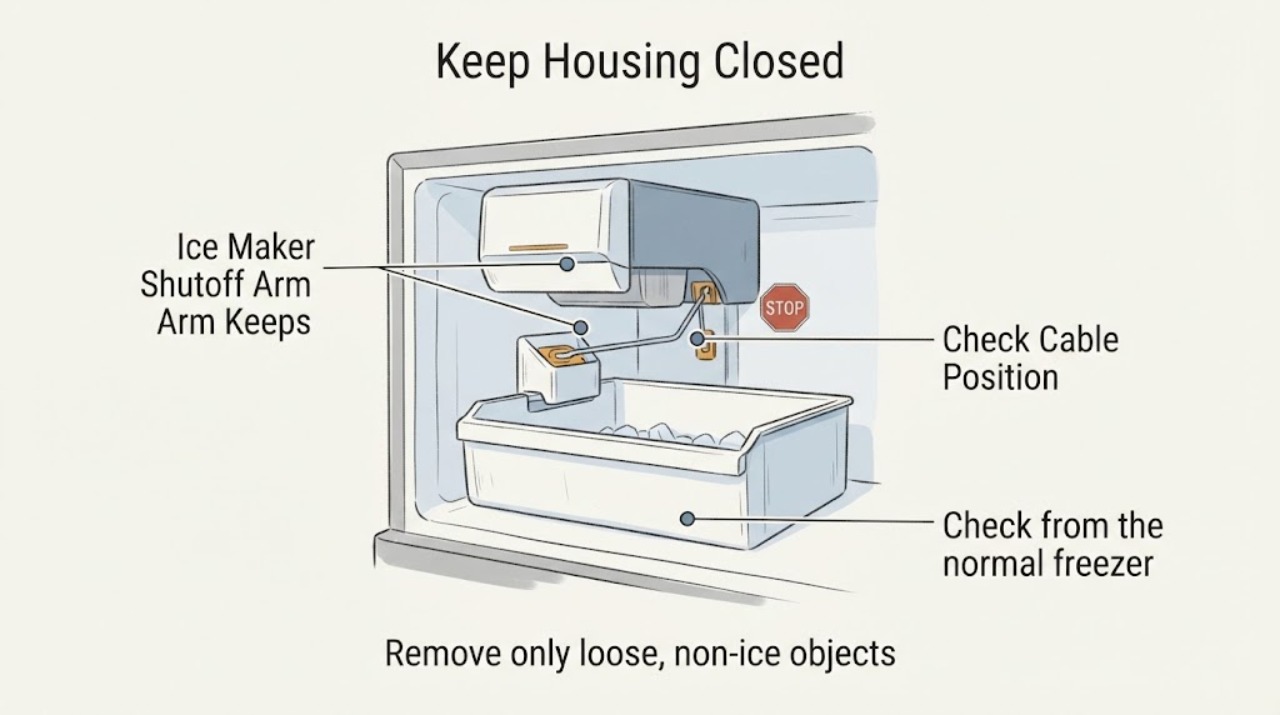
A shutoff arm that keeps freeing itself can leave the ice maker engaged and allow the bin to overfill, but the exact KRFC300EBS post does not establish which part is worn. KitchenAid says to lift the wire arm to OFF and listen for a click, never force it, and keep the ice bin directly below the maker. Stop ice production and arrange model-specific service if the arm will not click and remain up; do not cut, bend, stretch or guess a replacement arm or ice-maker assembly.
Before you begin
Safety first
- Do not cut, bend, stretch, file or pry the wire, open the ice-maker module, bypass the shutoff, reach into moving parts or order a generic arm or complete ice-maker assembly from the symptom alone.
Work through in order
Diagnostic checks
Use only checks that match the exact appliance or system and its official guide.
-
Check 1
With the freezer door open and fingers clear of moving parts, gently lift the wire shutoff arm to its OFF position once and listen for the click. Do not force it up or down.
Expected result: The arm clicks and stays up, feels loose and pops back out, or cannot reach the OFF position.
Next step: If it does not stay OFF, stop using the ice maker and arrange service. Do not repeat forceful tests or reshape the wire.
Why this matters
Why: A stable click supports the documented manual shutoff; a loose or non-latching arm means the automatic stop cannot be trusted, but does not identify the failed part.
-
Check 2
Check from the normal freezer opening that the ice bin is directly below the ice maker and that the shelf or support specified for the compartment is present. Do not move the refrigerator or remove the ice-maker module.
Expected result: The bin is misaligned, a shelf is missing, or the bin and shelf appear correctly positioned.
Next step: Restore only an obvious bin or shelf position using the owner's instructions. If alignment is correct and the arm still frees itself, stop ice production and request service.
Why this matters
Why: KitchenAid says incorrect bin spacing can keep the shutoff arm from working properly; correct alignment does not prove that a loose arm or module is healthy.
-
Check 3
Remove only loose, non-ice objects from the ice bin and confirm that the bin contains ice made by the appliance rather than bagged ice or stored items. Do not use a sharp tool to break ice or pry the arm.
Expected result: The bin contains foreign items, a hard obstruction or only appliance-made ice.
Next step: Empty and clean the bin according to the manual if needed. If overproduction continues with a clear, correctly placed bin, keep the maker off and arrange service.
Why this matters
Why: KitchenAid warns that non-ice storage can damage the arm or internal mechanism; a clear bin does not rule out wear at the arm engagement point.
-
Check 4
Observe one normal shutoff attempt from outside the mechanism and record whether ice production stops, whether the arm remains engaged, and whether ice is overflowing. Do not cut, bend, stretch or file the wire and do not open the ice-maker housing.
Expected result: The arm remains up and production stops, the arm pops out while the rear remains engaged, or ice continues to accumulate.
Next step: Keep the ice maker out of service and give the model-specific observations to KitchenAid service. Do not select a replacement part from a generic image or forum suggestion.
Why this matters
Why: The latter observations show that the automatic stop is unreliable; they do not distinguish a wire, holder, switch, gear or complete ice-maker fault.
-
Check 5
Use KitchenAid's model lookup with the full model suffix and serial label to obtain the correct literature before any part discussion. Keep the ice maker stopped while the arm is unreliable.
Expected result: The lookup supplies exact documentation, or the suffix/document is unavailable and only similar ice-maker diagrams can be found.
Next step: If exact documentation is unavailable, use KitchenAid-authorized service rather than buying or installing a guessed arm or ice-maker module.
Why this matters
Why: A full suffix can distinguish refrigerator variants and ice-maker layouts; a similar diagram cannot prove arm or assembly compatibility.
Use your observations
Decision map
Find the observation that best matches what you see, then follow the next safe action.
-
PATH 01Next step
What you see
The wire arm lifts, clicks into the up/OFF position and stays there, with the bin directly below the ice maker.
Do this next
Leave the maker off until the cause of the reported popping-out event is understood, or monitor only under the owner's manual and stop immediately if the arm loosens again.
Why this path and its safety boundary
Why it matters: The documented manual shutoff is functioning at that moment; this does not prove that the automatic bin-full stop will continue to work during production.
-
PATH 02Next step
What you see
The arm will not click, pops out from the front while the rear remains engaged, or moves without a stable OFF position.
Do this next
Keep the ice maker off and schedule KitchenAid service. Do not cut, bend, stretch or pry the arm.
Why this path and its safety boundary
Why it matters: The ice maker can continue producing ice and overfill the freezer; the external symptom does not identify a replaceable wire versus a module fault.
-
PATH 03Next step
What you see
The bin is not directly below the maker, a shelf is missing, or non-ice objects or bagged ice are stored in the bin.
Do this next
Restore the documented bin/shelf arrangement and remove foreign items without forcing the arm; seek service if the issue remains.
Why this path and its safety boundary
Why it matters: The physical arrangement can interfere with the arm and KitchenAid warns that non-ice storage can damage the arm or internal mechanism.
-
PATH 04Next step
What you see
The arm and bin look correct but ice continues to accumulate or the arm disengages again.
Do this next
Stop using the ice maker and provide the exact model suffix, serial, photos and observations to KitchenAid service.
Why this path and its safety boundary
Why it matters: The shutoff system remains unreliable even though the visible arrangement is correct; a hidden mechanism or engagement fault is possible but unconfirmed.
Helpful context
Understand the symptom
The model and symptom are a direct match
The exact community report names a KitchenAid KRFC300EBS bottom-freezer refrigerator and says the ice-maker arm repeatedly frees itself from the front end, leaving the back engaged and allowing ice to overflow. The thread contains unverified suggestions, including cutting or altering the wire, and no confirmed repair result. Those suggestions should not be treated as a safe procedure.
Use the arm only as KitchenAid documents
KitchenAid's bottom-freezer guidance says to lift the wire shutoff arm to OFF and listen for a click, and it warns not to force the arm. The same guidance says the ice bin must sit directly below the ice maker. A failed click, a loose arm or a bin that cannot align is a service clue, not permission to reshape the wire or open the module.
Check the bin relationship before choosing a part
An incorrectly positioned bin or missing shelf can prevent the arm from reaching the normal automatic shutoff position. KitchenAid also warns that storing anything other than the ice made by the appliance can damage the arm or internal ice-maker mechanism. Correct only an obvious bin-position or storage issue from the normal freezer opening; do not infer compatibility for an arm or complete ice maker.
Escalate when the arm cannot reliably stop production
If the arm pops out again, will not remain in OFF, the bin is overfilling, or ice is jammed around the arm, stop using the ice maker and schedule KitchenAid service. Provide the complete model suffix, serial label, photos of the arm and bin position, and whether a gentle lift produces a click. Do not keep harvesting ice to see whether the mechanism eventually catches.
When checks do not resolve it
Need a professional?
Arrange KitchenAid-authorized service when the arm will not click and stay OFF, pops out again, ice production continues with the arm raised, the bin overfills, or the bin/shelf arrangement is correct but the fault persists.
Safety scope: Do not cut, bend, stretch, file or pry the wire, open the ice-maker module, bypass the shutoff, reach into moving parts or order a generic arm or complete ice-maker assembly from the symptom alone.
Have this ready
- Provide the complete KRFC300EBS model suffix, serial label, photos of the arm ends and bin position, whether the arm clicks, whether the rear remains engaged, and whether any shelf or non-ice item was in the bin.
Common questions
FAQ
Does the popping-out arm prove that the whole ice maker must be replaced?
No. The exact post and KitchenAid guidance establish unreliable shutoff behavior, not which component is worn. A full model suffix and service inspection are needed before choosing an arm or assembly.
How do I turn the KitchenAid ice maker off?
KitchenAid says to lift the wire shutoff arm to the OFF position and listen for a click, without forcing it. If it will not click or stay up, stop using the ice maker and arrange service.
Could the ice bin position cause the arm to malfunction?
Yes, KitchenAid says the bin must be directly below the maker and that missing shelf space can prevent the shutoff arm from working properly. Correcting an obvious position issue does not clear a loose arm or hidden mechanism.
Can I bend or cut the wire so it stays engaged?
No. KitchenAid warns not to force the wire arm, and the community alteration suggestions are not a verified repair. Keep the maker off and use the exact model support path.
Read the exact guide
Official sources
- KitchenAid ice maker shutoff arm keeps popping out, stays on indefinitelyReddit r/appliancerepair · Exact community post for the assigned KRFC300EBS model and shutoff-arm symptom; it supports reported context and uncertainty only, not a confirmed part or repair method.
- KitchenAid Manuals & LiteratureKitchenAid · Official manual portal used to direct the reader to the full KRFC300EBS suffix and exact literature; it does not support unseen model-specific part compatibility.
- Owner's Manual - Ice Maker and Storage BinKitchenAid · Official KitchenAid owner manual used only for common wire-arm operation, click/OFF behavior, no-force warning and general ice-bin handling. It is not presented as the exact KRFC300EBS manual or proof of parts compatibility.
- Bottom Freezer - Too Much IceKitchenAid · Official KitchenAid bottom-freezer guidance used for the wire-arm click/OFF behavior, bin alignment, prohibited force and service boundary; it does not identify a KRFC300EBS-specific replacement part.
Community feedback
Share a repair observation
Share a plain-text repair observation. Accepted observations are published automatically; this page may take a moment to update.