
On this page
Start here
Quick answer
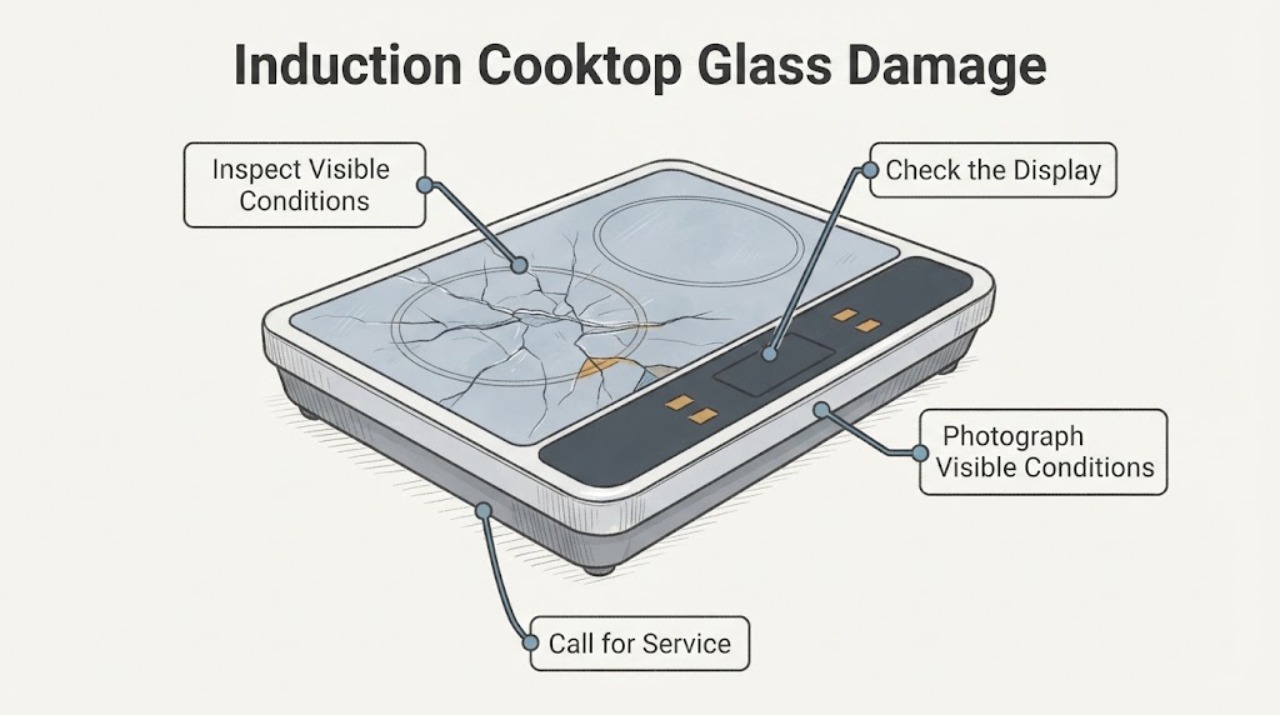
Do not cook on a cracked or broken glass surface on a KitchenAid KICU569XSS induction cooktop. KitchenAid's owner manual warns that a broken cooktop can let cleaning solutions or spills reach the electrical parts and create an electric-shock risk. From a dry, safe position, stop using the cooktop and isolate its circuit if you can do so without touching wet or damaged equipment. A qualified technician should identify the correct ceramic-glass assembly and inspect the underlying controls before any replacement; do not order a generic glass panel or remove the cooktop yourself.
Work through in order
Diagnostic checks
Use only checks that match the exact appliance or system and its official guide.
-
Check 1
From a dry, safe position, stop all cooking and look at the cool surface for a crack, hole, chip with an open edge, or a section that has separated; if the damage is structural, leave the cooktop unused and isolate its circuit only if the breaker or isolator is safely accessible.
Expected result: The glass is cracked or broken, liquid has reached the break, or the surface is intact with only a stain or fine scratch.
Next step: For any structural damage or liquid near the break, keep the cooktop isolated and arrange qualified service. If the surface is intact, continue with the control-state check without applying pressure to the glass.
Stop if: Do not touch sharp edges, wipe liquid through a crack, place a pan on the damaged area, or energize the cooktop to see whether it still heats.
Why this matters
Why: A broken surface can allow spills or cleaning solution to reach electrical parts and creates an electric-shock risk; a superficial mark does not establish that the glass assembly needs replacement.
-
Check 2
With the surface cool and intact, inspect the accessible display for a Control Lock indicator and check whether the problem began after power was restored; do not press repeatedly on a damaged or wet control area.
Expected result: The Control Lock indicator is lit, or the display remains abnormal with no lock indication.
Next step: If the surface is intact, use the manual's three-second Control Lock procedure once. If the display remains abnormal, record it and request service; if the glass is broken, skip operation and keep the circuit isolated.
Stop if: Do not bridge controls, remove the control panel, or continue testing when the surface is cracked, wet, or electrically abnormal.
Why this matters
Why: A locked panel after first connection or a power failure can prevent normal operation, while an abnormal display without that state needs model-specific service assessment; neither result proves that a glass replacement will fix the cooktop.
-
Check 3
Photograph the damage without moving the cooktop and record the complete model and serial information from the appliance label; confirm that the label identifies KICU569XSS before discussing a replacement assembly.
Expected result: The full identity is readable, or only a partial model number is available.
Next step: Give the complete identity and damage photos to KitchenAid or a qualified appliance technician and ask them to match the glass assembly and inspect related components.
Stop if: Do not buy a generic ceramic panel, substitute a part from another KICU569 variant, or remove the built-in cooktop to read hidden labels.
Why this matters
Why: KitchenAid lists KICU569XSS as a specific 36-inch five-element induction cooktop, but a partial model or a similar-looking KICU569 family number is not enough to confirm a glass assembly or control revision.
-
Check 4
Keep the cooktop out of service while arranging a qualified repair when the glass is cracked, a control area is damaged, liquid entered a break, or the display remains abnormal after the permitted lock check.
Expected result: The surface or controls are damaged, or the cooktop is fully intact and operates normally after the documented lock check.
Next step: Use the cooktop only when the surface is intact and controls operate normally. Otherwise provide the model, serial number, damage location, display behavior, and circuit status to qualified service.
Stop if: Do not continue cooking on cracked glass, open the underside, test live wiring, or replace the glass without the correct service procedure.
Why this matters
Why: Structural glass damage requires an electrical-safety inspection and correct assembly match; normal operation after a lock correction points to a control state rather than proving that any replacement part is needed.
Use your observations
Decision map
Find the observation that best matches what you see, then follow the next safe action.
-
PATH 01Next step
What you see
The surface has a through-crack, open chip, missing piece, liquid at the break, or an edge that is lifting.
Do this next
Stop using the cooktop, isolate the circuit from a dry safe position when possible, and arrange qualified service to match and install the correct assembly.
Why this path and its safety boundary
Why it matters: This is structural ceramic-glass damage with an electrical-shock and further-damage risk, even if the display still lights.
-
PATH 02Next step
What you see
The surface is intact and the only visible issue is a stain or fine scratch, while the controls respond normally.
Do this next
Follow the manual's cool-surface cleaning method and monitor the mark. Arrange service if the glass later cracks, flexes, or develops an edge chip.
Why this path and its safety boundary
Why it matters: The mark alone does not establish a failed glass panel; KitchenAid says minor scratches and abrasions do not affect cooking performance.
-
PATH 03Next step
What you see
The surface is intact but the Control Lock indicator is lit after power was restored, and there is no wet or damaged control area.
Do this next
Use the documented three-second Control Lock procedure once. If the panel remains abnormal, stop troubleshooting and provide the display behavior to service.
Why this path and its safety boundary
Why it matters: A control-lock state can explain a nonresponsive panel without proving glass or electronics failure.
-
PATH 04Next step
What you see
The glass is damaged and the display, touch controls, or a circuit protection device also behaves abnormally.
Do this next
Leave the circuit isolated and have qualified service inspect the glass, controls, wiring, and protection before any part is ordered.
Why this path and its safety boundary
Why it matters: The damage may involve more than the visible glass, and the manual's ordinary user checks cannot establish which internal assembly failed.
Helpful context
Understand the symptom
Treat a true crack as a stop-use problem
A crack, hole, or piece missing from the glass changes the safety decision. Do not test the damaged zone with a pan, pour cleaner over it, or wipe across a sharp edge. From a dry position, leave all controls off and isolate the cooktop circuit only if the breaker or isolator can be reached safely. Keep liquids and cookware away from the break until a qualified technician has inspected it.
Separate a surface mark from structural glass damage
When the cooktop is cool and the power is off, look without pressing on the surface. A stain, burned-on residue, or fine scratch is different from a continuous crack, chip, lifting edge, or glass that flexes. The manual says tiny scratches and abrasions do not affect cooking performance, but a broken cooktop must not be used. If you cannot confidently classify the mark, treat it as damage and arrange an inspection.
Do not confuse a control lock with glass failure
If there is no crack or chip and the surface is intact, check whether the control-lock indicator is lit. The KICU569 manual says the control panel can be locked after first connection or a power failure; holding the Control Lock keypad for three seconds should clear that state. If the display still behaves abnormally, do not keep cycling power or touch a damaged area; record the display and move to service guidance.
Give service the exact identity before ordering a part
Record the complete model and serial information from the rating label and take a photo of the damage from a safe distance. KitchenAid identifies the appliance as model KICU569XSS, but a replacement glass assembly must be matched to the complete appliance identity and revision. A technician should check the glass, mounting, touch controls, and wiring together; a glass-only purchase can be wrong if the damage also affected the control area.
Only after diagnosis
Potential parts
- ceramic-glass cooktop assembly
Only when a qualified technician confirms structural glass damage and matches the complete KICU569XSS identity.
When checks do not resolve it
Need a professional?
Call qualified appliance service immediately for a crack, broken or lifting glass, liquid at a break, sharp exposed edge, damaged controls, abnormal display after a safe lock check, or any electrical symptom.
Have this ready
- Provide the complete KICU569XSS model and serial information, damage photos taken from a safe position, whether liquid reached the break, display behavior, and whether the circuit was isolated.
Common questions
FAQ
Can I keep using the other zones if one area of the glass is cracked?
No. The manual's broken-cooktop warning applies to the cooktop surface, and spills can reach electrical parts through the break. Keep the appliance out of service until qualified service has assessed it.
Does a scratch mean the glass panel must be replaced?
Not by itself. KitchenAid says tiny scratches and abrasions do not affect cooking performance, but a crack, open chip, lifting edge, or uncertain damage should be treated as unsafe and inspected.
Can I order a replacement glass panel by searching KICU569XSS online?
Use the complete model and serial information and have service match the assembly. Similar KICU569 family numbers do not by themselves prove part compatibility, and hidden control or wiring damage may need repair as well.
Read the exact guide
Official sources
- 36-Inch 5-Element Induction Cooktop, Architect® Series II Stainless Steel KICU569XSSKitchenAid · Exact KICU569XSS induction cooktop
- Owner's ManualKitchenAid · KICU569 36-inch induction cooktop family, including the assigned KICU569XSS model
Community feedback
Share a repair observation
Share a plain-text repair observation. Accepted observations are published automatically; this page may take a moment to update.