
On this page
Start here
Quick answer
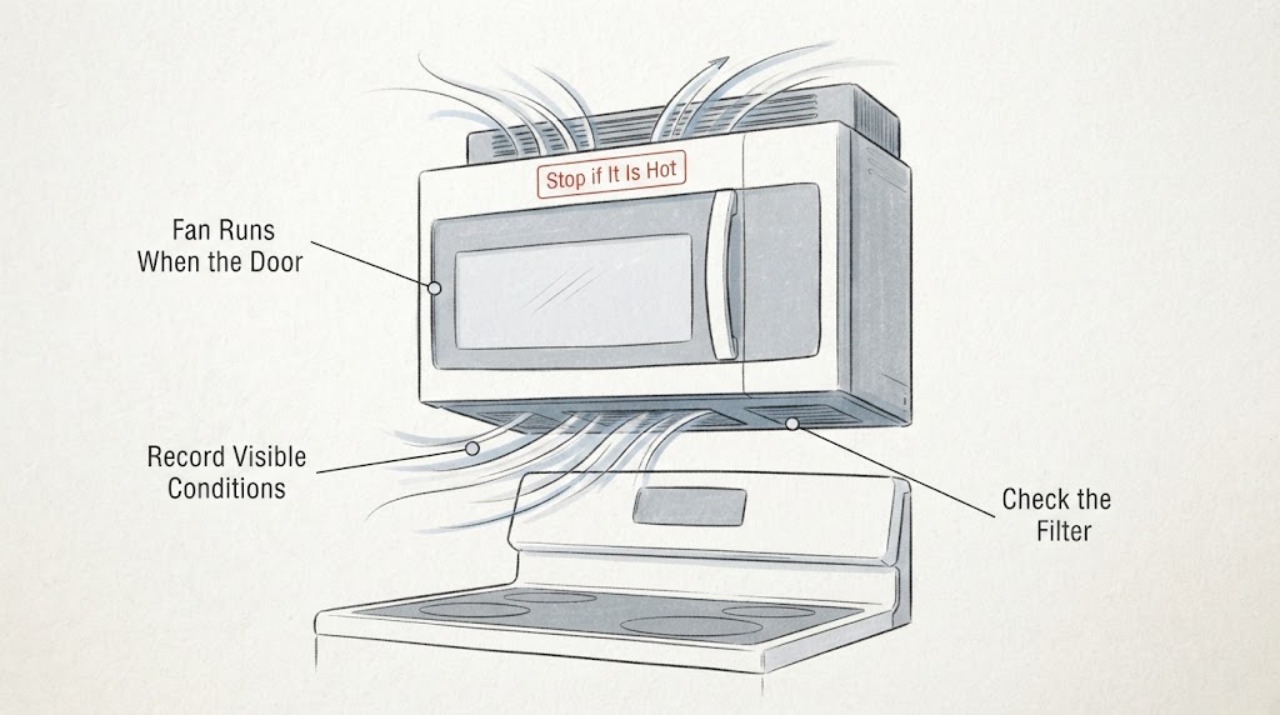
The KitchenAid KMHS120ESS is an over-the-range microwave with a three-speed ventilation system, so a fan can be a hood fan or a cooling fan rather than a microwave-cavity fault. First note whether the cooktop or microwave was recently hot, whether the fan starts only during or after cooking, and whether the display identifies an automatic-fan state. KitchenAid says over-the-range fans may start automatically during microwave or cooktop use and may remain on while heat is sensed. If the KMHS120ESS fan starts as soon as the door closes while the microwave is cool, idle, and not being used, or it will not stop after the appliance has cooled, do not test the door switch, open the cabinet, bypass an interlock, or repeatedly run the microwave. Turn the appliance off at its controls; if it remains powered or the fan behavior is accompanied by smoke, arcing, a burning odor, or a breaker trip, isolate power from a safe location and arrange qualified KitchenAid service.
Work through in order
Diagnostic checks
Use only checks that match the exact appliance or system and its official guide.
-
Check 1
Stop using the microwave function and record the fan trigger from a safe position: was the microwave cooking, was the cooktop below recently hot, was the door opened and then closed, what fan speed is present, and does the display show an automatic-fan message? Do not repeatedly open and close the door to reproduce the symptom.
Expected result: The fan starts after microwave/cooktop heat, starts only on door closure while the unit is cool and idle, or runs with smoke, arcing, burning odor, or a tripped breaker.
Next step: For a heat-related fan, allow the unit to cool and observe whether it stops without using the door as a test. For an idle door-closure fan or any safety symptom, stop and arrange qualified service; do not diagnose the door switch or control from the symptom alone.
Stop if: Stop immediately for smoke, arcing, a burning smell, exposed damage, a hot outlet, or a breaker/fuse that opens again.
Why this matters
Why: Heat-related operation is consistent with KitchenAid's documented automatic hood/cooling behavior. A cool idle unit that reacts to door closure is not identified by those pages as a normal fan mode, while smoke, arcing, odor, or a breaker trip is a safety condition.
-
Check 2
If the fan began after cooking or cooktop use, leave the microwave and cooktop off and allow them to cool naturally. Watch from outside whether the fan speed decreases or stops; do not cover the vents or place hands near hot exhaust air.
Expected result: The fan stops or cycles off as the appliance cools, or it continues at the same speed after the unit is cool and idle.
Next step: If the fan stops after cooling and does not start unexpectedly again, record the event. If it stays on after cooling or returns whenever the door closes without heat, turn the appliance off and request service rather than forcing the fan control or cycling the door.
Why this matters
Why: KitchenAid says automatic fan operation can continue while heat is sensed and may last up to one hour in the documented over-the-range guidance. Continued operation after cooling is not enough to identify a failed part, but it is less consistent with the normal heat explanation.
-
Check 3
With the controls off and the appliance cool, check only the visible fan-control state and the accessible underside grease filter for obvious heavy grease or blockage. Do not remove the microwave cover, reach into the fan assembly, or operate the microwave with a filter removed.
Expected result: A vent-fan setting is visibly selected, the accessible filter is dirty, or the controls and filter appear normal.
Next step: Use only the model's documented fan control to return a selected fan mode to off when the unit is cool and safe. Clean or replace accessible filters according to their labels and the model instructions; if the fan still starts on door closure, leave internal diagnosis to service.
Stop if: Stop if the filter is hot, damaged, stuck, or if accessing it would require reaching behind the unit or touching wiring.
Why this matters
Why: KitchenAid says fan controls and the number of speeds vary by model, and its vent guidance identifies underside grease filters as user-maintenance items. A setting or dirty filter may affect airflow, but neither proves a door-interlock or control failure.
-
Check 4
Determine the installation airflow path only from the outside: when the fan is intentionally running and the unit is safe to approach, note whether air exits at the top/front or at the external wall or roof termination. Inspect only an accessible exterior damper or screen for visible blockage; do not dismantle ductwork or the microwave.
Expected result: Airflow is absent at the expected outlet, the exterior damper is blocked, or the airflow path is visibly clear.
Next step: Correct only an obvious exterior obstruction when the unit is off and cool, or have the installer/qualified professional inspect the duct. Do not use a duct check as permission to keep operating a fan that starts unexpectedly while idle.
Why this matters
Why: KitchenAid says the airflow location helps distinguish external from internal venting and that an external wall-cap damper or insect screen can restrict exhaust. This addresses airflow performance, not the cause of a fan that starts at door closure.
-
Check 5
If the fan runs continuously while the KMHS120ESS is cool and idle, starts with door closure on every attempt, or the circuit breaker/fuse opens, turn the unit off at its controls and isolate the circuit only if the disconnect is safely accessible. Give the technician the model, fan speed, heat history, door trigger, display state, and any odor or electrical symptoms.
Expected result: The fan remains on after cooling, the door reliably triggers it, the breaker/fuse opens, or the fan behavior is accompanied by smoke, arcing, or burning odor.
Next step: Keep the microwave disconnected and contact KitchenAid or qualified appliance service. Do not open the cabinet, bypass the door interlock, test energized wiring, or repeatedly run the microwave to see whether the symptom changes.
Why this matters
Why: The public KitchenAid guidance explains heat-related automatic fan operation but does not establish an internal fault or authorize door-switch testing. Electrical or heat symptoms require the appliance to remain out of service.
Use your observations
Decision map
Find the observation that best matches what you see, then follow the next safe action.
-
PATH 01Next step
What you see
The fan starts after microwave cooking or recent cooktop heat and slows or stops as the appliance cools.
Do this next
Allow the appliance to cool without covering the vents and record the duration. If the fan later starts while the unit is cool and idle, use the service branch instead of repeatedly testing it.
Why this path and its safety boundary
Why it matters: This matches KitchenAid's documented heat-related hood/cooling behavior for over-the-range microwaves; it does not indicate that the door itself started a fault.
-
PATH 02Next step
What you see
The KMHS120ESS is cool and idle, but the fan starts whenever the door is closed and no cooktop or microwave heat is present.
Do this next
Keep the unit out of service, avoid door-switch or interlock tests, and arrange KitchenAid or qualified appliance service with the exact trigger and model recorded.
Why this path and its safety boundary
Why it matters: The opened KitchenAid guidance does not define this exact door-closure pattern as a normal automatic fan condition and does not identify which internal component is responsible.
-
PATH 03Next step
What you see
The fan is on because a fan setting is selected or airflow is restricted by an accessible grease filter or exterior damper.
Do this next
Turn the fan setting off only through the documented control when the unit is cool, clean or replace an accessible filter as directed, and have an installer inspect a blocked duct. Stop if the fan still reacts to door closure while idle.
Why this path and its safety boundary
Why it matters: The issue may be a selected vent mode or an airflow-maintenance condition, but a dirty filter or blocked damper does not prove a door-control fault.
-
PATH 04Next step
What you see
Smoke, arcing, burning odor, a hot or damaged outlet, a breaker/fuse trip, or fan operation that cannot be stopped safely is present.
Do this next
Stop using the microwave and isolate power only from a safe location; keep it disconnected and call qualified service. Do not open the cabinet or bypass a door interlock.
Why this path and its safety boundary
Why it matters: This is an electrical or heat safety concern, not a routine ventilation setting.
Helpful context
Understand the symptom
A fan can be normal after heat, but the trigger matters
KitchenAid lists the KMHS120ESS as a microwave hood combination with three fan speeds. Its over-the-range guidance distinguishes the hood/vent fan from the cooling fan and says either may run during microwave operation or while the cooktop below is hot. The useful question is therefore not simply whether air is moving: record whether the unit was cooking, whether the cooktop was hot, whether the fan speed changes, and whether it stops after cooling.
Keep a door-closure symptom outside the microwave cabinet
A fan that starts only when the door is closed while the appliance is cool and idle is outside the normal heat-related explanation documented on the public support pages. That observation may be useful to a technician, but it does not prove a door switch, relay, control, or wiring fault. Do not remove the outer cover, probe the door-interlock circuit, or defeat a safety switch.
When checks do not resolve it
Need a professional?
Provide the exact KMHS120ESS model, whether the microwave or cooktop was hot, whether the fan started only after closing the door, fan speed, display state, filter/duct observations, and any odor, smoke, arcing, or breaker history.
Common questions
FAQ
Can the KMHS120ESS fan run even when I did not press the fan button?
Yes, KitchenAid says over-the-range microwave hood or cooling fans may start automatically during microwave operation or when cooktop heat is high. Let the unit cool and observe whether the fan stops. A cool, idle fan that starts specifically when the door closes needs service rather than a guessed part diagnosis.
Is a fan that starts when the door closes proof that the door switch is bad?
No. The public KitchenAid pages explain heat-related automatic fan behavior but do not map an idle door-closure fan to a particular switch, relay, control, or wiring fault. Keep the microwave out of service and arrange qualified diagnosis; do not bypass or test the interlock yourself.
Can I remove the microwave cover to check the fan or door switch?
No. Do not open the microwave cabinet, perform live testing, or bypass a door interlock. Record the trigger and arrange KitchenAid or qualified appliance service, especially if there is an odor, smoke, arcing, or a breaker trip.
Could a dirty filter cause this fan behavior?
A dirty accessible grease filter can affect airflow, and KitchenAid provides filter and vent checks for hood performance. It does not prove why a fan starts on door closure while the unit is cool and idle. Clean or replace only the accessible filter as directed, and use service for the unexplained trigger.
Read the exact guide
Official sources
- Vent Not Turning On - Over-the-Range MicrowaveKitchenAid Product Help · KitchenAid over-the-range microwave family guidance; use the automatic-fan explanation conditionally because KitchenAid states behavior and fan speeds vary by model. The exact KMHS120ESS page establishes that the assigned appliance is in this product class.
- Vent Won't Turn Off - Over-the-Range MicrowaveKitchenAid Product Help · KitchenAid over-the-range guidance; it explains cooling/vent behavior during heat and does not diagnose an idle door-closure trigger or authorize internal repair.
- Vent Not Removing Odor or Vapor - Over-the-Range MicrowaveKitchenAid Product Help · KitchenAid over-the-range ventilation guidance for accessible filters and external damper/airflow observations; it does not support an internal fan or door-switch diagnosis.
- KMHS120ESS | KitchenAidKitchenAid · Exact model Owner's Center page; identifies KMHS120ESS as a 30-inch 1000-watt microwave hood combination. The rendered page currently exposes no model document contents, so it is used for identity and service boundary only.
- 30" 1000-Watt Microwave Hood Combination Stainless Steel KMHS120ESSKitchenAid · Exact model page: KMHS120ESS, 30-inch 1000-watt microwave hood combination; lists a three-speed 400 CFM motor-class ventilation system and over-the-range installation.
- Vent Randomly Turns On - Over-the-Range MicrowaveKitchenAid Product Help · KitchenAid family guidance used only for the documented heat-related normal branch; it does not establish a door-switch or control diagnosis for KMHS120ESS.
Community feedback
Share a repair observation
Share a plain-text repair observation. Accepted observations are published automatically; this page may take a moment to update.