
On this page
Start here
Quick answer
First classify the smell before using the KitchenAid oven again: food or grease residue, a new-appliance or packaging odor, a gas-like odor, a burning or electrical odor, or smoke and fire. A mild smell during the first few uses can come from new parts, insulation, protective oil or shipping tape and should fade. With the oven cool, remove all packaging and visible food residue, do not line the bottom with foil, and follow the model manual for cleaning. KitchenAid's range guidance permits one empty Bake cycle at 350°F for 60 minutes for a new-oven smell, with ventilation and no food; repeat only as the manual permits. A gas odor that persists beyond the brief preheat period, a sulfur or rotten-egg smell, hissing, delayed ignition, abnormal flame, smoke, arcing, melting, overheating or a carbon-monoxide alarm is not a deodorizing problem: stop, leave the area when necessary, avoid ignition sources and obtain emergency or qualified help from a safe location. Never open gas or electrical panels, adjust combustion parts or use the oven to heat the home.
Before you begin
Safety first
- Do not move the range to inspect a connector, loosen or adjust gas fittings, open electrical panels, probe live parts, use an open flame, bypass an interlock, block a vent, line the oven with foil, continue after gas odor or smoke, or use the oven to heat the home.
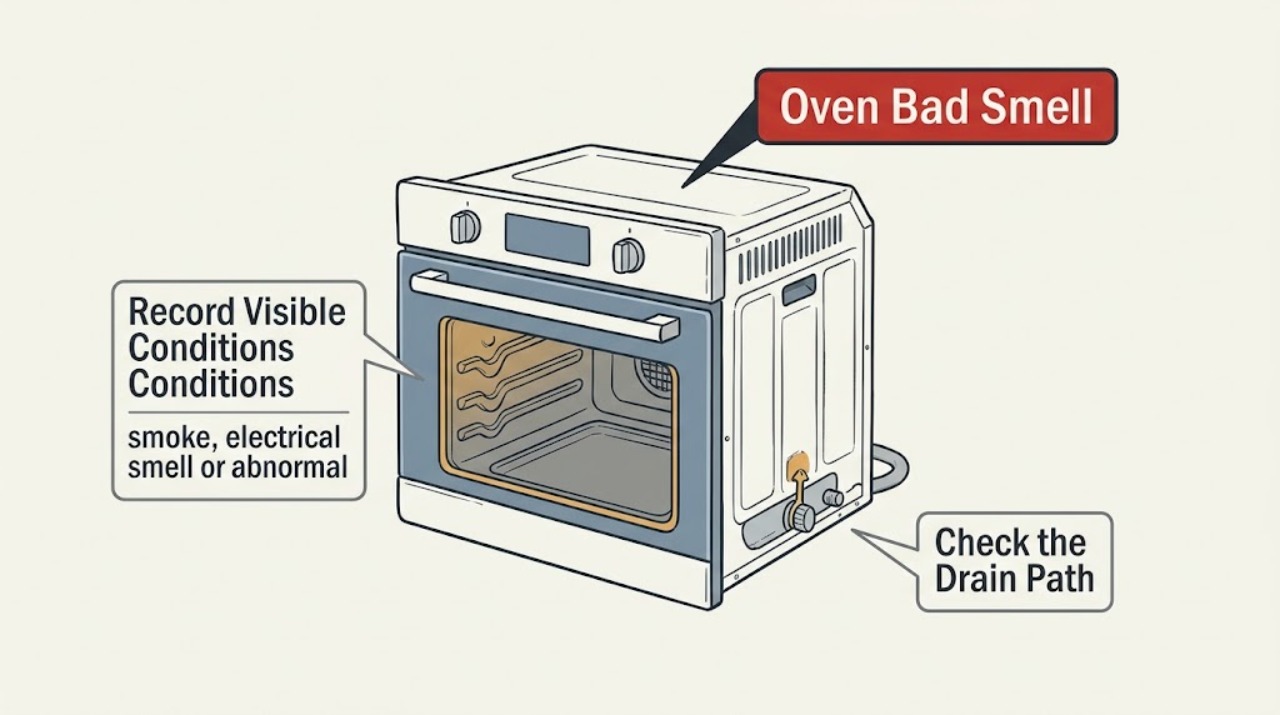
Work through in order
Diagnostic checks
Use only checks that match the exact appliance or system and its official guide.
-
Check 1
Stop the oven and classify the odor without moving the appliance. Record whether it smells like food or grease, new materials or plastic, gas or sulfur, burning insulation or electrical parts, and note whether there is smoke, a visible flame problem, hissing, unusual heat, an alarm or symptoms. Do not continue heating to make an unexplained smell disappear.
Expected result: The odor is a one-time food spill, a mild new-appliance smell, a brief gas smell only at ignition, a persistent gas-like smell, an acrid burning or electrical smell, or smoke and fire are present.
Next step: For gas odor, smoke, fire, an alarm or illness, stop, leave the area as needed and obtain emergency help from a safe location. For a non-hazardous smell, keep the oven off and cool before the matching inspection below.
Why this matters
Why: Residue and first-use materials can create ordinary odor paths. Persistent gas-like or burning odors, smoke, abnormal flame, an alarm or symptoms indicate a gas, combustion, fire or electrical risk rather than routine cleaning.
-
Check 2
If the oven is new or was recently installed and there is no gas odor, smoke, electrical smell or abnormal heat, inspect the cool cavity for tape, cardboard, plastic, protective film or other packaging. Check the model manual for the fuel type and installation instructions, and keep birds and other sensitive occupants away from the fumes.
Expected result: Packaging or a new-material source is present, the oven has already been used several times, or no source is visible and the odor is getting stronger.
Next step: Remove only accessible packaging after the oven is cool. If the model manual allows it and no hazard is present, use the one-time empty Bake procedure in the next check; otherwise keep the oven off and request service.
Why this matters
Why: KitchenAid attributes limited first-use odor to new parts, insulation, protective oil and shipping tape, and expects it to dissipate after the first few uses. A stronger or unexplained odor is not established as normal merely because the oven is new.
-
Check 3
For a verified new-oven odor with the cavity empty and cool, use the exact KitchenAid control sequence and manual-supported limits for one empty Bake cycle at 350°F for 60 minutes. Ventilate the room, do not cook food during the cycle, and stop immediately if the odor becomes gas-like, acrid or heavy, or if smoke, abnormal heat, a flame issue or an alarm occurs.
Expected result: The odor fades after the permitted empty cycle, remains after it, or changes into smoke, burning odor, gas odor or another hazard.
Next step: After full cooldown, wipe the cavity with a soft damp cloth if the manual permits. Do not repeat cycles beyond the manual's limit; arrange qualified service for persistence or any abnormal symptom.
Why this matters
Why: A fading odor supports a first-use materials explanation. Persistence after the manual-supported cycle needs an inspection or service decision; a change in character or any hazard ends the test.
-
Check 4
With the oven fully cool and all energy sources left untouched, inspect for accessible food spills, grease, foil, liners, blocked vents or a damaged door gasket. Clean only the user-accessible surfaces using the exact owner-manual method, rinse or wipe as directed and let them dry. Do not use mixed chemicals, cover the oven bottom, block a vent or run self-clean to investigate an unexplained burning smell.
Expected result: A recent spill or foil is present, the oven is heavily soiled, the vent is blocked, the gasket is damaged, or the cavity is clean and unobstructed.
Next step: Remove accessible residue or foil only after cooldown and correct the condition according to the manual. Do not disturb a damaged gasket or hidden vent; stop and arrange service if the smell persists or the source is not user-accessible.
Why this matters
Why: KitchenAid links trapped residue and foil with smoke or gas-like odors and says heavy soil makes self-clean produce more smoke. A damaged seal or blocked vent can change heat and odor behavior, while a clean cavity shifts concern toward ignition, combustion or electrical service.
-
Check 5
If the KitchenAid oven is gas, observe only from the normal user position during a model-supported start and do not move the range or open gas parts. Note whether a brief odor occurs only at ignition, whether the smell persists, whether ignition is delayed, whether the flame is abnormal, and whether the cooktop or oven behaves differently. Never use an open flame, adjust gas pressure or repeatedly attempt ignition.
Expected result: The odor clears promptly with normal ignition, persists while the oven runs, is accompanied by delayed ignition or hissing, or is present when no gas appliance is operating.
Next step: For persistent or unexplained gas odor, hissing, delayed ignition or abnormal flame, stop and leave the area if needed; contact emergency or gas-qualified help from a safe location. Do not perform gas-system repairs yourself.
Why this matters
Why: KitchenAid says a brief preheat odor may occur, but persistent gas smell, delayed ignition, an abnormal flame or an odor when the appliance is off can indicate a faulty igniter or gas leak. Cooktop operation does not prove that the oven gas path is safe.
-
Check 6
If the smell is burning, electrical or plastic, or smoke appears, press the model's Cancel or Off control only if it is safe to do so and keep the oven closed for an oven fire. Do not reset a tripping circuit, touch a damaged cord, open a panel or continue a self-clean cycle. Record the display, mode, visible smoke location and whether the odor returns without operating the oven.
Expected result: The smell stops after a safe shutdown, smoke or flame escapes the cavity, the breaker trips, the odor returns while off, or visible melting, scorching or arcing is present.
Next step: For flames escaping, leave the home and obtain emergency help. For any electrical, smoke, melting, scorching or recurring odor condition, keep the oven isolated when safe and arrange qualified appliance or electrical service.
Why this matters
Why: A small residue event may stop when heat ends, but escaping flames, electrical damage, recurring odor, a trip or visible scorching is a fire or electrical service condition. An oven fire must not be investigated by opening the door.
Use your observations
Decision map
Find the observation that best matches what you see, then follow the next safe action.
-
PATH 01Next step
What you see
The oven is new, the odor is mild, no hazard is present and the smell fades over the first few uses.
Do this next
Remove packaging, ventilate, keep food out during the manual-supported empty cycle and wipe the cool cavity. Request service if the odor does not fade.
Why this path and its safety boundary
Why it matters: New parts, insulation, protective oil or shipping materials are a plausible first-use source.
-
PATH 02Next step
What you see
A food spill, grease, foil or liner is visible in the cool oven.
Do this next
Remove accessible residue or foil using the owner-manual cleaning method. Do not line the bottom or block vents; stop for persistent or worsening odor.
Why this path and its safety boundary
Why it matters: Trapped residue can smoke or create an odor when heated, while foil or liners can obstruct airflow and combustion on applicable models.
-
PATH 03Next step
What you see
The oven is gas and the smell is brief at ignition, then clears without delayed ignition or abnormal flame.
Do this next
Use only the model-supported observation once. Stop and obtain service if the odor persists, returns when the oven is off, ignition is delayed or the flame is abnormal.
Why this path and its safety boundary
Why it matters: A short preheat odor can occur as the gas burner ignites, but it should not continue throughout operation.
-
PATH 04Next step
What you see
The smell is sulfur-like or gas-like, persists, occurs while the appliance is off, or is accompanied by hissing, delayed ignition or abnormal flame.
Do this next
Do not light appliances or operate electrical switches. Leave the area and contact emergency or gas-qualified help from a safe location; never move the range or open gas fittings.
Why this path and its safety boundary
Why it matters: A gas-supply or ignition problem, including a possible leak, cannot be safely distinguished by more home testing.
-
PATH 05Next step
What you see
The odor is acrid, electrical, burning plastic, or is accompanied by smoke, sparks, scorching, melting, abnormal heat or a repeated breaker trip.
Do this next
Stop the oven, isolate it only when safe, keep the door closed for an oven fire and obtain qualified service. If flames escape, leave the home and obtain emergency help.
Why this path and its safety boundary
Why it matters: This is a fire or electrical safety condition rather than a routine odor-removal task.
-
PATH 06Next step
What you see
A carbon-monoxide alarm sounds or anyone develops headache, dizziness, weakness, nausea, chest pain or confusion near the gas oven.
Do this next
Leave for fresh air and obtain emergency help from a safe location. Do not use the gas oven for space heating and do not return to diagnose it until cleared by qualified responders.
Why this path and its safety boundary
Why it matters: Carbon monoxide is odorless and can be produced by fuel-burning appliances; symptoms or an alarm require immediate fresh air and urgent help.
Helpful context
Understand the symptom
Smell type and timing change the diagnosis
Ask when the odor starts and whether it follows preheating, a spill, cleaning, a recent installation or a gas-burner cycle. Food, grease and new-appliance odors are different from sulfur-like gas odor or an acrid electrical smell. If the smell is unexplained, worsening or accompanied by smoke, heat or symptoms, stop using the oven rather than masking it with fragrance or another cleaning cycle.
A new-oven odor has a limited self-check
KitchenAid says a small amount of odor or smoke can occur during the first uses as new parts, insulation, protective oil or shipping tape heat up. Remove packaging, ventilate the room, keep food out, and use the model-supported empty Bake procedure only when no gas-leak, fire or electrical warning is present. Birds are especially sensitive to these fumes and should be moved to another closed, well-ventilated room.
Cleaning must preserve airflow and seals
After a full cooldown, wipe accessible spills with the mild method specified by the owner manual and let surfaces dry. Do not cover the oven bottom or rack with foil or liners, block vents, or scrub, move or damage the door gasket. High-temperature self-clean can itself create heat, smoke and odor, especially with heavy soil, so it is not the first response to an unexplained burning smell.
Gas and combustion symptoms need a safety boundary
A brief gas smell while a gas oven first ignites may dissipate during preheating, but a persistent smell, delayed ignition, abnormal flame, hissing or a rotten-egg odor can indicate an ignition or supply problem. Carbon monoxide has no smell, so an alarm or symptoms such as headache, dizziness, weakness, nausea, chest pain or confusion require leaving for fresh air and urgent help. Do not diagnose a gas leak by moving the appliance or opening fittings.
Safety boundary
Stop conditions
- Persistent or unexplained gas or sulfur-like odor, hissing, delayed ignition or abnormal flame
- Smoke, flames, burning or electrical odor, sparks, arcing, melting, scorching or abnormal heat
- Carbon-monoxide alarm or headache, dizziness, weakness, nausea, chest pain or confusion
- A fire with flames escaping the oven, a damaged cord or repeated breaker trip
- A blocked vent, damaged gasket or odor source that is not safely accessible
- Any need to move the appliance, open panels, adjust gas pressure, test live parts or bypass safety protection
Only after diagnosis
Potential parts
- gas oven igniter or ignition electrode
Consider only when a qualified technician confirms delayed ignition or a failed igniter after safe checks of odor, settings and fuel conditions.
Confirm the complete model and fuel configuration; ignition parts are safety-critical and must not be tested or replaced by bypassing controls. - oven door gasket
Consider only when the model manual or qualified inspection confirms a damaged seal contributing to heat loss, smoke escape or abnormal odor.
Match the exact model and do not scrub, move or damage the installed gasket during cleaning. - gas valve or pressure-control assembly
Consider only after qualified diagnosis links persistent gas odor, delayed ignition or abnormal flame to the gas-control path rather than residue or settings.
Gas components require model-specific professional handling; never adjust gas pressure or open fittings as a user check.
When checks do not resolve it
Need a professional?
Arrange KitchenAid or qualified appliance service for an odor that persists after safe first-use or cleaning checks, a recurring burning or electrical smell, smoke, a damaged gasket or vent, delayed gas ignition, abnormal flame, gas odor when off, a returning fault or any condition requiring panels, wiring or gas components. Treat a gas leak suspicion, carbon-monoxide alarm, symptoms, fire, sparks or active smoke as an emergency rather than a routine service visit.
Safety scope: Do not move the range to inspect a connector, loosen or adjust gas fittings, open electrical panels, probe live parts, use an open flame, bypass an interlock, block a vent, line the oven with foil, continue after gas odor or smoke, or use the oven to heat the home.
Common questions
FAQ
Why does my KitchenAid oven smell bad when it is new?
A mild odor during the first few uses can come from new parts, insulation, protective oil or shipping tape. Remove all packaging, ventilate and follow the exact manual-supported empty Bake procedure with no food. The smell should fade; smoke, gas odor, electrical odor or persistence needs service.
Can food or foil make a KitchenAid oven smell?
Yes. Spills and grease can smoke when heated, and KitchenAid warns that foil or liners can trap debris and restrict airflow or combustion on applicable models. After a full cooldown, clean accessible residue using the owner manual and do not cover the oven bottom or vents.
Is a gas smell from a KitchenAid gas oven always an emergency?
A brief odor at gas ignition may clear during preheating, but a persistent or unexplained gas odor, sulfur smell, hissing, delayed ignition or abnormal flame must be treated as unsafe. Do not operate switches or attempt repairs; leave the area as needed and obtain emergency or gas-qualified help from a safe location.
What should I do about a burning or electrical smell from the oven?
Stop using the oven and isolate it only when safe. Do not open panels or continue self-clean. Smoke, sparks, melting, scorching, abnormal heat or a recurring electrical odor needs qualified service; if flames escape the cavity, leave the home and obtain emergency help.
Can carbon monoxide cause a bad smell from a KitchenAid gas oven?
No. Carbon monoxide has no smell, so odor alone cannot rule it in or out. A carbon-monoxide alarm or symptoms such as headache, dizziness, weakness, nausea, chest pain or confusion require leaving for fresh air and obtaining urgent help; never use a gas oven to heat the home.
Read the exact guide
Official sources
- Odors or Smells - RangeKitchenAid Product Help · KitchenAid range and oven first-use odors, packaging, ventilation, self-clean smoke and foil guidance
- Pictographs: CookingU.S. Fire Administration · Cooking and oven fire response
- Control GuideKitchenAid · KitchenAid oven control, cooking, cooling-fan and odor guidance for the covered control family
- Carbon Monoxide Poisoning BasicsCenters for Disease Control and Prevention · Carbon-monoxide hazards, symptoms and gas-appliance safety
- Cleaning and Maintenance of RangeKitchenAid Product Help · KitchenAid range cleaning, residue, foil, ventilation and gasket care
- 7 Reasons an Oven Smells Like GasKitchenAid · KitchenAid gas-like oven odors, preheating, ignition, residue, foil and gas-leak safety
Community feedback
Share a repair observation
Share a plain-text repair observation. Accepted observations are published automatically; this page may take a moment to update.