
On this page
Start here
Quick answer
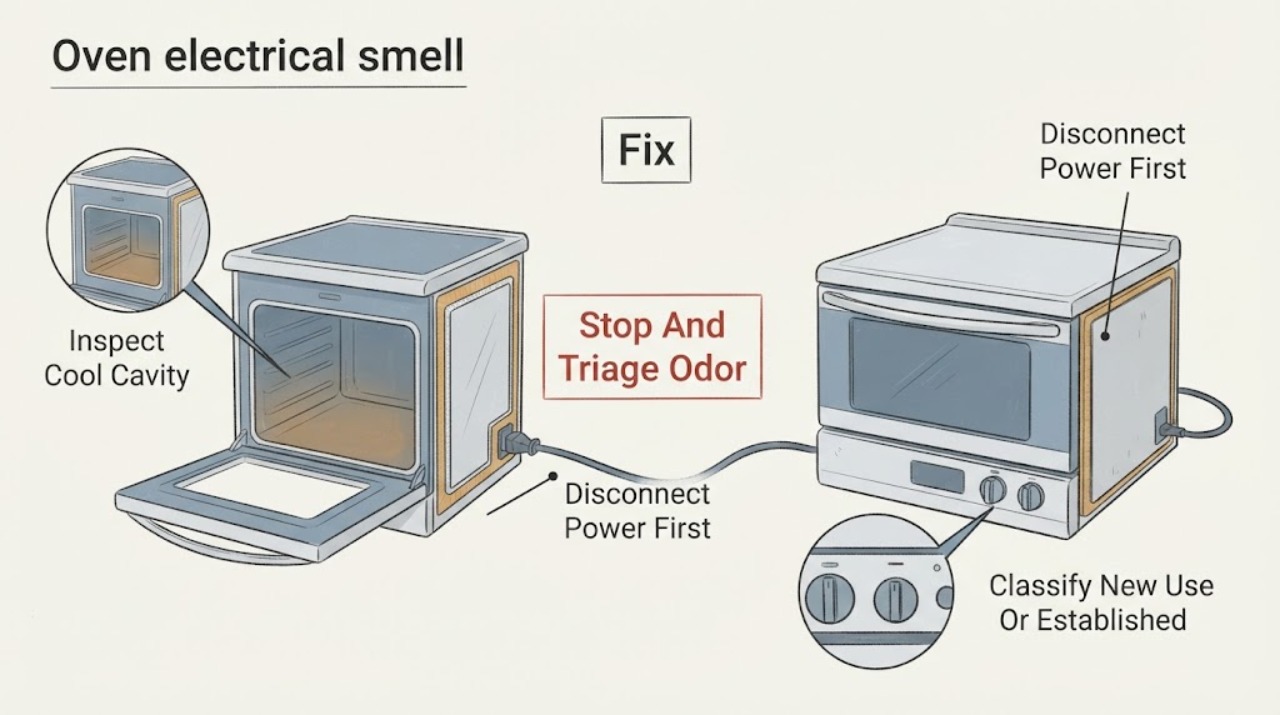
Turn the KitchenAid oven off and stop testing it if the smell is sharp, worsening, accompanied by smoke, sparks, flame, melted material, a repeat breaker trip or visible electrical damage. KitchenAid says a small odor or smoke can be normal during the first uses of a new range or oven because new parts, insulation, protective oil or shipping tape heat up, and that heavy soil or self-cleaning can also produce odor and smoke. That explanation does not establish that an established electrical smell is normal: let the oven cool, inspect only the accessible cavity for remaining packaging, spills or foil/liners, and use the exact model manual for any control or installation question. If the smell persists after the documented new-oven condition has ended, starts after an electrical event or repair, or returns with a breaker trip, leave the oven disconnected when safe and arrange KitchenAid or qualified service; do not open the cabinet, test live wiring or replace an element/control from the odor alone.
Work through in order
Diagnostic checks
Use only checks that match the exact appliance or system and its official guide.
-
Check 1
Turn the oven off and stop cooking. From a safe position, note whether the odor is accompanied by smoke, sparks, flame, melted or scorched material, a hot power connection, a gas odor, or a circuit breaker/fuse that opens. Do not lean into the oven or switch it back on to reproduce the smell.
Expected result: There is smoke, flame, sparking, visible damage, a gas odor, a repeat breaker trip, or only a mild odor with no visible hazard.
Next step: For a hazard, keep clear, ventilate only if safe, leave the oven disconnected if safe and arrange emergency/qualified assistance. For a mild odor, let the oven cool completely before the limited cavity check below.
Why this matters
Why: Smoke, heat damage, gas odor, sparking and repeat power trips are stop conditions. A mild odor without a hazard still needs age and operating-mode context before it can be considered a normal new-oven smell.
-
Check 2
Record whether the oven is newly installed or has only a few uses, versus established or recently repaired, and record whether the odor started during ordinary baking, after self-cleaning, after a spill, or after electrical work.
Expected result: The odor occurred during the first uses of a new oven, during/after self-cleaning or heavy soil, after a spill/liner, or on an established/repaired oven without one of those conditions.
Next step: Follow only the applicable model manual and KitchenAid first-use/cleaning guidance. If the timing does not match a documented normal condition or the smell persists, keep the oven off and arrange service.
Why this matters
Why: KitchenAid supports limited new-part and insulation odor during first use and smoke/odor from heavy soil or self-cleaning. That evidence does not make a persistent electrical smell on an established oven normal.
-
Check 3
After the oven is cool, inspect the cavity, racks and oven bottom without removing panels. Confirm that shipping packaging, tape and protective materials are gone and look for spilled food, foil, a liner or residue that could be heating. Do not scrape, move the door gasket or touch an element.
Expected result: Packaging remains, a spill or foil/liner is present, the cavity is visibly clean, or scorching/melted material is visible.
Next step: If safe and cool, remove only loose, visible packaging or food residue as directed by the model manual. Leave the oven off and request service for scorching, melted material, damaged insulation or any uncertainty.
Why this matters
Why: KitchenAid says packaging and new protective materials can contribute to first-use odor and that foil/liners can trap debris and cause odors. Scorching or melted material is not a reason to continue operating.
-
Check 4
Without opening the appliance, check whether the household breaker/fuse has tripped, whether the smell began after installation or electrical work, and whether the oven has a displayed fault. Do not reset a breaker repeatedly and do not inspect terminal wires while energized.
Expected result: The breaker/fuse has opened, the problem followed installation or wiring work, the supply appears normal, or no power symptom is present.
Next step: If the breaker/fuse opens again, leave the oven disconnected when safe and contact a qualified electrician or appliance technician. Use the exact model manual for any non-hazardous display/control interpretation.
Why this matters
Why: KitchenAid identifies unresolved breaker/fuse problems and incorrect newly installed connections as service boundaries. A normal external supply does not rule out an internal fault and does not identify a failed part.
-
Check 5
Record the model number, operating mode, start time, odor description, visible observations, breaker behavior and any code for the service request. Keep the oven out of use if the smell returns, persists beyond the applicable first-use condition, or appears with smoke, damage or abnormal power behavior.
Expected result: The odor dissipates within the documented new-oven condition and no hazard is present, or the odor persists/returns or is linked to a hazard.
Next step: Do not cook if the smell persists or returns. Request KitchenAid or qualified service with the exact model and observations; do not open the oven or substitute internal parts.
Why this matters
Why: A dissipating first-use odor can fit KitchenAid's documented new-part explanation. Persistent or hazardous odor needs diagnosis; odor alone cannot identify an element, harness, control or insulation failure.
Use your observations
Decision map
Find the observation that best matches what you see, then follow the next safe action.
-
PATH 01Next step
What you see
The oven is new or has only a few uses, the odor is mild, no smoke/sparks/damage or breaker trip is present, and the smell diminishes.
Do this next
Keep the area ventilated, remove packaging only when cool and follow the exact owner manual. Stop if the smell persists, worsens or develops a hazard.
Why this path and its safety boundary
Why it matters: This pattern is consistent with KitchenAid's documented first-use odor from new parts, insulation, protective oil or shipping materials.
-
PATH 02Next step
What you see
The odor appears during or after self-cleaning or with heavy soil, but there is no electrical damage, smoke beyond the cleaning condition or power fault.
Do this next
Keep the kitchen ventilated, do not block vents or disturb the door gasket, and follow the exact self-clean instructions. Seek service if an electrical smell remains after the oven is cool.
Why this path and its safety boundary
Why it matters: KitchenAid says high-temperature self-cleaning and heavy soil can produce heat, odors and smoke.
-
PATH 03Next step
What you see
The oven is established or recently repaired, the smell is sharp or returns, or visible scorching/melting, sparks or a repeat breaker trip occurs.
Do this next
Leave the oven off/disconnected when safe and arrange qualified appliance or electrical service. Do not remove panels or repeatedly reset the breaker.
Why this path and its safety boundary
Why it matters: The documented new-oven explanation does not safely cover this pattern, and the symptom does not identify a particular internal component.
-
PATH 04Next step
What you see
The smell is accompanied by gas odor, flame outside the normal burner area, smoke that does not clear, or a hot/damaged power connection.
Do this next
Do not operate or investigate the appliance. Leave the area and contact the appropriate emergency, gas or qualified service provider from a safe location.
Why this path and its safety boundary
Why it matters: This is an immediate safety boundary rather than a user troubleshooting condition.
Helpful context
Understand the symptom
Separate first-use odor from an electrical hazard
KitchenAid says a small odor or smoke can occur during the first uses of a new range or oven as new parts, insulation, protective oil and shipping materials heat. That is a limited, new-appliance explanation. A sharp electrical or burning-plastic smell on an established oven, a smell after electrical work, visible scorching, smoke, sparks or a repeated breaker trip should be treated as an unsafe fault condition rather than something to burn off.
Inspect only after the oven is cool and disconnected when needed
Once the oven is off and cool, look only at the accessible cavity and controls for packaging, a spill, foil or a liner. KitchenAid says packaging should be removed before the first-use cycle and warns that foil can trap debris and cause odors. Do not remove panels, probe terminals or reach near an element or wiring.
Use the exact model manual for remaining checks
KitchenAid's electric-oven support lists model-dependent door, control-lock, demo-mode and delayed-start conditions and directs owners to the model manual. Those conditions may explain nonoperation but do not prove the source of an electrical smell. Persistent odor or an unresolved power problem belongs with qualified service.
When checks do not resolve it
Need a professional?
Arrange KitchenAid or qualified appliance/electrical service for a persistent or returning electrical smell, any smoke/sparks/scorching/melted material, a smell after installation or repair, a repeat breaker/fuse trip, a damaged connection, or any uncertainty about the source. Provide the exact model and recorded conditions.
Common questions
FAQ
Is an electrical smell from a new KitchenAid oven normal?
KitchenAid says a small odor or smoke can be normal during the first uses of a new range or oven as new parts, insulation, protective oil and shipping materials heat. It should dissipate; a persistent, sharp or hazardous smell needs service rather than repeated testing.
Can I keep using the oven if it smells like burning plastic?
Do not keep using it when the smell is sharp, worsening, returns after the first-use period, or occurs with smoke, sparks, melted material or a breaker trip. Turn it off and arrange qualified service; do not assume it is a normal coating smell.
Could foil or a spill cause an oven odor?
KitchenAid says foil or liners can trap spills and debris and create odors, and heavy soil can increase self-clean smoke. After the oven is cool, inspect only the accessible cavity and follow the model manual; do not remove panels or touch hot elements.
What if the breaker trips when the KitchenAid oven runs?
KitchenAid says to check for a tripped breaker or blown fuse and to disconnect power or turn off the controlling breaker if the issue is not resolved. Do not reset it repeatedly or inspect terminal wiring yourself; use qualified service.
Does the smell prove that the heating element or control board is bad?
No. Odor can have several causes, including documented first-use materials, soil or foil, installation/electrical conditions and internal faults. The smell alone does not identify a part; service must use the exact model and safe diagnosis.
Read the exact guide
Official sources
- Oven Not Heating - Powering On - ElectricKitchenAid Product Help · Official KitchenAid electric-oven support; model-dependent control/installation details are kept in the owner manual and the page does not authorize live wiring work.
- Odors or Smells - RangeKitchenAid Product Help · Official KitchenAid range/oven guidance for new-installation odor, self-cleaning smoke, packaging, foil/liner and service boundary; it does not diagnose an electrical component.
- Owners Center | KitchenAidKitchenAid · Official KitchenAid Owner Center; model number is needed for installation, use and troubleshooting documents and exact service scope.
- Circuit Breaker Tripped or Fuse Blown - ElectricKitchenAid Product Help · Official KitchenAid electric-oven guidance for breaker/fuse trips and installation connection concerns; unresolved power faults are a disconnect/service boundary, not a live user repair.
Community feedback
Share a repair observation
Share a plain-text repair observation. Accepted observations are published automatically; this page may take a moment to update.