
On this page
Start here
Quick answer
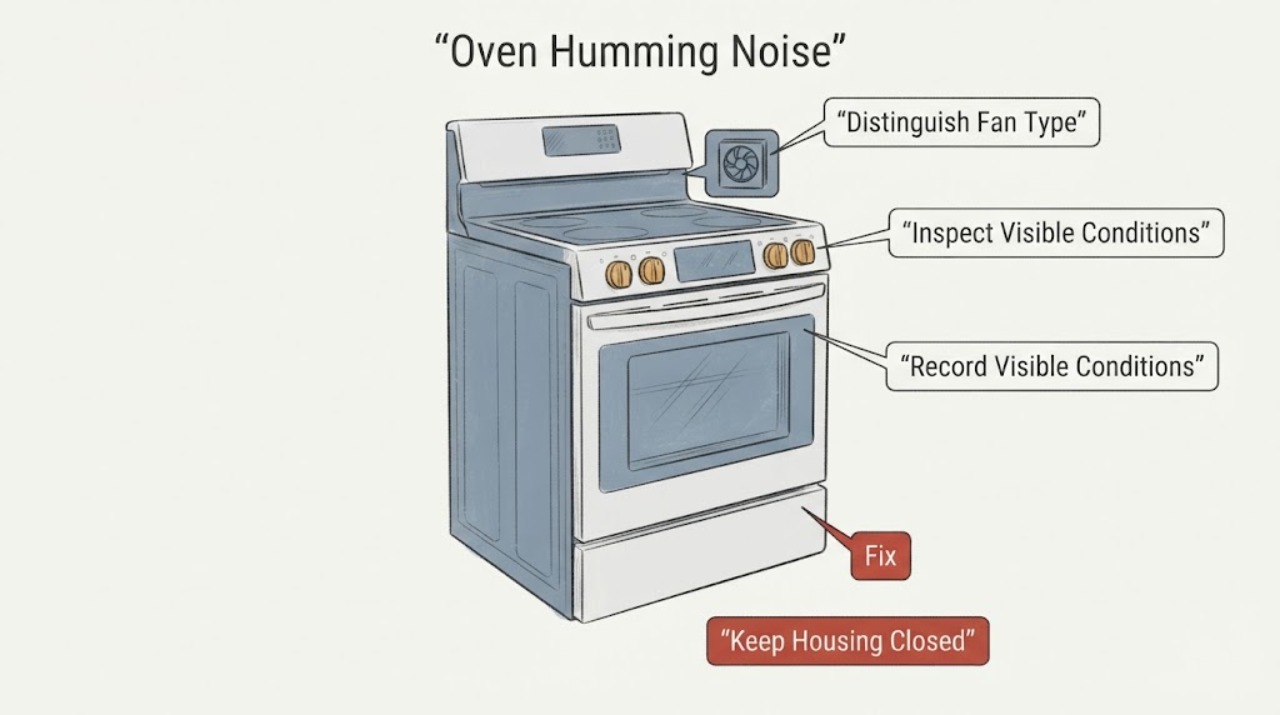
A KitchenAid oven hum is often the automatic cooling fan, which can run during cooking and after the cycle to cool the cavity and electronic controls. On a convection model, the convection fan can also run during preheating or other cooking functions. First note when the sound starts, whether it stops when the oven door opens, whether air is moving, and whether it ends after the oven cools. A brief or extended fan sound with normal heating can be expected; a harsh or rubbing sound, burning odor, smoke, sparks, loss of heating or a fan that remains abnormal outside the documented operating pattern needs qualified service. Do not remove panels or test wiring without the exact model procedure.
Work through in order
Diagnostic checks
Use only checks that match the exact appliance or system and its official guide.
-
Check 1
Note whether the humming starts during preheating, only during cooking, immediately after the cycle, or while the oven is otherwise idle; also note whether the oven still heats and whether controls work normally.
Expected result: The sound follows preheat/cooking or continues briefly after a cycle, or it occurs while idle with no cooling context and is accompanied by a functional or safety symptom.
Next step: Continue to the door/fan observation for a cycle-related sound. Stop user troubleshooting and arrange service for smoke, burning odor, sparks, loss of heating or a control problem.
Why this matters
Why: KitchenAid identifies fan operation during use and after a cycle as normal, while an unexplained idle sound or sound combined with loss of function needs service evaluation.
-
Check 2
If it is safe to observe from outside the appliance, note whether the sound stops when the oven door is opened during a normal cycle; do not place hands or tools near openings and do not defeat a door switch.
Expected result: The sound stops with the door open, or it continues while the oven is cooling.
Next step: For a model-consistent fan sound, let the cycle and cooling period finish. If the sound is harsh, rubbing, intermittent in a new way or paired with a heating/control problem, arrange model-specific service.
Why this matters
Why: KitchenAid's convection guidance uses this distinction to identify likely convection-fan versus cooling-fan operation; it does not prove either fan is defective.
-
Check 3
From a safe position outside the oven, listen for steady fan operation and note whether warm air is discharged as the oven cools; do not block vents or remove trim/panels.
Expected result: Air movement and cooling behavior match the cycle, or there is no expected cooling, an unusual vibration/rattle, or an overheating symptom.
Next step: If operation matches the manual's pattern, monitor it. If cooling is absent or abnormal, stop using the oven until qualified service confirms safe operation.
Why this matters
Why: KitchenAid says the cooling fan moves air to cool the oven cavity and controls and can run for an extended period. Missing or abnormal cooling cannot identify a particular motor without model-specific diagnosis.
-
Check 4
Record the complete model number, whether the appliance is a standard or convection oven/range, the cooking function, and how long the hum continues after the cycle; use the exact Owner's Manual for model-specific noise information.
Expected result: The manual describes the observed fan behavior, or the sound is not covered, has changed, or cannot be matched to the oven type/function.
Next step: Follow only the matching manual's user-level guidance. If the sound remains unexplained or abnormal, provide the model and observations to KitchenAid-authorized service.
Why this matters
Why: KitchenAid's noise guidance is organized by oven type and directs users to model-number-based literature; an unidentified model cannot support a universal repair sequence.
-
Check 5
Stop the oven and arrange qualified service if the hum is accompanied by smoke, burning smell, sparks, visible damage, a breaker trip, loss of heating or control failure; do not keep cycling it to reproduce the noise.
Expected result: A safety or functional fault is present, or the hum becomes harsh, rubbing, grinding or continuously abnormal.
Next step: Turn the oven off. From a safe location, isolate power only if needed for an immediate electrical hazard, and contact qualified appliance service; do not open panels or bypass the door switch.
Why this matters
Why: The public KitchenAid fan guidance explains normal cooling/convection behavior but does not authorize live electrical diagnosis, internal fan access or a part replacement for an unidentified model.
Use your observations
Decision map
Find the observation that best matches what you see, then follow the next safe action.
-
PATH 01Next step
What you see
The hum starts during cooking and continues after the cycle while the oven cools normally and no heating or control problem is present.
Do this next
Allow the cooling fan to finish and monitor it. Use the exact model manual if the duration or sound changes.
Why this path and its safety boundary
Why it matters: KitchenAid identifies automatic cooling-fan operation in this pattern as normal for standard ovens and ranges.
-
PATH 02Next step
What you see
The sound occurs during preheat or a convection-capable function and stops when the door opens.
Do this next
Do not interfere with the fan or door interlock. Continue only if heating and controls behave normally, and consult the model manual for expected cycling.
Why this path and its safety boundary
Why it matters: KitchenAid says this pattern is consistent with the convection fan; the fan may also cycle during non-convection functions on some models.
-
PATH 03Next step
What you see
The hum occurs outside a cycle, is newly harsh/rubbing/grinding, or the expected cooling air movement is absent.
Do this next
Stop using the oven if heating or control safety is affected and arrange qualified service with the model number and timing observations.
Why this path and its safety boundary
Why it matters: The public guidance no longer distinguishes a normal fan cycle from a hardware or electrical problem without the exact model and service checks.
-
PATH 04Next step
What you see
Smoke, burning odor, sparks, breaker trips, visible damage or loss of heating/control function accompanies the hum.
Do this next
Turn the oven off, avoid repeated testing and contact qualified appliance/electrical service. Do not remove covers or perform live measurements.
Why this path and its safety boundary
Why it matters: This is outside the normal fan-noise explanation and requires a safety stop; the symptom does not identify a specific fan, motor or control part.
Helpful context
Understand the symptom
A hum can be normal cooling operation
KitchenAid says a standard oven's automatic cooling fan can run while the oven is in use and after a cycle completes. It cools the enclosed cavity and electronic controls, so a hum that continues after cooking is not by itself a failed part. The run time can vary with internal and external temperature.
Convection and cooling fans behave differently
On a convection model, KitchenAid says the convection fan can operate during preheating and cycle during cooking functions, including some non-convection functions. Its separate guidance says a fan that stops when the oven door opens is the convection fan, while a fan that continues is the cooling fan. Treat this as an observation aid, not permission to reach into the oven or bypass a door switch.
When a hum needs service
A normal fan hum should not be confused with a harsh rubbing or grinding sound, smoke, burning odor, sparks, loss of heating or a control problem. KitchenAid's public pages route unresolved oven-noise concerns to model-specific manuals and service. Without the model number, there is no safe universal fan-access, motor-test or replacement procedure to publish.
When checks do not resolve it
Need a professional?
Arrange service when the hum is harsh, rubbing, grinding or unrelated to a documented cooling/convection cycle., Stop using the oven for smoke, burning odor, sparks, breaker trips, visible damage, loss of heating or control failure., Do not remove panels, reach through openings, bypass a door switch, test energized wiring or order a fan part without the exact model documentation.
Have this ready
- complete oven/range model number
- standard or convection oven type and selected cooking function
- when the hum starts and how long it continues after the cycle
- whether the sound stops when the door opens
- any smoke, odor, sparks, breaker trip, heating or control symptom
Common questions
FAQ
Is a humming sound from a KitchenAid oven normal?
Often, yes. KitchenAid says the automatic cooling fan can run during use and after a cycle, and a convection fan can operate during preheat or other cooking functions. The timing and oven type matter; a hum with smoke, odor, sparks, loss of heating or a harsh rubbing sound needs service.
Why does the oven fan keep running after I turn it off?
KitchenAid says the automatic cooling fan may continue after a cycle to cool the oven cavity and electronic controls, and its run time can vary with internal and external temperature.
Can I remove the fan cover to find the source of the hum?
Do not remove panels or reach into the oven based on this general symptom. KitchenAid directs users to model-number-based manuals and service, and the exact access and electrical procedure vary by appliance.
Read the exact guide
Official sources
- Understanding Fan or Humming Noise in OvenKitchenAid · Official KitchenAid Product Help page opened directly. Supports normal cooling-fan and convection-fan explanations and model-literature boundary; it does not diagnose a specific failed component.
- Fan Noise - Non Convection - RangeKitchenAid · Official KitchenAid Product Help page opened directly. Supports cooling fan timing, air movement, cavity/control cooling and extended run time; it routes unresolved concerns to service.
- Fan Noise - Convection - RangeKitchenAid · Official KitchenAid Product Help page opened directly. Supports the door-open observation, convection preheat/cycle behavior and cooling-fan distinction.
- Oven Noise Product HelpKitchenAid · Official KitchenAid Product Help page opened directly. Supports the separation of common/fan noise guidance and model-number-based manuals/service; it is not a component diagnosis.
Community feedback
Share a repair observation
Share a plain-text repair observation. Accepted observations are published automatically; this page may take a moment to update.