
On this page
Start here
Quick answer
PF on a KitchenAid KEBC208KSS03 means the control detected a power failure or interruption; it is not, by itself, a diagnosis of a control board, sensor, heater, or other part. Stop the cooking function, record the complete display and which cavity or mode was running, and check for a recent household outage or tripped protection. If the oven is cool, dry, and free of smoke, arcing, burning odor, unusual heat, or a damaged connection, press Cancel once as KitchenAid describes for PF and reset the clock if needed. Use a single manufacturer-approved power reset only when the exact manual permits it. If PF returns, the display goes blank, the breaker trips again, or the oven behaves abnormally, leave it off and arrange qualified appliance or electrical service.
Work through in order
Diagnostic checks
Use only checks that match the exact appliance or system and its official guide.
-
Check 1
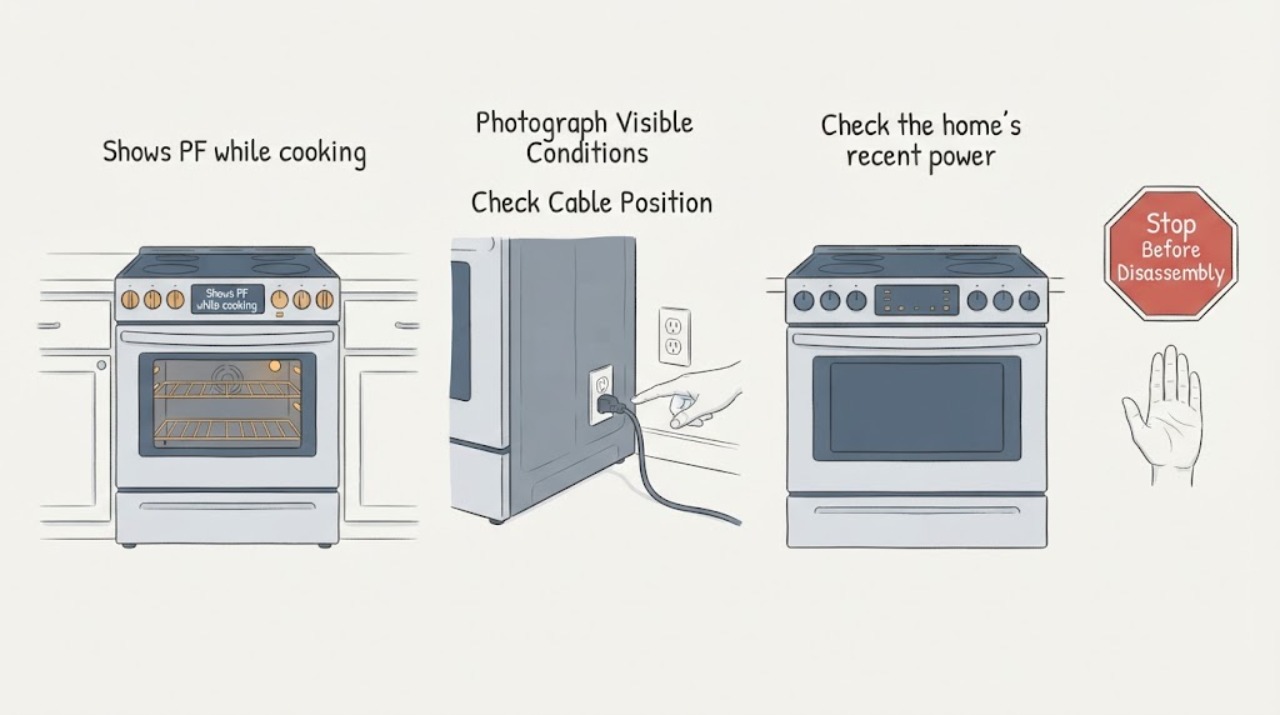
Stop the active cooking function normally, stay clear of the hot cavity, and photograph or write the complete PF display before it changes. Note the model and serial, upper or lower cavity if applicable, selected mode, set temperature, and whether the display or controls respond.
Expected result: Record whether there is smoke, fire, arcing, a burning or melting odor, a hot or damaged connection, unusual uncontrolled heat, water near electrical parts, or a repeated breaker trip.
Next step: For smoke or fire, leave and contact emergency help from a safe location. For suspected supply arcing, a hot connection, or repeated trips, keep the oven off and arrange qualified electrical service; do not touch wet or damaged electrical parts.
Why this matters
Why: A safety symptom overrides PF code lookup. A steady display with no hazard is a different decision from a blank display, unstable power, or a hot or damaged connection.
-
Check 2
Check the home's recent power history from a safe location: ask whether an outage or surge occurred, see whether other appliances or clocks reset, and check whether the oven's household protection is currently on without repeatedly cycling it.
Expected result: Compare a one-time outage with PF that returns during cooking, appears at startup, affects more than one function, or coincides with a breaker or protection trip.
Next step: Keep a one-time event record for the service handoff. For recurring interruption or a repeat trip, stop using the oven and arrange qualified electrical service for the supply and qualified appliance service for the oven.
Why this matters
Why: A single external interruption can explain PF, while recurring loss or a cavity that repeatedly drops out points to a supply, connection, control, or model-specific fault that PF alone cannot identify.
-
Check 3
With the oven inactive, cool, dry, and free of smoke, gas odor, arcing, unusual heat, or damaged wiring, press the applicable Cancel or Cancel/Off control once; do not keep pressing controls to force the display clear.
Expected result: See whether PF clears, whether the time of day is missing or flashing, and whether ordinary controls respond normally afterward.
Next step: Reset the clock only through the ordinary model control instructions. If PF remains, the display is unresponsive, or the oven cannot return to a normal control state, leave it off and arrange service.
Why this matters
Why: KitchenAid documents Cancel as the normal PF-clearing action, with a clock reset needed on some models. Clearing PF does not prove the interruption will not recur.
-
Check 4
Use the KitchenAid Manuals and Literature search with the complete KEBC208KSS03 identity and follow only the matching wall-oven or double-oven instructions; if that exact manual permits a power reset, switch the dedicated circuit off for the documented interval once and restore it once from a dry safe position.
Expected result: After the single permitted reset, note whether the display returns normally, PF reappears immediately, the controls respond, or the household protection trips again. Do not start repeated heating cycles to test it.
Next step: If the exact manual does not support the reset, skip it. If PF returns or the protection trips, leave the oven off and arrange qualified appliance or electrical service with the reset result.
Why this matters
Why: KitchenAid publishes a one-minute reset for some cooking faults, but the exact model manual controls applicability. Immediate recurrence or another power symptom is evidence of an unresolved fault, not a reason to reset again.
-
Check 5
Make an external service record instead of opening the oven: list the exact PF characters, date and cooking stage, cavity, mode, whether heat stopped, recent installation or electrical work, any outage, Cancel or reset performed, and every odor, sound, display, or breaker symptom.
Expected result: Look only at the accessible display, controls, door and rating-label information; do not remove trim, panels, junction-box covers, or service sheets from their protected location.
Next step: Give the record to qualified KitchenAid appliance service, and include a qualified electrician when the supply connection, arcing, hot connection, or repeated protection trip is involved.
Why this matters
Why: PF does not select a replacement board, sensor, heater, latch, or wiring part. The timing and associated symptom tell a qualified professional whether to assess the home's supply, the oven connection, or the appliance controls.
Use your observations
Decision map
Find the observation that best matches what you see, then follow the next safe action.
-
PATH 01Next step
What you see
PF is accompanied by smoke, fire, arcing, a burning or melting odor, a hot or damaged connection, water near electrical parts, uncontrolled heat, or repeated protection trips.
Do this next
Stop use and leave for active smoke, fire, or suspected carbon monoxide; contact emergency, gas, or electrical professionals from a safe location. Do not press controls, reset the breaker, or re-enter until safe.
Why this path and its safety boundary
Why it matters: This is an immediate fire or electrical safety problem, not a harmless code-clearing situation.
-
PATH 02Next step
What you see
A single household outage or surge occurred, PF clears once with Cancel, the clock can be restored normally, the display and controls remain stable, and no abnormal heat or odor returns.
Do this next
Keep the event record, follow the exact manual's limited verification instruction once if provided, remain nearby, and stop use if PF or abnormal behavior returns.
Why this path and its safety boundary
Why it matters: A transient power interruption is plausible, but clearing PF is not proof that the oven has been repaired.
-
PATH 03Next step
What you see
PF returns immediately after Cancel or the one model-approved reset, appears at power-up, affects more than one function or cavity, the display becomes blank, or the household protection trips again.
Do this next
Keep the oven off and arrange qualified appliance service. Use qualified electrical service as well for suspected supply wiring, hot connections, arcing, or repeated trips; do not cycle the breaker again.
Why this path and its safety boundary
Why it matters: A persistent supply, connection, control, or wiring fault is more likely than a one-time interruption; the PF label still does not identify a replaceable part.
-
PATH 04Next step
What you see
PF clears but the clock is flashing or missing while the oven otherwise responds normally.
Do this next
Set the clock through the model's normal controls once. If the clock repeatedly loses time, PF returns, or the display is unstable, stop use and arrange service.
Why this path and its safety boundary
Why it matters: The control is consistent with a recent power loss and may need the ordinary time-of-day setting, subject to the exact model manual.
-
PATH 05Next step
What you see
The characters are unclear, the complete model or cavity is not confirmed, PF is paired with no-heat or abnormal-heat behavior, or the published instruction does not match this wall oven.
Do this next
Keep the oven off, preserve the photo and model information, and request qualified KitchenAid appliance service; do not continue heating tests to obtain another code.
Why this path and its safety boundary
Why it matters: There is not enough model-specific evidence to select a safe reset or diagnose a part from the display.
Helpful context
Understand the symptom
PF is a power-event indication, not a part number. The key decision is whether the interruption was a one-time household event that cleared normally or whether power loss is recurring, cavity-specific, or accompanied by heat, odor, arcing, or an unstable display. Those patterns determine whether the next call is appliance service, electrical service, or emergency help.
The steps below stay at the controls, rating information, and external observations. They do not authorize opening a wall-oven control area, taking electrical measurements, or repeatedly resetting a breaker.
When checks do not resolve it
Need a professional?
Stop immediately for smoke, fire, arcing, burning or melting odor, a hot or damaged connection, uncontrolled heat, water near electrical parts, suspected carbon monoxide, or repeated protection trips. For any recurring PF, blank or unstable display, unexpected loss of heat, or unverified model-specific code, keep the oven off and arrange qualified appliance and, where appropriate, electrical service.
Common questions
FAQ
Does PF prove the oven control board failed?
No. KitchenAid defines PF as a power failure or interruption. The code does not distinguish a household outage from a supply, connection, control, or other appliance fault, and it should not be used alone to select a part.
Can I keep resetting the breaker until PF stays away?
No. If the exact model manual permits a power reset, perform it once under the stated safe conditions. A returning PF or another trip is a service signal, not a reason for repeated resets or heating tests.
What should I record for service?
Record the complete KEBC208KSS03 model and serial, cavity, cooking mode, set temperature, exact PF characters, whether heat stopped, recent power event or installation, Cancel or reset result, and any odor, arcing, abnormal heat, blank display, or breaker trip.
Read the exact guide
Official sources
- Error Codes for Cooking AppliancesKitchenAid Product Help · KitchenAid cooking-appliance code guidance; the PF entry defines a power failure and gives the Cancel and clock-reset response.
- F9 or F9 E0 - Wall OvenKitchenAid Product Help · KitchenAid wall-oven power guidance that explicitly discusses PF after a power interruption and limits a power reset and brief recurrence check; not a claim that F9 is the assigned code.
- Owner's ManualKitchenAid · KitchenAid wall-oven owner manual covering PF display behavior, Cancel/CANCEL OFF, clock reset after power failure, and double-oven cavity display conventions; use the exact KEBC208KSS03 manual when available.
- Where Can I Find the Tech Sheet for My Appliance?KitchenAid Product Help · KitchenAid safety guidance that identifies tech sheets as trade-service material containing wiring and component tests, and warns against unqualified major-appliance repair.
- Kitchen Appliance ManualsKitchenAid · KitchenAid manual lookup for the complete KEBC208KSS03 model identity; the page instructs users to enter the appliance model to retrieve matching literature.
Community feedback
Share a repair observation
Share a plain-text repair observation. Accepted observations are published automatically; this page may take a moment to update.