
On this page
Start here
Quick answer
The KitchenAid KFGD500EBS is a gas double-oven range whose product sheet describes a thermal upper oven and a convection lower oven. A working lower oven therefore does not prove that the upper oven's gas or ignition path is healthy. First stop for gas odor, hissing, repeated clicking, delayed ignition, an abnormal flame, smoke, or a breaker trip. If there is no hazard, check that the upper cavity is selected, the door closes fully, the display is not locked, in Demo Mode, or delayed, and the range has safe grounded 120-volt power. If the cooktop works but the upper oven does not ignite, KitchenAid specifically notes that a pressure-regulator shutoff can allow cooktop gas while withholding gas from the oven; checking that valve may require moving the range, so do not pull it out or touch gas tubing—use a qualified technician.
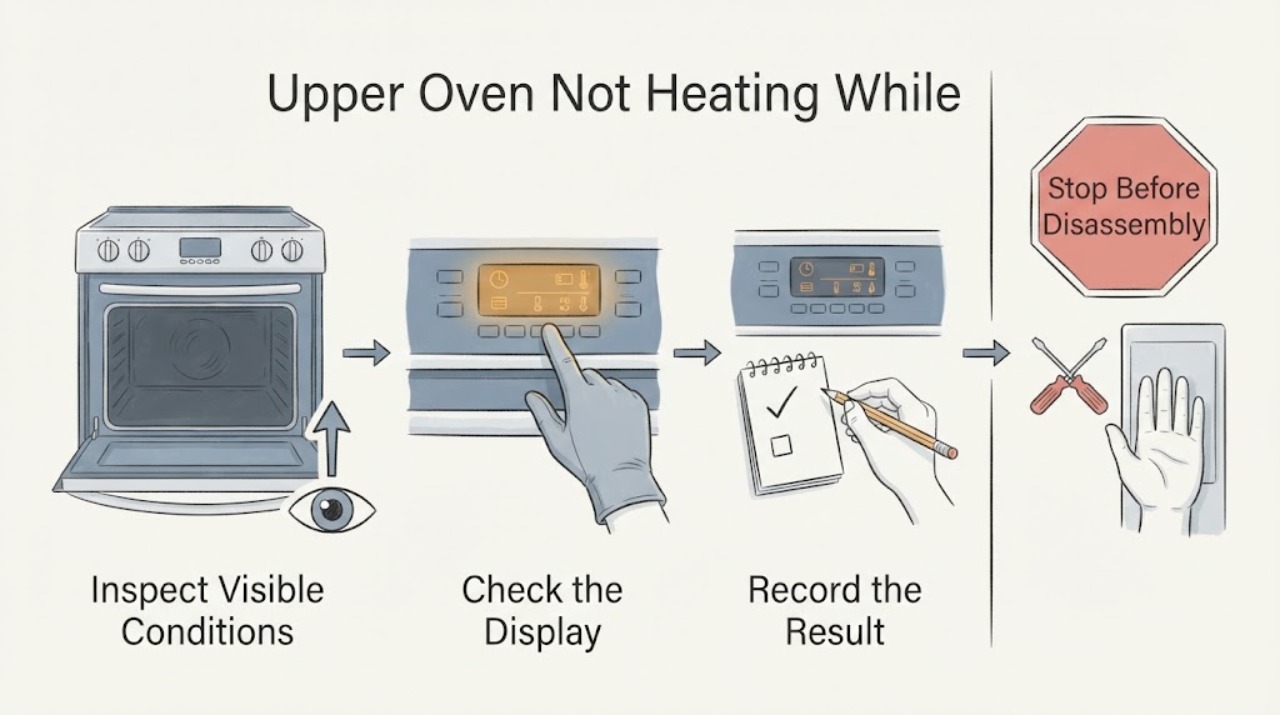
Work through in order
Diagnostic checks
Use only checks that match the exact appliance or system and its official guide.
-
Check 1
Before another preheat, observe from outside for gas odor or hissing, repeated clicking, a delayed ignition or flare, an abnormal flame, smoke, burning odor, a hot or damaged cord, or a breaker that trips again.
Expected result: Any gas, fire, combustion, or electrical warning is present, or the range is stable and free of those warnings.
Next step: For gas odor, do not light an appliance or operate electrical switches; leave the area and follow local gas-emergency instructions from outside. For smoke, abnormal flame, sparking, burning odor, or a carbon-monoxide alarm, stop use and obtain emergency or qualified service help. Do not retry ignition.
Why this matters
Why: A safety event takes priority over comparing the two cavities or checking a valve. A stable range can proceed only to external control and setting checks.
-
Check 2
Identify the upper-cavity control and select a basic upper-oven Bake mode with a temperature above room temperature. Confirm that the display shows the upper oven and that the door closes fully; do not assume a lower-oven Bake command also starts the upper cavity.
Expected result: The lower oven works but the upper oven was not actually selected, the door remains open or misaligned, or the upper oven accepts the mode and remains cold.
Next step: Correct only a visible selection or loading obstruction and make one normal upper-oven start. If the door will not close or the upper cavity remains cold, stop repeated starts and continue to the service branch.
Why this matters
Why: A cavity-selection or door state can prevent the intended upper mode from starting. If the upper mode is accepted with a closed door but stays cold, the symptom is no longer explained by selecting the wrong cavity alone.
-
Check 3
Check the lit display for Control Lock, Demo Mode, Delayed Start, Sabbath-related state, or an error indication. Use only the exact KFGD500EBS documentation or the model's on-screen instruction; do not borrow a button sequence from another KitchenAid range.
Expected result: A lock, demo, or delay state is active, the display is normal, or the upper oven accepts settings but produces no heat.
Next step: Clear only the documented setting once and observe one normal preheat. If the display is normal and the upper oven remains cold, stop changing settings and arrange qualified service.
Why this matters
Why: A user-facing control state can make a healthy oven appear not to heat. A normal display with a valid upper Bake command and no heat shifts concern toward gas delivery, ignition, or an internal control condition.
-
Check 4
From a dry position, check the accessible grounded 120-volt outlet and household breaker or fuse state without opening the range or touching wiring. Record whether the lower oven, cooktop controls, and upper-oven display remain powered.
Expected result: The breaker is tripped, the cord or outlet looks damaged, the display is dark, power trips again, or all controls remain powered while only the upper oven fails.
Next step: Reset a normal household breaker only once when safe and understood and no hazard is present. For a repeat trip, damage, a blank display, or an uncertain ground, leave the range off and use a licensed electrician or qualified appliance technician. Do not test live voltage or remove a cover.
Why this matters
Why: KitchenAid says oven igniters depend on a good ground and operational 120-volt supply. A repeat trip or visible damage is a supply fault; normal power with one cavity failing does not identify a component.
-
Check 5
Without moving the range or touching gas tubing, compare the safe visible operation of the cooktop burners with the upper oven's response. Note whether cooktop burners light normally, whether the upper oven clicks or shows an ignition attempt, and whether the lower oven still heats.
Expected result: The cooktop works while the upper oven has no ignition response, the cooktop and both ovens are affected, or the upper oven clicks repeatedly or ignites abnormally.
Next step: Do not pull the range out to reach the regulator, move a connected gas appliance, adjust the shutoff, light the burner manually, or remove the storage drawer or bottom to reach an igniter. Record the comparison and arrange qualified gas-appliance service; stop immediately for odor, delayed ignition, or abnormal flame.
Why this matters
Why: KitchenAid specifically says a gas pressure-regulator shutoff can be off while gas still flows to the cooktop but not the oven. If both cooking areas are affected, a main supply or power condition becomes more relevant. Repeated or abnormal ignition is unsafe to troubleshoot by continued attempts.
-
Check 6
Check only visible loading and cavity conditions: remove an oversized dish or rack obstruction, confirm no foil or liner covers the oven bottom, and make sure the upper door and seal area are not visibly blocked. Do not dismantle hinges, the bottom panel, storage drawer, or burner area.
Expected result: A visible obstruction or prohibited liner is present, the door closes normally and the cavity is clear, or the door remains damaged or misaligned.
Next step: Remove only the accessible obstruction and make one normal upper-oven start if there is no safety warning. If the door remains abnormal or the upper cavity stays cold, leave the range off and request service.
Why this matters
Why: KitchenAid warns that an open door or a covered oven bottom can inhibit the burner or gas flow. A clear cavity with a normal door does not prove the upper ignition system is sound.
-
Check 7
Record the exact KFGD500EBS model and serial details, upper versus lower cavity, selected mode and temperature, display state, door behavior, cooktop and lower-oven comparison, any clicking or ignition timing, and all safety observations. Do not order a part from the upper-only symptom.
Expected result: The upper oven heats after a safe setting correction, or it remains cold after settings, power, cavity, and external gas observations are normal.
Next step: Keep the range off and provide the recorded sequence to KitchenAid-authorized appliance service or a qualified gas technician. Do not continue cycles to reproduce the problem or bypass a safety control.
Why this matters
Why: A corrected user-facing state can explain the symptom. Persistent upper-only no heat requires a qualified distinction among gas delivery, ignition, temperature control, and other internal conditions; the lower oven working is not a part diagnosis.
Use your observations
Decision map
Find the observation that best matches what you see, then follow the next safe action.
-
PATH 01Next step
What you see
Gas odor or hissing, delayed ignition, abnormal flame, repeated clicking with no normal ignition, smoke, burning odor, sparking, unusual heat, or a repeated breaker trip is present.
Do this next
Stop immediately. For suspected gas, avoid flames and electrical switches, leave the area, and follow local gas-emergency instructions from outside. For smoke, fire, sparking, or electrical damage, keep clear and obtain emergency or qualified service help. Do not restart the range.
Why this path and its safety boundary
Why it matters: This is a gas, combustion, fire, or electrical safety event, not a routine upper-versus-lower comparison.
-
PATH 02Next step
What you see
Only the upper cavity fails, while the display, cooktop, lower oven, and household power appear normal and the upper mode is correctly selected.
Do this next
Stop user diagnosis after the safe external checks and arrange qualified KitchenAid gas-appliance service. Give the technician the cavity comparison and whether the upper oven clicked or attempted ignition.
Why this path and its safety boundary
Why it matters: The lower oven working narrows the observation to an upper-cavity path, but does not establish an igniter, burner, sensor, or control failure.
-
PATH 03Next step
What you see
The cooktop burners work, but the upper oven has no ignition response or remains cold on a valid upper Bake command.
Do this next
Do not slide the range out, access the rear regulator, touch the gas connector, or change the shutoff. Arrange qualified service to identify and verify the oven gas path safely.
Why this path and its safety boundary
Why it matters: KitchenAid says an oven pressure-regulator shutoff can prevent gas to the oven while allowing gas to the cooktop. This is different from the home's main gas valve and cannot be confirmed by the lower oven working.
-
PATH 04Next step
What you see
The display shows Control Lock, Demo Mode, Delayed Start, or another user-facing state, and there is no gas or electrical hazard.
Do this next
Use the KFGD500EBS documentation to clear that state once and observe one normal upper preheat. If the upper oven remains cold with normal controls, stop and arrange service.
Why this path and its safety boundary
Why it matters: A control state can prevent a heating command from starting and is separate from an internal gas or ignition failure.
-
PATH 05Next step
What you see
The upper door is open or misaligned, or foil, a liner, dish, rack, or storage-drawer item visibly interferes with the burner or door area.
Do this next
Remove only the accessible obstruction and close the door normally once. If the door remains abnormal or the upper oven still will not heat, leave it off and arrange service without bypassing the interlock.
Why this path and its safety boundary
Why it matters: KitchenAid identifies door closure and an uncovered burner/air path as prerequisites for normal oven operation. A visible obstruction is a safer first correction than opening the appliance.
-
PATH 06Next step
What you see
The display is dark, power is uncertain, the breaker trips again, or the outlet, cord, or grounding appears damaged.
Do this next
Leave the range off and obtain licensed electrical or qualified appliance service. Do not remove the terminal cover, test live voltage, or keep resetting the breaker.
Why this path and its safety boundary
Why it matters: The range has a supply or installation concern that cannot be safely separated from an appliance fault by comparing oven cavities.
Helpful context
Understand the symptom
Treat the lower oven working as a comparison observation, not as a diagnosis. The exact KFGD500EBS feature sheet lists two oven cavities with an upper thermal system and lower convection system. That difference makes it useful to record which cavity, mode, and display response fail, but it does not identify a particular igniter, burner, sensor, or control part.
KitchenAid's gas-range help distinguishes the home's main valve from a shutoff at the gas pressure regulator. On some ranges, the regulator shutoff can be off while the cooktop still receives gas. The support instructions that inspect it involve sliding the range and accessing the rear, which is outside a safe user-level check for this case.
Do not keep trying to light the upper oven to see what happens. KitchenAid says gas odor, abnormal ignition, or an uncertain gas supply requires stopping and arranging qualified help; no user should bypass an ignition or door interlock, move a connected range, or perform live electrical or gas tests.
When checks do not resolve it
Need a professional?
Stop immediately for gas odor or hissing, delayed ignition, abnormal flame, repeated clicking without normal ignition, smoke, burning odor, sparking, unusual heat, visible damage, or a repeated breaker trip. Arrange qualified KitchenAid gas-appliance service when the upper oven remains cold on a valid mode after safe setting and external checks, when the cooktop works but the oven gas path is uncertain, or when inspecting the pressure regulator, igniter, burner, wiring, or controls would require moving the range or opening it. Do not slide a connected range, touch gas tubing, light the burner manually, remove the bottom or storage drawer to reach components, bypass an interlock, or perform live tests.
Common questions
FAQ
If the lower oven works, does that prove the upper oven igniter is bad?
No. The KFGD500EBS has two cavities with different listed cooking systems, and the lower oven working is only a comparison observation. It does not identify an igniter, burner, sensor, or control part. Record whether the upper oven clicks or attempts ignition and have the gas path assessed safely.
Can the cooktop work while the upper oven has no gas?
Yes. KitchenAid explains that a pressure-regulator shutoff can be off while gas still flows to the cooktop but not to the oven. That valve is different from the home's main gas valve, and checking it may require moving the range. Do not pull the range out or touch the connector; use qualified service.
Should I keep trying Bake until the upper oven lights?
No. Stop for gas odor, hissing, delayed ignition, repeated clicking, abnormal flame, smoke, or burning odor. Even without those warnings, repeated ignition attempts do not distinguish a regulator, igniter, burner, or control issue and should be replaced by qualified diagnosis.
Read the exact guide
Official sources
- Oven Not Working - Cooktop Working - Clicking | KitchenAid Product HelpKitchenAid · Opened official KitchenAid support page. It distinguishes cooktop-working/oven-clicking symptoms, identifies an oven pressure-regulator shutoff, warns about foil and storage-drawer interference, and directs persistent problems to service.
- Oven Not Working - Gas | KitchenAid Product HelpKitchenAid · Opened official KitchenAid gas oven support. It covers trapped air after reconnection, grounded 120-volt power needed by igniters, main gas valve status, and qualified service when the oven remains inoperative.
- Nothing is Working - Gas | KitchenAid Product HelpKitchenAid · Opened official KitchenAid gas-range support article covering visible main-valve, breaker, lock, delay, and demo-state checks.
- 6.0 cu. ft. Double Oven Gas Range Feature SheetKitchenAid Canada · Opened official KitchenAid Canada feature sheet listing KFGD500EBS among the KFGD500E variants; it identifies gas fuel, a 2.1-cu.-ft. thermal upper oven, a 3.9-cu.-ft. convection lower oven, and 120-volt supply.
- How to Check the Gas Regulator Shut-Off Valve on an Oven | KitchenAid Product HelpKitchenAid · Opened official KitchenAid installation-support article. It explains that the regulator shutoff can be OFF after handling, that the regulator is at the back, and that checking it may require sliding the range; the article warns about hard-piped or flexible connections.
- KFGD500EBS | KitchenAid Owner's CenterKitchenAid · Opened official KitchenAid Owner's Center page identifying KFGD500EBS as a 30-inch five-burner gas double-oven convection range and linking model support resources.
- Oven Not Working - Cooktop Working - Not Clicking | KitchenAid Product HelpKitchenAid · Opened official KitchenAid support page. It states that cooktop gas can remain available when a pressure-regulator shutoff is off, while the oven receives no gas; it also covers door, oven-bottom, main-valve, and grounded-power checks.
- Oven Not Heating - Powering On - Electric | KitchenAid Product HelpKitchenAid · Opened official KitchenAid oven support article for user-facing control states and door conditions. Those control-state checks are used only as general control guidance and not as an electric-fuel diagnosis for KFGD500EBS.
Community feedback
Share a repair observation
Share a plain-text repair observation. Accepted observations are published automatically; this page may take a moment to update.